Last Updated on 4 months ago by TodayWhy Editorial
Germany’s 2-1 comeback win over Ivory Coast at the 2026 World Cup — sealed by substitute Deniz Undav’s stoppage-time winner — has put one detail back in the spotlight: the team plays under two names that don’t quite match. English commentary calls them “Ivory Coast.” Their own shirts, and FIFA’s official broadcasts, say “Côte d’Ivoire.” That mismatch isn’t a translation quirk — it’s the result of a naming dispute the country’s government has been fighting, with mixed success, for nearly 40 years.
Where the name actually comes from
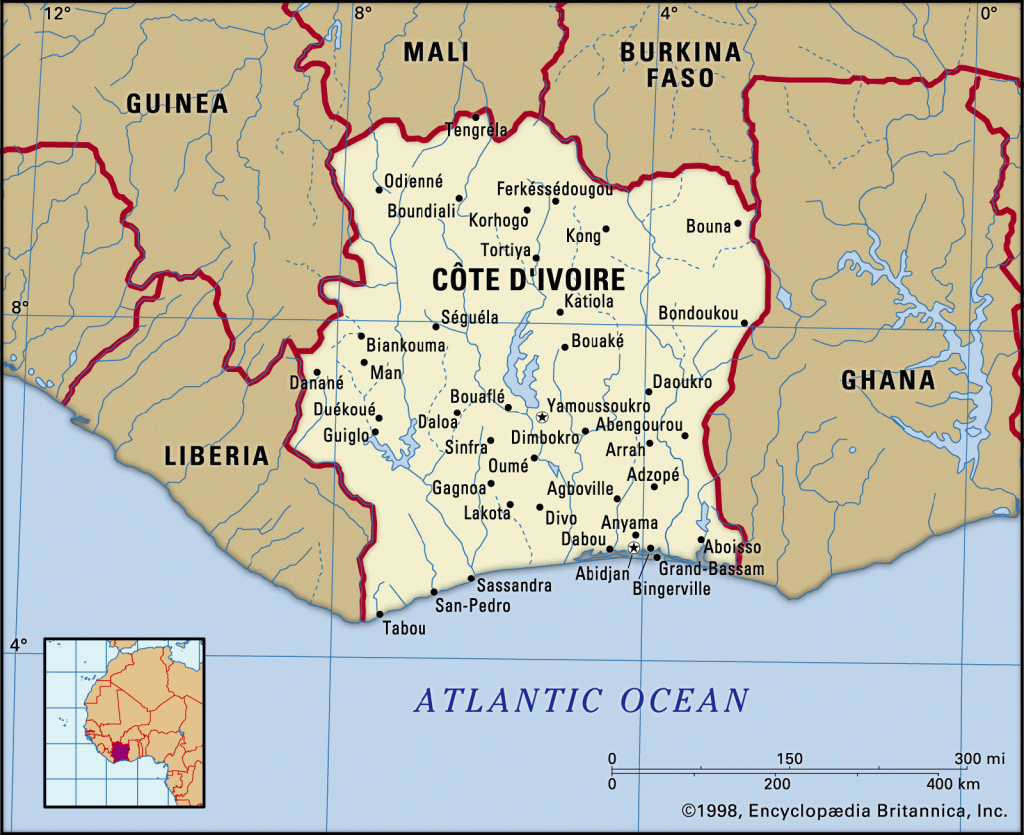
The name dates back to Portuguese merchant-explorers of the 15th and 16th centuries, who divided the West African coastline into a handful of “coasts,” each labeled after whatever commodity was most profitably traded there. Moving along the coast, traders marked out a Grain Coast (modern Liberia), a Gold Coast (modern Ghana), a Slave Coast (modern Togo, Benin, and Nigeria) — and, in between, a stretch known as the Costa do Marfim, literally “coast of ivory,” later rendered in French as Côte d’Ivoire. The commodity in question was elephant tusks, exported in large quantities to Europe for use in jewelry, carving, and decorative objects.
Other names that didn’t stick
“Ivory Coast” wasn’t the only label applied to the region. European traders also used Côte de Dents (“Coast of Teeth”), a more literal reference to the tusks themselves, and Côte de Quaqua, named after a local people the Dutch called the Quaqua. There was even a “Coast of the Five and Six Stripes,” referring to a type of striped cotton cloth traded there. By the 19th century, the French version, Côte d’Ivoire, had become the standard term, and it stuck through French colonization and into independence in 1960.
1985: the government decides “Ivory Coast” has to go
After independence, the new country kept its French name — but as its diplomatic ties expanded beyond French-speaking partners, officials grew increasingly frustrated that the name was being freely translated into dozens of languages: Ivory Coast in English, Elfenbeinküste in German, Costa de Marfil in Spanish, and so on. In 1985, the Ivorian government formally decreed that “Côte d’Ivoire” should be used as the country’s name in every language, with no translation, in all official and diplomatic contexts.
Why “Ivory Coast” never really went away
Nearly four decades later, the request has only been partially honored. International bodies that follow it closely include FIFA, the International Olympic Committee, the CIA’s World Factbook, and the Encyclopaedia Britannica, all of which use “Côte d’Ivoire” in official references. The U.S. State Department uses “Côte d’Ivoire” in formal documents but reverts to “Ivory Coast” in general speeches and briefings. Major English-language outlets are split: the BBC and The Economist explicitly favor “Ivory Coast,” while organizations like National Geographic use the French form. The result is exactly the inconsistency the 1985 decree was meant to prevent — just with English added to the mix instead of resolved by it.
Video: Ivory Coast: Africa Most Developed Country you never Knew
Why the World Cup broadcast shows “CIV,” not “IVC”
The naming split even shows up in how the team is abbreviated on screen. Viewers confused by seeing “CIV” in the World Cup score box rather than an English-style abbreviation like “IVO” are seeing FIFA’s country code, which is drawn directly from the official name “Côte d’Ivoire” rather than from the English translation “Ivory Coast.” It’s a small, recurring reminder that on the official stage, at least, the country’s own naming request wins out.
What this has to do with the team’s nickname
Côte d’Ivoire’s national football team is nicknamed Les Éléphants — the Elephants — a direct callback to the ivory trade that gave the country its historical name, even though wild elephants have become rare there as a consequence of exactly that trade. The national emblem still features an elephant head. International trade in ivory is now heavily restricted worldwide specifically to protect the species the name was built around.
Germany’s win secured the group stage’s first major milestone — a place in the round of 32 — while Ivory Coast’s own path forward was still being decided in their final group match against Curaçao.
Frequently Asked Questions
Why is it called Ivory Coast?
Because 15th- and 16th-century European traders named the stretch of West African coastline after its most lucrative export at the time: ivory from elephant tusks.
What is the country’s official name now?
Côte d’Ivoire, officially the Republic of Côte d’Ivoire. The government decreed in 1985 that this French form should be used untranslated in every language.
Is it wrong to say “Ivory Coast”?
It goes against the country’s own naming preference, but it isn’t illegal or formally incorrect — many major outlets, including the BBC, still use it regularly.
Why does the World Cup scoreboard show “CIV” for Ivory Coast?
FIFA uses country codes based on official names rather than English translations, and “CIV” is drawn from “Côte d’Ivoire,” not from “Ivory Coast.”
What does the team’s nickname “the Elephants” refer to?
It references the ivory trade that originally gave the region its name, and elephants still appear on the country’s national emblem.
When did Côte d’Ivoire become independent?
It gained independence from France on 7 August 1960.
More stories: