
Last Updated on 4 months ago by TodayWhy Editorial
As the 2026 World Cup kicks off across the United States, Canada, and Mexico, fans are watching the biggest tournament in the competition’s 96-year history: 48 teams, 104 matches, 16 host cities, and a brand-new Round of 32. But why did FIFA expand the World Cup from 32 to 48 teams in the first place? The answer combines an ideal of global inclusion, a projected $4 billion revenue windfall, and decades of political pressure within world football. Here is the full story.
The Short Answer
The 2026 World Cup has 48 teams because the FIFA Council voted unanimously in January 2017 to expand the tournament from 32 teams, citing the goal of making football’s biggest event “more inclusive” for regions historically underrepresented at the finals — above all Africa and Asia. Behind the inclusion narrative sit two harder forces: FIFA’s own projection of roughly $4 billion in additional revenue from more matches, broadcasting rights, and sponsorship inventory, and the political reality that more World Cup slots win more support among FIFA’s 211 member associations.
The Decision: FIFA’s Unanimous 2017 Vote
The expansion was formally decided on 10 January 2017, when the FIFA Council met at the Home of FIFA in Zurich and voted unanimously in favour of a 48-team World Cup starting with the 2026 edition. The decision followed an analysis of four different format options and came less than a year after Gianni Infantino became FIFA president — expansion had been a central plank of his election campaign.
The original blueprint approved that day looked different from what fans are watching in 2026: 48 teams in 16 groups of three, producing 80 matches, with the tournament kept inside a 32-day window and a maximum of seven matches for the finalists — concessions designed to appease powerful European clubs worried about player release periods. The format would later change substantially (more on that below), but the headline number was locked in: 48.
You can read FIFA’s original announcement on the governing body’s official site: FIFA Council unanimously decides on expansion of the FIFA World Cup.
The Official Reason: A “More Inclusive” World Cup
FIFA’s stated rationale has been consistent since 2016: the World Cup should reflect the global game, not just its traditional powers. Infantino framed the expansion as making the tournament “more inclusive,” arguing that football is more than just Europe and South America, as reported by the BBC at the time of the vote.
Arsène Wenger, FIFA’s Chief of Global Football Development since 2019, has become the expansion’s most prominent advocate. In interviews ahead of the 2026 tournament, Wenger argued that FIFA “had to open” the World Cup to the world, calling 48 teams the minimum needed to give more African and Asian countries access to the game’s biggest stage, and pointing to how development funds tied to World Cup participation have transformed smaller federations.
There is substance to the inclusion argument. With 48 participants, nearly a quarter of FIFA’s 211 member associations now appear at the finals. The 2026 edition features debutants who could never have qualified under the old format — including Curaçao, the smallest nation ever to reach a World Cup.
The Financial Reason: $4 Billion in Extra Revenue
Inclusion is the official story; money is the structural one. FIFA’s own projections put the additional revenue from the 48-team format at roughly $4 billion compared to the 32-team model. The math is straightforward: 104 matches instead of 64 means 40 extra broadcast windows to sell, more ticket inventory, more hospitality packages, and more sponsor activations across a tournament that now spans three countries and 16 host cities.
For FIFA, which finances its global development programmes almost entirely from World Cup cycles, the expansion effectively super-sizes its only major revenue engine. Critics note that this financial logic — not footballing merit — best explains why the expansion passed unanimously despite widespread skepticism from coaches, players’ unions, and European leagues.
How the 48-Team Format Actually Works
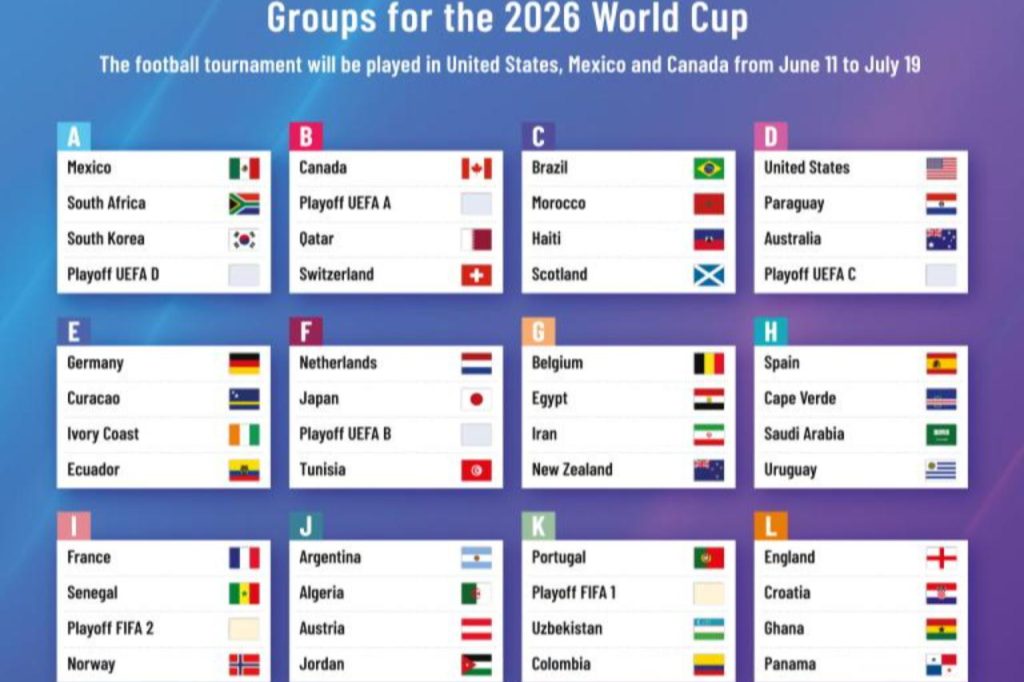
Group stage: 12 groups of four
The 48 teams are split into 12 groups of four. Each team plays three group matches, with standard scoring: three points for a win, one for a draw. The familiar four-team group rhythm — including simultaneous final group matches to prevent collusion — is preserved.
The new Round of 32
The top two teams from each group (24 teams) advance, joined by the eight best third-placed teams, producing a 32-team knockout bracket. The Round of 32 is an entirely new stage in World Cup history. From there the tournament proceeds through the Round of 16, quarter-finals, semi-finals, and final.
More matches, longer road to the trophy
The 2026 World Cup features 104 matches, up from 64. The two finalists each play eight matches instead of seven — the longest campaign ever required to lift the trophy.
Why FIFA Scrapped the Original Three-Team Groups
The 2017 vote approved 16 groups of three — a format that immediately drew criticism. With three-team groups, one side sits out each matchday, the final group game cannot be played simultaneously, and two teams meeting in the last fixture could in theory engineer a mutually convenient result to eliminate the absent third team. The ghost of the 1982 “Disgrace of Gijón” — when West Germany and Austria played out a result that eliminated Algeria — loomed over the design.
The turning point came at Qatar 2022, where the drama of simultaneous final group matches (Germany’s elimination despite beating Costa Rica, Japan topping a group containing Spain and Germany) reminded everyone what the four-team format delivers. In March 2023, the FIFA Council formally abandoned the three-team plan and adopted 12 groups of four — accepting a jump from 80 to 104 matches as the price of competitive integrity.
Who Gained the Most: New Slots by Confederation
The expansion redistributed qualifying slots heavily toward Africa and Asia — the constituencies whose support Infantino courted. The allocation of the 46 direct berths, agreed by the FIFA Bureau in 2017:
| Confederation | Old format (32 teams) | 2026 format (48 teams) | Change |
|---|---|---|---|
| UEFA (Europe) | 13 | 16 | +3 |
| CAF (Africa) | 5 | 9 | +4 |
| AFC (Asia) | 4.5 | 8 | +3.5 |
| CONCACAF (N./C. America) | 3.5 | 6 | +2.5 |
| CONMEBOL (South America) | 4.5 | 6 | +1.5 |
| OFC (Oceania) | 0.5 | 1 | +0.5 |
The final two of the 48 places are decided through a six-team intercontinental playoff tournament. Host nations qualify automatically, with their slots counted against their confederation’s quota — which is how the United States, Canada, and Mexico all entered the 2026 field.
Notably, South America’s six guaranteed slots mean that with only ten CONMEBOL members, more than half the continent now qualifies — one of the statistics critics cite most often.
The Criticism: Dilution, Workload, and Politics
Quality dilution
The most common objection is competitive: more teams means more mismatches and more low-stakes group games. Al Jazeera’s analysis of the format notes that the expansion risks altering the competitive dynamics of the group stage — a team could theoretically draw all three matches and still advance as a best third-placed side. Read the full breakdown: Al Jazeera: What to expect from the 48-team format.
Player workload
European clubs and player unions have warned for years about calendar congestion. A finalist now plays eight matches at the end of a season that may already include 60+ club fixtures, expanded continental competitions, and the enlarged Club World Cup.
Political and commercial motives
Skeptics argue the expansion was as much about FIFA politics as football: more slots reward more member associations, who in turn vote in FIFA presidential elections, while the additional matches create inventory for sponsors and broadcasters. Defenders counter that knockout football has always thrived on David-versus-Goliath stories — and that the same dilution arguments were made before the 1998 expansion to 32 teams, which is now remembered fondly.
A Century of Growth: From 13 Teams to 48
Expansion is the World Cup’s oldest tradition. The inaugural 1930 tournament in Uruguay featured just 13 teams. The field grew to 16, then to 24 in 1982 in Spain, and to 32 in 1998 in France — a format that lasted seven editions and is widely considered the competitive sweet spot. The 2026 jump to 48 is the largest single expansion in the tournament’s history, and Wenger has framed it as a “natural evolution” as the World Cup approaches its centenary in 2030.
Whether 48 becomes the new sweet spot or a stepping stone — proposals for a 64-team centenary edition have already circulated — will depend largely on how the next five weeks unfold across North America.
Frequently Asked Questions
When did FIFA decide to expand the World Cup to 48 teams?
The FIFA Council voted unanimously on 10 January 2017 in Zurich to expand the tournament from 32 to 48 teams, effective from the 2026 edition hosted by the United States, Canada, and Mexico.
How many matches are played at the 2026 World Cup?
104 matches — up from 64 under the 32-team format. The finalists each play eight matches, one more than before.
How does the 48-team format work?
Twelve groups of four teams. The top two from each group plus the eight best third-placed teams advance to a new Round of 32, followed by the traditional knockout rounds.
Why did FIFA abandon the original 16 groups of three?
Three-team groups raised collusion concerns because final group matches could not be played simultaneously. After the dramatic group finishes at Qatar 2022 showcased the four-team format’s value, FIFA switched to 12 groups of four in March 2023.
Which confederations gained the most slots?
Africa gained four direct slots (five to nine) and Asia 3.5 (4.5 to eight). Europe holds 16, CONCACAF and South America six each, and Oceania received its first guaranteed place.
How much extra revenue does the 48-team World Cup generate?
FIFA projected roughly $4 billion in additional revenue compared to the 32-team format, driven by 40 extra matches and the broadcasting and sponsorship inventory they create.