
Last Updated on 2 months ago by TodayWhy Editorial
In the final seconds before totality on 12 August 2026, alongside the eclipse glasses and the countdown, a handful of scientists in Spain will be watching something most eclipse-goers never notice: faint, rippling lines of light and shadow racing across a white sheet on the ground. They’re called shadow bands, and after more than a century of study, nobody can fully explain what causes them.
Why do shadow bands appear during a solar eclipse? The honest answer is that scientists have narrowed it to two competing explanations, tested one of them with a NASA-funded balloon, and got a result that complicated things rather than settling them.
What shadow bands actually look like
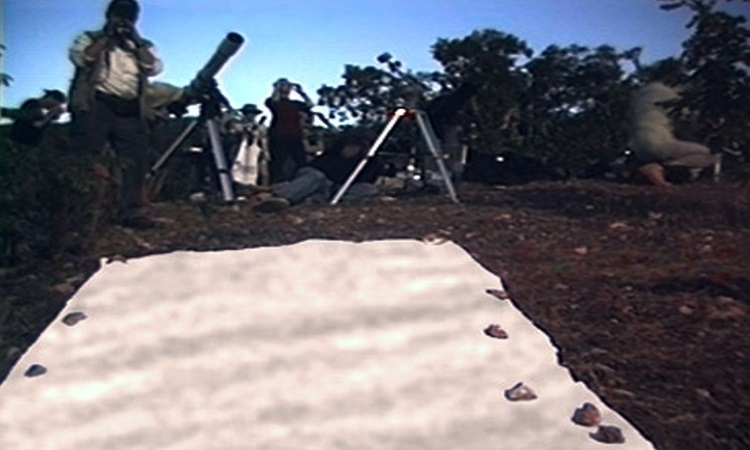
Eclipse-watchers have described the phenomenon for centuries: long, faint, parallel lines of light and dark, spaced a few centimetres apart, rippling across the ground or the side of a building in the minute or so just before and after totality. According to the University of Pittsburgh’s Allegheny Observatory, they’ve been reported by eclipse enthusiasts for centuries, yet their exact origin is still uncertain.
The human eye picks them up easily. Cameras struggle badly. The contrast between the light and dark ripples is so subtle that most photos and videos simply fail to register them at all — which is part of why, despite eclipses being observed and documented for thousands of years, the mystery remains genuinely unsolved.
Why they’re so easy to miss
They don’t show up on grass, gravel, or ordinary pavement. Eclipse chaser Gordon Telepun, a former NASA eclipse ambassador who has spotted them during five of the seven total eclipses he’s witnessed, advises looking for a smooth, light-coloured surface — a white sheet, a pale wall, a light patio — and knowing in advance to look for rows of movement, because the effect is faint and easy to look straight past if you don’t know what you’re watching for.
Timing makes them harder still. The bands appear in the narrow window when only the thinnest crescent of Sun remains, which is also the most dramatic, distracting moment of the entire eclipse — exactly when most observers are looking up through their eclipse glasses rather than down at the ground.
Why scientists still can’t agree on the cause
Two competing explanations have dominated the discussion for decades. The leading theory holds that the effect is caused by turbulence — the same constantly shifting pockets of warm and cool air in Earth’s atmosphere that make stars twinkle — bending light from the Sun’s last thin crescent as it passes through. The rival explanation points to diffraction and interference: light bending around the sharp edge of the Moon in a way that should, in theory, produce faint bands even above the atmosphere, where there’s no turbulence to blame.
Those two theories make a testable prediction that pulls in opposite directions. If turbulence is the cause, the bands should appear on the ground but vanish above the bulk of the atmosphere. If diffraction is the cause, they should appear at both altitudes.
Why a NASA-funded balloon experiment complicated the leading theory
In 2017, a University of Pittsburgh team led by physics professor David Turnshek travelled to Tennessee, inside the path of that year’s total eclipse, to test exactly that prediction. They set up a light-sensing screen on the ground and launched a high-altitude balloon carrying photodiode arrays roughly 80,000 feet up — well above most of the turbulent lower atmosphere — as part of NASA’s Nationwide Eclipse Ballooning Project.
The result, later published in the Journal of Atmospheric and Solar-Terrestrial Physics, was not what the turbulence theory predicted. Both the ground sensors and the balloon detected the same signal: light and dark ripples pulsing at a frequency of 4.5 hertz, appearing on the ground and 80,000 feet above it at essentially the same time. If turbulence near the ground were the whole story, the balloon should have seen nothing.
“We saw this effect above the atmosphere and on the ground,” Turnshek told CNN, “which meant that the leading theory for this phenomenon could be wrong” — or at least incomplete.
Why the mystery still isn’t solved
An unexpected result from one experiment isn’t proof of anything on its own, and Turnshek’s team has spent the years since trying to replicate and refine it. A repeat attempt during the annular eclipse of October 2023 and the total eclipse of April 2024 added weather balloons carrying radiosondes — instruments that measure real-time temperature, pressure and wind data — to check directly whether atmospheric turbulence lined up with the ripples. Cloud cover over Texas during the 2024 eclipse kept the team from getting usable data.
That leaves 12 August 2026 as the next real opportunity. Turnshek is travelling to León, Spain for the eclipse, though logistics mean he won’t be repeating the full balloon setup this time. Independent researcher Joe Conti is separately inviting eclipse-goers across Iceland and Spain to record the phenomenon as informal citizen-science data, in the hope that enough footage from enough locations might help settle what a century of professional study hasn’t.
How to try to see them yourself
If you’re anywhere along Wednesday’s path of totality, the practical advice from researchers who chase this phenomenon deliberately comes down to a few points: set up a large, smooth, light-coloured surface in advance — a white sheet works well — and check it in the roughly 60 seconds before and after totality, not during the main event itself. Don’t expect strong contrast; the bands are genuinely faint, which is exactly why they’ve resisted a clean answer for so long.
If you’re catching this eclipse from outside the path of totality, shadow bands aren’t part of the show — they require the near-total darkening only totality itself produces. For everything else about watching Wednesday’s eclipse safely, see our full guide to the 12 August eclipse.
Frequently asked questions
What causes shadow bands during a solar eclipse?
Nobody knows for certain. The leading theory blames turbulence in Earth’s atmosphere bending the Sun’s last sliver of light; a rival theory points to diffraction around the Moon’s edge. A 2017 balloon experiment found evidence complicating the turbulence theory, without fully confirming the alternative.
When do shadow bands appear during an eclipse?
In the roughly 60 seconds immediately before and after totality, when only a very thin crescent of the Sun remains visible.
Why are shadow bands so hard to photograph?
The contrast between the light and dark bands is extremely subtle. The human eye picks it up more easily than most cameras, which is a major reason the phenomenon has been so difficult to study rigorously.
Do you need special equipment to see shadow bands?
No. A smooth, light-coloured surface such as a white sheet or pale wall is enough. Grass, gravel and most ordinary ground don’t show enough contrast for the bands to be visible.
Can you see shadow bands during a partial solar eclipse?
No. They only appear in the brief window surrounding totality, so they’re limited to locations inside the path of totality.
How long have shadow bands been documented?
Eclipse observers have described the phenomenon for centuries, though the earliest scientific attempts to explain it date to the 19th century. Despite that long history, a definitive cause still hasn’t been confirmed.