
Last Updated on 16 hours ago by TodayWhy Editorial
Why did the Spain train crash happen? On the morning of 28 October 2026, a Renfe high-speed AVE train rear-ended a stationary Iryo train near Urda in Toledo province, killing at least 30 people in Spain’s second major high-speed rail disaster of the year. Early indications point to a failure in the LZB continuous signaling system that forced controllers into manual mode, followed by a human error in which an operator at the Atocha control center in Madrid ordered the Renfe train to proceed while the Iryo was still blocking the track.
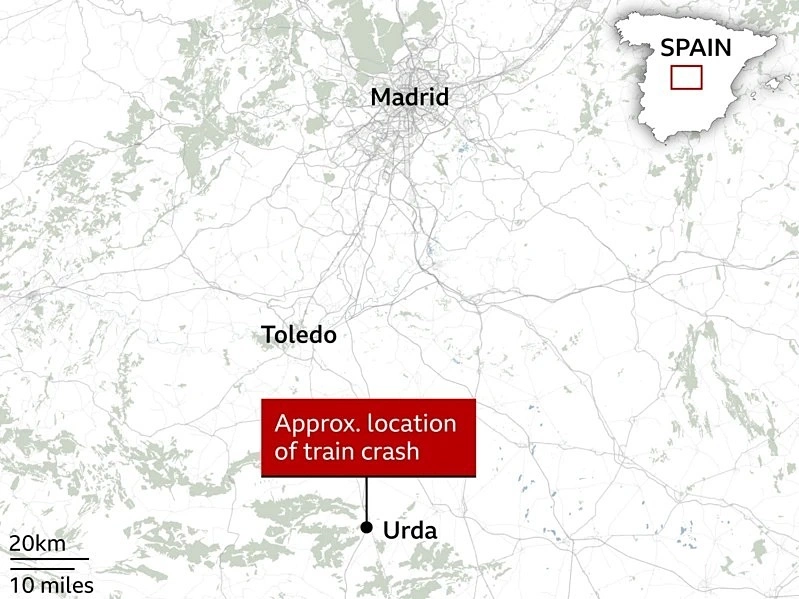
The collision occurred at approximately 08:54 local time at kilometer marker 118 on the Madrid–Seville high-speed line, between the towns of Mora, Orgaz and Urda, roughly 140 kilometres south of Madrid. Both trains were travelling in the same direction toward Seville. The Iryo service (private operator) was carrying 146 passengers plus one baby; the Renfe AVE 2080 carried 397 passengers. Together they held 544 people. Two or more carriages of the Iryo train derailed and plunged down an embankment.
What Happened in the Spain Train Crash
Rail infrastructure manager Adif confirmed a rear-end collision between a Renfe train and an Iryo train on the Madrid–Andalusia corridor. High-speed services between Madrid, Ciudad Real and Andalusia were immediately suspended. Regional government spokesperson Esther Padilla of Castilla-La Mancha initially reported 10 deaths and warned the figure would “almost certainly rise.” Within hours the confirmed toll reached at least 30, with some Civil Protection sources telling Spanish media the number could exceed 40. Hospitals in Toledo, Ciudad Real and Alcázar de San Juan cancelled elective surgery to free capacity. The Military Emergency Unit was deployed, and a blood-donation appeal was issued in Madrid. Live updates were carried by the BBC, The Guardian and The New York Times.
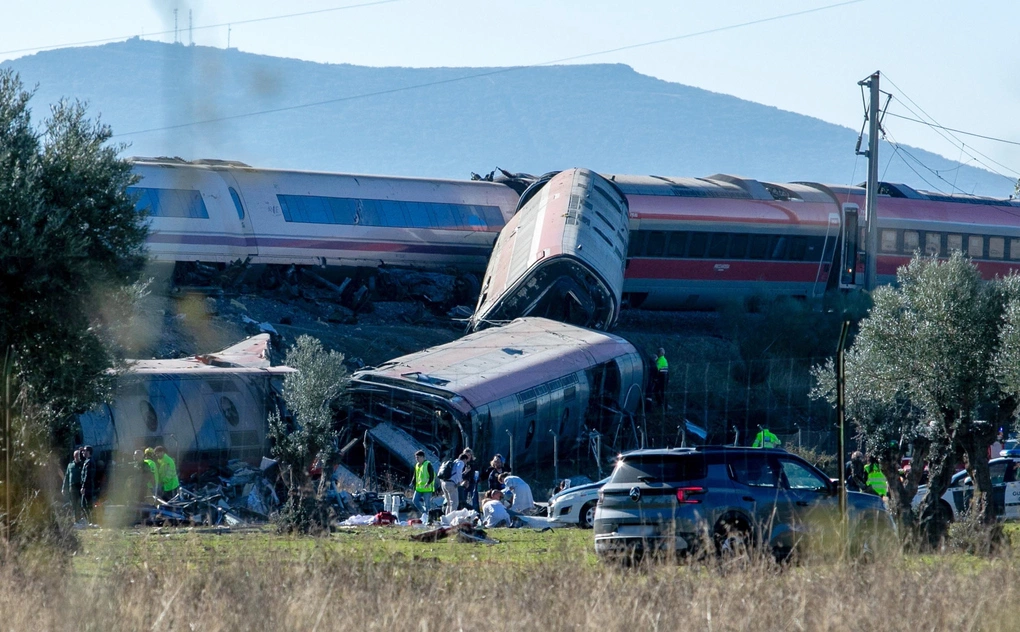
Prime Minister Pedro Sánchez described the accident as “serious,” cancelled public engagements and remained in constant contact with Transport Minister Óscar Puente and the president of Castilla-La Mancha. King Felipe VI and Queen Letizia expressed deep regret. European Commission President Ursula von der Leyen said Europe mourned with Spain. Footage and photographs from the scene showed twisted silver and red carriages, one or more overturned on the slope, debris scattered across the rural landscape, and emergency crews working under clear skies.
Why the Spain Train Crash Occurred: Signaling Failure and Human Error
The most coherent early explanation, drawn from government sources quoted by El País and corroborated by other Spanish outlets, centres on the interaction between a technical failure and a subsequent human mistake under degraded operating conditions.
The Madrid–Seville line, Spain’s first high-speed railway (opened in 1992), is still protected by the German LZB (Linienzugbeeinflussung) continuous cab-signalling system. LZB uses inductive cable loops laid in a zigzag pattern between the rails. A central computer continuously transmits movement authorities, permitted speeds and distance-to-target information to the train. If the track is obstructed or a fault is detected, the system can automatically apply the brakes. When LZB fails, traffic falls back to a degraded mode that relies on lineside signals, the older ASFA point-based system, and verbal or digital authorisations from the control centre.
According to initial technical analyses reported on 28 October, the LZB system experienced a malfunction. Approximately eight trains in the sector stopped. Controllers then began issuing proceed orders under manual procedures. The Iryo train either could not move or remained stationary for reasons still under investigation. An operator at the Atocha control centre in Madrid is said to have mistakenly authorised the following Renfe AVE to continue, despite the Iryo still occupying the track ahead. The Renfe train, which had itself been held briefly for “heavy traffic,” then accelerated and struck the rear of the stationary Iryo at speed. The impact derailed carriages that fell down the embankment.
This sequence matches classic failure-mode analysis in high-speed rail: automatic protection is removed, separation responsibility shifts to humans, and a single incorrect authorisation can produce a catastrophic rear-end collision. Official investigators (CIAF and judicial authorities) have not yet confirmed the precise chain of events; the account above reflects the strongest early indications from Spanish government and media sources as of mid-morning on the day of the crash.
How the LZB System Works and Why It Matters
LZB was introduced in Germany in the 1960s–70s and adopted for Spain’s first AVE line because conventional lineside signals become unreliable above roughly 160 km/h. At 300 km/h the braking distance is long and the time available for a driver to observe and react to a signal is measured in seconds. Continuous cab signalling solves that problem by displaying the permitted speed and target distance inside the driver’s cab and supervising compliance automatically.
When LZB is fully functional it provides a high level of protection against both overspeed and rear-end collisions. The vulnerability appears when the system is unavailable. In degraded mode the line reverts to procedures that depend on accurate communication between the control centre and the train drivers, correct identification of which train is where, and strict adherence to stop-and-proceed rules. Spanish engineers have noted for years that LZB on the Madrid–Seville corridor is a legacy system scheduled for progressive replacement by the European ETCS/ERTMS standard, a migration that has been slower on this particular line than on later high-speed routes such as Madrid–Barcelona.
The 28 October crash therefore raises two linked questions: why the LZB failed on that morning, and why the subsequent manual authorisation process did not prevent the Renfe train from being sent into the occupied section.
Comparison with the January 2026 Adamuz Disaster
This is the second major high-speed collision in Spain in 2026 involving the same two operators. On 18 January near Adamuz in Córdoba province, an Iryo train travelling from Málaga to Madrid derailed after a rail fracture (a defective aluminothermic weld that created a roughly 40-centimetre break). Rear carriages crossed onto the opposite track and were struck by a southbound Renfe Alvia service from Madrid to Huelva. Forty-six people died. Investigations by the CIAF and the Civil Guard pointed to a combination of a poor-quality weld, inspection shortcomings, incomplete data collection from track-monitoring equipment, and alert thresholds that were not triggered by earlier voltage drops in the track circuit.
While the January accident was primarily an infrastructure failure (broken rail) and the October accident appears to be a signalling-plus-human-error event, both occurred on the same Madrid–Andalusia high-speed corridor and both involved Renfe and Iryo. The repetition has intensified public and political scrutiny of Spain’s once-celebrated high-speed network. Spain operates one of the world’s largest high-speed systems by length, yet two disasters in nine months have undermined confidence. Background on the January disaster is available from the Wikipedia entry on the Adamuz rail disaster and contemporary reporting by the BBC.
For more context on other major events dominating international headlines this year, see our explainers on why the French are protesting and the latest Cuba news.
Immediate Aftermath and Official Response
Adif suspended all high-speed traffic on the affected line. Renfe and Iryo activated emergency protocols and offered free changes or refunds. The regional government of Castilla-La Mancha coordinated with national emergency services; a sports pavilion in Urda was prepared to receive passengers. Transport Minister Óscar Puente went to the emergency control centre. Political campaigning was paused across parties.
The death toll is still provisional. Rescue teams continued working inside the wreckage hours after the collision, and authorities warned that the final figure would be higher. Identification of victims and notification of families is expected to take time, as is standard in mass-casualty rail accidents.
What Investigators Will Examine
The formal investigation will be led by the Comisión de Investigación de Accidentes Ferroviarios (CIAF) with parallel judicial inquiry. Key lines of inquiry include:
- The exact nature and timing of the LZB failure and any related faults in the backup ASFA or interlocking systems.
- The sequence of stop and proceed authorisations issued by the Atocha control centre.
- Why the Iryo train remained stationary after other trains were ordered to move.
- The speed of the Renfe train at the moment of impact and the performance of its onboard protection systems in degraded mode.
- Training, workload and communication protocols for controllers and drivers when operating under LZB failure conditions.
- Any recent maintenance or software changes affecting the signalling equipment on that section.
Data from the trains’ Juridical Recording Units (black boxes), trackside logs, radio communications and CCTV will be critical. Similar data proved decisive in the Adamuz investigation, which confirmed the rail had already fractured before the Iryo train passed over it.
Broader Implications for Spanish High-Speed Rail
Spain’s high-speed network was long held up as a model of rapid infrastructure development. The 1992 Madrid–Seville line was a political and engineering showcase. Subsequent expansions created one of the densest high-speed systems outside China. Yet the combination of the Adamuz rail-fracture disaster and the October rear-end collision has exposed two different classes of risk: physical infrastructure integrity and the resilience of signalling systems under failure.
Experts have previously questioned the pace of migration from LZB to ETCS on the older corridors. ETCS Level 2, already used on newer Spanish high-speed lines, uses radio (GSM-R or future FRMCS) rather than trackside cables and is designed with clearer degraded-mode procedures. Completing that migration on the Madrid–Seville line has been delayed for budgetary and technical reasons. The 28 October crash is likely to accelerate political pressure for both a full independent review of LZB failure modes and a firm timetable for ETCS deployment.
Private competition on Spanish high-speed routes (Iryo, Ouigo) has increased traffic density. Higher utilisation makes the consequences of any protection-system failure more severe, because the physical separation between trains is smaller. The fact that both 2026 disasters involved mixed Renfe–Iryo traffic is therefore not coincidental; it reflects the current operating pattern on the corridor.
Passenger Accounts and Scene Conditions
Passengers described a brief earlier stop attributed to “heavy traffic,” followed by a sudden violent impact. One survivor spoke of a “massive roar” and “enormous thud.” Because the collision was a rear-end strike rather than a head-on collision at combined closing speeds (as in Adamuz), the energy dissipation was different, yet still sufficient to derail and destroy carriages and throw them down an embankment. The rural setting complicated access for heavy rescue equipment; helicopters and military units were used to move casualties.
The visual evidence—overturned carriages, scattered luggage, emergency vehicles lining the access track—matches the pattern of other high-speed derailments in which secondary impacts after the initial collision cause the majority of fatalities.
Historical Context of Spanish Rail Accidents
The 28 October crash joins a short but grim list of major Spanish rail disasters in the high-speed era. The 2013 Santiago de Compostela derailment (Alvia train entering a curve at excessive speed) killed 80 people and remains the deadliest. Adamuz in January 2026 was the worst since then until Wednesday’s collision. Earlier conventional-line accidents (Torre del Bierzo 1944, El Cuervo 1972, Valencia Metro 2006) involved different technologies and operating regimes. The two 2026 high-speed events are distinctive because they occurred on modern, purpose-built infrastructure that was supposed to have eliminated the most common historical causes of rail fatalities.
What Happens Next
In the coming days authorities will release more precise casualty figures, identify the victims, and begin the formal technical investigation. Political debate is already focusing on whether the LZB system should be taken out of service on the Madrid–Seville line until independent verification of its failure modes, and on the timetable for full ETCS migration. Renfe and Iryo will face questions about their internal safety management systems and the training given to drivers for degraded-mode operation.
For passengers, the immediate effect is the suspension of high-speed services on one of Spain’s busiest corridors. Restoration of normal traffic will depend on the completion of the technical investigation and any temporary speed or procedural restrictions imposed by Adif.
The Spain train crash of 28 October 2026 is still in its first hours of investigation. What is already clear is that a rear-end collision on a high-speed line protected by continuous signalling should, in principle, have been prevented by either the automatic system or the manual procedures that replace it. The emerging explanation—that a signalling failure was followed by an incorrect proceed order from the control centre—points to a classic and preventable failure mode. Whether that account is confirmed by the black-box data and controller logs will determine the precise lessons Spanish rail authorities must draw from the country’s second high-speed disaster in a single year.
Frequently Asked Questions
How many people died in the Spain train crash?
As of the latest updates on 28 October 2026, at least 30 people had been confirmed dead. Authorities warned the toll would rise as rescue operations continued inside the wreckage. Some media cited Civil Protection sources suggesting the figure could exceed 40.
Which trains were involved in the Spain train crash?
A Renfe AVE high-speed train (service 2080) carrying 397 passengers rear-ended an Iryo train carrying 146 passengers plus one baby. Both were travelling from Madrid toward Seville on the high-speed line.
Where did the Spain train crash happen?
The collision occurred at kilometre 118 of the Madrid–Seville high-speed line, between the towns of Mora, Orgaz and Urda in Toledo province, Castilla-La Mancha, approximately 140 km south of Madrid.
What caused the Spain train crash?
Early indications from government sources and Spanish media point to a failure of the LZB continuous signalling system that forced traffic into manual control, followed by a human error in which a controller at the Atocha centre authorised the Renfe train to proceed while the Iryo train was still stopped on the track. The official investigation is ongoing.
Is this related to the January 2026 Adamuz crash?
Both accidents involved Renfe and Iryo trains on the Madrid–Andalusia high-speed corridor. The January Adamuz disaster was caused by a rail fracture that led to a derailment and subsequent collision (46 deaths). The October crash appears to stem from signalling failure and human error. They are distinct events but have intensified scrutiny of the same network.
What is the LZB system?
LZB (Linienzugbeeinflussung) is a German continuous cab-signalling and train-protection system used on Spain’s original Madrid–Seville high-speed line since 1992. It transmits speed and movement-authority information continuously via trackside cables. When it fails, operations fall back to degraded procedures that rely more heavily on human controllers and drivers.