
Updated 1 November 2026. Why are the French protesting? It began as a teachers’ strike in Créteil on 18 September over staffing and conditions, spread to school students, and grew into mass demonstrations on 17 and 24 October. Roughly a million people have taken part across the wave.
Two things have changed since this article was first published. The unions have called a general day of strike action for 5 November. And the protests are no longer only French: comparable movements are now running in at least ten European countries, with British students planning a walkout on 20 November.
What happens on 5 November
The next fixed date is Thursday 5 November, an inter-union day of strikes and demonstrations. The CGT has gone further than joining it: the union is calling on workplaces to hold general assemblies and generalise the strike, meaning extend it beyond a single day.
Its stated demands are wage and pension increases, budgets for public services, funding for the social security system, and a meeting between the prime minister and youth organisations. The CGT is also demanding a change in policing strategy and an end to what it calls repression.
That last demand is new in tone, and it follows the arrest figures above. It moves the dispute from pay and budgets to how the protests themselves have been handled — which tends to prolong a conflict rather than settle it.
The protests have spread across Europe
This is the part that has changed most since mid-October. What began in France is now a continent-wide pattern, and the movements are in contact with each other.
An assembly in Paris on 17–18 October brought together 27 organisations from eleven European countries. The coordinated action they are building was first called at a meeting in Cologne on 14 June.
| Country | Since | What has happened |
|---|---|---|
| France | 18 Sep | Teachers’ strike, then students and fuel protests; about 1 million participants |
| Italy | 16 Oct | Student protests in Milan, Turin, Bologna and Rome; riots on 17 Oct; new security decree with 2–5 year sentences for violent rioting |
| Spain | 23 Sep | Housing and eviction protests, camp at Puerta del Sol; emergency eviction ban agreed, housing bill failed; snap election called for 29 Nov |
| Portugal | Sep | Tens of thousands in Lisbon, Porto and Braga; 37 injured when police cleared a Porto camp; 55 arrested in Lisbon |
| Belgium | 17 Oct | Brussels and Liège; tear gas and water cannon; up to 195 arrests |
| Greece | 13 Oct | Student camp at Syntagma Square, Athens, over housing costs and school funding |
| Austria | 22 Oct | 20,000–30,000 in Vienna, called by the national student union |
| Serbia | 22 Oct | About 150,000 in Belgrade ahead of the 25 October election |
| Germany | Dec 2025 | School strikes against new conscription rules; nationwide “Gen Z regelt” protests on 31 Oct in 34 cities |
| Ireland | 1 Oct | More than 1,500 students marched in Dublin over fees and living costs |
| Albania | late May | The “Flamingo Revolution” against a resort project on protected Sazan Island; new wave from 13 Oct over student costs |
| United Kingdom | planned 20 Nov | Walkouts announced in at least 50 towns and cities and over 100 schools and colleges, with a London rally at Parliament Square |
A running country-by-country record is kept in the Wikipedia entry on the 2026 European unrest.
Note the last row. Britain has not yet seen protests on this scale. Socialist Students has called a walkout for Friday 20 November as part of what organisers call an International Youth Strike, under the slogan “fight for our future not their wars”. Whether it reaches the size of the French or German actions is still open.
Britain does have large protests at present, but on a separate issue. On 31 October police arrested 139 people outside the US embassy in London at a demonstration against the proscription of the group Palestine Action, ahead of a Supreme Court hearing on 4 November. That dispute is about protest and terrorism law, not about the cost of living, and it is not part of the wave described here.
The demands differ by country but overlap heavily: housing costs, school and university funding, the cost of living, and in France, Germany and Britain, opposition to military spending or conscription. Germany’s protests have the clearest generational framing, which our explainer on why Gen Z is protesting covers in detail.
Outside Europe, demonstrators in Montreal marched on 17 October in solidarity with French students.
What happened when the French started protesting?
The 17th was called as a joint day of action. Students who had been protesting for weeks over school conditions met unions, left-wing parties and remnants of the Yellow Vests. The slogan was “On en a marre” — we’ve had enough. In Paris tens of thousands marched from Place de la République toward Place de Clichy. Other cities held their own marches.
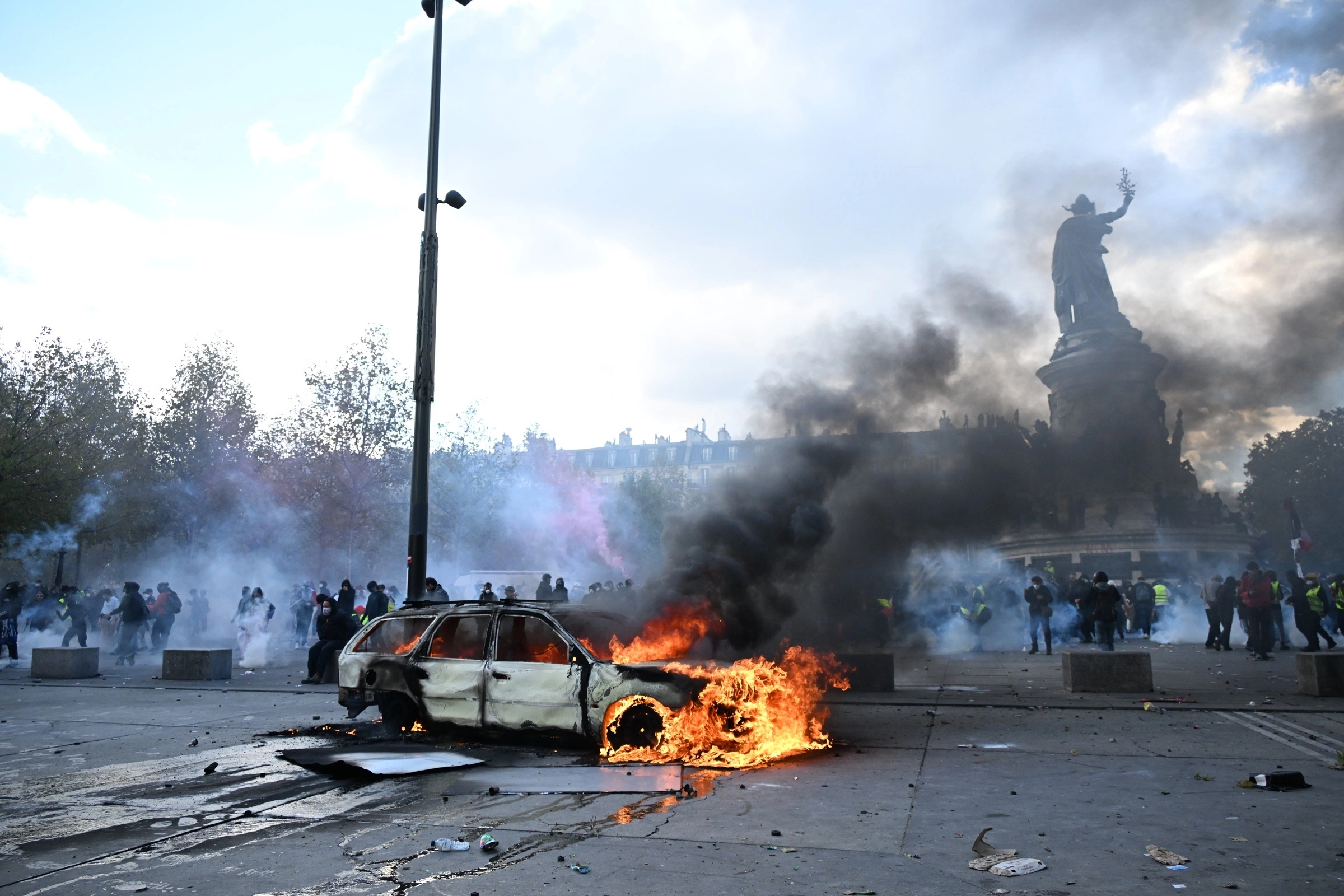
Interior Minister Laurent Nuñez said about 550,000 people took part nationwide, including 110,000 in Paris. The CGT union put the figure at 800,000. Most of the marches were peaceful. From the afternoon the edges turned violent. In Paris masked groups built barricades and looted shops. In Limoges the historic city hall burned and part of the roof collapsed. In Marseille protesters broke into the city hall and defaced it. In Lyon the tourist office was set on fire. Police used tear gas and water cannon. Prime Minister Sébastien Lecornu spoke of roughly 1,200 arrests and more than 500 injured officers. One demonstrator died in Paris after a cardiac arrest. A 17-year-old in Saint-Étienne lost a hand after being hit by a crowd-control grenade. Later reports put the arrest total higher, above 1,800, as police continued to make arrests into Sunday.
What happened on 24 October
A week later, on 24 October 2026, hundreds of thousands marched again. The interior ministry counted about 410,000 participants nationwide, including roughly 110,000 in Paris. Organisers again claimed around 800,000. Authorities deployed 70,000 police and gendarmes — 10,000 more than on 17 October. After largely peaceful marches, clashes erupted in Paris, Marseille and other cities. Police used tear gas and water cannons. Interior Minister Laurent Nuñez reported nearly 1,000 arrests by the evening, with the number expected to rise. Several cities had imposed protest bans and curfews to prevent a repeat of the previous weekend’s unrest. Officials said the violence was less intense than on 17–18 October, but the protests continued.
President Emmanuel Macron condemned the violence in a televised address on Sunday evening. “Nothing justifies it, nothing explains it, nothing excuses it,” he said. He spoke of “anger and shame” and said further demonstrations could be banned if necessary. Lecornu blamed the “ultra-left” and criminals and said the government would not be intimidated.
Why are the French protesting?
The demands are not a single list. Anyone asking why are the French protesting will find three strands running together.
Cost of living. Fuel, energy and food have become more expensive. The Iran war and the restricted Strait of Hormuz have pushed oil prices up. Reuters noted the protests as the worst unrest in years. Many workers earn little more than the minimum wage. The Yellow Vests, who took to the streets in 2018 against a fuel tax, see themselves confirmed. They want higher wages, a cap on fuel prices and better public services.
Schools. Students have been protesting for weeks over teacher shortages, crumbling buildings and oversized classes. The protests began at high schools in the northern suburbs of Paris and spread. The government’s draft budget includes cuts in education. Students want more teachers, smaller classes and better facilities. They also accuse the police of using excessive force at earlier student protests.
Government and the future. Many demonstrators say politics is not listening. Macron is the main target. The 2027 presidential election is less than a year away. Unions, left-wing parties and parts of the Yellow Vest movement used the day to gather discontent. Worries about war, climate and an uncertain future sit on top of the concrete demands. It is not one issue. It is an accumulation of “ras-le-bol” — enough is enough.
The numbers
| Measure | 17 October | 24 October |
|---|---|---|
| Participants, interior ministry | about 550,000 | about 410,000 |
| Participants, Paris | about 110,000 | about 110,000 |
| Participants, CGT estimate | about 800,000 | about 800,000 |
| Arrests | about 1,200 (later reports above 1,800) | nearly 1,000 by evening |
| Arrests in Paris | 855 | — |
| Police deployed | about 60,000 | about 70,000 |
| Injured police, cumulative | more than 500 | |
| Deaths | one (cardiac arrest, Paris) | |
| Notable damage | part of Limoges town hall destroyed; Lyon tourist office burned | |
Official and union figures differ widely, as they usually do. The interior ministry counts the crowd at fixed points; the CGT counts the whole march. Both numbers are given here rather than one.
Across the whole wave, more than 6,700 minors have been arrested in France. Several were seriously injured, and at least one family has filed a criminal complaint over police conduct.
Participant and arrest figures come from authorities and organizers and differ. The damage to public buildings is documented by photos and video.
How the French protesting started
Student protests began in September at high schools in the northern suburbs of Paris. The trigger was missing teachers and buildings that had not been repaired for years. The protests spread to other cities and drew in students and parents. At the same time remnants of the Yellow Vest movement and unions organised a day of action against the cost of living. On 17 October the two strands met. That is the concrete answer to why are the French protesting on that day: two movements arrived at the same place.
The government had previously described the student protests as limited. On 17 October it was clear they had become something larger. The combination of youth protests and Yellow Vest themes recalled 2018, and it is the clearest recent answer to why are the French protesting in such numbers, when Macron made concessions after months of demonstrations. Whether 17 October is the start of a similar movement or a single day is open. The CGT has called another inter-union day of action for 5 November.
The Yellow Vest background
The Yellow Vest movement of 2018 began with protests against a planned fuel tax increase. Background on that earlier wave is in the BBC’s account of the 2018 gilets jaunes. It quickly widened into a general critique of Macron and the cost of living. After months of demonstrations and riots the government made concessions: the tax was suspended, the minimum wage was raised, and a national debate was held. The movement lost strength afterwards but did not disappear. On 17 October 2026 the yellow vests reappeared, especially at roundabouts outside the big cities.
The student protests are newer. They began in September 2026. The government reacted cautiously at first. On 17 October it was clear that more had grown out of them. The combination of the two strands is new. In 2018 the Yellow Vests were mainly adults from the provinces. In 2026 students are the most visible group, and the Yellow Vests are joining them. That makes the movement harder to categorise. It has no single face and no single demand. That is its strength and its weakness.
The violence and the demands
Most of those asking why are the French protesting were peaceful demonstrators. The riots came from smaller groups who wore masks and targeted public buildings and shops. The government blames the “ultra-left” and criminals. Left-wing parties accuse the police of escalating the situation. Both accounts are political. What is certain is that there were fires, looting and injuries. The demands of the students and the unions were overshadowed by the coverage of the violence.
This is a familiar pattern. During the Yellow Vest protests of 2018 the riots at the roundabouts overshadowed the original demand for lower fuel prices. On 17 October something similar happened. Anyone who wants to know why people are protesting has to look at the demands and the violence separately. One does not explain the other.
What the government can do
Macron has condemned the violence and said further demonstrations can be banned if necessary. That does not answer why are the French protesting in the first place. That does not answer the demands. The government is negotiating a budget that includes cuts in education. Concessions on schools or fuel prices would strain the budget. No concessions would probably not end the protests. The 2027 presidential election is less than a year away. Macron cannot run again. The opposition on both left and right will use the discontent.
For Europe the 17th is a signal. France is the EU’s second-largest economy. Sustained unrest there affects European politics. The cost of living that is driving the protests has also risen in Germany and elsewhere. The causes — the Iran war, the Strait of Hormuz, inflation — are the same. Whether the protests spread is open. The issues are not.
The cost of living in detail
The high prices are the common denominator. Fuel, energy and food have become more expensive since the Iran war began in February 2026. The Strait of Hormuz is restricted, and Brent crude has traded above 100 dollars at times. For households on low incomes this hits directly. Many workers in France earn little more than the minimum wage. A tank of fuel or a higher electricity bill is not an abstract problem for them.
The government points to international causes it does not control. The demonstrators point to the consequences they carry. Both are right. The Iran war was not decided in Paris. The prices at the pump were. That is why the Yellow Vests of 2018 recognise themselves. Then the tax was the trigger. Now it is the prices themselves.
What the riots change
The violence has dominated the coverage. Images of burning town halls and looted shops push aside the demands of the students and the unions. That is politically useful for the government, which can present the protests as the work of the “ultra-left”. It is politically damaging for the organisers, who want to emphasise the peaceful part of the movement. For readers it is a problem: the question “why are people protesting” is replaced by the question “who looted”.
The arrests concentrated in the evening hours in the big cities. In Paris there were 855 on the day. Nationwide the figure was around 1,200, with later totals higher as police continued to make arrests. Most of those arrested were adults, not students. That suggests the riots did not come from the student protests but from groups that formed on the edges of the marches. Whether these were organised groups or spontaneous looters is not settled. The government speaks of the “ultra-left”. The opposition speaks of police violence. Both are political labels.
Looking ahead
The CGT has called an inter-union day of action for 5 November. Whether the student protests continue until then is open. The autumn holidays began on 17 October. That can dampen mobilisation or let it rise again after the holidays. The 2027 presidential election is approaching. Any larger wave of protest in the coming months will be used by the candidates. Macron cannot run again. His successor will have to reckon with the discontent that became visible on 17 October.
For readers outside France the practical consequence is limited. The protests do not change prices at the pump elsewhere overnight. They show that the cost of living in France is politically explosive. The causes — the Iran war, the Strait of Hormuz, inflation — are the same as in Germany, Britain and elsewhere. See also why gas prices are so high. Whether the protests spread depends on the political situation, not on the prices alone. France has a tradition of large street protests. Other countries have it less. The issues are the same anyway.
The coverage on 18 October focused on the damage. That is understandable. Burning buildings are more visible than demands for more teachers. For the question of why people are protesting, the coverage of the violence is not enough. The demands of the students and the unions were there before 17 October. They will be there after it. The violence did not create them. It covered them.
The short answer
Why are the French protesting? Because students, unions and parts of the Yellow Vest movement marched together on 17 October 2026 against high living costs, rundown schools and a government they say is not listening. About 550,000 people took to the streets. In several cities the day turned into riots. The demands are not uniform. The discontent is. Whether this becomes a longer movement will be decided in the coming weeks.
Frequently asked questions
Why are the French protesting?
Because of high living costs, rundown schools and a sense that the government is not listening. Students, unions and Yellow Vests marched together on 17 October.
How many people protested?
The interior ministry said about 550,000 nationwide, including 110,000 in Paris. The CGT union said 800,000.
Was there violence?
Yes. In Paris, Marseille, Lyon and Limoges the day turned violent. The city hall in Limoges partly burned. More than 1,200 people were arrested on the day, with later totals higher.
What do the protesters want?
Higher wages, lower fuel prices, more teachers, better school buildings and better public services in general. The demands are not a single list.
What has the government said?
Macron condemned the violence and said further demonstrations could be banned if necessary. Lecornu blamed the “ultra-left” and criminals.
Will it continue?
The CGT has called another day of action for 5 November. Whether the student protests continue is open.
Has the protest spread to other countries?
Yes. Comparable movements are running in Italy, Spain, Portugal, Belgium, Greece, Austria, Serbia, Germany, Ireland and Albania. Representatives of 27 organisations from eleven countries met in Paris on 17–18 October to coordinate.
Are there protests in the UK?
Not yet at this scale. Socialist Students has announced walkouts for 20 November in at least 50 towns and cities, with more than 100 schools, colleges and universities involved and a central rally in Parliament Square, London.
What is happening on 5 November?
An inter-union day of strike action in France. The CGT is urging workplaces to vote to extend the strike beyond that single day, and is demanding higher wages and pensions, public service funding, and a change in how the protests are policed.