
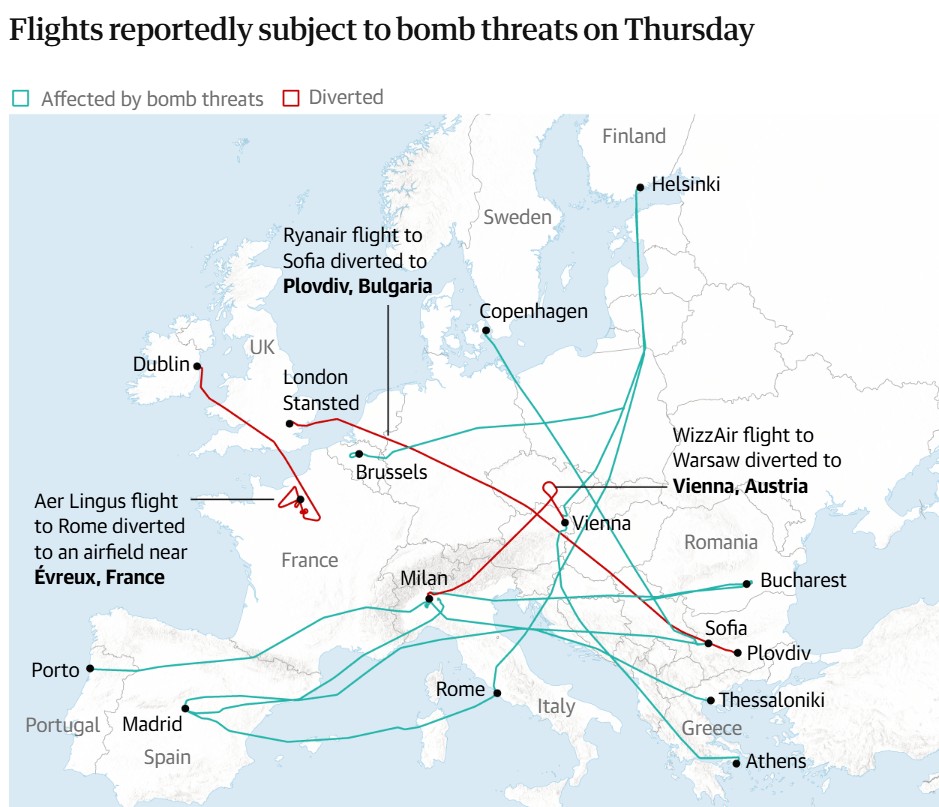
Why are bomb threats disrupting flights across Europe today? On Thursday, November 5, 2026, civil aviation across the continent was thrown into chaos after coordinated bomb threats on flights forced at least 25 commercial airliners into emergency landings, military fighter jet escorts, or mid-air diversions—bringing the weekly total to at least 33 affected flights across 16 European countries. From an Aer Lingus Airbus A320 forced down at a French military airbase near Évreux to Ryanair, Wizz Air, and LOT Polish Airlines planes surrounded by sniffer dogs in Sofia, Milan, Rome, Vienna, and Brussels, millions of travelers are searching for bomb threats flights and bomb threats Europe to understand who is behind the chaos.
While extensive police searches of all 33 aircraft and terminals (including London Heathrow and Birmingham) confirmed that every single alert was a malicious false alarm, European defense ministers and aviation intelligence analysts warn that the wave of hoax bomb threats is no random prank. Coming less than 72 hours after hackers sabotaged supermarket refrigeration systems across seven EU nations, Italian Defense Minister Guido Crosetto explicitly described the aviation alerts as “under-threshold warfare” designed to stoke tension without crossing the line of direct military attribution. Below is the complete breakdown of the Europe bomb threats, the mysterious “Male State” emails, how airline red-alert protocols work at 35,000 feet, and which airports and airlines were hit hardest.
✈️ At a Glance: The European Flight Bomb Threats (Nov 2026)
- How Many Bomb Threats Today? At least 25 commercial flights were hit by bomb threats on Thursday, November 5, 2026, following 7 plane diversions on Tuesday (Nov 3) and 1 on Monday (Nov 2)—totaling at least 33 disrupted flights across Europe this week.
- 16 Countries Affected: The UK (7 flights to/from London Heathrow, Stansted, Luton, and Birmingham), Italy, Ireland (4 flights including Dublin and Cork), Spain, Bulgaria, Romania, Poland, Finland, Austria, Denmark, Belgium, Portugal, France, Greece, Serbia, and Czechia.
- 10 Airlines Targeted: Ryanair (hardest hit with 8 confirmed cases), Wizz Air, Aer Lingus, Finnair (2 planes), easyJet, Aegean Airlines, Iberia, Sky Express, Air Serbia, and LOT Polish Airlines.
- The “Male State” Email Clue: Anonymous emails sent to Rome and Sofia airports threatening an explosion within 60 minutes were signed by “fighters of the Male State”—a Russian far-right ultranationalist movement founded in 2016 by Vladislav Pozdnyakov, though investigators have not yet confirmed whether the group or a state actor orchestrated the wave.
- Why Target Airborne Planes? Under airline “Traffic-Light” security rules (Red, Amber, Green), an airborne plane has no “Amber” option—meaning a credible-looking threat sent mid-flight forces an immediate emergency descent, fighter jet scramble, and costly diversion.
What Happened? How 33 Flights Across 16 European Countries Were Disrupted
If you are checking bomb threats flights today or wondering why European air traffic faced sudden delays on November 5, the disruption unfolded as a multi-day wave that escalated dramatically on Thursday morning.
The pattern began on Monday, November 2, when a Wizz Air flight from London Luton to Sofia, Bulgaria, was diverted to Budapest following an unsubstantiated security alert. On Tuesday, November 3, seven more passenger jets across Europe were diverted or searched on the tarmac—including a Ryanair aircraft inspected by police and sniffer dogs in Murcia, Spain. Then, on Thursday, November 5, at least 25 separate flights were targeted almost simultaneously across 16 nations, prompting military fighter jets to scramble in Bulgaria, France, Hungary, and Italy.
According to data compiled by The Guardian and Flightradar24, here is the verified breakdown of the major flights and airports hit during the November 2026 wave:
| Airline / Airport Hub | Confirmed Incidents & Routes | Emergency Response & Diversion Details |
|---|---|---|
| Ryanair (8 Flights Hit) | London Stansted → Sofia; Madrid → Sofia; Copenhagen → Sofia; Stansted → Cork; Pescara → Brussels-Charleroi; Milan Malpensa | Hardest-hit carrier. Stansted–Sofia diverted to Plovdiv; Copenhagen and Madrid flights made emergency landings in Sofia; Pescara flight searched after the word “bomb” was scrawled on an onboard toilet wall. |
| Aer Lingus (Dublin → Rome) | Airbus A320 from Dublin to Rome Fiumicino | Diverted mid-flight to Évreux-Fauville Air Base (BA 105) in northern France; French authorities questioned the pilot after initial hesitation to land at a military facility. |
| Wizz Air (Multiple Routes) | Milan → Warsaw; London Luton → Sofia | Milan–Warsaw flight forced to divert and land in Vienna, Austria; Monday’s Luton–Sofia flight diverted to Budapest, Hungary. |
| Italian Hubs (Milan & Rome) | Milan Malpensa (6 incidents) & Rome (5 incidents); flights from Helsinki, Dublin, Thessaloniki, and Porto | Airport operator ADR and Milan Malpensa received anonymous emails written in Italian listing exact flight numbers, airlines, and landing times. |
| Central & Eastern Europe | Sofia (6 incidents), Prague (4 incidents), Brussels (LOT Polish Airlines), Athens & Bucharest | Czech police inspected 4 planes at Václav Havel Airport in Prague; Finnair (2 flights), easyJet, Aegean, Iberia, Sky Express, and Air Serbia also targeted. |
| UK Airports (7 Flights Total) | London Heathrow, Birmingham Airport, London Stansted, London Luton | Heathrow and Birmingham received overnight bomb threats assessed as hoaxes by the Metropolitan Police Aviation Policing Command. |
Who Sent the Bomb Threats on Flights? The “Male State” Emails & Hybrid Warfare Explained
The biggest question behind searches for bomb threats Europe and flights bomb threats is who has the motive and capability to target 33 commercial aircraft across 16 countries without making a single ransom demand.
1. The “Fighters of the Male State” Email Signature
According to sources at Aeroporti di Roma (ADR) and text messages reviewed by Agence France-Presse (AFP), the bomb threat emails sent to airports in Rome and Sofia on Thursday carried a bizarre ideological signature: “fighters of the Male State” (contributing to a sudden spike in global searches for male state).
The anonymous emails—some written in fluent Italian and containing precise flight numbers and scheduled arrival times—read:
“We, the fighters of the Male State, will make history with our actions today. Your feminist regime will remember this for ever. The explosion will occur in 60 minutes. Today, your skies will turn red.”
What is “Male State” (Muzhskoye Gosudarstvo)? Founded in Russia in 2016 by far-right, ultranationalist, and misogynistic activist Vladislav Pozdnyakov (a vocal supporter of Russia’s war in Ukraine), Male State has a history of coordinating online harassment and swatting campaigns against Western and Russian targets. However, Pozdnyakov did not claim responsibility for the aviation alerts on his Telegram channel, and European intelligence officials caution that hybrid threat actors frequently use extremist group names as a “false flag” smokescreen to obscure state-level or coordinated cyber origins.
2. “Under-Threshold Warfare”: The Link to Europe’s Supermarket Fridge Hacks
While police investigators stated on Thursday that there is no conclusive forensic proof yet tying the emails directly to Moscow or Tehran (and Kremlin spokesperson Dmitry Peskov dismissed accusations as “absurd”), senior European defense officials see an unmistakable pattern.
Just 72 hours before the aviation wave, on November 2, hackers remotely hijacked industrial refrigeration systems in supermarkets across seven European countries, heating freezers to 50°C (read our full technical investigation: Supermarket Cyber Attack Explained: Why Hackers Heated Europe’s Fridges to 50°C). Speaking in Rome on Thursday, Italian Defense Minister Guido Crosetto connected the dots directly:
“It seems to me that every day now, from refrigerators to blood supplies in France, to these fake alarms, there’s someone who has an interest in stoking tensions. It’s called ‘under-threshold warfare’ because it’s below the attribution threshold. It’s done that way on purpose, so no one can pin the blame.”
This escalating campaign of unattributable infrastructure disruption is precisely why security ministers across the UK, Germany, France, and the Nordic nations recently activated civilian preparedness advisories—as detailed in our report on why governments are telling people to stockpile food and water in 2026.
Why Do Hoax Bomb Threats Force Planes to Land? The “Red vs. Green” Protocol at 35,000 Feet
Many travelers asking why bomb threats on planes cause such massive disruption wonder why airlines cannot simply ignore an anonymous email once security agencies realize a wave of hoaxes is underway. Aviation safety directors explain that physics, public flight-tracking data, and strict international aviation law leave pilots with zero margin for error:
1. How Public Flight Trackers Empower Modern Hoaxers
Decades ago, only airline insiders knew the exact tail number, aircraft model, routing, and real-time position of a commercial jet. Today, as The Guardian’s aviation analysis notes, open-source flight trackers allow any malicious actor with an internet connection to look up live schedules, aircraft specifications, and exact landing times in Milan, Sofia, or Prague—making a hoax email look alarmingly specific and credible to airport security screeners.
2. The “Traffic-Light” Assessment System (No Amber Option in the Air)
According to Captain Martin Drake and Joji Waites, Director of Flight Safety at the British Airline Pilots’ Association (BALPA), every bomb threat received by an airline or airport is immediately routed to a specialized threat-assessment team that grades the alert on a Traffic-Light Scale:
- GREEN (Not Credible): The threat lacks specificity or is verified as a mass spam hoax (such as the overnight alerts sent to London Heathrow and Birmingham, or the four low-relevance alerts in Prague). The flight continues normally.
- AMBER (Partly Credible – Ground Only): Available only if the aircraft has not yet taken off. Passengers are evacuated on the tarmac, and sniffer dogs re-screen all baggage before the plane is cleared to depart.
- RED (Credible – Airborne Emergency): Once an airplane is in the air, there is no Amber option—only Green or Red. Because cabin pressurization at a cruising altitude of 35,000 feet multiplies the destructive force of even a small explosive device, a “Red” grade requires the pilot to immediately open the cockpit Quick Reference Handbook (QRH), descend rapidly to a lower altitude where the cabin is depressurized, and divert to the nearest suitable airfield or military base.
3. The Goal of the Attackers: Cost, Chaos, and “Alert Fatigue”
Even though the 25 flights disrupted on Thursday represented a tiny fraction of the 27,400 daily flights managed across Europe by Eurocontrol, each mid-air diversion triggers a massive domino effect. Diverting a single Airbus A320 or Boeing 737 costs an airline tens of thousands of euros in fuel dumping, emergency landing fees, hotel accommodations, and displaced flight crews whose legal duty-hour limits expire out of position.
More dangerously, as aviation intelligence analyst Rhys Jones (Osprey Flight Solutions) warned, flooding European air traffic control with dozens of false alarms risks creating “normalization of threats”—stretching military quick-reaction alert (QRA) fighter squadrons and airport bomb squads thin while eroding public confidence in European air travel.
🌍 Related Global Security, Aviation & Market Explainers on TodayWhy
- Wave 1 of Europe’s Hybrid Sabotage: Supermarket Cyber Attack Explained: Why Hackers Heated Europe’s Fridges to 50°C
- Civilian Emergency Readiness: Why Are Governments Telling People to Stockpile Food and Water in 2026?
- Transport Safety Investigations: Why Did the Spain Train Crash Happen? Signaling Failure and Human Error
- Global Markets & Geopolitics: Why Is the Stock Market Down Today? & Why Did the CIA Director Visit Moscow?
Frequently Asked Questions (FAQ)
Why were so many flights across Europe hit by bomb threats on November 5, 2026?
At least 25 flights on Thursday (and 33 across the week) were targeted by a coordinated wave of anonymous hoax bomb threats sent primarily via email to European airports and airlines. While no explosives were found on any plane, defense officials such as Italian Defense Minister Guido Crosetto warned the alerts bear the hallmarks of “under-threshold” hybrid warfare designed to cause travel disruption and public anxiety.
Which airlines and airports were affected by the Europe bomb threats?
Ten airlines were affected across 16 European countries: Ryanair (8 flights), Wizz Air, Aer Lingus, Finnair, easyJet, Aegean Airlines, Iberia, Sky Express, Air Serbia, and LOT Polish Airlines. The hardest-hit airport hubs were Sofia (6 incidents), Milan Malpensa (6), Rome (5), and Prague (4), alongside alerts involving London Heathrow, Birmingham, Stansted, Luton, Dublin, Cork, Vienna, Brussels, and Madrid.
Who is the “Male State” group named in the Rome and Sofia airport bomb threat emails?
Bomb threat emails sent to Rome and Sofia airports were signed by “fighters of the Male State”—referring to a Russian far-right, ultranationalist, and misogynistic online movement founded in 2016 by Vladislav Pozdnyakov. However, its founder did not claim responsibility on Telegram, and European investigators have not ruled out false-flag spoofing by other threat actors.
Is it safe to fly in Europe right now?
Yes. Every single one of the 33 reported threats this week was confirmed to be a false alarm after thorough police and sniffer-dog inspections, and the affected flights represent less than 0.1% of the 27,400 daily flights operating safely across European airspace.