
Last Updated on 5 hours ago by TodayWhy Editorial
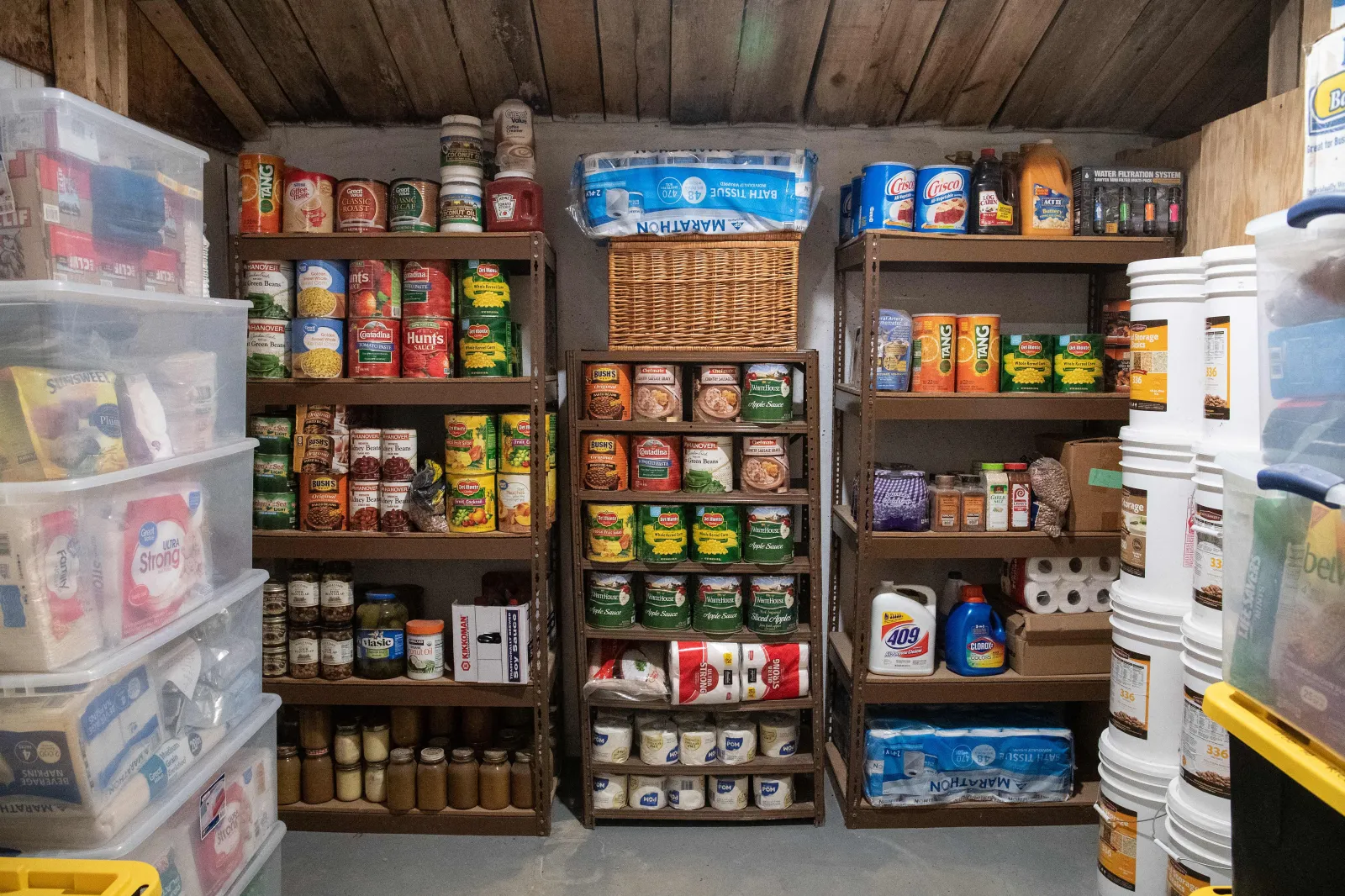
Recently, a wave of countries across Europe, North America, and Asia simultaneously issued public advisories urging citizens to store water, non-perishable food, and essential survival equipment. This has triggered a massive surge in people asking: why is the government telling people to stockpile right now?
This sudden shift in public policy is not a coincidence. It reflects a major transformation in the national security strategies of developed nations—moving away from comprehensive state protection toward building “community resilience.” Below is the complete picture of why are countries telling people to stockpile and prepare for crises, alongside specific household preparation guidelines.
The Three Pillars of Crisis: Why Are Governments Acting Right Now?
The urgent messaging behind why are governments telling people to stockpile does not stem from a single isolated threat tomorrow, but rather from the convergence of three systemic risks reshaping the global security architecture in 2026.
1. State-Sponsored Terrorism and Hybrid Warfare
In the United Kingdom, Defence Secretary Wes Streeting delivered some of the most specific warnings seen in decades. Speaking at the opening of a new tank gun barrel factory owned by German manufacturer Rheinmetall in Telford, West Midlands, Streeting emphasized that the public must prepare for sabotage actions that stop just short of all-out war.
“Terms like ‘hybrid warfare’ and ‘grey zone threats’ do not accurately capture or convey to the general public what I prefer to describe as ‘state-sponsored terrorism,'”Secretary Streeting stated. “So in the face of those threats, which are not hypothetical but real, and not somewhere else but increasingly here, we have to step up and take seriously our national resilience as well as our national defence.”
“It’s really important that we ask households and businesses, are they prepared? Are they ready? Do they know how they would respond in the event of everyday challenges that might manifest themselves?”
These threats are no longer theoretical. Europe has grown increasingly vigilant against sabotage efforts by hostile states aimed at disrupting infrastructure or directly threatening civilian safety. These hazards include an explosives-laden drone discovered next to a Ukrainian cargo plane at Germany’s Leipzig airport in August, alongside a series of explosions and fires at defense facilities across the continent. Furthermore, the British Royal Navy has continuously tracked spy ships monitoring undersea pipelines and fiber-optic cables connecting the UK to mainland Europe. An attack on this undersea cable network would sever communications and financial systems in an instant (for deeper context on high-level intelligence tensions, see our analysis on why did the CIA Director visit Moscow).
2. The Fragility of Cloud and Digital Infrastructure
The modern world is built upon an extremely fragile digital foundation. The UK government’s “Be Ready” warning was issued immediately after 32 government websites were taken offline as an emergency precaution. This measure responded to the discovery of a critical security vulnerability in the PHP programming language—used by millions of websites worldwide. Britain’s National Cyber Security Centre had to dispatch 50,000 alerts to affected organizations.
Further south in Europe, a stark demonstration of infrastructure collapse occurred in April 2025. Spain and Portugal were suddenly plunged into darkness for hours due to a cascading failure triggered by voltage instability across the power network. Approximately 55 million people were affected in Europe’s worst blackout in modern memory. When the electrical grid collapses, credit card payment systems, clean water pumps, gas stations, and telecommunications networks are all disabled (similar to the regional grid vulnerabilities analyzed in our report on the US emergency order across 17 states for backup generators). Over-reliance on technology has turned developed nations into “giants with feet of clay.”
3. Extreme Weather and the Super El-Nino
Disruption comes not only from human conflict but also from nature. The “super El-Nino” phenomenon is projected to potentially make 2027 the hottest year ever recorded in human history. These erratic weather patterns directly threaten global food supply chains and energy systems.
In the UK, the stockpiling campaign was timed to launch right before the winter storm season. Fierce storms in recent years—most notably Storm Goretti in January, with winds reaching nearly 100 mph—left tens of thousands of homes across the Midlands, South West England, and Wales without power. Recognizing this risk, the European Commission unveiled its Preparedness Union Strategy in March 2025, acknowledging that Europe faces rising geopolitical tensions alongside climate-driven natural disasters (which have also triggered severe local shortages, as detailed in our Thames Water hosepipe ban 2026 explained guide).
The Policy Map: Emergency Recommendation Levels by Country
Globally, warning levels and recommended stockpiling durations differ significantly based on each nation’s geopolitical risk assessment and geographic location.
1. The 72-Hour (3-Day) Standard: The Global Baseline
Maintaining emergency supplies for a 3-day period is the most common recommendation, rooted in disaster management principles: 72 hours is the minimum window required for state rescue forces to clear roads and reach isolated areas.
- United Kingdom: The “Be Ready” campaign launched by the Cabinet Office directs every citizen to prepare food and water for 72 hours. UK Prime Minister Andy Burnham even shared on BBC Radio: “I do like my beans, so I have plenty of those in the cupboard, and soup. I think those are the kind of things that I would recommend people to have.” (Read more about the UK leadership context in our profile of Andy Burnham and his cabinet).
- France: Regional authorities are also taking urgent action. A government social media account for the French region of Normandy issued an urgent appeal: “Don’t wait for the emergency: prepare now!”
- Other Nations: Canada, Japan, Mexico, the Netherlands, South Africa (specifically the city of Cape Town), and Australia (particularly cyclone-prone Western Australia) all use the 72-hour benchmark to advise households on self-protection.
- India: India’s National Disaster Management Authority advises households to prepare a disaster emergency kit, though it does not stipulate a specific time frame.
2. The Medium-to-Long-Term Standard (1 Week to 10 Days): Nordic Countries and Germany
In nations closer to conflict frontlines or possessing strong civil defense traditions, requirements are substantially higher.
- Sweden and Norway: These two Nordic countries advise citizens to stockpile essential supplies sufficient for approximately one week, accounting for both harsh winter conditions and the risk of maritime supply chain disruptions.
- Germany: Germany currently holds the highest civilian readiness benchmark in Europe, instructing households to stockpile emergency food and supplies to last for up to 10 days.
3. The Expanded Approach: The United States and the Pentagon’s Initiative
In the United States, guidance for civilians remains broad, whereas military directives reveal an extraordinary level of urgency:
- Civilian Guidance: The U.S. Department of Homeland Security (DHS), via Ready.gov, states: “Being prepared means having your own food, water and other supplies to last for several days.” Former FBI Deputy Director and conservative podcaster Dan Bongino also emphasized on his show: “The way to reduce anxiety and panic in tumultuous times is to be prepared. Have yourself an emergency radio, have yourself some batteries. Get yourself some emergency food, get yourself a rain collection and water filtration tablets.”
- Military Directive (The FORTRESS Initiative): On September 30, 2026, U.S. Defense Secretary Pete Hegseth unveiled the Federal Operations for Resilience, Troop Resources, Energy, Supply and Survivability (FORTRESS) initiative. This directive requires U.S. military bases to operate independently without external supplies for at least 90 days should a major conflict sever traditional supply chains. Hegseth dubbed it the “nation’s insurance policy.”
Countries Issuing Emergency Preparedness Advisories
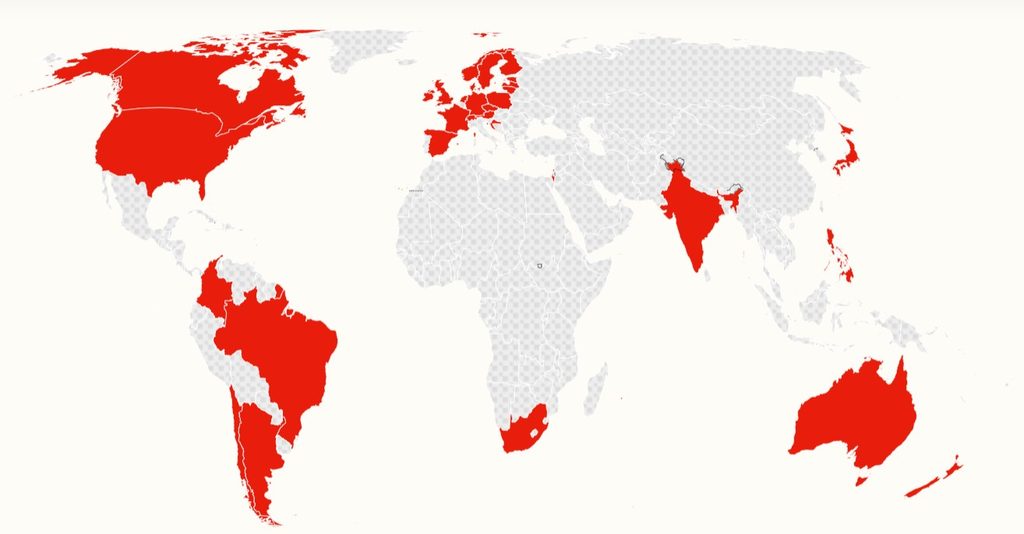
According to Newsweek’s global tracking report, governments actively advising citizens on emergency preparedness and food stockpiling span six continents:
- Europe: United Kingdom, Ireland, France, Germany, Netherlands, Denmark, Norway, Sweden, Finland, Estonia, Latvia, Lithuania, Poland, Czech Republic, Austria, Switzerland, and Croatia.
- North America: United States, Canada, and Mexico.
- South America: Chile, Colombia, Argentina, and Brazil.
- Africa: South Africa.
- Asia: Japan, Taiwan, Israel, India, Philippines, and Singapore.
- Oceania: New Zealand and Australia.
The Emergency Stockpiling Checklist (For Every Household)
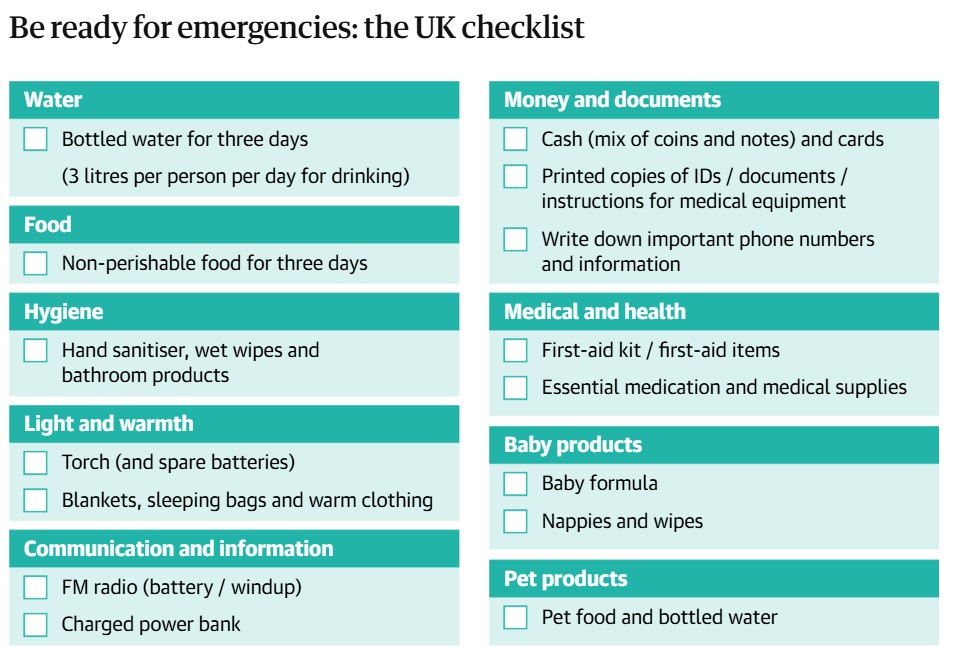
Although recommended durations (from 3 to 10 days) vary by region, the essential items inside an “Emergency Kit” are remarkably consistent across governments. Based on the UK’s Be Ready campaign, the U.S. Ready.gov checklist, and expert resilience guidance, every household should prepare the following five categories:
1. Water: The Absolute Priority
Humans can survive for weeks without food, but only about three days without water. A power outage immediately disables municipal water pumping stations.
- Basic Drinking Supply: Store at least 3 liters of bottled water per person per day for drinking (9 liters per person for a 72-hour period).
- Household Sanitation Water: Store additional water containers for cooking and basic personal washing.
- Independent Filtration: Maintain rain collection setups and water filtration tablets to purify non-potable water if bottled reserves run dry.
2. Non-Perishable Food
Power grid failures render refrigerators and electric induction stoves inoperable.
- Stockpile canned goods (such as beans, soup, canned meat, and fish), nuts, dry cereals, high-calorie energy bars, and peanut butter.
- Prioritize nutrient-dense foods with a 2-to-5-year shelf life that require no cooking or heating.
3. Light, Energy, and Warmth
During cyber-attacks or storm-induced grid blackouts, maintaining warmth and device power is vital:
- Lighting: Flashlights (torches) with plenty of spare batteries. Avoid draining your smartphone battery by using its built-in flashlight.
- Power: Fully charged high-capacity power banks to keep essential communication devices running.
- Warmth: Blankets, thermal sleeping bags, and warm clothing for all family members in case central heating systems fail during winter.
4. Communication, Finance, and Documents
- Information Reception: A battery-powered or hand-crank (wind-up) FM radio. When cellular and internet networks collapse (such as during the T-Mobile SOS outage), FM radio broadcasts remain the sole channel for receiving official government instructions.
- Finance: Cash (a mix of banknotes and coins) alongside physical cards, in case electronic payment terminals and ATMs go offline.
- Documents: Printed copies of identification cards, passports, insurance documents, instructions for medical equipment, and a handwritten list of emergency phone numbers.
5. Medical, Hygiene, and Special Needs Supplies
- Medical & Health: A complete first-aid kit alongside essential prescription medications and medical supplies.
- Hygiene: Hand sanitizer, wet wipes, and bathroom products in case water-flushed toilets stop working.
- Infants & Pets: Baby formula, diapers (nappies), and wipes for infants; dry pet food and separate bottled water for pets.
Germany’s ten-day rule: the strictest civilian guidance
Germany’s Federal Office of Civil Protection and Disaster Assistance, the BBK, recommends being able to supply yourself for ten days.
That phrasing matters, and it is widely reported incorrectly. English coverage often says Germany recommends “up to ten days”, which implies a ceiling. The BBK means the opposite: ten days is the target to work toward.
The agency pairs it with a second sentence that almost no coverage quotes, and it is the more useful one:
A stock for at least three days already helps a great deal, and it can be built up step by step.
This reframes the whole exercise. The official advice is not “assemble a ten-day bunker this weekend”. It is “start with three days, then extend”. For most households that is the difference between acting and doing nothing.
The BBK publishes a free guide, Vorsorgen für Krisen und Katastrophen, along with a printable checklist.
Why are they saying to prepare for 90 days?
This figure circulates widely and is almost always misattributed. The 90-day standard comes from the Pentagon’s FORTRESS initiative and applies to military installations, which are expected to operate without external resupply for that long.
No government anywhere is asking private households to hold 90 days of food. Civilian guidance tops out at Germany’s ten days.
The confusion is understandable, because the two numbers appear in the same news cycle. But a base with fuel reserves, generators and its own water treatment is solving a different problem from a flat with a kitchen cupboard.
Why are people stocking up on food in some countries and not others?
The pattern is not random, and it is not about which countries face the most danger. It tracks two things: recent experience, and whether the state has a civil defence tradition that survived the end of the Cold War.
Finland, Sweden and Norway never dismantled theirs. Public shelters, stock rotation and household guidance stayed in place through decades when the rest of Europe treated them as relics. Advice there reads as routine because it never stopped.
Germany rebuilt its guidance after major flooding exposed gaps in warning systems. Japan’s preparedness culture is built on earthquakes rather than conflict. Cape Town’s municipal advice came out of a near-total water shortage, not a security threat.
Countries without a recent domestic shock tend to publish thinner guidance, and their populations react more sharply when it appears. That is why identical advice lands as unremarkable in Helsinki and as alarming elsewhere.
Social Significance: From Fear to Self-Reliance
Publicly launching a stockpiling campaign carries political risks, as governments have historically been reluctant to be accused of scaremongering. In the UK, public warning campaigns are rare; a 1980 Cold War campaign titled Protect and Survive advised citizens on how to build a home bomb shelter and store 14 days of food to survive a nuclear war.
However, the 2026 campaign carries a pragmatic message. UK Security Minister Dan Jarvis stressed that “those who can follow this advice should follow this advice,” describing it as “simple steps to be ready for everyday emergencies” as part of a community-oriented effort “to improve our resilience as a nation.”
When a major crisis strikes—whether from natural disasters or hostile sabotage—state emergency services (police, fire brigades, and medical responders) are stretched to their absolute limits. By encouraging capable households to sustain themselves for the first 72 hours, governments can concentrate critical rescue resources on society’s most vulnerable citizens, including the elderly, the disabled, and hospital patients. Preparing a 3-day supply of food, water, and an FM radio is no longer extreme “doomsday prepping”—it is a practical civic responsibility in an era of unpredictable global disruptions.
Frequently asked questions
Why are people stocking up on food and water?
Mostly because national civil protection agencies have asked them to. Germany advises ten days of supplies, the UK and most other countries 72 hours. The advice reflects infrastructure vulnerability, cloud and payment system fragility, and more frequent extreme weather.
Which country recommends the most?
Among civilian guidance, Germany, at ten days. Sweden and Norway advise about a week. Most others, including the UK, France, Canada, Japan and Australia, use a 72-hour baseline.
Why are countries telling people to stockpile at the same time?
Partly coordination. The European Commission’s Preparedness Union Strategy pushed member states to align and publicise civil protection advice, so several national campaigns launched close together. That clustering makes long-standing guidance look like a sudden warning.
How much water do I actually need?
At least three litres per person per day for drinking, so nine litres per person for 72 hours. Cooking and basic hygiene require more on top of that.
Should I be worried?
The guidance itself is not a warning about a specific threat. It is standing advice, published openly and updated during calm periods. Building up a three-day supply gradually is the step the agencies themselves recommend starting with.
Sources
- BBK, Germany: Vorsorge (civil protection guidance) — the ten-day recommendation and official guide.
- BBK: So können Sie sich vorbereiten — the detailed German food, water and documents lists.
- Ready.gov, US Department of Homeland Security — US household preparedness guidance.
- UK Cabinet Office, “Be Ready” campaign — the 72-hour standard and UK checklist.
A German-language version of this guide, with the full BBK list, is available at warum Regierungen zur Vorratshaltung auffordern.