
Last Updated on 4 months ago by TodayWhy Editorial
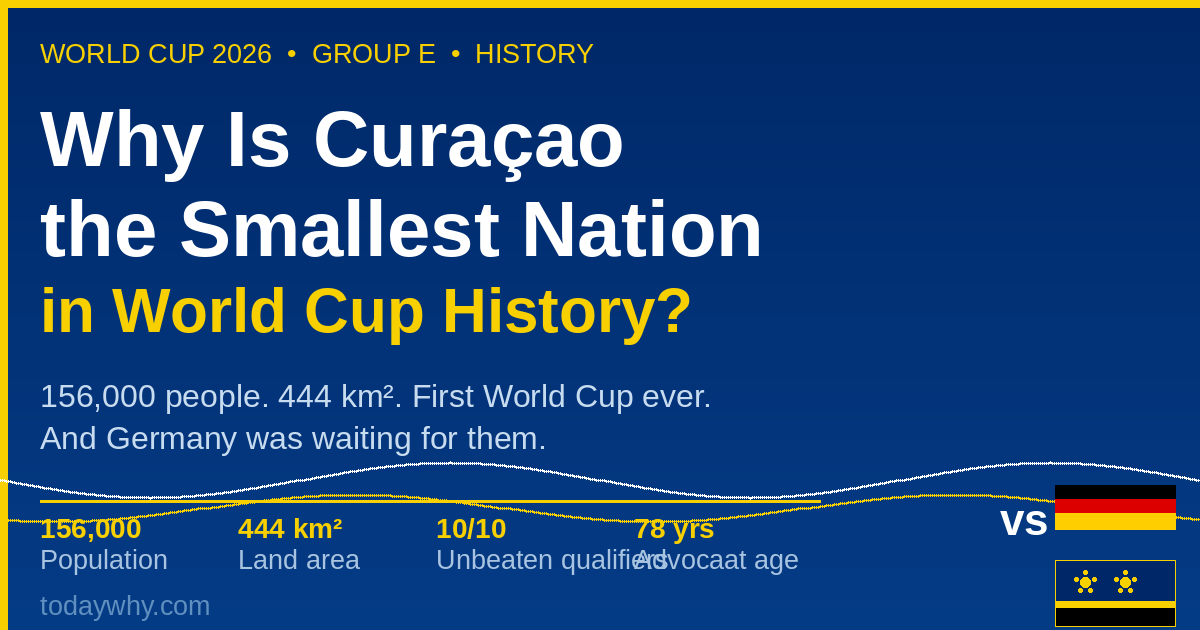
On June 14, 2026, at NRG Stadium in Houston, Texas, a Caribbean island of 156,000 people walked onto the same pitch as one of the most successful footballing nations in history. Germany have won four World Cups. Curaçao has never played in one before.
That contrast — 83 million people against 156,000; four world titles against zero appearances — is the most dramatic mismatch in the tournament’s history. But the more interesting question is not about the score. It is about how Curaçao got there at all, and what their presence says about the modern game.
The Numbers That Put Everything in Perspective
Curaçao is a Caribbean island located approximately 65 kilometres north of Venezuela. It covers 444 square kilometres — smaller than many cities — and has a population of approximately 156,000 people. To put that in context:
- India and China — combined population of nearly 3 billion — have never qualified for a World Cup together
- The previous record for smallest nation at a World Cup was held by Iceland, with 350,000 people at Russia 2018 — more than twice Curaçao’s population
- 156,000 people is roughly the population of Cambridge, England, or Tallahassee, Florida
- Germany, their opening opponent, has a population 531 times larger
According to FIFA’s official team profile, Curaçao are also the smallest nation by land area to have ever qualified — a double record that may stand for a very long time.
How Curaçao Actually Qualified
Curaçao’s path to the World Cup was not a lucky accident. It was a systematic, unbeaten campaign through CONCACAF qualifying that left no room for doubt.
Their journey began in the second round of CONCACAF qualification, where they swept through a group containing Barbados, Aruba, Saint Lucia, and Haiti — scoring 15 goals and conceding just three across eight matches. That form earned them a place in the decisive third round, where the stakes were far higher.
In Group B of the final qualifying round, Curaçao faced Jamaica, Trinidad and Tobago, and Bermuda. Jamaica — led by former England manager Steve McClaren — were the favourites. Curaçao needed to finish in the top two to qualify automatically.
They finished first.
The decisive moment came on November 18, 2025, in Kingston. Jamaica needed to win to qualify. Curaçao needed only a draw. Despite Jamaica striking the woodwork three times in the second half, and a stoppage-time penalty awarded to the home side — and then overturned by VAR — the scoreline remained 0-0. Curaçao had done it.
There was one more extraordinary detail: head coach Dick Advocaat was not on the touchline. He had returned to the Netherlands for a family emergency. His assistant managed the team that night. The qualification held regardless.
The Dutch Connection: Why 25 of 26 Players Were Born in the Netherlands
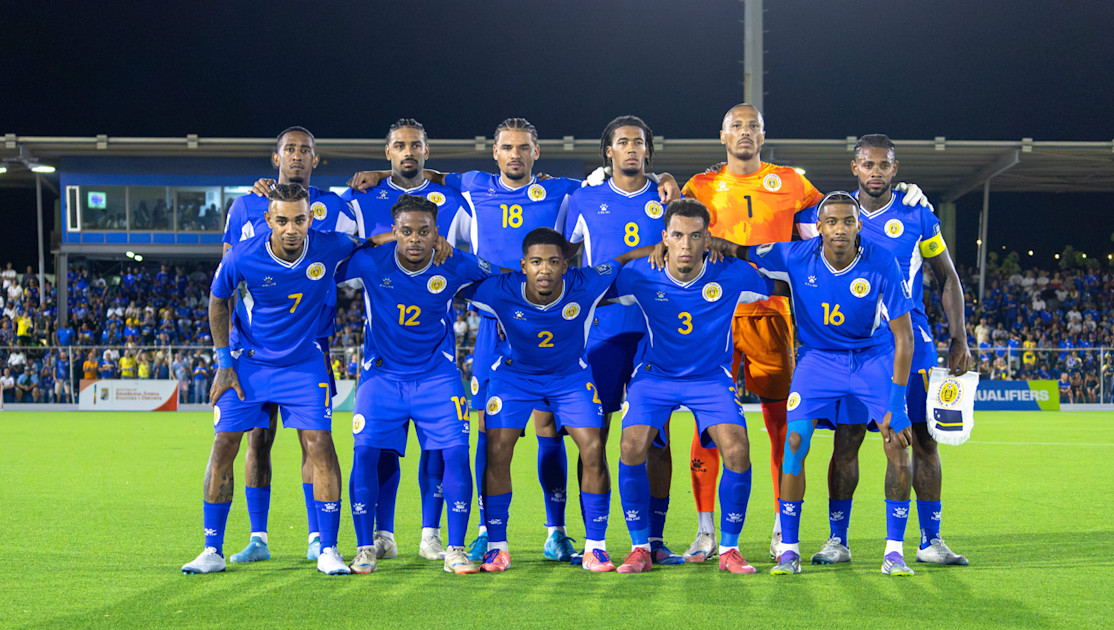
One of the most striking facts about Curaçao’s World Cup squad is that 25 of the 26 players were born in the Netherlands — not on the island itself. The sole exception is Tahith Chong, who was born in Willemstad, Curaçao’s capital, before moving to the Netherlands as a child.
This is not a quirk. It is the logical result of a century of political and cultural entanglement between the island and its European partner.
Curaçao is an autonomous territory within the Kingdom of the Netherlands. Until 2010, it was part of the Netherlands Antilles — a political entity dissolved when Curaçao and Sint Maarten gained individual autonomous status. The island uses the Dutch language in government and education, and its residents hold Dutch passports. Movement between Curaçao and the Netherlands is unrestricted.
For generations, the island’s most talented footballers made a well-worn journey: grow up on Curaçao, move to the Netherlands in their teens, develop through Dutch academy systems, play in the Eredivisie or across European leagues. The result is a player pool that is technically Dutch-developed but nationally Curaçaoan.
According to Opta Analyst, 11 of the 26 players in Curaçao’s World Cup squad play in the Eredivisie. Others are based in England, Turkey, Israel, and Malaysia. The squad is, in effect, a Caribbean-rooted diaspora team playing through the Dutch football infrastructure.
Dick Advocaat: The Oldest Coach in World Cup History
The man who built this squad and guided it to qualification is Dick Advocaat — a 78-year-old Dutch manager whose career spans five decades and three continents.
At the 2026 World Cup, Advocaat broke the record for the oldest head coach in tournament history, surpassing Otto Rehhagel, who was 71 when he led Greece at the 2010 World Cup in South Africa. More remarkably, this is Advocaat’s third World Cup with a third different national team: the Netherlands in 1994 (quarterfinals), South Korea in 2006, and now Curaçao in 2026.
His connection to Curaçao began in January 2024, when the federation — having spent years building the squad’s infrastructure — brought in Advocaat to provide World Cup-level experience at a critical moment. Within two years, he had delivered something the island had never achieved.
“I consider qualifying the smallest country in the world for the World Cup one of the highlights of my career,” Advocaat said when he temporarily stepped away from the role in February 2026.
The Coaching Drama That Nearly Derailed Everything
Between qualification and the World Cup, Curaçao endured a coaching crisis that tested the squad’s cohesion at the worst possible moment.
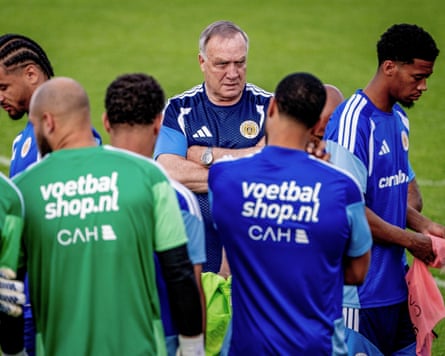
In February 2026, Advocaat resigned. His daughter was experiencing serious health problems, and he chose family over football — a decision he announced publicly and without ambiguity. His compatriot Fred Rutten, a 63-year-old Dutchman with experience at PSV, Feyenoord, and Schalke 04, was appointed as his successor.
Rutten’s tenure lasted four months. Under his management, Curaçao lost 5-1 to Australia and 2-0 to China in March friendlies — results that triggered significant internal tension. Players reportedly pushed for Advocaat’s return. The federation’s main sponsor made its continued financial backing conditional on it.
On May 11 — less than five weeks before the World Cup opener against Germany — Rutten resigned, citing his desire to avoid “a climate that harms healthy professional relationships.” The following day, Advocaat was confirmed as returning.
It was a soap opera compressed into three months. But the squad, when asked about it, were characteristically direct. “I don’t even care who’s going to lead us,” one player told CBS Sports. “We’re going to the World Cup.”
The Players: From Manchester United to the World Cup
Curaçao’s squad is built around a group of players who have spent their careers in mid-tier European football, without the glamour of Champions League appearances but with the technical grounding of professional development in the Netherlands and England.
Leandro Bacuna is the captain and the longest-serving member of the squad. He holds the national team appearance record (68 caps) and spent a decade in English football with Aston Villa, Reading, Cardiff City, and Watford before moving to Turkey. At 34, he is both the experience and the identity of the side.
His younger brother Juninho Bacuna brings a different quality — more direct, with three goals in qualifying. Between them, the Bacuna brothers have scored more than 30 goals for Curaçao. They are the heartbeat of the midfield and the bond that holds the squad together.
The most recognisable name for English football fans is Tahith Chong. Born in Willemstad, Curaçao, Chong came through Manchester United’s academy, making his Premier League debut at 19. He has since played for Club Brugge, Birmingham City, and Sheffield United. In August 2025, he switched international allegiance from the Netherlands to Curaçao — and scored twice in his debut qualifying appearance against Bermuda. He is 26, technically sharp, and the player most likely to create something unexpected against a high-quality defence.
Goalkeeper Eloy Room, who plays in the MLS, is one of the most experienced shot-stoppers in CONCACAF and the last line of a defence that conceded just three goals in the entire qualifying campaign.
Video: Curaçao 2026 World Cup SPOTLIGHT | SMALLEST Nation, BIGGEST Dream
Why Germany Was Waiting for Them First
The draw that placed Curaçao in Group E alongside Germany, Ivory Coast, and Ecuador was, by any measure, about as difficult a group as the smallest nation in World Cup history could have received.
Germany are four-time world champions. They have appeared at 21 consecutive World Cups — a record of consistency unmatched in football history. They have never failed to reach the second round in any tournament before 2018, when a catastrophic group-stage exit in Russia triggered a period of rebuilding under Julian Nagelsmann.
For Germany, this World Cup is a statement of recovery. For Curaçao, it is a statement of arrival.
Germany had never played Curaçao before June 14, 2026. No head-to-head history, no psychological reference point. For a team making their first World Cup appearance, that is not necessarily a disadvantage. They have nothing to lose and a script that no one has written yet.
The population ratio between the two teams on that pitch in Houston — roughly 531 to 1 in Germany’s favour — is the largest between any two nations ever to meet at a World Cup. The scoreline, whatever it turns out to be, is secondary to the fact of the meeting itself.
Curaçao’s story did not depend on the result against Germany. It was already written the moment a 0-0 draw in Kingston sent an island of 156,000 people to the biggest tournament in sport.
Frequently Asked Questions
Why is Curaçao the smallest nation in World Cup history?
Curaçao qualified for the 2026 World Cup with a population of approximately 156,000 — less than half the previous record held by Iceland (350,000 in 2018). They earned their place by finishing first in their CONCACAF qualifying group, going unbeaten across 10 matches. The expansion of the tournament to 48 teams opened new pathways, but Curaçao’s campaign went far beyond lucky timing.
How did Curaçao qualify for the 2026 World Cup?
Curaçao qualified by finishing top of CONCACAF Group B, winning seven of ten matches and conceding just three goals throughout. They secured qualification with a 0-0 draw against Jamaica in Kingston on November 18, 2025 — despite head coach Dick Advocaat being absent due to a family emergency.
Who is Dick Advocaat and why is he significant for Curaçao?
Dick Advocaat is a 78-year-old Dutch manager who guided Curaçao through qualification. At the 2026 World Cup, he became the oldest coach in World Cup history, surpassing the previous record of 71 years set by Otto Rehhagel with Greece in 2010. He also became the first person to coach three different nations at three different World Cups: the Netherlands (1994), South Korea (2006), and Curaçao (2026).
Why do 25 of Curaçao’s 26 players come from the Netherlands?
Curaçao is an autonomous territory within the Kingdom of the Netherlands. For generations, the island’s best footballers moved to the Netherlands to develop through Dutch academy systems. The arrangement allows players with Curaçaoan heritage to represent the island internationally even if born and raised in the Netherlands.
Who are Curaçao’s best players at the 2026 World Cup?
Key players include captain Leandro Bacuna (former Aston Villa midfielder), his younger brother Juninho Bacuna, and Tahith Chong — the only Curaçao-born player in the squad, who came through Manchester United’s academy. Together the Bacuna brothers have scored over 30 international goals.
What group is Curaçao in at the 2026 World Cup?
Curaçao are in Group E alongside Germany, Ivory Coast, and Ecuador. They opened the tournament against Germany on June 14 in Houston, followed by Ecuador (June 20, Kansas City) and Ivory Coast (June 25, Philadelphia).