
Last Updated on 3 months ago by TodayWhy Editorial
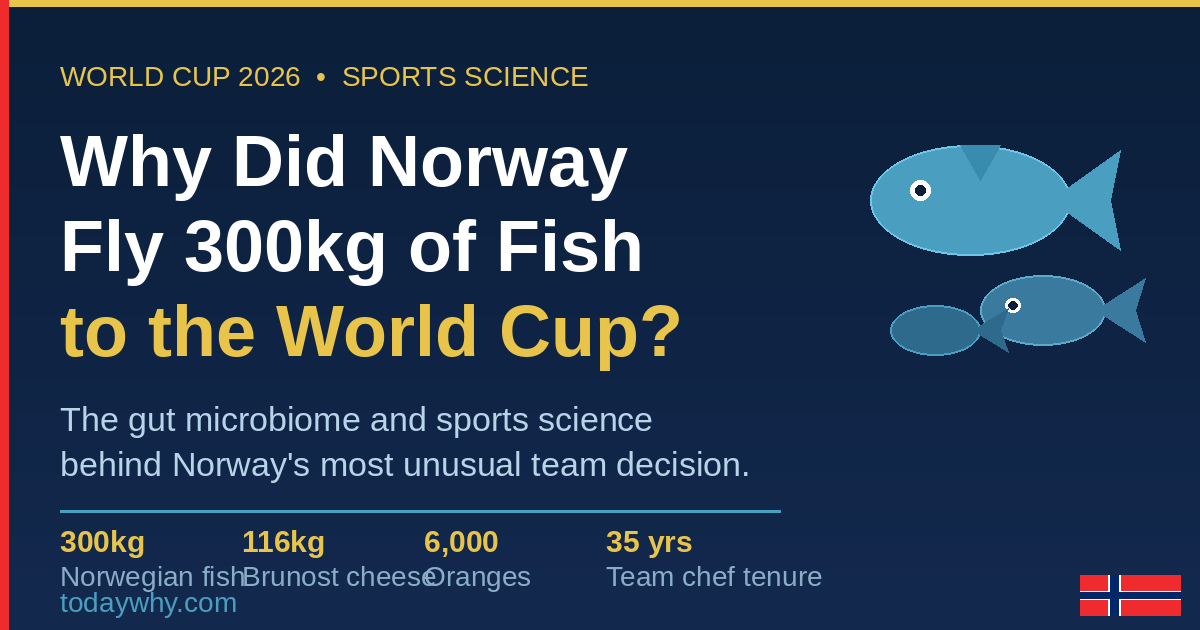
When Norway’s squad landed in Greensboro, North Carolina ahead of the 2026 FIFA World Cup, they did not arrive like most football teams. Alongside the tactical dossiers, training kits, and medical equipment came something considerably more unusual: approximately 300 kilograms of fish, 116 kilograms of traditional Norwegian brown cheese, and 6,000 oranges — a combined food shipment exceeding one metric ton.
The story, first reported by Norway’s largest newspaper VG (Verdens Gang), quickly became one of the more memorable pre-tournament headlines. Social media reacted with a mix of amusement and admiration. But strip away the novelty, and what Norway did is not a quirky PR stunt. It is a precise, science-backed intervention — and it tells you something important about how elite football has changed.
The Shipment: What Norway Actually Brought
According to VG, the Norwegian Football Federation coordinated the transport of the following to their base camp in Greensboro, North Carolina:
- ~300kg of red fish (Norwegian rødfisk — primarily salmon and similar cold-water species)
- 116kg of brunost — Norway’s iconic caramelized brown cheese, made from whey
- 6,000 oranges
- Two professional chefs, including a Culinary Olympics gold medalist
The total food package exceeds 1,000kg once the oranges are included. It was flown across the Atlantic on dedicated freight.
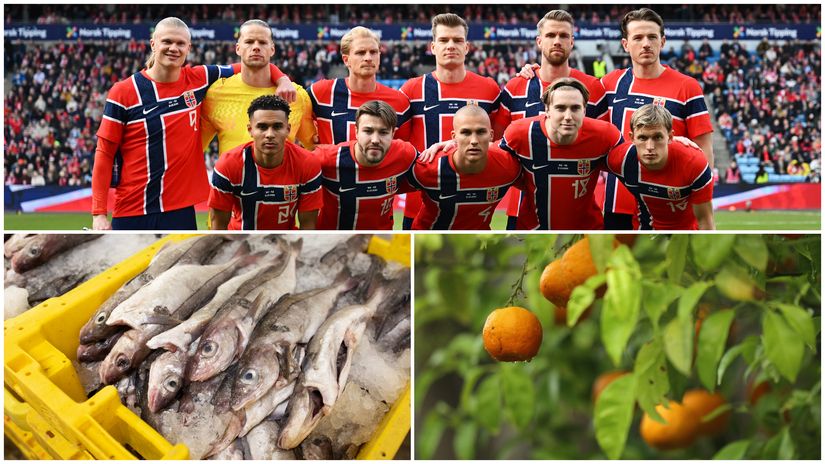
Three chefs are travelling with the squad. Heading the operation is Christian Karlsson, who has been the Norwegian national team’s cook since Ståle Solbakken himself was a player in the 1990s — a tenure of more than three decades. Joining him are Aron Espeland and Eirik Tufte, both recruited from Norway’s national culinary team (kokkelandslaget) specifically for this tournament. Together, they will prepare four meals a day for more than 60 people throughout the competition — potentially running into July if Norway advances deep into the knockout stages.
Espeland, a gold medallist at the Culinary Olympics in 2020, told VG that the team expects to work through all 300kg of fish before the tournament ends. “Being able to serve it when it really matters is something we take pride in,” he said. Planning began as early as November 2025.
Norway is playing in Group I, which opens on June 16 against Iraq at Gillette Stadium in Foxborough, Massachusetts. They face France and Senegal in their remaining group matches. It is their first World Cup appearance since 1998 — a 28-year wait.
Why Fish, Specifically?
The choice of fish as the centrepiece of Norway’s food operation is not sentimental. Cold-water fatty fish — salmon, trout, mackerel, herring — are among the most nutritionally dense foods available to an elite athlete, and the physiological case for prioritising them during a compressed tournament schedule is substantial.
The key compound is omega-3 fatty acids, specifically EPA (eicosapentaenoic acid) and DHA (docosahexaenoic acid). These are found in high concentrations in exactly the type of Norwegian red fish that landed in North Carolina.
Research published in Cureus (2025) and indexed by the National Institutes of Health found that omega-3 supplementation significantly reduced creatine kinase levels — a key marker of muscle damage — in the days following intense eccentric exercise. In practical terms: players who maintain adequate omega-3 intake recover faster between matches.
The Gatorade Sports Science Institute has published a dedicated review on omega-3 for athletes, noting that EPA and DHA are incorporated into skeletal muscle cell membranes, where they upregulate signalling pathways that control muscle tissue remodelling. The anti-inflammatory properties of omega-3 fatty acids, the review notes, provide “reasonable rationale to explore the efficacy of O3FA to accelerate the muscle repair process” during competitions involving two to four day intervals between matches — exactly the timeline Norway faces at this World Cup.
In a tournament where Norway could play up to seven games in approximately four weeks, the cumulative effect of better recovery between matches is not a marginal gain. It compounds.

The Gut Microbiome Problem No One Talks About
Beyond omega-3 content, the deeper reason to maintain a familiar diet during international travel is one that receives surprisingly little public attention: gut microbiome stability.
Every person carries a unique population of trillions of microorganisms in their digestive tract. This microbiome takes years to establish and is highly sensitive to sudden dietary change. When an athlete shifts abruptly from their habitual diet to unfamiliar food — different protein sources, different cooking oils, different fibre profiles, different bacteria on local produce — the microbiome can be disrupted within days.
A review published in Advances in Nutrition by researchers at the University of Illinois found that abrupt dietary changes of the kind typical during international tournaments can negatively affect gut microbiota composition, gastrointestinal function, and immune regulation — all of which feed directly into athletic performance. The review concluded that “fueling your microbes” should be treated as a deliberate performance strategy, not an afterthought.
The consequences of gut disruption during competition are well-documented: increased risk of gastrointestinal illness, impaired nutrient absorption, reduced energy availability, and compromised immune function. Any one of these is a serious problem. All of them together — in the week before a World Cup group stage opener — would be a disaster.
Norway’s fish shipment is, in part, a gut microbiome protection strategy. By ensuring the squad eats food that is chemically and microbiologically familiar, the medical and nutrition staff are insulating players from one of the most underappreciated risks of tournament football: getting sick in week two because of what you ate in week one.
The Psychological Dimension: Routine as a Competitive Edge
There is a third factor in Norway’s calculation that sits outside the laboratory: psychology.
Elite sport has increasingly recognised that an athlete’s cognitive load — the mental energy consumed by processing unfamiliar environments — directly affects performance. When a player is comfortable, well-fed on food they recognise, sleeping in a space that feels settled, and following routines they have followed for years, their brain can dedicate more of its available resources to the game. When they are not comfortable, those resources are quietly redirected toward managing discomfort.
This is not an abstract concept. Research in sports psychology has established that perceived control over one’s environment is a significant predictor of pre-competition anxiety. Food is one of the most immediate and emotionally resonant expressions of that control. A meal that tastes like home, prepared by chefs who have spent months planning every detail of this operation, is not just calories. It is a signal to the nervous system that says: this situation is under control.
For a squad returning to the World Cup after 28 years away — with Erling Haaland playing on the biggest stage of his international career — the value of that signal should not be underestimated.
The Three Men Behind the Menu
The anchor of Norway’s food operation is Christian Karlsson, who has served as the national team’s chef since Ståle Solbakken was still a player in the squad in the 1990s. His institutional knowledge is unmatched: he knows how individual players eat, how their appetites and preferences shift across the stages of a tournament, and how to maintain quality and consistency across an unfamiliar kitchen for weeks at a time.
For this World Cup, Karlsson is joined by two chefs recruited from Norway’s national culinary team: Aron Espeland and Eirik Tufte. Espeland won a gold medal at the Culinary Olympics in 2020 and is the restaurant director at the critically acclaimed Cru in Oslo. But there is another detail that makes his involvement particularly fitting: Espeland grew up in Bryne — the same small town on the west coast of Norway where Erling Haaland grew up. He and Haaland are, in the most literal sense, products of the same place.

The three of them are responsible for four meals a day for more than 60 people — players, coaches, medical staff, and support personnel — throughout a competition that could run deep into July. Planning for the operation started in November 2025, four months before a ball was kicked. Espeland told VG: “Vi er litt sære” — “We’re a bit peculiar.” It is the kind of peculiar that wins gold medals and, Norway hopes, football matches.
If the fish runs out before the tournament ends, it will mean Norway are still playing. That is the whole point.
Norway Is Not Alone — This Is Now Standard Practice
Norway’s food shipment has attracted attention because the numbers are striking. But the underlying strategy — importing familiar food to protect players from dietary disruption during major tournaments — is now standard among elite national programmes.
Japan’s national teams have long been known to travel with specialist rice varieties and miso products, given the difficulty of sourcing equivalent quality outside East Asia. Several Gulf national teams incorporate halal-certified local staples that cannot be reliably sourced abroad. South Korea’s programmes have historically ensured access to kimchi and fermented foods that form the core of the players’ habitual diets.
What has changed in recent years is the scientific framework that underlies these decisions. Where food logistics were once driven primarily by cultural preference or player comfort, they are increasingly planned by nutritionists and sports medicine professionals who treat the gut microbiome as a performance variable — because the evidence now supports doing exactly that.
Norway’s operation represents the most publicly visible example of this shift, but it is the direction the entire sport is moving.
Why It Matters More for Norway Than Almost Anyone Else
Context matters here. This is not a programme with deep World Cup experience and an established infrastructure for managing tournament life. Norway last appeared at a World Cup in France in 1998. The squad that travelled to Greensboro this month is the first Norwegian generation in 28 years to have this experience — and they arrived there on the back of an almost flawless qualifying campaign: eight games played, eight won, 37 goals scored, with Haaland personally accounting for 16 of them.
That qualification record sets expectation. It also means Norway cannot afford self-inflicted problems. Every controllable variable — travel recovery, sleep, training load, match preparation — is being managed with unusual precision. Food is one of the most controllable variables in a football player’s environment. Managing it aggressively is not excessive. It is proportionate to the stakes.
If Norway advances from Group I — which requires navigating France, Senegal, and Iraq — the 300kg of fish will begin to look less like a curiosity and more like an early chapter in a serious sporting story.
And if Espeland runs out of fish before the tournament ends, it will mean Norway are still playing. That is the whole point.
Frequently Asked Questions
Why did Norway bring 300kg of fish to the 2026 World Cup?
Norway’s medical and nutrition staff wanted to maintain the players’ familiar diet to avoid disrupting their gut microbiome and psychological routines during a high-pressure tournament played far from home. Sudden dietary changes can impair digestion, energy levels, and recovery — all of which directly affect match performance.
What food did Norway bring to the 2026 World Cup?
According to Norwegian newspaper VG, Norway shipped approximately 300kg of red fish, 116kg of brunost (traditional Norwegian brown cheese), and 6,000 oranges to their base camp in Greensboro, North Carolina — a total food load exceeding 1,000kg.
Who is the chef cooking for Norway at the 2026 World Cup?
Three chefs are travelling with the squad. Christian Karlsson has served as the national team’s cook since the 1990s and leads the operation. He is joined by Aron Espeland — a Culinary Olympics gold medallist (2020) who grew up in the same town as Erling Haaland — and Eirik Tufte, restaurant director at Oslo’s critically acclaimed Cru. All three began planning the World Cup menu in November 2025.
Does fish really improve athletic performance?
Yes. Fatty fish is rich in omega-3 fatty acids (EPA and DHA), which have been shown in multiple peer-reviewed studies to reduce exercise-induced inflammation, support faster muscle recovery, and help maintain gut microbiome stability — all key factors during a compressed tournament schedule.
Are other national teams doing the same thing at the 2026 World Cup?
Yes. Importing familiar home foods for tournament camps is now standard practice among elite national teams. Japan is known to bring specialist rice and miso supplies; several Gulf programmes ensure halal-certified local staples are available. Norway’s operation is more visible due to its scale and the specific nature of the shipment.
When does Norway play its first game at the 2026 World Cup?
Norway opens their 2026 World Cup campaign against Iraq on June 16 at Gillette Stadium in Foxborough, Massachusetts. They are placed in Group I alongside France, Senegal, and Iraq.