
Last Updated on 2 months ago by TodayWhy Editorial
Quick Answer: If you are wondering why is the moon so low tonight, the phenomenon is driven by a combination of seasonal orbital geometry and a famous optical illusion. During late spring and summer, a full moon sits directly opposite the high daytime Sun along the ecliptic plane, forcing it to follow an exceptionally low arc across the night sky. This physical position is then dramatically enhanced by the NASA-documented Moon Illusion
—a psychological effect where your brain misinterprets the horizon moon as giant and close when framed against trees, buildings, and distant landscapes. For more in-depth astronomical explainers, explore our Tech & Science section on TodayWhy.
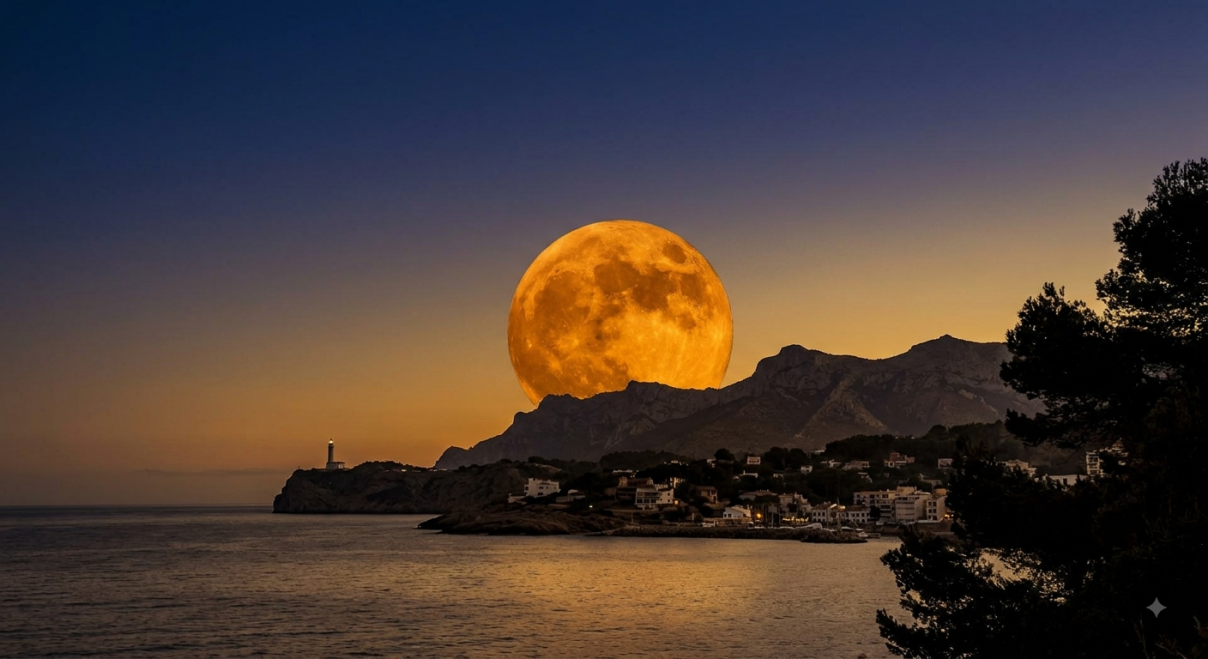
Stepping outdoors, glancing toward the horizon, and asking why is the moon so low tonight is a shared human experience that spans generations. On certain evenings, the full moon appears to barely skim the tops of trees, city skylines, or distant mountain ridges, glowing with a rich, amber hue and looking unnaturally massive.
While it is easy to assume that something unusual is happening in space, this breathtaking sight is actually a regular, predictable event. Understanding why is the moon so low tonight requires examining three distinct scientific disciplines: celestial mechanics (how Earth and Moon orbit), atmospheric optics (how air bends and filters light), and cognitive psychology (how the human brain interprets visual scale).
1. The Astronomical Science: Orbital Geometry and Seasonal Tilts
The fundamental physical reason behind why the moon is so low in the sky tonight comes down to geometry—specifically, the relationship between Earth’s axial tilt, the Sun’s path, and the Moon’s orbit around our planet.
The Opposites Principle of Full Moons
To understand lunar elevation, one must first understand how full moons work. A full moon occurs only when the Moon is positioned directly opposite the Sun in relation to Earth. This spatial alignment creates a strict celestial rule: whatever the Sun does during the day, the full moon does the exact opposite at night.
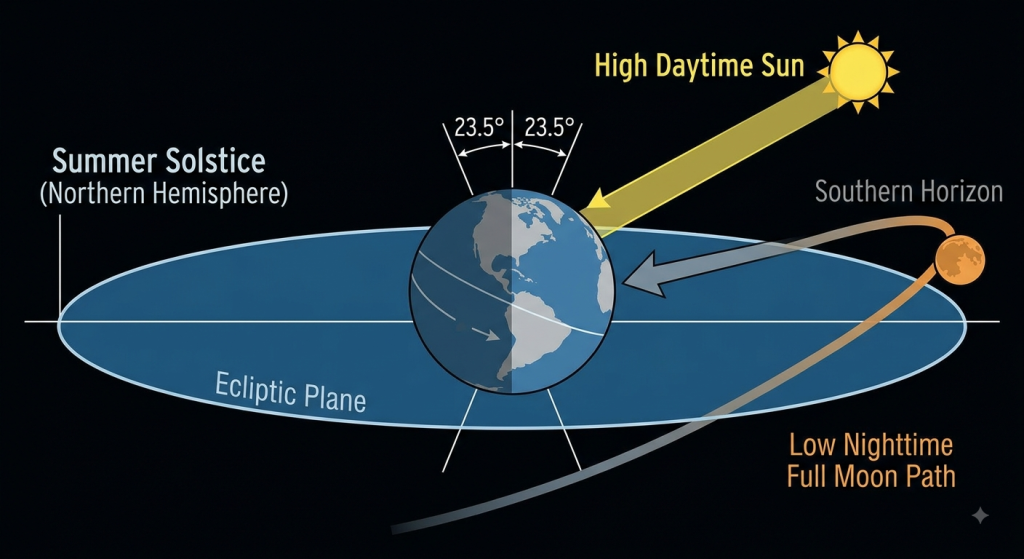
- Summer Alignment: During late spring and summer in the Northern Hemisphere, Earth’s North Pole tilts toward the Sun. This causes the Sun to climb very high in the daytime sky, tracing a long, tall arc from east to west. Because the full moon must sit opposite the Sun along the ecliptic plane (the flat disk of the solar system), it is forced to stay extremely low in the southern sky throughout the night.
- Winter Alignment: During winter, the reverse occurs. The Sun stays very low in the sky during short winter days. Consequently, winter full moons travel across the absolute highest points of the night sky, sometimes shining almost directly overhead at midnight.
- Equinox Alignment: Around the spring and autumn equinoxes, the Sun and full moon take intermediate, balanced paths through the sky.
If you are observing a full moon during the warmer months and wondering why is the moon so low tonight, you are seeing the direct consequence of this celestial symmetry. You can read more about how seasonal alignments impact daily phenomena on TodayWhy World News & Science.
The Ecliptic Plane and Axial Tilt
Earth does not sit upright relative to its orbit around the Sun; it is tilted on its axis by approximately 23.5 degrees. Furthermore, the Moon’s orbital path around Earth is inclined by another 5.1 degrees relative to the ecliptic plane.
When these two tilts align in specific ways, the moon’s maximum altitude above the horizon can vary even more dramatically. According to NASA Solar System Exploration, this 5.1-degree tilt means the moon can sometimes appear even lower—or higher—than the Sun ever reaches at its seasonal extremes.
The 18.6-Year Lunar Nodal Cycle
Adding another layer to lunar mechanics is the 18.6-year lunar standstill cycle (also known as a lunar stagnation). Because the Moon’s orbit wobbles over an 18.6-year period, there are periods called major lunar standstills where the moon reaches its most extreme northern and southern rising positions. During a major standstill, summer full moons hover even lower along the horizon than usual, providing an exceptionally striking answer to anyone asking why is the moon so low tonight.
2. The Moon Illusion: Why a Low Moon Looks Unnaturally Massive
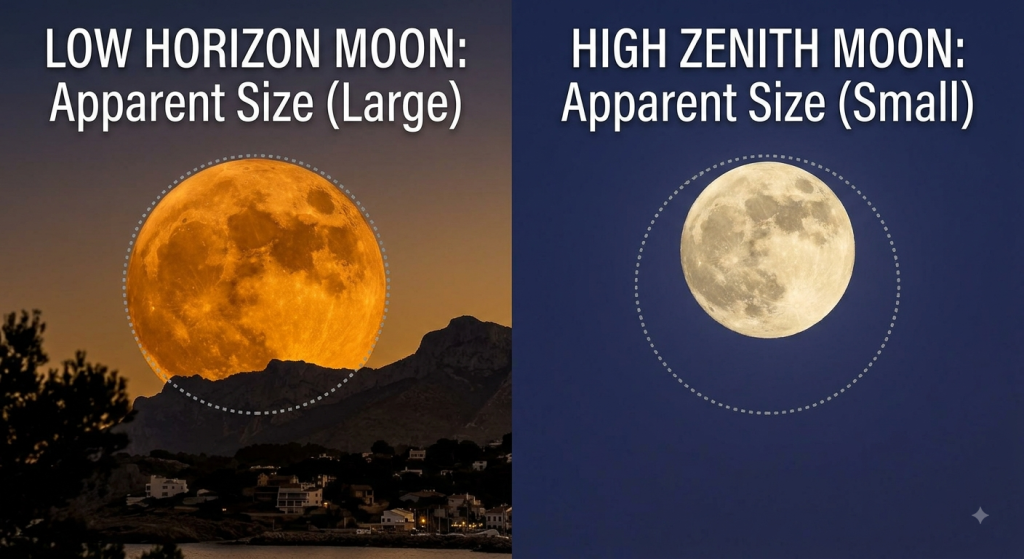
While celestial mechanics dictate where the moon sits in the sky, human psychology dictates how big it looks. One of the main reasons people search why is the moon so low tonight is that a horizon moon looks giant—often appearing two to three times larger than when it is high overhead.
Is the Low Moon Actually Closer to Earth?
Counterintuitively, no. In fact, the moon is actually slightly farther away from you when it is on the horizon than when it is high in the sky.
When the moon is directly overhead (at zenith), you are standing on Earth’s surface directly beneath it, placing you one Earth radius (about 3,959 miles or 6,371 kilometers) closer to the moon. When the moon is on the horizon, you are viewing it from the side of the planet, making it roughly 4,000 miles further away. Despite being physically further, the low moon appears significantly larger to the human eye.
Explaining the Psychological Trick
Scientists and philosophers have debated the cause of this Moon Illusion for thousands of years, dating back to Aristotle, Ptolemy, and Ibn al-Haytham. Today, cognitive psychologists attribute the illusion primarily to two theories (detailed further in research compiled by NASA’s Moon Illusion Guide):
- The Apparent Distance Theory (Spatial Context): When the moon is high overhead, it floats in an empty, featureless sky with zero visual reference points. Lacking context, your brain perceives it as a relatively small object nearby. However, when you ask why is the moon so low tonight, you are looking at a moon framed by terrestrial objects—distant mountains, trees, skyscrapers, and bridges. Your visual system knows these objects are miles away and enormous. When the moon sits directly behind a distant 500-foot building and appears larger than the building, your visual cortex automatically recalibrates the moon’s apparent physical size, rendering it gigantic.
- The Flattened Sky Dome Hypothesis: The human brain does not perceive the sky as a perfect hemisphere. Instead, we perceive the sky as a flattened bowl or shallow dome, where the horizon feels much further away than the overhead sky. Because your brain believes the horizon is further away, any object resting on the horizon that subtends the same visual angle must logically be larger than an object overhead.
Simple Experiments to Prove the Illusion
You can easily prove that the moon’s size is an optical trick using a few simple DIY tests:
- The Paper Tube Test: Roll a piece of paper into a small tube just wide enough to fit the low moon inside. Look at the low moon through the tube to block out all trees and buildings. The moon will instantly shrink back to its normal overhead size.
- The Coin or Aspirin Test: Hold a small aspirin pill or a dime at arm’s length next to the “giant” low moon. The coin will easily cover the entire disk of the moon. Do the same test six hours later when the moon is high overhead, and you will find that the coin covers the exact same amount of space.
- The Camera Reality Check: Take a photo of the low moon with a standard smartphone camera without zooming in. In the photo, the moon will look surprisingly tiny, proving that the giant appearance existed only inside your brain’s visual processing center.
3. Atmospheric Physics: Why Is the Low Moon Orange or Red Tonight?
Beyond its low position and huge size, a horizon moon almost always exhibits a deep golden, orange, or reddish glow. This color shift frequently leads people to search why is the moon so low tonight and why it looks like a glowing ember.
Rayleigh Scattering Explained
The alteration in color is caused by Rayleigh scattering—the exact same atmospheric principle explained by the National Weather Service (NOAA) that turns sunsets crimson and the daytime sky blue.
Sunlight reflected off the moon contains all wavelengths of visible light (red, orange, yellow, green, blue, and violet). As this light passes through Earth’s atmosphere, gas molecules, nitrogen, oxygen, and microscopic dust particles scatter the light waves in different directions:
- Short Wavelengths (Blue and Violet): Easily scattered away in all directions by atmospheric molecules.
- Long Wavelengths (Red, Orange, and Yellow): Pass straight through the air with minimal disruption, reaching your eyes intact.
Air Mass and Atmospheric Density
When the moon is directly overhead, its light travels through a relatively thin vertical slice of atmosphere—an air mass index of 1.0.
However, when you ask why is the moon so low tonight, its light is striking the atmosphere at a shallow angle and must travel through up to 38 times more air mass to reach your eyes. By the time this light passes through miles of dense surface air, virtually all the blue light has been scattered out, leaving only the warm red and orange tones to illuminate the lunar surface.
The Impact of Smoke, Dust, and Pollution
The orange or red hue of a low moon can become dramatically intensified by ground-level environmental conditions:
- Wildfire Smoke: Fine particulate matter (PM2.5) from regional wildfires scatters yellow light as well, leaving the moon looking blood-red or dark crimson.
- Summer Humidity & Smog: High moisture levels and urban pollution trap dust particles in the lower boundary layer, making low summer moons look distinctly amber.
- Dust Storms & Volcanic Ash: High-altitude dust clouds create intense scattering effects, creating vibrant golden horizon moons miles away from the source.
4. Comparing Lunar Phenomena: Low Moon vs. Other Lunar Events
To clearly understand why is the moon so low tonight, it helps to compare a low horizon moon against other common astronomical terms and phenomena.
| Lunar Phenomenon | Primary Cause | Visual Characteristics | Actual Physical Change? |
| Low Horizon Moon | Seasonal ecliptic geometry & Earth’s axial tilt | Sits near the horizon; looks golden/orange; appears giant due to illusion | No change in physical distance or orbit |
| Supermoon (Perigee) | Moon reaching the closest point in its elliptical orbit to Earth | Approximately 14% larger and 30% brighter than a perigee full moon | Yes, physically ~17,000 miles closer to Earth |
| Harvest Moon | Full moon closest to the autumnal equinox | Rises shortly after sunset for several consecutive nights; sits low in early fall | No change in physical size; trajectory angle creates early moonlight |
| Blood Moon | Total lunar eclipse | Moon passes completely into Earth’s umbral shadow, turning deep red | No change in position; lit by filtered sunlight passing through Earth’s atmosphere |
| High Overhead Moon | Winter ecliptic alignment | Traverses directly overhead near zenith; looks small, bright white, and crisp | No change in size; light travels through minimal atmosphere |
5. Historical, Cultural, and Photography Perspectives
Historical Human Interpretations
Throughout history, civilizations viewed low, golden full moons with deep reverence and practical necessity.
Before the advent of electric lighting, agrarian societies depended heavily on low-hanging autumn full moons. The Harvest Moon and Hunter’s Moon hovered near the horizon right around sunset for several nights in a row, extending daytime working hours so farmers could harvest crops and hunters could track game before winter set in.
Great thinkers across history were fascinated by the question of why is the moon so low tonight and why it looks so large. Ptolemy believed Earth’s atmosphere acted like a magnifying lens (a theory later disproved by optics). Leonardo da Vinci and René Descartes correctly deduced that the size alteration was a mental projection rather than a physical change in atmospheric magnification.
Photography Tips for Capturing a Low Moon
If you step outside, see a low moon, and want to photograph it, keeping these professional tips in mind will prevent disappointment:
- Use a Telephoto Lens: Because smartphone wide-angle lenses capture a wide field of view, the moon will appear as a tiny white speck. Use a lens with a focal length of at least 200mm to 600mm to compress the perspective and capture the moon’s true detail.
- Include Foreground Elements: Frame the low moon behind recognizable objects—such as a lighthouse, city skyline, historic bridge, or mountain peak. This incorporates terrestrial context into your composition and reproduces the visual impact of the Moon Illusion in your photo.
- Shoot During Blue Hour: The best time to photograph a low moon is during “blue hour”—roughly 20 to 40 minutes after sunset. At this time, the ambient light of the sky matches the brightness of the moon, allowing your camera sensor to expose both the foreground and the lunar surface properly without blowing out details.
6. Frequently Asked Questions About Why Is the Moon So Low Tonight
Why is the moon so low tonight during summer?
During late spring and summer, the Northern Hemisphere tilts towards the Sun, pushing the daytime Sun high into the sky. Because a full moon must sit directly opposite the Sun along the ecliptic plane, summer full moons are forced to trace an exceptionally low arc across the southern horizon throughout the night.
Is the moon physically closer to Earth when it is low on the horizon?
No. In fact, a moon sitting low on the horizon is roughly 4,000 miles (one Earth radius) further away from your eyes than when it is high overhead. Its giant appearance is purely an optical illusion caused by your brain comparing the moon to distant terrestrial objects like trees and buildings.
What is the difference between a low moon and a supermoon?
A low moon refers to the moon’s altitude above the horizon, governed by seasonal geometry and Earth’s tilt. A Supermoon refers to orbital distance—specifically when a full moon occurs at perigee (the closest point in the Moon’s elliptical orbit to Earth), making it physically 14% larger and 30% brighter regardless of where it sits in the sky.
Why does the moon look orange or red when it is low?
When the moon is near the horizon, its reflected light must travel through significantly more atmospheric air mass than when it is overhead. Earth’s atmosphere scatters away short blue wavelengths of light (Rayleigh scattering), while allowing longer red and orange wavelengths to pass through to your eyes.
Does air pollution or wildfire smoke affect a low moon?
Yes. Fine particulate matter from wildfire smoke, dust, humidity, and urban air pollution enhances atmospheric scattering. Extra particles in the air filter out yellow light in addition to blue light, turning a low horizon moon a dramatic deep amber, blood-orange, or crimson red.
When will the full moon sit high in the night sky again?
As the seasons transition from summer into autumn and winter, the path of the full moon naturally shifts higher. By the winter solstice in December, the daytime Sun stays very low, causing winter full moons to ride exceptionally high overhead near zenith.
When you find yourself gazing toward the horizon and wondering why is the moon so low tonight, you are enjoying a fascinating convergence of astronomy, physics, and human biology. The seasonal tilt of Earth forces the full moon into a low sky path, atmospheric Rayleigh scattering washes it in warm golden light, and your brain’s visual cortex finishes the spectacle by magnifying it into a breathtaking celestial view. Explore more intriguing everyday science explainers in the TodayWhy Tech & Science hub.