Plane crash today searches across the United States and worldwide have surged dramatically in November 2026 following the catastrophic Florida plane crash in Palm Beach County that claimed nine lives and triggered an intensive federal investigation. On November 10, 2026, investigators from the National Transportation Safety Board (NTSB) achieved a major breakthrough at the waterlogged crash site in Greenacres near West Palm Beach: recovery teams successfully extracted the intact cockpit voice recorder (CVR)—commonly known as the “black box”—from the wreckage of the Learjet 60 (registration N722BD) and transported it to the NTSB Vehicle Recorders Laboratory in Washington, D.C. Whether you are searching for plane crash in Florida today, checking for a Florida plane crash update, or asking did a plane crash today elsewhere in the world, understanding what happened requires examining the aerodynamic physics of high-altitude airframe icing, severe convective turbulence, and structural tail separation.
Because breaking aviation emergencies and federal safety briefings develop rapidly, this comprehensive investigative hub combines our deep-dive engineering analysis of the Learjet crash in Florida and our verified November 2026 U.S. aviation incident tracker with an automated real-time news feed at the bottom of the page. Below is the complete factual breakdown of the plane crash today cause, the victims and flight crew, the recovered cockpit audio, and the NTSB investigation timeline.
🚨 Executive Summary: Plane Crash Today & Florida Learjet 60 Investigation Update (November 2026)
- Black Box (CVR) Recovered on Nov 10: After torrential South Florida rains flooded the impact crater on Military Trail in Greenacres, NTSB investigators successfully located and recovered the Learjet 60’s cockpit voice recorder, sending it to Washington to analyze the crew’s final conversations and cockpit warning chimes.
- Midair Breakup Confirmed (Elevator Found Miles Away): NTSB Board Member Tom Chapman confirmed that three sections of the aircraft’s left elevator—the critical horizontal tail control surface governing pitch—were discovered 1.3 to 3.8 miles (2.1 to 6.1 km) away from the main impact site, proving the jet began breaking apart midair before hitting the ground.
- Severe Icing, 700-Foot Updrafts & 20,000 FPM Dive: Moments before the fatal plunge, 20-year-old first officer Nathalia Gadelha Filgueiras radioed air traffic control to report airframe icing, heavy precipitation, and extreme turbulence throwing the aircraft up and down by more than 700 feet. Moments later, the jet entered a catastrophic overspeed dive exceeding 20,000 feet per minute (230+ mph vertical rate).
- All 9 Occupants Identified: The crash—recorded as the deadliest involving a Learjet 60—killed Captain Jeff Gregory (55), First Officer Nathalia Gadelha Filgueiras (20), Austin tech entrepreneur Adam Robinson, his wife Helen Sharp, their two young children Emma (4) and Charlie (2), nanny Rachael Reed, and family friends Charmi Fehr and Anita Maria Cetina.
- Broader Autumn 2026 Icing Pattern: The Florida tragedy follows closely behind the fatal Wisconsin plane crash (near Mirror Lake State Park, affecting a family from Nelson, Wisconsin) that killed six people after the pilot similarly reported wing ice accumulation inside a thunderstorm.
Plane Crash Today — Live Aviation Incident & NTSB Investigation Tracker (Autumn/November 2026)
Many readers searching for plane crash today, recent plane crashes, or was there a plane crash today want to distinguish between today’s breaking NTSB laboratory developments and recent general aviation accidents across the United States. The reference table below tracks the primary aviation incidents and investigation updates dominating headlines in November 2026:
| Incident & Location | Aircraft & Operator | Fatalities & Ground Impact | Latest NTSB / FAA Investigation Status (November 2026) |
|---|---|---|---|
| Palm Beach County / Greenacres, Florida (Flight from Austin, TX to North Eleuthera, Bahamas) | Bombardier Learjet 60 (Reg: N722BD), operated by Aurora Aviation d/b/a Upper Jet. | 9 killed (2 pilots, 7 passengers); 1 injured on ground; 600 mobile home residents evacuated; Military Trail severed. | Nov 10 Update: Cockpit Voice Recorder (CVR) recovered and sent to Washington lab. NTSB Case ERA27MA026 confirmed midair separation of the left tail elevator 1.3–3.8 miles from crater after icing and 700-ft turbulence. |
| North Fort Myers, Florida (Southwest Florida Highway Emergency) | Single-engine Cessna 172D Skyhawk. | Emergency road landing resulted in collision with a moving pickup truck; non-fatal injuries reported. | Federal Aviation Administration (FAA) and NTSB investigating mechanical engine power loss prior to forced highway touchdown. |
| Dellona / Mirror Lake State Park, Wisconsin (Affecting family from Nelson, Wisconsin) | Private single-engine/light twin aircraft owned by Woodville businessman Ron Riek. | 6 killed (grandmother, two adult daughters, 13-year-old grandson from Nelson/Wisconsin, CFI Tyler Harvey, and pilot Ron Riek). | Investigators analyzing LiveATC recordings in which the pilot reported severe wing ice accumulation while flying through a thunderstorm cell near Wisconsin Dells. |
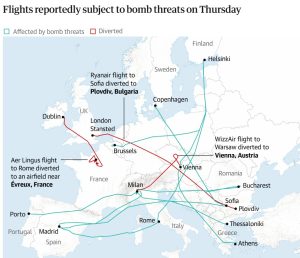
| European Commercial Aviation Corridor (16 Nations / 33 Flights) | Commercial airliners (Ryanair, Aer Lingus, Wizz Air, LOT Polish Airlines). | 0 casualties; 33 commercial flights diverted or searched after coordinated hoax bomb threats. | European aviation security agencies and NATO intelligence investigating hybrid-warfare false-flag email campaigns (see our European flight diversions report). |
✈️ TodayWhy Aviation & Emergency Investigation Series
To understand how commercial and private flight emergencies are handled by pilots and air traffic control, explore our related aviation explainers:
- Transatlantic In-Flight Emergency: Why Lufthansa Flight LH430 Declared an Emergency and Diverted to Glasgow
- European Airspace Security Crisis: Bomb Threats on Flights Across Europe Explained: Why 33 Planes Were Diverted
- Urban Aviation Incident Analysis: Why the Beijing CITIC Tower Plane Crash Video Went Viral: Fact-Check & Airspace Rules
- Airspace Radar & UAP Disclosures: Pentagon UFO & UAP Files Released: What Military Pilots Actually Reported
Florida Plane Crash Update: Learjet Crash Kills Nine in Florida’s Palm Beach County
The single largest driver of searches for plane crash today, Florida plane crash, and plane crash West Palm Beach is the tragic loss of Upper Jet Flight N722BD—an event widely searched under the headline “Learjet crash kills nine in Florida’s Palm Beach County.”
On November 1, 2026, the twin-engine Bombardier Learjet 60 departed Austin–Bergstrom International Airport (AUS) in Austin, Texas, bound for North Eleuthera Airport (ELH) in the Bahamas. As the business jet crossed southern Florida approaching the Atlantic coast near West Palm Beach, southern Florida was being battered by a volatile line of convective thunderstorms producing heavy rain, hail, and severe vertical wind shear.
Timeline of the Final Minutes: From 37,000 Feet to Military Trail in Greenacres
According to flight-tracking telemetry from Flightradar24, air traffic control audio, and official briefings by NTSB Board Member Tom Chapman, the final sequence of the Learjet crash in Florida unfolded with terrifying speed:
- Weather Avoidance and Storm Cell Entry: NEXRAD weather radar imagery captured five minutes prior to impact showed the Learjet attempting to steer around a massive thunderstorm cell over Palm Beach County, only to fly directly into a rapidly intensifying smaller convective cell.
- 700-Foot Altitude Swings & Icing Report: From the cockpit, 20-year-old First Officer Nathalia Gadelha Filgueiras contacted air traffic controllers to report that the jet was encountering airframe icing, heavy precipitation, and severe turbulence that was violently throwing the aircraft up and down by more than 700 feet (213 meters). She urgently requested a routing deviation and clearance to climb to 37,000 feet (11,300 meters) to get above the weather.
- Overspeed Warning & Loss of Pitch Control: Seconds after requesting the climb, the pilots declared an emergency. As the aircraft pitched downward, the crew reported a critical overspeed condition. Telemetry showed the Learjet 60 entering a near-vertical high-speed dive, with its descent rate exceeding 20,000 feet per minute (6,100 meters per minute, or more than 230 mph vertically).
- In-Flight Structural Breakup of the Tail Elevator: As aerodynamic loads exceeded the structural design limits of the tailplane during the high-speed dive, the aircraft’s left elevator—the movable horizontal tail surface that controls whether the nose points up or down—ripped away from the empennage in midair. Investigators later recovered three separate pieces of the left elevator scattered between 1.3 and 3.8 miles (2.1 to 6.1 km) back along the flight path from the main crater.
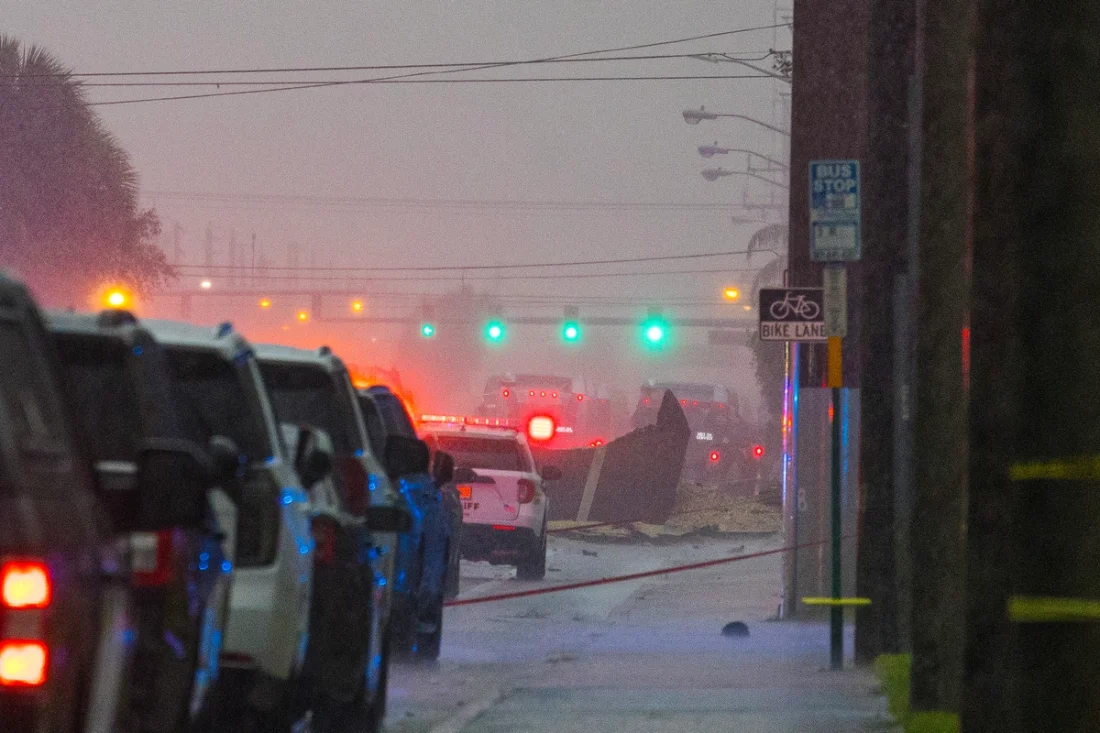
- Impact in a Florida Neighborhood (Greenacres): Completely stripped of pitch authority, the Learjet plummeted into the side of South Military Trail in the Palm Beach County city of Greenacres (roughly six miles from Mar-a-Lago and adjacent to West Palm Beach), exploding into a massive fireball captured on passing motorists’ dashcams.
Ground Impact: 600 Evacuated and High School Closed
For local residents searching for plane crash in Florida neighborhood or plane crash today location, the jet struck right beside a densely populated residential mobile home community along Military Trail in Greenacres (coordinates 26°37′58.4″N 80°06′47.2″W). Witnesses described the impact as looking “like a meteor hit the ground.”
The explosion blasted a deep crater beside the roadway, severed high-voltage overhead power lines, ruptured underground municipal water mains, and injured one person on the ground. Because the smoldering crater and aviation fuel hazard blocked the sole access road to the adjacent mobile home park, Palm Beach County Commissioner Joel G. Flores confirmed that approximately 600 residents had to be evacuated via Palm Tran buses to Red Cross emergency shelters, while nearby John I. Leonard Community High School was forced to close on Monday, November 2.
Plane Crash Today Cause: What the Recovered Black Box (CVR) & Tail Debris Reveal
Why did searches for plane crash today, Florida plane crash update, and plane crash today cause spike over 6,300% between November 10 and November 12, 2026? The catalyst was the November 10 announcement reported by The Guardian and Associated Press that NTSB investigators had finally recovered the Learjet’s cockpit voice recorder (CVR) from the rainwater-filled crater in Greenacres.
For over a week, torrential downpours across South Florida had turned the impact crater into a flooded pit, forcing crews to pump out water and remove a damaged utility pole before they could unearth the crash-hardened memory unit. Now at the NTSB’s Vehicle Recorders Laboratory in Washington, D.C., acoustic engineers are extracting the audio tracks to answer three pivotal engineering questions:
1. How Airframe Icing and Convective Updrafts Trigger High-Altitude Upsets
When a swept-wing business jet like the Learjet 60 flies through supercooled liquid water droplets inside a developing cumulonimbus thunderstorm top, ice can rapidly accrete on the leading edges of the wings, horizontal stabilizer, and air data probes (Pitot tubes and angle-of-attack sensors). Even a thin, sandpaper-like layer of ice disrupts smooth laminar airflow over the wing, drastically reducing lift and increasing aerodynamic drag.
Compounding the danger, the Learjet 60 features a “T-tail” configuration—where the horizontal stabilizer and elevators are mounted at the very top of the vertical tail fin, well above the wings and rear fuselage-mounted Pratt & Whitney Canada PW305A turbofan engines. In severe turbulence (such as the 700-foot vertical updrafts and downdrafts reported by the co-pilot), a rapid change in the aircraft’s angle of attack can cause the wing to stall or experience “Mach tuck” at high speed, pitching the nose sharply downward.
2. Why the Left Elevator Separated 1.3 to 3.8 Miles Before Impact
One of the most important forensic clues in the Learjet crash is the discovery of the left elevator in three pieces up to 3.8 miles away from the crash site. In aerospace engineering, every aircraft has a “never-exceed speed” ($V_{NE}$ / $M_{MO}$) and a maximum structural G-load limit. Once the Learjet entered a steep dive exceeding 20,000 feet per minute, the airspeed rapidly surpassed the design envelope.
At transonic speeds during an overspeed dive, two destructive phenomena can occur on a tailplane:
- Aeroelastic Flutter: High-frequency, self-exciting aerodynamic vibrations across the elevator control surface that can tear metal hinges and composite structures apart in fractions of a second.
- Overstress during Pull-Up Recovery: If the pilots—or the aircraft’s automatic pitch trim / autopilot system—pulled back forcefully on the control yoke to arrest the 20,000-fpm dive while the jet was traveling well above its maximum operating speed, the aerodynamic downforce on the horizontal tail could exceed its ultimate structural load limit, snapping the left elevator off in midair.
The recovered CVR will allow NTSB specialists to hear the exact sequence of cockpit alerts—such as the stick shaker/pusher (stall warning), the “clacker” (overspeed warning chime), autopilot disconnect tones, and the pilots’ verbal callouts—to determine whether an icing-induced stall or an autopilot trim anomaly initiated the dive.
3. Why the Learjet Steered Into a Developing Storm Cell
Investigators are also using the CVR and air traffic control transcripts to understand why the flight crew navigated around one large storm system only to enter a rapidly building secondary cell. In cockpit weather radar systems, heavy rain directly ahead of the nose can sometimes “attenuate” (absorb or reflect) radar beams, creating a deceptive “radar shadow” that makes a violent thunderstorm cell behind the first rain band appear weaker than it actually is. Additionally, NTSB investigators are interviewing staff at Austin–Bergstrom International Airport and executives at Upper Jet (Aurora Aviation) to review pre-flight weather briefings and aircraft maintenance logs.
Why the Bombardier Learjet 60 Demands Precision Handling at High Altitude
To understand why aviation safety analysts following the Florida plane crash and Learjet crash are scrutinizing the aircraft’s aerodynamic profile, it helps to examine the engineering history of the Bombardier Learjet 60. Introduced in the early 1990s as an upgraded, longer-fuselage successor to the Learjet 55, the mid-size business jet is powered by two rear-mounted Pratt & Whitney Canada PW305A turbofan engines and is certified to cruise at altitudes up to 51,000 feet (Flight Level 510)—substantially higher than most commercial airliners, which typically cruise between 31,000 and 39,000 feet.
While that high-altitude performance allows corporate operators to climb above many routine weather systems, aviation safety records documented by the Flight Safety Foundation and the SKYbrary Aviation Safety Knowledge Base highlight three demanding aerodynamic characteristics when flying a swept-wing, T-tail business jet near severe convective storms:
- The Narrow “Coffin Corner” Margin at High Altitude: As an aircraft climbs into the thin air between 35,000 and 45,000 feet (recall that N722BD requested a climb to 37,000 feet moments before its fatal dive), the gap between its low-speed stall speed and its high-speed critical Mach number (overspeed buffet boundary) narrows significantly. When violent vertical updrafts and downdrafts—such as the 700-foot altitude excursions reported over West Palm Beach—strike the aircraft within this narrow speed envelope, the jet can transition from a low-speed aerodynamic stall into a transonic overspeed dive in a matter of seconds.
- Anti-Icing Bleed Air Systems & Ice Bridging: The Learjet 60 utilizes hot engine compressor bleed air routed through internal ducts to heat the leading edges of the wings and prevent ice accumulation. However, if the aircraft encounters extreme supercooled large droplets (SLD) inside a tropical or subtropical cumulonimbus anvil over Florida, ice can occasionally accrete further back on the unheated upper wing surface (“runback icing”) or on the high T-tail stabilizer, altering pitch trim authority before the crew can escape the cloud cell.
- High Wing Loading & Rapid Vertical Acceleration: Designed for high-speed cruise efficiency, the Learjet family has a relatively compact wing area with high wing loading. Once the nose pitches below the horizon in an uncommanded upset inside clouds (where pilots have zero visual horizon reference and must rely entirely on attitude instruments), gravity and twin-turbofan thrust accelerate the airframe downward at an extraordinary rate—explaining how N722BD reached a vertical descent speed exceeding 20,000 feet per minute before the left elevator suffered structural overstress.
Who Was on the Plane That Crashed? Victims, Captain Jeff Gregory & Co-Pilot Nathalia Filgueiras
Searches for plane crash victims, who was on the plane that crashed today, and name of pilot in crash today reflect deep public grief over the nine lives lost aboard N722BD. Authorities and family members confirmed that there were no survivors among the two flight crew members and seven passengers:
- The Robinson–Sharp Family (Austin, Texas): Tech entrepreneur Adam Robinson, his wife Helen Sharp, and their two young children, Emma (age 4) and Charlie (age 2), who were traveling to Eleuthera in the Bahamas for a family vacation.
- Nanny and Family Friends: The children’s nanny, Rachael Reed, along with family friends Charmi Fehr and Anita Maria Cetina.
- Captain Jeff Gregory (Age 55): A seasoned veteran pilot described by friends and colleagues as a devoted Christian and experienced aviator. In the final seconds of the cockpit radio transmission as the aircraft plunged toward the ground, a man’s voice could be heard calmly reciting the Lord’s Prayer—which friends confirmed was Captain Gregory.
- First Officer Nathalia Gadelha Filgueiras (Age 20): A 20-year-old Brazilian-American pilot from Boca Raton, Florida, who had famously earned her pilot’s license in high school before even getting her driver’s license and had been profiled three years earlier by local CBS affiliate WPEC for her dedication to aviation.
Fact-Checking Online Claims: NASA Administrator Defends Co-Pilot & Debunking AI Video Rumors
In the aftermath of the Florida plane crash, two viral social media narratives prompted official fact-checks and public statements from aerospace leaders:
- Defense of First Officer Nathalia Filgueiras: After online commentators unfairly targeted the 20-year-old co-pilot’s age and gender on social media, NASA Administrator Jared Isaacman—an accomplished jet pilot and commercial astronaut—along with Filgueiras’s flight instructors publicly defended her credentials, professionalism, and calm communication on the ATC radio under extreme duress. Under FAA regulations, a Learjet 60 requires a two-pilot crew, and NTSB investigators routinely examine operator training records and FAA certification logs before drawing any conclusions about crew pairing.
- Dashcam Footage Is Real, Not AI-Generated: Because the dashcam video of the Learjet plunging nearly vertically into Military Trail and exploding looked so catastrophic, some social media users claimed the plane crash today video was AI-generated. Independent fact-checkers at PolitiFact and NTSB officials verified that the bystander and dashcam videos are completely authentic and are being used by NTSB trajectory analysts to calculate the jet’s exact impact angle and speed.
Why “Miami Plane Crash Today” & “Wisconsin / Nelson Plane Crash” Are Also Trending
When analyzing the 133 aviation queries in our November 2026 search dataset, two additional geographic clusters appear alongside West Palm Beach: Miami plane crash (25,497 impressions) and Wisconsin plane crash / Nelson plane crash (963 combined impressions).
1. Why Searching for “Miami Plane Crash” Points to Palm Beach County
Although the Learjet 60 crashed in Greenacres (Palm Beach County), roughly 65 miles north of downtown Miami, international news outlets and out-of-state readers frequently refer to the entire South Florida metropolitan corridor (stretching from Miami-Dade through Broward to West Palm Beach) as “the Miami area.” Furthermore, Miami Air Route Traffic Control Center (ZMA) manages high-altitude airspace across all of South Florida and the Bahamas corridor, explaining why thousands of users searching for miami plane crash today or plane crash in miami today are actually looking for the Palm Beach County Learjet 60 investigation.
2. The Parallel Tragedy: The Wisconsin & Nelson Plane Crash (6 Killed After Wing Icing)
Aviation safety experts have pointed out a chilling parallel between the November 1 Florida Learjet crash and the mid-October Wisconsin plane crash near Mirror Lake State Park in the Town of Dellona (near Wisconsin Dells), which claimed six lives and devastated the small community of Nelson, Wisconsin.
In that tragedy, a private aircraft owned and piloted by experienced Woodville businessman Ron Riek—accompanied by 36-year-old certified flight instructor Tyler Harvey of Cadott—was flying four family members from western Wisconsin (including a grandmother from Nelson, Wisconsin, her two adult daughters, and her 13-year-old grandson) to watch a family volleyball match five hours away. Just like the Florida Learjet crew, the pilot radioed air traffic control (captured on LiveATC.net) to report that ice was rapidly building up on the wings while flying through a thunderstorm shortly before the aircraft lost lift and crashed into a wooded area. Together, the Wisconsin and Florida crashes have placed convective in-flight icing at the very top of the NTSB’s autumn 2026 safety agenda.
Technical Explainer: How the NTSB Investigates a Catastrophic Jet Crash (30-Day vs. 18-Month Timeline)
For readers following plane crash today live updates and wondering when the official cause of the Learjet crash in Florida will be legally finalized, the NTSB Investigation Process follows a strict three-phase federal protocol:
| Investigation Phase | Expected Timeframe | What the NTSB Examines & Releases |
|---|---|---|
| 1. On-Scene & Lab Recovery (“Go-Team”) | Days 1 to 14 (Completed Nov 1–10, 2026) | Mapping the debris field (confirming the left elevator 1.3–3.8 miles away), recovering the Cockpit Voice Recorder (CVR) from the flooded Greenacres crater, and moving wreckage to a secure Florida hangar for 2D/3D reconstruction. |
| 2. NTSB Preliminary Report | ~30 Days After Crash (Expected Early December 2026) | Publishes verified factual data: exact flight track coordinates, meteorological NEXRAD radar charts, initial CVR audio timeline, pilot flight-hour logs, and aircraft maintenance history—without stating the final legal probable cause. |
| 3. Final Report & Probable Cause | 12 to 18 Months (Expected Late 2027 / Early 2028) | With roughly 400 NTSB specialists managing over 1,200 active investigations, metallurgy labs test fractured tail hinges for fatigue vs. overstress, simulator teams recreate the 700-ft turbulence and 20,000-fpm dive, and the Board issues formal FAA safety recommendations. |
Plane Crash Today – Live Aviation & NTSB News Feed (Updated Hourly)
Your real-time tracker for plane crash today live updates, FAA emergency landings, and NTSB investigation briefings across the United States and worldwide. Stay informed with our continuously updated aviation safety feed below:
Frequently Asked Questions (FAQs) About the Plane Crash Today & Florida Learjet Investigation
Did a plane crash today, and why is “plane crash today” trending in November 2026?
Searches for plane crash today and plane crash in Florida today surged between November 10 and November 12, 2026, after the National Transportation Safety Board (NTSB) announced that investigators had recovered the black box cockpit voice recorder (CVR) from the Bombardier Learjet 60 that crashed in Greenacres (Palm Beach County, Florida), killing all nine people on board.
What caused the Learjet 60 plane crash in West Palm Beach / Greenacres, Florida?
While the final NTSB probable cause report takes 12 to 18 months, preliminary evidence shows the Learjet 60 encountered severe convective turbulence (throwing the jet up and down by 700 feet) and airframe icing before entering an overspeed dive exceeding 20,000 feet per minute. Three pieces of the aircraft’s left tail elevator were found 1.3 to 3.8 miles from the main crater, confirming the tail began breaking apart midair prior to ground impact.
Who were the nine victims in the Palm Beach County Florida plane crash?
The nine victims killed aboard Upper Jet Learjet 60 (N722BD) were Captain Jeff Gregory (55), First Officer Nathalia Gadelha Filgueiras (20) of Boca Raton, Austin tech entrepreneur Adam Robinson, his wife Helen Sharp, their two young children Emma (4) and Charlie (2), the children’s nanny Rachael Reed, and family friends Charmi Fehr and Anita Maria Cetina.
What will the recovered cockpit voice recorder (black box) reveal?
Sent to the NTSB Vehicle Recorders Laboratory in Washington, D.C. on November 10, 2026, the cockpit voice recorder (CVR) captures the pilots’ final conversations, air traffic control radio calls, and background cockpit warning chimes (such as stall stick-shakers and overspeed clackers) as the crew battled wing icing and extreme turbulence.
How is the Wisconsin (Nelson) plane crash connected to the Florida jet crash?
Both the mid-October Wisconsin crash near Mirror Lake State Park (which killed six people, including a grandmother from Nelson, Wisconsin, her daughters, and grandson) and the November Florida Learjet crash involved private aircraft encountering severe thunderstorm cells and reporting rapid wing ice accumulation on air traffic control radio immediately before losing control.