

Last Updated on 7 days ago by TodayWhy Editorial
Updated October 2026. Federal flags are at full-staff. Three states have active orders.
Why are flags at half-mast today is almost never a national story. A lowered flag in the United States is ordered either by the president, for the whole country, or by a governor, for one state. On most days the White House flag is up. The flag you saw on the way to work is a state order, for a police officer, a firefighter, or a local official, and it stops at the state line.
Current federal status: full-staff. There is no presidential half-mast order in effect on 17 October 2026. Federal buildings, military posts and U.S. facilities abroad fly the flag at full-staff. The next day the whole country lowers it by law is 7 December 2026, Pearl Harbor Remembrance Day.
Why are flags at half-mast today in your state?
As of 17 October 2026 these state orders are active. If yours is not listed, the flag near you is either at full-staff or under a local order that has not reached a national tracker. Check your governor’s site, or an aggregator such as SmartFlag.
- Oregon — Governor Tina Kotek ordered U.S. and Oregon flags at public institutions to half-mast on 17 October for David Taylor, 38, a federal wildlife officer who died on 29 August while aiding evacuations at the Railroad South Fire near Indiahoma, Oklahoma. He grew up in Scio, Oregon. The date matches his memorial service in Salem.
- Ohio, Ottawa County — Governor Mike DeWine ordered U.S. and Ohio flags at half-mast on public buildings in Ottawa County, and at the Statehouse, Vern Riffe Center and Rhodes State Office Tower in Columbus, for Sgt. Jacob Roesler of the Clay Township Police Department. Flags stay down until sunset on the day of his funeral. Other Ohio buildings may lower at their discretion.
- Pennsylvania — Governor Josh Shapiro ordered U.S. and Commonwealth flags at half-mast from 10 October until sunset on 20 October for Philadelphia Police Officer Shane Seiber, killed in the line of duty.
These three orders explain why a driver in Salem, a driver in Port Clinton, and a driver in Philadelphia can all see a lowered flag on the same morning, while a driver in Chicago or Dallas sees the flag at the peak. There is no single national reason today. There are three local ones.
Half-mast or half-staff: which word is right?
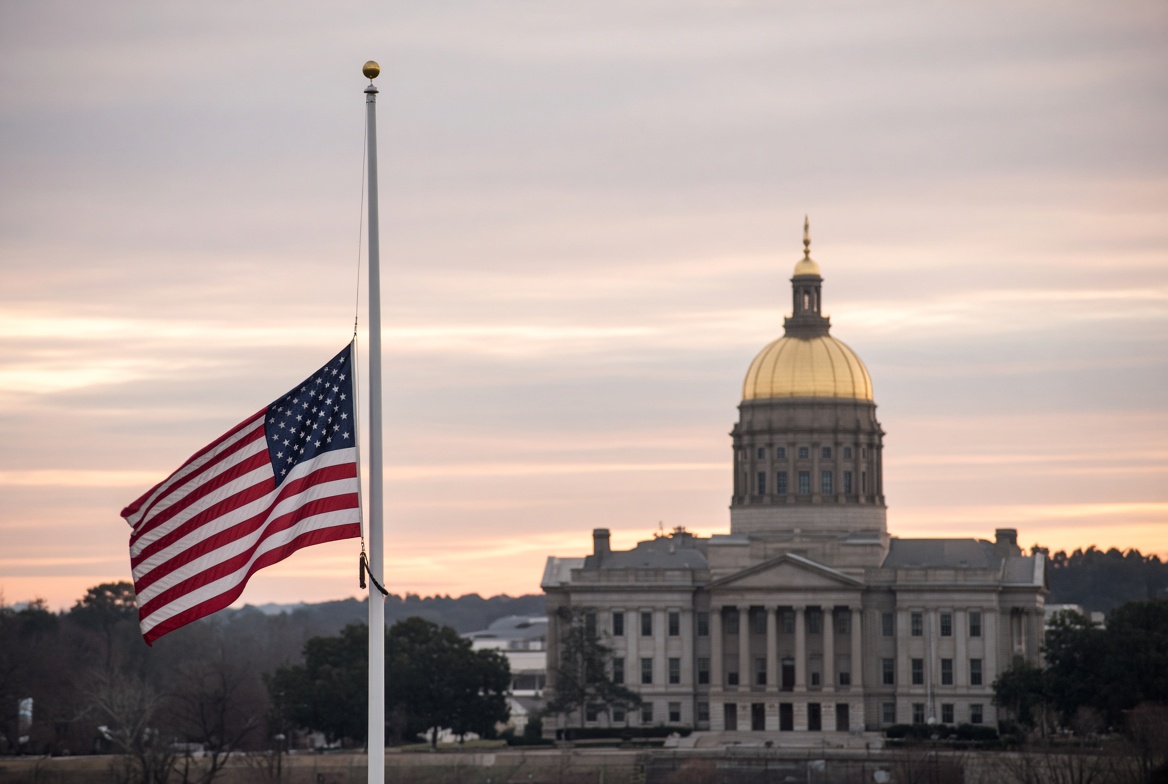
People search for half-mast. The Flag Code says half-staff for a flag on land, and half-mast for a flag on a ship. In ordinary speech the two words mean the same thing: the flag is lowered to roughly the middle of the pole as a mark of mourning or respect. Official notices use half-staff. Search results treat them as one query. This page uses both.
The distinction is old and narrow. A mast is a ship’s pole. A staff is a land pole. When the U.S. Navy flies a flag at half-mast, it is using the correct naval term. When a post office or a school does the same on land, the Flag Code calls it half-staff. No one is fined for using the other word. The only place the distinction matters is in an official proclamation or a written order.
Who can order the flag down?
Two authorities, and only two, under 4 U.S.C. § 7(m).
The president orders the flag to half-mast nationwide, by proclamation. The order covers federal buildings, military posts, naval stations, and U.S. facilities abroad. It does not automatically bind a state capitol or a city hall, though governors usually follow a national order. The president can also lower the flag for the death of a foreign dignitary, or for any national tragedy the president deems appropriate. There is no fixed duration for those discretionary orders. The proclamation sets the end date.
A governor orders the U.S. flag and the state flag on state property within that state. The Flag Code gives governors authority for three categories: the death of a present or former state official, the death of a member of the armed forces from that state who dies on active duty, and the death of a first responder who dies in the line of duty. That is why Ohio and Pennsylvania can be at half-mast while the White House is not. The Mayor of the District of Columbia holds equivalent authority for Washington, D.C.
A mayor, a school board, or a private business cannot order the U.S. flag to half-mast under the Flag Code. They can lower a flag they own, as a courtesy. They cannot require anyone else to do the same. Private homeowners may lower their own flags. They are not required to, and they are not violating the code if they do.
How long the flag stays down
The Flag Code sets fixed durations for the deaths of federal officials. These apply at federal facilities. A presidential proclamation can extend them. When it does, the proclamation controls.
| Who died | How long |
|---|---|
| President or former president | 30 days from the day of death |
| Vice president, chief justice or retired chief justice, Speaker of the House | 10 days from the day of death |
| Associate justice, cabinet secretary, former vice president, governor | From the day of death until interment |
| Member of Congress | Day of death and the following day |
The member-of-Congress rule has a geographic wrinkle under Presidential Proclamation 3044. At federal facilities in the Washington, D.C. area, the flag is lowered on the day of death and the next day. At federal facilities in the member’s own state or district, it stays down from the day of death until burial. A senator’s tribute is longer at home than in the capital.
For a first responder or a service member, the duration is set by the governor’s order, not by a national table. Some orders run sunrise to sunset on the day of the funeral. Some run until interment. Some, like Pennsylvania’s order for Officer Shane Seiber, name an end date in advance. Read the order. Do not assume it ends at sunset on the day you first noticed the flag.
Fixed half-mast days in 2026
| Date | Observance | Duration |
|---|---|---|
| 15 May | Peace Officers Memorial Day | Sunrise to sunset |
| 25 May | Memorial Day | Sunrise until noon, then full-staff |
| 11 September | Patriot Day | Sunrise to sunset |
| 7 December | Pearl Harbor Remembrance Day | Sunrise to sunset |
Memorial Day is the one that confuses people every year. The flag is at half-mast from sunrise until noon only, then raised to full-staff for the rest of the day. It is the only fixed observance that changes position at a set hour. Peace Officers Memorial Day yields to Armed Forces Day if the two fall on the same date. Other dates, such as the National Fallen Firefighters Memorial Service, are set each year by proclamation. They are not automatic. From today, the next fixed federal day is 7 December.
How to lower a flag correctly
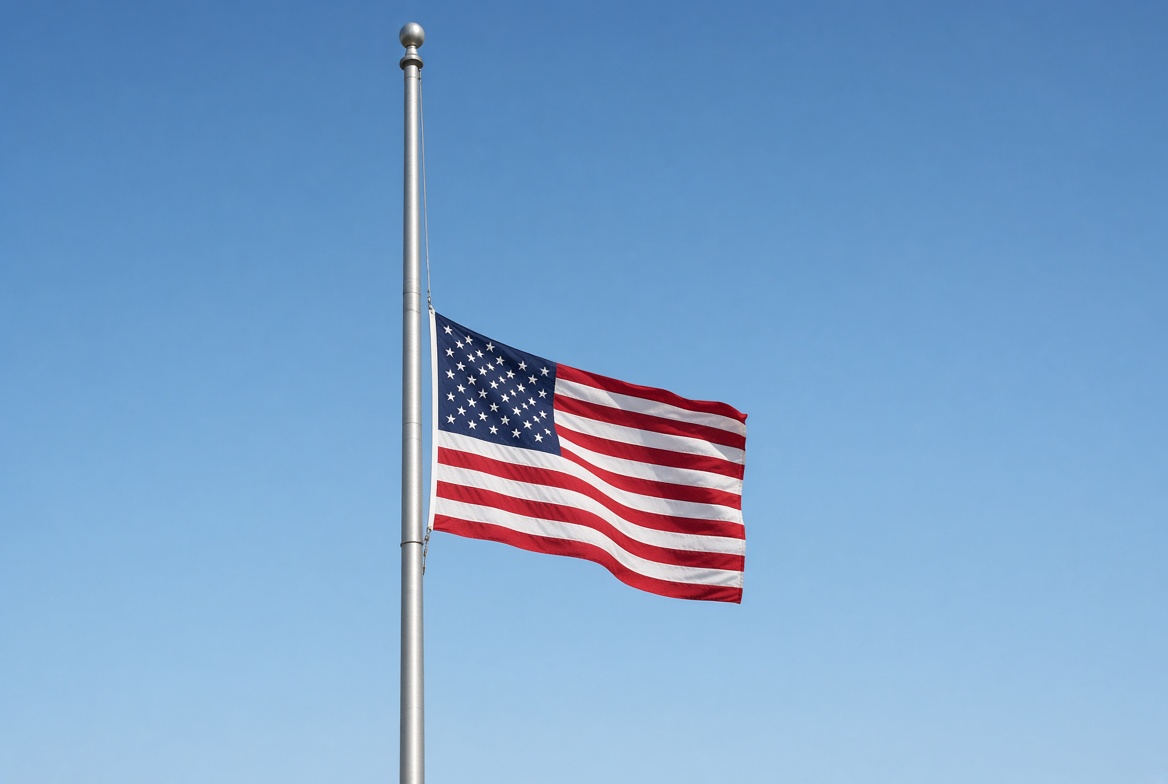
The procedure is in the Flag Code and is not optional for an official display. Hoist the flag briskly to the peak for an instant, then lower it slowly to the half-mast position, roughly halfway down the length of the pole. At the end of the day, raise it to the peak again before you bring it down. Do not simply run it up to the middle and leave it. Do not lower it straight from half-mast at sunset.
When the U.S. flag is at half-mast, no other flag on the same pole or on an adjacent pole should fly above it. The state flag is lowered with it. On a single pole with multiple flags, the U.S. flag remains at the top of the set, even at half-mast, and the others sit below it.
How to check the status for your state
There is no single federal page that lists every state order in real time. The reliable sequence is:
- Check whether a presidential proclamation is in effect. If the White House has ordered half-mast, federal buildings nationwide follow it.
- Check your governor’s website or the state department of general services. Pennsylvania, for example, posts current orders on the Department of General Services flag-notices page.
- Use an aggregator such as SmartFlag or Mast for a quick national view, then confirm against the official order before you treat it as binding.
If none of those shows an order for your state, the flag near you should be at full-staff. A lowered flag with no order is a courtesy by the property owner, not a legal requirement.
Frequently asked questions
Are flags at half-mast today?
Federally, no. As of 17 October 2026 there is no presidential order. Oregon, parts of Ohio, and Pennsylvania have active state orders.
Why are flags at half-mast in my state but not next door?
Because a governor’s order stops at the state line. A police funeral in Pennsylvania does not lower flags in New York.
Can a mayor order half-mast?
Not for the U.S. flag under the Flag Code. A mayor can request it, or lower a municipal flag. The binding orders come from the president or a governor.
Do private businesses have to lower their flags?
No. It is a courtesy, not a requirement.
How long do flags stay at half-mast for a president?
30 days from the day of death, at federal facilities nationwide and abroad. That is the longest fixed period in the Flag Code.
When is the next national half-mast day?
7 December 2026, Pearl Harbor Remembrance Day, sunrise to sunset.
Is half-mast the same as half-staff?
In search and in ordinary speech, yes. In the Flag Code, half-staff is the land term and half-mast is the naval term. Official notices use half-staff.
The short answer
Why are flags at half-mast today depends on the pole you are looking at. On 17 October 2026 the federal flag is at full-staff. Oregon is honoring David Taylor. Ohio’s Ottawa County is honoring Sgt. Jacob Roesler. Pennsylvania is honoring Officer Shane Seiber until sunset on 20 October. If none of those is your state, check your governor. The next day the whole country lowers the flag by law is 7 December. Half-mast is the word people search. Half-staff is the word the Flag Code uses. The order, either way, is almost always local.