
Last Updated on 2 months ago by TodayWhy Editorial
Who owns the Strait of Hormuz? It is the question the entire 2026 war now turns on, and the honest answer is uncomfortable: three separate parties claim authority over that water, and not one of them has the law cleanly on its side.
Iran says it administers the strait. Oman shares the water but rejects Iran’s terms. And the United States has just declared itself the strait’s “guardian” and asked for 20% of the cargo. Each claim is contested. Each claimant has broken or ignored the rules it cites against the others.
Here is what ownership actually means in the world’s most important waterway — and why the legal answer and the practical answer are not the same.
Who owns the Strait of Hormuz? The short answer
Iran and Oman own the water. Nobody owns the passage.
That single sentence explains almost every dispute in this war. The strait is not international waters in the way most people assume. It sits entirely inside the territorial seas of two countries. But owning the sea and controlling who sails through it are two completely different rights — and international law grants the first while withholding the second.
The geography that makes ownership impossible
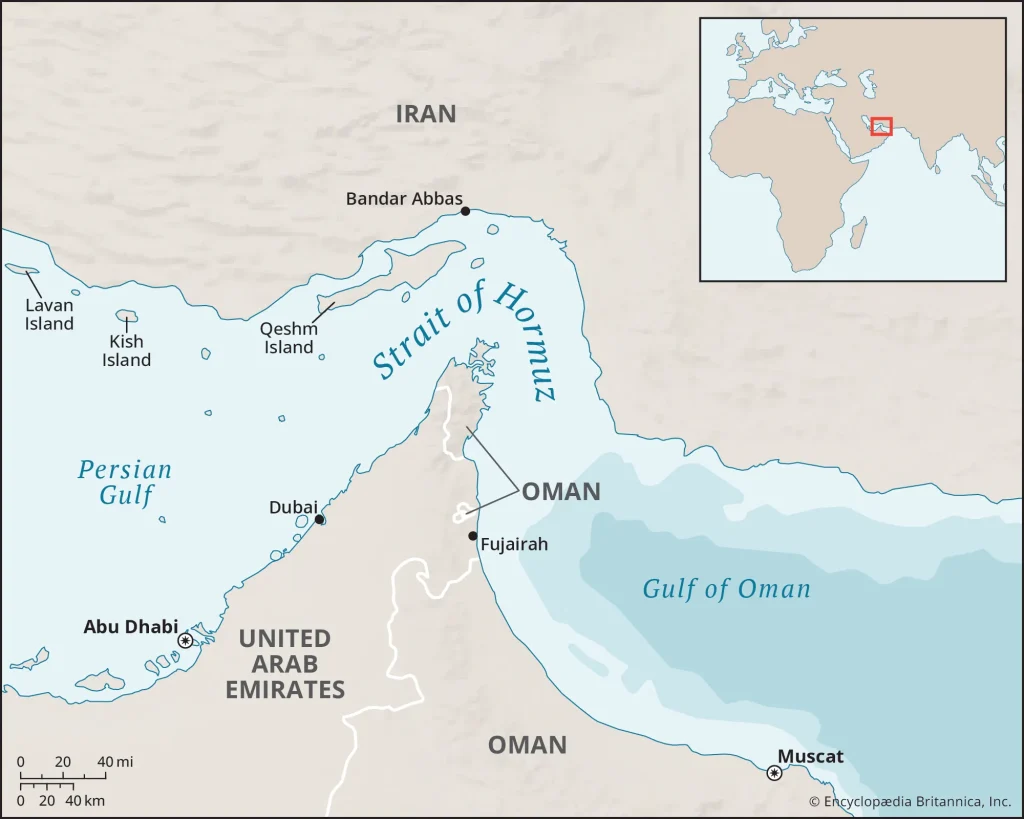
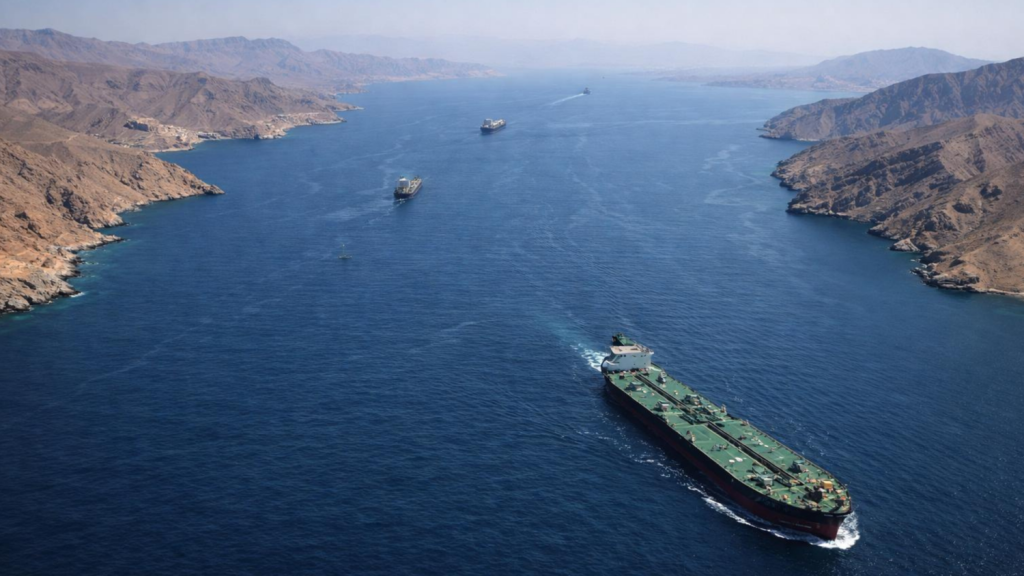
The physical facts do most of the work here. The strait runs 167 kilometres, narrows to just 33 kilometres at its tightest point, and carries around 20 million barrels of oil a day — roughly a fifth of the world’s supply.
Now apply the law. A country’s territorial sea extends 12 nautical miles from its coast. Iran on the north, Oman on the south. At the narrowest point, 12 plus 12 covers the entire strait with room to spare.
There is no sliver of high seas in the middle. No neutral corridor. Every ship crossing Hormuz is, at every moment, inside somebody’s territorial waters. That is the geographic trap — and it is why “who owns the Strait of Hormuz” has no clean answer.
Why owning the water doesn’t mean controlling the traffic
Maritime law anticipated exactly this problem. If chokepoints could be closed by whoever happened to live beside them, a handful of countries would hold the global economy hostage. So the UN Convention on the Law of the Sea (UNCLOS) created a special regime for straits used for international navigation.
It is called transit passage, set out in Articles 37 to 44. Ships get continuous and expeditious passage that cannot be impeded or suspended. Coastal states keep sovereignty over the water — but that sovereignty is deliberately hollowed out where passage is concerned. They may write rules on safety, pollution and sea lanes. They may not turn the strait into a permission-based corridor.
Article 26 is the one that kills the toll idea outright: no charge may be levied on a foreign ship for the mere fact of its passage. Fees are allowed only for actual services rendered — pilotage, port assistance. Not for existing.
So under UNCLOS, the answer to “who controls the Strait of Hormuz” is clear: nobody does. Not Iran, not Oman, not Washington.
The catch: Iran never ratified UNCLOS. Neither did the US.
This is the part almost every news report skips, and it is the reason the dispute is genuinely unresolved rather than merely lawless.
Iran signed UNCLOS but never ratified it — and under treaty law, a signature alone does not bind a state. Tehran has spent decades rejecting the idea that transit passage applies to it, positioning itself as what lawyers call a persistent objector. Its legal case is not frivolous. It is just extremely convenient.
The United States is not a party to UNCLOS either. It has never ratified the convention. Washington’s position is that transit passage is customary international law and therefore binds everyone regardless — a reading it applies enthusiastically to Iran and rather less enthusiastically to itself.
Oman, meanwhile, is a party — but attached a declaration reserving its right to take “appropriate measures” to protect its security interests in international straits.
Read that back. The three states arguing about the Strait of Hormuz are: one that signed the treaty and refused to ratify it, one that refused to ratify it at all, and one that ratified it with a carve-out. Everyone is citing a rulebook they have not fully signed.
The 1949 case that still decides this
Strip away UNCLOS entirely and there is still a floor beneath the argument, and it was laid down in 1949.
In the Corfu Channel case, the International Court of Justice ruled that Albania could not require the United Kingdom to seek permission before using an international strait. Passage through such straits in peacetime, the court held, cannot be made contingent on the coastal state’s discretion.
That principle survives regardless of who signed what. And it is why legal scholars argue that proposals letting Iran and Oman issue permits or collect transit fees “would be difficult to reconcile with international law” — even on the most generous reading of Iran’s position.
Why Hormuz is not the Suez Canal
This is the confusion that lets the toll arguments sound reasonable, so it is worth being blunt about.
Suez and Panama charge transit fees. Everyone accepts this. So why can’t Iran?
Because Suez and Panama are artificial. Somebody dug them. Egypt and Panama built, maintain and operate infrastructure that would not otherwise exist, and they charge for the use of that infrastructure. If you don’t want to pay, sail around Africa or South America. The route is a product; the fee is its price.
Hormuz is natural. Nobody built it. There is no alternative route out of the Persian Gulf — none of “similar convenience,” in the language of the treaty. It is the only door. That is precisely why the law treats it differently: a chokepoint that cannot be bypassed cannot be monetised, or the owner of the door owns the room.
What Iran wants: money, and a precedent
Iran began charging tolls in April 2026 and has pushed since then to formalise a joint administration of the strait with Oman. Its legal justification is straightforward: the peacetime rules do not apply during a war. Iran’s deputy foreign minister for legal affairs put it plainly — “wartime conditions cannot be governed by peacetime rules.”
But the money is only half of it. With its proxies degraded and its nuclear and missile programmes battered, the strait is close to the last leverage Tehran holds. Establishing that a coastal state may license passage through a natural chokepoint would also hand a template to anyone else with a chokepoint and an ambition — a point that worries Washington far more than the fees themselves.
What Trump wants: a 20% toll of his own
And then the argument inverted.
On July 13, with the ceasefire collapsing and the US naval blockade returning, Trump announced that the United States would henceforth be known as “THE GUARDIAN OF THE HORMUZ STRAIT” — and would be reimbursed at 20% of the value of all cargo shipped through it, in exchange for providing security.
The problem is that the United States has spent five months arguing that Iranian tolls are economic blackmail violating freedom of navigation. The legal objection to a toll does not care who collects it. Article 26 does not contain an exception for guardians.
The International Maritime Organization — the UN agency that regulates global shipping — has said there is no legal basis for mandatory fees in the strait. It said this to Iran. It is now saying it to Washington. Iran’s joint military command, for its part, has warned it will not allow any US role in managing the waterway, and has told regional states that cooperating with such a plan would be treated as an act of war.
Neither claimant is backing down, and the shipping industry is caught between two tollbooths on the same stretch of water. We traced how the ceasefire got here in our explainer on Trump declaring the ceasefire over.
Trump’s August 2026 claim: “NEW U.S. Territory”
In mid-August 2026 the dispute escalated beyond tolls. On 14 August President Trump said he would “pretty soon” declare the Strait of Hormuz a territory of the United States. Four days later he posted a map on Truth Social circling the strait (and portions of Iranian, Omani and Emirati coastline) with the label “NEW U.S. Territory.”
He simultaneously claimed the strait was “open and operating” and that “all water mines have been removed or detonated.” Shipping data contradicted both statements: daily commodity transits remained in single digits (Kpler), war-risk insurance stayed at extreme levels, and major carriers continued to avoid the waterway.
Iran’s response was immediate. Deputy Foreign Minister Kazem Gharibabadi stated: “The Strait of Hormuz has been Iranian, is Iranian, and will remain Iranian; this strait will only be closed and opened under Iran’s command.” Other officials called the claim a “delusion” and “nonsense.”
Under international law the claim has no foundation. Neither UNCLOS nor the Corfu Channel principle permits unilateral annexation of an international strait by social-media post or naval blockade. Ownership of the water remains with Iran and Oman; the right of transit passage belongs to all states.
The southern corridor reality (mid-to-late August 2026)
While the legal arguments remain unchanged, the practical contest over the strait has shifted on the water. Data from Kpler shows that more than 80% of commercial transits in the two weeks to mid-August used the southern corridor through Omani territorial waters — the route protected by the U.S. Navy — reversing the pattern of a month earlier when almost no vessels dared use it.
The U.S. escort operation, which began in May and intensified through the summer, has moved roughly 5 million barrels per day through the protected southern lane. Combined with diverted volumes, total oil leaving the Gulf reached approximately 15 million barrels per day in recent weeks, according to U.S. Energy Secretary Chris Wright — closer to the pre-war average of 20 million.
CENTCOM reports it has facilitated more than 1,000 safe transits. Recent U.S. airstrikes degraded Iranian coastal radar and surveillance, forcing Iran to fire “blind” and sharply reducing its hit rate. In June at least 15 vessels on the southern route were attacked; by August the number of successful hits had fallen to one, according to UKMTO data.
Iran continues to insist that vessels must use the northern corridor under its control and declares the strait closed until U.S. commitments in the June memorandum are met. The United States, for its part, now claims effective control of the only route most commercial traffic is willing to use. The legal ownership of the water has not changed. The ability to enforce passage has.
So who actually owns the Strait of Hormuz?
Three answers, and you need all three.
On paper: Iran and Oman own the water. Neither owns the right of passage, which belongs to everyone.
In law: nobody may charge, license or close it. This is the settled view of the IMO, the ICJ’s reasoning in Corfu Channel, and 172 states party to UNCLOS.
In practice (August 2026): whoever can enforce their claim on any given day. Traffic has collapsed to roughly 4–9 commercial vessels per day (versus 130+ pre-war). Iran continues to demand coordination through its Persian Gulf Strait Authority and has attacked vessels using the southern corridor. The United States maintains its naval blockade of Iranian ports and escorts limited traffic through Omani waters. Insurers price most commercial transit beyond reach. The legal answer remains clear; the practical answer is that the strait is effectively closed to normal commerce.
That gap — between what the law says and who has the guns — is the real story of the Strait of Hormuz in 2026. The law is unusually clear. It has simply stopped mattering to the two parties who most loudly invoke it. For the market consequences of that gap, see our Strait of Hormuz oil price tracker.
Frequently asked questions
Does Iran own the Strait of Hormuz?
Iran owns roughly the northern half of the water, as its territorial sea. It does not own the strait, and it does not own the right to decide who crosses it. Ownership of the sea and control of passage are separate rights under international law.
Is the Strait of Hormuz international waters?
No — and this surprises most people. It lies entirely within the territorial seas of Iran and Oman. What makes it “international” is not the water’s status but the legal regime that applies to it: transit passage, which guarantees free crossing through waters that belong to somebody.
Can Iran legally charge tolls in the Strait of Hormuz?
Almost certainly not. UNCLOS Article 26 bars charges levied on a ship for the mere fact of passage; fees are permitted only for specific services like pilotage. Iran’s counter-argument is that it never ratified UNCLOS and that wartime suspends peacetime rules — a position most maritime lawyers reject.
Can the US legally charge a 20% toll as the strait’s “guardian”?
The same rule that blocks Iran blocks Washington. The IMO has stated there is no legal basis for mandatory transit fees in the strait, and it draws no distinction based on who is collecting. The US is also not a party to UNCLOS, which weakens its standing to enforce the convention against others.
Why can Egypt charge for the Suez Canal but Iran can’t charge for Hormuz?
Suez is a man-made canal — Egypt built and maintains it, and ships can avoid it by sailing around Africa. Hormuz is a natural strait with no alternative route out of the Persian Gulf. International law treats artificial waterways as infrastructure that may be sold, and natural chokepoints as passages that may not be.
Can the United States legally declare the Strait of Hormuz U.S. territory?
No. International law does not recognise unilateral annexation of an international strait. The claim has been rejected by Iran, carries no weight under UNCLOS or customary law, and has not altered the legal status of the waterway.