
Last Updated on 2 months ago by TodayWhy Editorial
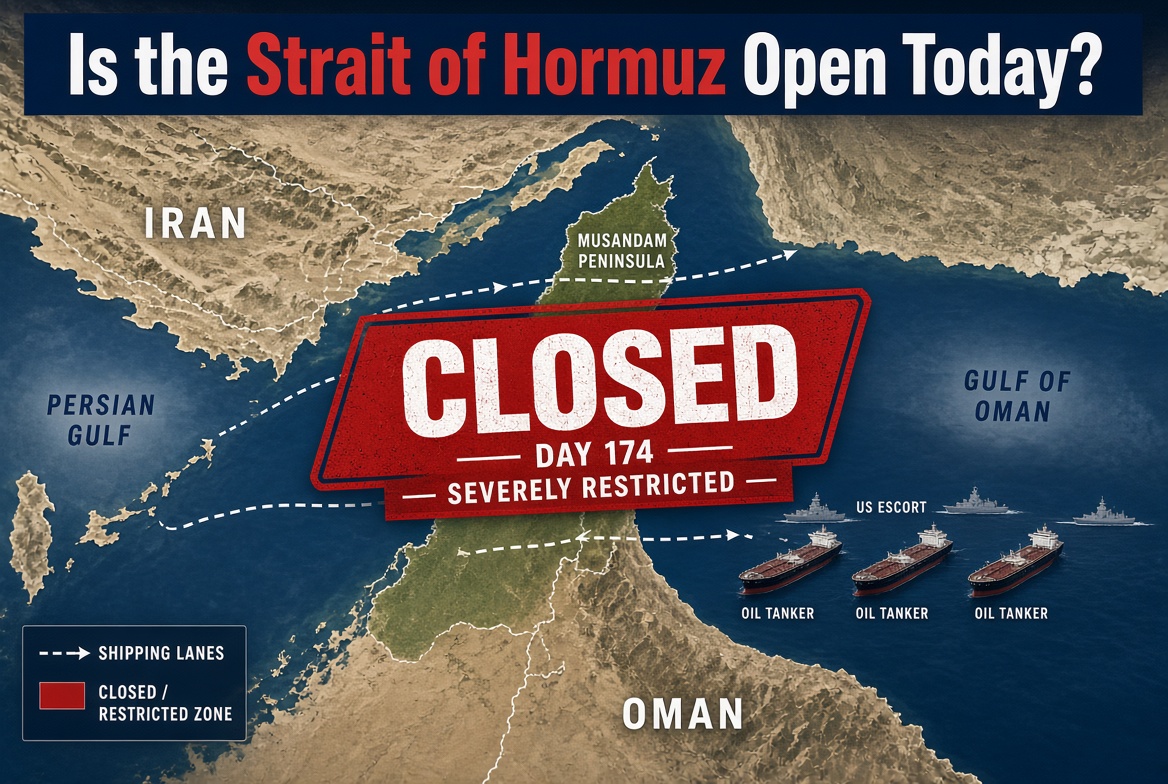
Is the Strait of Hormuz Open Today? Short answer for today is here.
Source: Straits
The Strait of Hormuz remains effectively closed or severely restricted to normal shipping. As of the latest data (21–22 August 2026), this is approximately Day 174 of the disruption that began on 28 February 2026. Daily commercial transits are running at roughly 4–9 vessels (sometimes as low as 1), compared with a pre-war average of more than 130 ships per day. That is about 3–7% of normal traffic.
Physical passage is still possible under heavy naval escort and extreme risk, but major shipping lines continue to avoid the waterway, war-risk insurance remains prohibitively expensive, and insurers treat most commercial transit as effectively closed.
Live Status Snapshot
Source: Straits
| Indicator | Current Reading | Pre-war Normal |
|---|---|---|
| Overall status | Effectively CLOSED / Severely Restricted | Fully open |
| Day of disruption | ~174 | — |
| Daily commercial transits | 4–9 (recent range) | 130+ |
| 7-day average arrivals | ~4 per day (IMF PortWatch) | ~73–100 |
| % of normal traffic | ~3–7% | 100% |
| Dominant route | Southern corridor (Omani waters) under U.S. escort | Central TSS |
| Brent crude | ~$93–94 | ~$72 (late Feb) |
| War-risk insurance | Extreme (up to 40× normal) | Standard |
Sources: straits.live, straitofhormuz.report, Kpler (via media), IMF PortWatch, UKMTO.
Interactive Map & Live Tracker
Source: Straits
For the most current visual picture, we recommend these free public monitors:
- straits.live – Live AIS map + daily status (has embed option)
- straitofhormuz.report – Clean “Is it open today?” dashboard
- hormuz.data-tracking.net – Crossings and estimated oil flow
- tankermap.com – Tanker-specific view
(If embedding is enabled on this site, the straits.live live map can be placed here. Otherwise, click through for real-time positions. Note: AIS data in the strait is currently degraded by jamming and many vessels sail with transponders off.)
What “Open” Actually Means Right Now
The question “Is the Strait of Hormuz open today?” has three different answers depending on who you ask:
- Iran’s position The strait remains closed until the United States lifts its naval blockade of Iranian ports, removes sanctions, and meets other conditions from the June 2026 memorandum. Iran insists vessels must use the northern corridor under its control and has continued to attack ships using the southern route.
- United States / CENTCOM position The southern corridor through Omani waters is open and operating under U.S. naval escort. President Trump has claimed the strait is “open and operating” and has gone further by posting a map labelling it “NEW U.S. Territory.” CENTCOM reports more than 1,000 safe transits facilitated so far.
- Market & shipping reality Most commercial operators treat the strait as closed. Traffic is a small fraction of normal. Major container lines have suspended use. War-risk premiums make most voyages uneconomic. The southern corridor is functioning only because of continuous U.S. military protection.
The Southern Corridor Recovery (Key Development in August 2026)
One important change in recent weeks is the shift in routing:
- More than 80% of recent commercial transits (last two weeks of data) have used the southern corridor through Omani territorial waters — the route protected by the U.S. Navy.
- This is a complete reversal from a month earlier, when almost no vessels dared use that lane.
- U.S. escorts (approximately 20 warships including two aircraft carriers) organise night-time convoys that frequently sail with AIS switched off.
- Protected southern-lane traffic was moving about 5 million barrels per day by July. Combined with diverted volumes, total oil leaving the Gulf has approached 15 million barrels per day in recent weeks (pre-war average ~20 million), according to U.S. Energy Secretary Chris Wright.
- Recent U.S. airstrikes degraded Iranian radar and surveillance, sharply reducing the accuracy of Iranian drone and missile attacks. Successful hits on the southern route fell from at least 15 vessels in June to one in August (UKMTO figures).
Despite this partial recovery under escort, overall volumes remain far below normal and the risk level is still classified as extreme by most monitors.
Why Traffic Has Not Returned to Normal
Several factors keep the strait effectively closed for ordinary commercial use:
- Persistent threat of mines, drones and anti-ship missiles
- Extreme war-risk insurance costs
- Conflicting claims of control (Iran northern route vs U.S./Oman southern route)
- Major carriers’ internal risk policies
- AIS jamming and “dark” vessel activity that makes reliable tracking difficult
- Political uncertainty (Trump territory claims, expired MOU, ongoing tit-for-tat attacks)
How This Affects Oil Prices and Global Trade
Even with severely reduced traffic, oil prices have not returned to the panic levels of March–April 2026 (when Brent briefly exceeded $109 and dated Brent passed $140). Current prices around $93–94 reflect:
- Partial restoration of export volumes via the protected southern corridor
- OPEC+ output increases
- Demand destruction from earlier high prices
- Market fatigue with repeated escalations
The bigger hidden cost is in shipping: higher freight rates, longer routes, and elevated insurance that eventually reach consumers.
For the full price history and analysis, see our detailed tracker: Why the Strait of Hormuz closure didn’t push oil prices sky-high
Source: Straits
Who Controls the Strait Right Now?
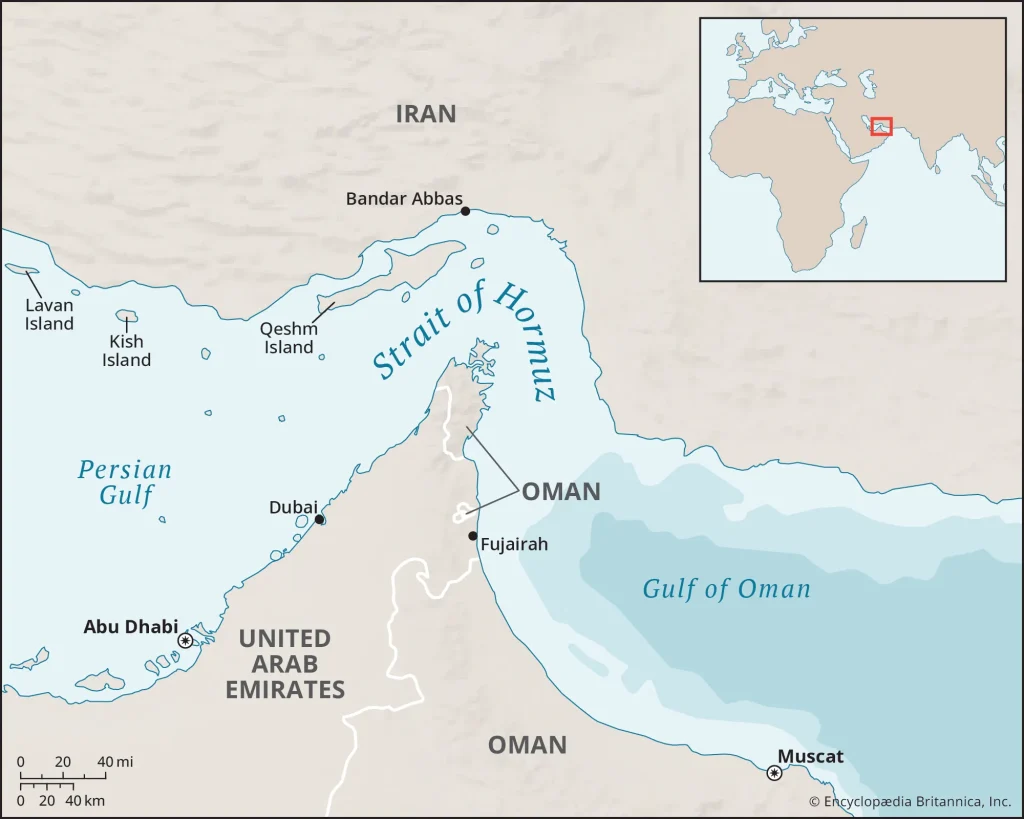
Legally, Iran and Oman own the territorial waters; no state owns the right of transit passage. Practically, the side that can provide credible protection currently shapes which ships move.
Full legal and political analysis: Who owns the Strait of Hormuz? Iran, Oman, or nobody
Frequently Asked Questions
Is the Strait of Hormuz closed today? Yes, for practical commercial purposes. Physical transit is possible only under heavy escort and extreme risk.
How many ships are passing through the Strait of Hormuz today? Recent daily figures range from 1 to 9 commercial vessels (Kpler and IMF PortWatch data). Pre-war normal was 130+.
Is there a live map of Strait of Hormuz traffic? Yes — see straits.live, hormuz.data-tracking.net and tankermap.com for current AIS-based views (with the caveat that many vessels are dark or jammed).
Can ships still go through the Strait of Hormuz? A limited number can, primarily on the southern corridor under U.S. Navy escort. Most commercial operators choose not to.
What would reopen the strait fully? A durable political agreement that removes the threat of attack, lowers insurance costs, and restores confidence among shipowners and insurers. No such agreement currently exists.
How We Update This Page
This page is checked against the main public monitors (straits.live, straitofhormuz.report, Kpler reports, IMF PortWatch) and will be refreshed whenever material changes occur in traffic volume, official statements, or major incidents.
Related articles on TodayWhy