
Last Updated on 1 month ago by TodayWhy Editorial
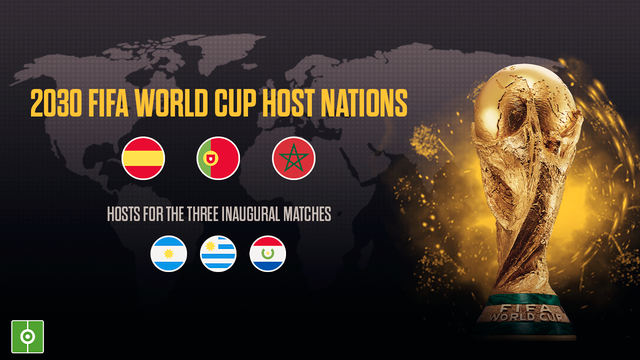
The 2030 World Cup will be played across six countries on three continents — a first in the tournament’s history. Spain, Portugal and Morocco will host the bulk of the games, while Uruguay, Argentina and Paraguay will each stage a single centenary match before the tournament moves to Europe and Africa.
Here’s why FIFA landed on this unusual format, and how it will actually work.
Why six countries instead of three?
The core reason is timing: 2030 marks the 100th anniversary of the very first World Cup, which Uruguay hosted and won in 1930. FIFA decided to mark the centenary by returning, briefly, to where it all began.
Uruguay will host a match in recognition of staging that inaugural tournament. Argentina gets a game because it was the runner-up in 1930, losing the first-ever final 4-2 to Uruguay in Montevideo. Paraguay’s match honors its role as home of CONMEBOL, South America’s football confederation and, at the time, the only continental confederation in existence.
How the schedule actually works
According to FIFA’s proposed calendar, the three centenary matches take place in Uruguay, Argentina and Paraguay on June 8 and 9, 2030. After a short break, the main opening ceremony and first matches in Morocco, Portugal and Spain follow on June 13 and 14. Teams whose group includes Uruguay, Argentina or Paraguay then begin their own campaigns on June 15 and 16, with second-round group matches on June 21 and 22. The final is expected on July 21, 2030, though FIFA hasn’t yet confirmed the complete match schedule.
To offset the logistics, teams playing their opening match in South America get roughly 11 to 12 days to travel, recover and prepare before their second group game — far more than the usual turnaround, and more than the five to six days other teams get.
Why Spain, Portugal and Morocco won the main hosting rights
Spain, Portugal and Morocco submitted a joint bid, and it was formally confirmed as the sole candidacy for the event by the FIFA Council in October 2023, later ratified at an Extraordinary FIFA Congress in December 2024. It will be the first time the event returns to Spain in 48 years, and the first time ever for Portugal and Morocco as hosts.
All six host countries — Spain, Portugal, Morocco, Uruguay, Argentina and Paraguay — qualify automatically, without needing to go through continental qualifying tournaments.
What comes after 2030?
The 2034 World Cup moves to a single host nation, Saudi Arabia, confirmed in December 2024 after it emerged as the only bidder. Unlike 2030’s six-country format, the entire 2034 tournament will be staged in one country.
Could it expand further?
The 2030 tournament is currently planned for 48 teams, the same format introduced in 2026. However, FIFA President Gianni Infantino has said the organization will examine a proposal to expand to 64 teams, describing the 48-team format as a “huge success” that has broadened global participation. Whether that expansion happens, and how it would affect the centenary schedule, remains an open question.
Frequently asked questions
Why is the 2030 World Cup in six countries?
FIFA is marking the tournament’s 100th anniversary by staging three centenary matches in Uruguay, Argentina and Paraguay — the host, runner-up, and confederation headquarters of the first World Cup in 1930 — before the rest of the tournament is played in Spain, Portugal and Morocco.
Which countries have already qualified for the 2030 World Cup?
All six hosts — Spain, Portugal, Morocco, Uruguay, Argentina and Paraguay — qualify automatically.
When is the 2030 World Cup final?
It’s expected to be played on July 21, 2030, though FIFA has not yet released the full match schedule.
Where is the 2034 World Cup?
Saudi Arabia, as the sole host — a return to the traditional single-country format.
Sources: Al Jazeera, July 19, 2026; FIFA official announcements, 2023–2024.