
Last Updated on 4 months ago by TodayWhy Editorial
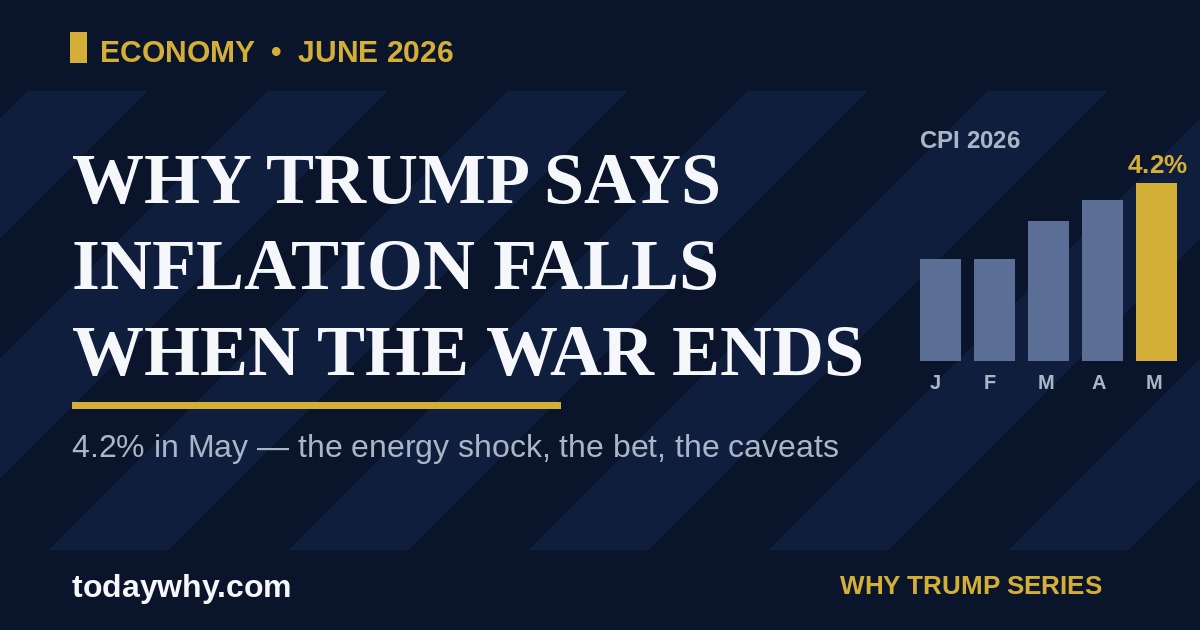
US inflation hit 4.2% in May — the highest reading since April 2023 — and President Trump’s response has been consistent: the number is the war, and the war is about to end. After canceling the June 11 strikes and declaring a deal with Iran imminent, he argued that recent figures point to an even bigger decline in inflation once the conflict is over.
Is that a campaign line or an economic forecast? The honest answer: the claim has more data behind it than critics usually concede — and more caveats than the White House mentions. Here is both sides of the ledger.
The Numbers: How the War Rebuilt Inflation
The trajectory tells the story by itself. Inflation stood at 2.4% in January and February 2026 — elevated but cooling. Then the war began on February 28, Iran moved against the Strait of Hormuz, and the line bent upward: 3.3% in March, 3.8% in April, 4.2% in May — three consecutive accelerations.
Inside the May report, the cause is unambiguous. Energy prices rose 23.5% year over year, with gasoline up 40.5% and fuel oil up 58.9%. The Labor Department attributed more than 60% of the month’s CPI increase to energy alone. The national average gas price crossed $4 per gallon this spring for the first time in over three years.
The mechanism runs through one waterway. Per the US Energy Information Administration, the Strait of Hormuz normally carries oil equal to about one-fifth of global petroleum liquids consumption. The Federal Reserve Bank of Dallas modeled a full Gulf export halt as a roughly 20% disruption of global oil supplies, with crude prices peaking in April–May and staying above $80 per barrel throughout 2026 — adding 1.7 percentage points to annualized headline inflation in the first quarter alone. America imports little oil through Hormuz directly, but oil is priced globally; Tehran’s chokehold reaches every US pump.
The Case for Trump’s Claim
Three features of the data genuinely support the argument that peace would pull inflation down fast.
It’s an energy shock, not broad overheating. Core inflation — stripping out food and energy — sits at just 2.9%, and its monthly rise in May actually came in below forecasts. Analysts note higher energy prices have largely not spilled into other categories beyond airfares. That matters: shock-driven inflation reverses when the shock does, unlike the demand-driven inflation of 2021–22.
The reversal mechanism is concrete. A signed deal that reopens Hormuz restores a fifth of global oil flow and unlocks most of the world’s spare production capacity. Oil markets move on Hormuz headlines within minutes — they would reprice a confirmed peace within days, and gasoline would follow within weeks. Fuel prices have already eased slightly in early June on deal optimism.
Forecasters see a peak, not a plateau. Some economists already expect May to mark the 2026 high, with easing later in the year even without a deal. A deal would compress that timeline. The Federal Reserve has implicitly endorsed the “temporary shock” reading by holding rates at 3.5%–3.75% and keeping a 2026 rate cut on the table rather than hiking into the spike.
This is why the inflation argument and the Iran deal are, for Trump, the same project: peace is his fastest available lever on the number voters feel most, and the May report — paradoxically — strengthens the case that the lever would work.
What the Claim Leaves Out
Tariffs are the other engine. Even before the war, tariff pass-through was feeding consumer prices, and the OECD expects both the war and tariffs to exert longer-term price pressure — it forecasts US inflation at 4.2% for 2026 if disruption persists, notably above the Fed’s own outlook. The Tax Foundation estimates the 2026 tariff regime amounts to an average tax increase of about $1,500 per US household. Ending the war removes the energy shock; it does not touch the tariff architecture the administration is actively rebuilding.
The baseline is sore. Fact-checkers note average gas prices today exceed those of most of the previous administration’s tenure — so even a meaningful post-deal decline would return prices to levels voters already disliked, not to the multi-year lows the White House has promised.
The deal isn’t signed. Every part of the disinflation scenario depends on a document Tehran has not yet confirmed. If the agreement stalls — as previous deadlines did in February, March, and April — the energy shock persists, and 4.2% stops looking like the peak.
What to Watch Next
Three checkpoints will test the claim in real time. First, tanker traffic through Hormuz: physical transits resuming would be the earliest hard evidence the shock is unwinding. Second, the June CPI report in mid-July — the first reading that could capture a post-deal energy decline. Third, the Fed’s next meetings: a confirmed peace plus falling headline inflation would put the penciled-in 2026 rate cut back in play, compounding the economic boost the administration is counting on.
The fair summary: Trump’s inflation claim is directionally sound — this is a war-driven energy spike, and ending the war would genuinely bring headline inflation down. The contested part is magnitude and destination: how far it falls, how fast, and whether tariffs keep the floor higher than voters expect. For how this front connects to the war, the trade fight, and the rest of the agenda, see the pillar guide: Why Trump Dominates the News in 2026.
FAQ: Trump, Inflation, and the Iran War
Why does Trump say inflation will fall after the Iran war?
Because the 2026 spike is overwhelmingly an energy story: energy drove more than 60% of May’s monthly CPI increase, with gasoline up 40.5% year over year, all traced to the war and the Hormuz closure. His argument is that a peace deal removes the shock at its source.
How high is US inflation right now?
4.2% annually as of May 2026 — the highest since April 2023, up from 2.4% in January before the war. Core inflation is much lower at 2.9%.
Is the Iran war really the main cause?
Of the 2026 spike, yes — the timing and composition of the data make that clear. But tariffs also continue to pass through into prices, which is why peace alone wouldn’t return inflation fully to the Fed’s 2% target.
What does the Strait of Hormuz have to do with US prices?
It normally carries about one-fifth of global petroleum liquids consumption; the Dallas Fed modeled its closure as a ~20% global supply disruption keeping crude above $80 all year. Oil is priced globally, so the closure hits American pumps despite minimal direct US imports through the strait.
When could inflation start falling?
Some economists see May as the 2026 peak even without a deal, and gas prices already eased slightly in early June. A signed agreement reopening Hormuz would accelerate the decline; the June CPI report in mid-July is the first checkpoint.
What is the Federal Reserve doing?
Holding rates at 3.5%–3.75% and treating the spike as a shock to look through, helped by contained core inflation. One 2026 rate cut remains penciled in, contingent on the war and prices.
The Why Trump series: Why Trump Dominates the News in 2026 | Why Trump Canceled the Strikes on Iran | Why the Strait of Hormuz Closure Is Pushing Oil Prices Sky-High | Why Trump Is Rebuilding His Tariff Engine