
Last Updated on 1 month ago by TodayWhy Editorial
On Tuesday, 1 September 2026, search boxes filled with the same cluster: Dyson toothbrush, Dyson CameraJet, Dyson electric toothbrush, toothbrush with a camera. The spike is not a leak. James Dyson unveiled the product in Paris that morning. The official name is CameraJet. The price is $499 in the United States, £419.99 in the United Kingdom and about €479 in the eurozone. Pre-orders opened the same day in Dyson’s own stores and selected retailers.
The short answer to why Dyson toothbrush is a habit the company thinks almost nobody keeps. Nine in ten people, Dyson says, do not floss as often as dentists want. The average brush lasts about 45 seconds, not the recommended two minutes. Plaque starts in the gaps. So Dyson spent six years putting a 100,000-pixel macro camera, an AI model and a conical jet of mouthrinse into one handle, so the floss happens while you brush.
That is the pitch. Whether a $499 Dyson toothbrush is a dental upgrade or a very expensive gadget is the rest of this page.
What the Dyson toothbrush actually is
CameraJet is Dyson’s first oral-care product. It is not a rebadged Oral-B. It is a sonic electric toothbrush with three extra systems stacked into the head and neck:
- a 100k-pixel macro lens and LED sitting under the bristles
- Gap Optical Targeting, Dyson’s machine-learning model trained on about 470,000 dental images
- a 12.5 ml reservoir that fires a conical burst of mouthrinse into a gap within 100 milliseconds of the camera seeing it
The camera analyzes 28 live frames per second. The jet is not a Waterpik needle stream. Dyson calls competing flossers “needle jets” and says those punch a hole through plaque without lifting it. The CameraJet spray is a cone of microdroplets, designed to cover a wider interdental space at lower pressure. The tank is small on purpose: targeted bursts, not a 60-second flood.
The brush itself uses what Dyson brands as variable sonic oscillation — up to 58,000 vibrations a minute, with the angle of oscillation changing so bristles do not stall when you press. Dual bristles: firmer inner filaments for stains, softer outer filaments for the gumline. An RFID chip in the head counts cleans and tells the app when to replace it. A sensitive head is also on the price list. Official specs list the handle at 228 g and 273 × 44 × 44 mm, with about 10 days of battery and an 8-hour full charge.
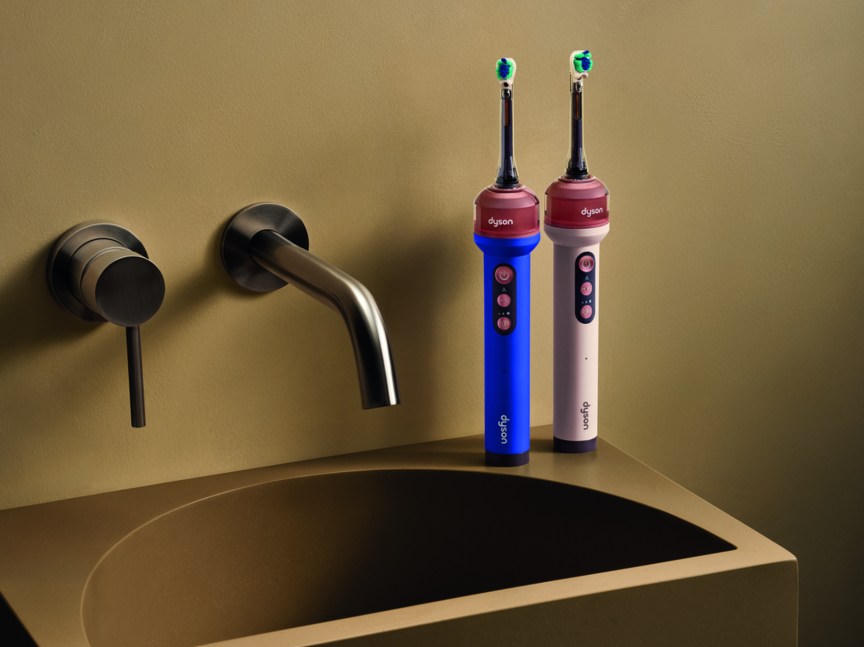
In the box: the handle, a refill dock that both charges the battery and tops up the 12.5 ml tank in about three seconds, two regular heads, a charging cable and a travel case. Colors are Ceramic Ultra Blue and Ceramic Pink. Dyson’s own non-foaming, SLS-free toothpaste and a low-foam mouthrinse are sold as a “Dental System” add-on. Foam would blind the camera. That is not a marketing flourish. It is an optical constraint.
Why Dyson built a toothbrush at all
James Dyson’s launch line is the brief. “Flossing is an awkward and time-consuming chore. Few of us do it even though we know we should.” He framed three engineering problems: see the gaps, remove the plaque that lives there, and keep the bristles moving while you brush. The company says 661 engineers, 38 patents and 16 million lines of code went into the answer. Development ran six years after more than a decade of oral-care research, including a five-year collaboration with the National University of Singapore’s Faculty of Dentistry on a proxy plaque for lab tests.
This is the same Dyson pattern as the bagless vacuum and the hair dryer without a hot grill: take a daily object people already own, decide the incumbent design is lazy, then over-engineer a premium replacement. Oral-B and Philips already sell app-connected brushes that map coverage and shout at you about pressure. None of them put an endoscope in the head and fire rinse on a 100-millisecond trigger. That gap — literally — is why a vacuum company is now in the bathroom aisle.
It is also why the search term is Dyson toothbrush and not “CameraJet.” People type the brand plus the object. They do the same with Airwrap, Zone and the stick vac. The product name is for the press kit. The query is the category grab.
Why the $499 price is the second search
Five hundred dollars is a lot of money for something that lives next to the tap. It is also not an outlier at the very top of the electric-toothbrush market. Flagship Oral-B iO and Philips Sonicare models have listed well above $300, and some bundles have touched far higher. Dyson is pricing CameraJet as a hybrid: one device instead of a premium brush plus a cordless water flosser.
The honest cost is not only the handle. Brush heads need replacing on the usual three-month cycle; early reports put a two-pack around €30 / about £25. Mouthrinse and the non-foaming paste are extra once the starter sachets run out. Metro’s first-look math put consumables above £200 a year if you stay inside Dyson’s own system. That is the subscription layer every Dyson category eventually grows — filters, fluid, heads — and it is why “is the Dyson toothbrush worth it” will sit next to the launch query for months.
Availability on day one: Dyson.com, Dyson Demo Stores, and in the US a retail list that includes Amazon, Sephora, Best Buy and Costco. Singapore listed S$699. Taiwan listed NT$16,990. Australia listed A$799. The number changes with tax and channel. The positioning does not.
Does the camera actually help — and who sees the pictures?
The medical claim to watch is narrow. External lab testing, Dyson says, shows CameraJet removes up to 69 percent more plaque than “market-leading premium electric toothbrushes” in hard-to-reach areas — in brush-only variable mode, on the company’s proxy plaque, not as a published multi-center clinical trial of cavities prevented. A separate four-week Italian study of 60 people is being cited in European coverage for plaque and gum-inflammation numbers versus manual brushing. That is a different comparison. Read the asterisk before you throw out the floss.
Dentists will still want string or an interdental brush in many mouths. Crowns, tight contacts, implants and orthodontics are not a 100-millisecond jet’s ideal customer. CameraJet is a compliance machine for people who already skip the second step. It is not a diagnosis tool and Dyson does not claim it treats gum disease.
Privacy is the other half of “why a camera.” Dyson’s line, repeated in the official release and in WIRED’s launch write-up, is specific: the camera is active only during live view in the MyDyson app or while auto-jetting. No images are recorded or stored on the device or in the cloud. A light on the handle shows when the lens is on. You can brush without opening the app at all. If you do open it, you get a live intraoral feed, coverage mapping, guided cleans and how-to films. James Dyson has joked about sticking the same camera in an ear. That is not a listed feature.
Believe the no-storage claim or not, the architecture is the same one Dyson already uses on robot vacuums and some purifiers: process on device, do not keep the picture. The uncomfortable part is cultural, not cryptographic. A lot of people do not want a livestream of their molars on the same phone that holds their banking app. That tension is part of why the query exists.
Why searches spiked on 1 September 2026
Four things landed in the same hour.
- The category jump. Dyson does floors, hair, air and now teeth. Every new category produces the same search shape: brand + everyday object.
- The camera. “Toothbrush with a camera” is a sentence that writes its own headline. It is also the feature people either want explained or want banned.
- The price. $499 / £420 / €479 is a number people check against Oral-B and Sonicare before they decide if they are angry or tempted.
- The floss problem. Public-health copy about skipped flossing is old. A gadget that claims to delete the chore is new. WHO still puts oral disease in the billions of cases; Dyson’s briefing cited that backdrop without turning CameraJet into a medical device.
Patents for a Dyson brush-plus-reservoir go back years. Trade press asked “is Dyson about to launch an electric toothbrush?” as early as 2025. 1 September 2026 is when the rumor became a SKU.
How you are supposed to use it
Early testers say the technique is not “hold it like every other sonic brush.” Dyson wants a more horizontal grip and slow oval passes so the camera can see the next gap before the head is over it. AutoJet can be switched off. A button fires a manual burst. The dock refills the tank from a bottle so you are not pipetting 12.5 ml by hand. Empty and rinse the reservoir after use; leftover liquid is not meant to sit until tomorrow.
The app is optional for cleaning and mandatory if you want the live view, coverage map or replacement alerts. Bluetooth plus 2.4 GHz Wi-Fi. Features vary by market. None of that changes the basic loop: charge and fill on the dock, brush, jet, spit, put it back.
What this is not
It is not a dentist. It is not a replacement for check-ups, radiographs or treatment of existing decay. It is not proof that string floss is obsolete. It is not cheap. It is not a vacuum accessory, despite a decade of people calling every Dyson attachment a “brush.” And it is not, on day one, a product with years of independent clinical follow-up. The 69 percent figure is a lab comparison in a defined mode. Treat it as a manufacturer claim until journals and hygienists have used the thing for a year.
Dyson has also shipped hybrids that did not become category defaults — the Zone air-purifying headphones being the usual cautionary slide. CameraJet is more practical than that pairing. Whether it becomes the Airwrap of the bathroom or a $499 curiosity depends on heads, fluid cost and whether the jet feels like flossing or like being squirted.
Frequently asked questions
Why Dyson toothbrush — what launched?
The Dyson CameraJet, announced 1 September 2026 in Paris. It is an electric toothbrush with a built-in camera and a precision mouthrinse jet that fires when the camera sees a gap between teeth.
How much is the Dyson toothbrush?
$499 in the US, £419.99 in the UK, about €479–480 in the eurozone. Two colors. Dock, two heads, cable and travel case included. Paste and rinse extra after the starter kit.
Does it replace flossing?
Dyson designed it so you do not have to floss as a separate step. Dentists may still recommend string, tape or interdental brushes depending on your contacts, restorations and gum health. The device is not a licensed treatment for periodontal disease.
Does the camera record my mouth?
Dyson says no. The lens is on only for live view or auto-jetting. Images are not stored on the brush or in the cloud. A handle light shows when the camera is active.
Why does Dyson sell its own toothpaste?
Ordinary foaming paste (typically with SLS) would block the camera. The company made a non-foaming gel so Gap Optical Targeting can keep seeing enamel versus gap.
Is this Dyson’s first health product?
It is the first dedicated oral-care device. Dyson already sells air treatment, lighting and, briefly, the Zone headphones. CameraJet is positioned as the first piece of a wider Dyson Dental System, including consumables and possible refill subscriptions.
The bottom line on why Dyson toothbrush
People are searching Dyson toothbrush on 1 September 2026 because a company famous for sucking dirt off floors has decided the unsolved problem in the bathroom is the gap you never floss. CameraJet is a $499 answer: see the space with a camera, wash it with a cone of rinse, keep the bristles from stalling, sell the fluid later. The engineering is real. The price is Dyson. The clinical file is still a lab graph plus a small human study.
If you want the same “why is this suddenly everywhere” treatment of other launch-day spikes, TodayWhy keeps the same format for market days and product shocks — from why the stock market is down today to why gold ran so hard in 2026 and how we write these explainers. The sentence that matches the search is simple. The Dyson toothbrush exists because Dyson thinks you will not floss unless the brush does it for you.