
Last Updated on 1 month ago by TodayWhy Editorial
Updated 31 August 2026. Gold is not at its January record. It did just have one of its strongest Augusts in a generation — then gave a chunk back in a day.
Why gold price is near record highs is still the search. The honest snapshot on 31 August 2026 is more specific. Spot gold is trading around $4,440–$4,460 an ounce, roughly 10 percent above where August began near $4,040 and about 27–29 percent higher than a year ago. That is not the all-time high. The peak this year was around $5,600 in January. What people are reacting to is the late-summer rebound: gold ran from the low $4,000s in late July toward the mid-$4,600s — futures prints even poked above $4,730 — before a sharp drop on 28 August after the new Federal Reserve chair spoke at Jackson Hole.
Three engines explain the month. A US Treasury plan to double long-bond buybacks revived the “debasement” trade. The Iran war never left the price. And investment demand — ETFs, not just central banks — came back. The brake is the same as always: real yields and a Fed that is talking hikes again.
Where the gold price actually stands today
Real-Time Gold Price Chart
Treat the tape as a staircase, not a straight line.
- January 2026: all-time high near $5,600 an ounce.
- Late July: the fade bottomed close to $4,040–$4,050.
- 11–12 August: a bounce toward $4,400–$4,435 — the level the earlier version of this article froze on, after a weak US jobs report.
- 19–25 August: the real leg. After Treasury said it would at least double buybacks of 10-to-30-year bonds, spot gold pushed through $4,500 and printed three-month highs around $4,650–$4,695. August was on track for one of the strongest monthly gold performances since the late 1990s.
- 28 August: a one-day air pocket. Spot dropped on the order of 3 percent, from the mid-$4,600s toward about $4,455, as Chair Kevin Warsh’s Jackson Hole speech lifted rate-hike odds.
- 31 August: a grind near $4,450. Still up on the month. Still a long way from January.
Silver travelled with it — back above $70 at the August peak, nearer $67 into the month-end pullback. Live prints move; use Trading Economics or the LBMA fix for the exact tick. The shape matters more than the last decimal.
Why the August rally was not just “Iran again”
Safe-haven demand is real. The war that began in late February is in its sixth month. Oil spent parts of August back toward $90. That alone would have supported bullion. It does not explain the speed of the mid-month jump.
The catalyst that changed the narrative was fiscal, not kinetic. On 19 August the US Treasury said it would raise the cap on liquidity-support buybacks of longer-dated nominal Treasuries from $2 billion to at least $4 billion per operation in the 10–20 and 20–30 year sectors, from 9 September through 4 November. Secretary Scott Bessent then said the size “could be more than the $4 billion per issue.” Yields fell the day of the announcement. Gold jumped and kept climbing after the bond rally faded.
That is the debasement trade in one paragraph. If the government is buying its own long bonds to cap yields while debt heads toward $40 trillion, investors read it as more paper, not more discipline. Gold does not need a rate cut to rally on that story. It needs the market to believe the Treasury is managing the long end because the long end is a problem. Reuters and subsequent market notes framed the buyback as the spark; ING and others said the follow-through was about fiscal credibility, not just lower yields.
Why interest rates still decide the next 200 dollars
Gold pays no coupon. When real yields rise, the opportunity cost rises with them. That is why the same metal that ignored a week of Iran headlines can drop 3 percent on a speech.
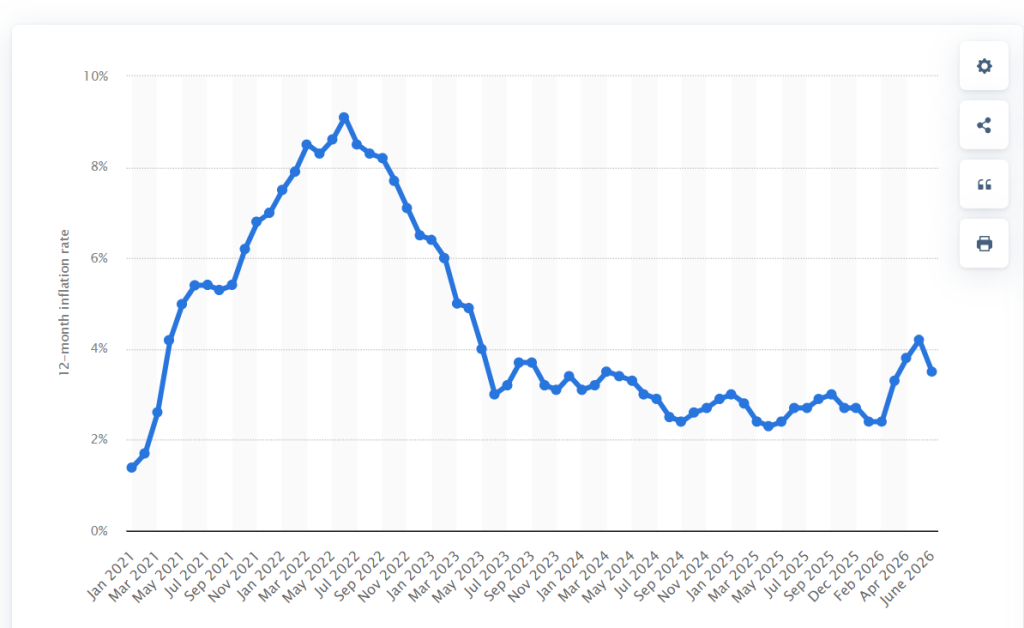
Kevin Warsh marked his 100th day as Fed chair at Jackson Hole on 28 August. He did not pre-commit to September. He did say the economy had “strengthened,” that Main Street and Wall Street had been “remarkably resilient” to shocks, and that inflation remains the dominant problem — PCE at 3.7 percent over twelve months and 4.1 percent over six, with more of the basket still running hot than before the pandemic. Traders lifted the odds of a quarter-point hike at the 15–16 September meeting toward the mid-50s, from the mid-30s before the speech. The two-year yield jumped. Gold sold off.
That is the tension inside why gold price is near record highs in late August. The fiscal story wants the metal higher. A Fed that is willing to hike into an oil spike wants it lower. The July jobs shock that first restarted the rally — a 23,000 payroll decline and downward revisions that crushed the trailing twelve-month average — is still in the data. It is no longer the only input.
Why central banks and ETFs both matter now
Official-sector buying was the quiet floor under gold for two years. It still is. What changed in July and August is the investment account. The World Gold Council tracked about $3 billion of inflows into gold-backed ETFs in July, adding 23 tonnes. Fund flow notes in mid-August pointed to one of the strongest single-day accumulation prints in almost a year. That is not a central bank in Singapore. That is Western money coming back after a summer spent waiting.
Seasonal physical demand from India and China has been described as quieter than the paper rally. If that stays true, the August move is tactical — funds and fear — rather than a jewelry-led squeeze. Tactical rallies give back faster when the Fed talks.
Why the Iran war is support, not a one-way bid
Over the weekend of 30–31 August, US forces struck two Iranian launchers on Larak Island in the Strait of Hormuz — the first acknowledged American strikes on Iran since late July. Tehran said it hit US positions in Jordan. Brent jumped back through $90. That is the same oil-inflation loop this site has tracked on why fuel costs stay high and on why the stock market is down today.
Gold’s reaction into Monday was muted compared with mid-August. That is the tell. When the metal already rallied 15 percent on fiscal headlines, a fresh Hormuz scare is an overlay, not a reset. If Kharg Island — Iran’s main export terminal — were verifiably hit, oil and gold would both reprice harder. As of Monday morning that claim had not been confirmed by the US military.

Is gold actually “near record highs”?
Relative to January: no. $4,450 is roughly 20 percent below $5,600. Relative to the summer low: yes. Relative to any year before 2025: still historically extreme. The search query flattened a year of violence, rate cuts, rate-hike scares and a Treasury experiment into one phrase. The useful version is: gold spent 2026 proving it can lose a thousand dollars and still look expensive, then proving it can recapture $600 in three weeks when the bond market blinks.
Bank targets remain scattered above the tape — JPMorgan’s $6,000 call sits well above spot; others cluster between $4,600 and $5,400. Targets are not a bid.
What could move the price next
- 15–16 September FOMC. A hike would pressure gold. A hold with hawkish language already did, on 28 August.
- Treasury buyback operations from 9 September. Size and follow-through will test the debasement story.
- Hormuz and Kharg. A verified export-terminal hit is a different oil shock than a launcher strike.
- ETF flows. If July–August inflows reverse, the August high becomes a ceiling.
Frequently asked questions
Why is the gold price near record highs in 2026?
Because the January record near $5,600 reset the scale, and the August rebound toward $4,700 put the metal back in the headlines. The drivers are fiscal fear, the Iran war, and returning ETF demand — offset last week by a hawkish Fed.
What is the gold price today, 31 August 2026?
Spot is around $4,440–$4,460 an ounce after Friday’s drop. Check a live feed for the print.
Did gold make a new all-time high in August?
No. August made a three-month high, not a record.
Why did gold fall on 28 August?
Kevin Warsh’s Jackson Hole speech lifted odds of a September rate hike. Higher expected real rates are gold’s least favorite headline.
The bottom line
Why gold price is near record highs in 2026: the record was January; the scare-rally was August; the reminder that the Fed still exists was 28 August. As long as Treasury is buying its own long bonds and the Strait of Hormuz is a war zone, the floor is higher than it was in 2024. As long as the chair talks hikes, the ceiling is lower than the January spike. That is the market, not a slogan. More context sits on how TodayWhy reports these tapes.