
Last Updated on 3 months ago by TodayWhy Editorial
SpaceX stock did not exist a year ago. Today it trades on the Nasdaq under the ticker SPCX, and it belongs to one of the biggest companies on Earth by market value. If you searched for “SpaceX stock price” and were confused about how a private rocket company suddenly became something you can buy, here is the full story.
What actually happened
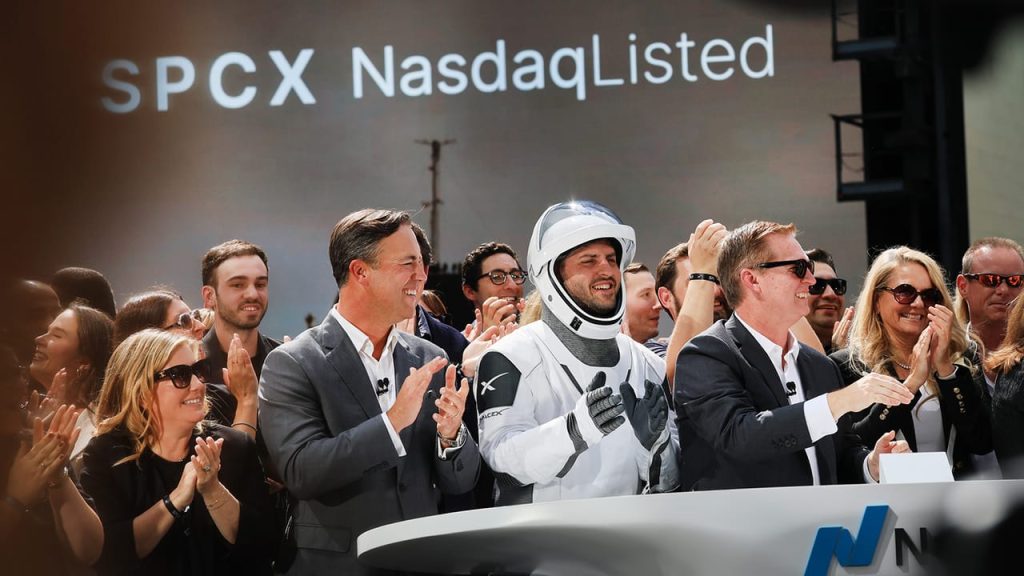
On June 11, 2026, SpaceX priced its initial public offering at $135 a share, selling 555,555,555 shares. That raised $75 billion — the largest IPO in history, easily beating Saudi Aramco’s $29.4 billion listing in 2019.
Shares began trading the next day and jumped as much as 30% on day one, briefly pushing SpaceX’s market value above $2.25 trillion. That single event made Elon Musk the world’s first trillionaire, at least on paper.
SpaceX isn’t just rockets anymore, either. Earlier in 2026 it absorbed Musk’s AI company xAI, so the SPCX ticker now covers Falcon rockets, Starlink internet, and a growing artificial intelligence business all at once.
Real Time SpaceX stock price:
Why Spacex stock fell
The SpaceX stock has fallen due to several factors:
- Sputtering Demand: Investors are moving past the initial public offering (IPO) and are taking a closer look at the company’s bottom line, leading to a decline in stock price.
- Valuation Concerns: The stock has fallen below its IPO price, raising concerns about its valuation and potential for future growth.
- Profit-Taking:
Many investors are booking profits after the stock’s rapid rise following the IPO, contributing to the overall decline. - Uncertainty Surrounding SpaceX: Analysts express uncertainty about the company’s ability to generate sufficient profits to justify its current valuation. These factors combined have led to a significant drop in SpaceX’s stock price, which has now fallen 40% below its peak.
Why SpaceX went public now
For years, Musk insisted SpaceX would stay private. Two things changed that. First, the company’s valuation had climbed so high that early investors and employees wanted a way to cash out. Second, SpaceX needed cash — a lot of it — for AI computing infrastructure, launch facilities, and its satellite fleet, and public markets are the fastest way to raise tens of billions of dollars at once.
SpaceX isn’t going it alone. ChatGPT maker OpenAI and Claude developer Anthropic have both filed paperwork for their own mega-IPOs later this year. Analysts are already calling this trio the biggest test yet of how much investors trust the AI boom.
Why it matters even if you didn’t buy the stock
Nasdaq and other index providers fast-tracked SPCX into their major indexes. That means retirement funds and other passive investment vehicles that track those indexes now have to hold SpaceX shares, whether individual investors chose to or not.
That concentration cuts both ways. SpaceX now sits among the ten most valuable public companies. If its stock swings hard on a single earnings report, that shock ripples through far more portfolios than just the people who deliberately bought SPCX.
The risks worth knowing before you chase the ticker
SpaceX is not yet profitable. It posted a net loss of roughly $5 billion last year even as revenue grew to about $18.7 billion, and capital spending — much of it now going toward AI — has more than doubled year over year.
There’s also a control issue. Musk kept more than 80% of voting power through the IPO structure, meaning public shareholders own a piece of the company but have almost no say in how it’s run. As NPR reported, analysts describe buying SPCX as less a bet on the business model and more a bet on one person’s judgment and attention, at a time when Musk is running multiple companies at once.
SpaceX’s debut also landed in the middle of a jumpy stock market, one already swinging on oil prices and AI-stock selloffs. That backdrop is exactly why Vanguard and other advisors have urged retail investors to treat SPCX as a speculative position, not a core long-term holding, until the company proves it can turn its scale into steady profit.
Why SpaceX shares (SPCX) down
After peaking above $225 following its landmark IPO, SpaceX shares (SPCX) have fallen under pressure, sliding below their $135 IPO price to around $122–$124.
Several fundamental, technical, and macro factors have driven this pull-back:
1. High Valuation & Post-IPO “De-bubbling”
- Aggressive Pricing: At its peak, SpaceX’s market capitalization surged past $2.5 trillion. At current levels, its price-to-sales multiple remains near 87×, with a market cap to adjusted EBITDA ratio over 240×.
- Profit-Taking: After the initial post-listing surge, initial narrative-driven momentum wore off, leading early buyers and institutional investors to lock in profits.
2. Massive AI Cash Burn vs. Unproven Space Data Centers
- Folding in AI: Following its integration with xAI and aggressive expansion into AI infrastructure (including plans for orbital data centers and large language model compute), SpaceX shifted from a net-profitable rocket/satellite provider to posting massive quarterly net losses.
- Capital Expenditures: SpaceX burned over $12.7 billion in its AI segment alone during 2025. Investors are questioning whether massive capital spending on AI will deliver timely returns, especially as low-cost foreign AI models challenge American “compute-heavy” infrastructure strategies.
3. Starship Test Delays
- Flight testing of Starship V3 experienced recent last-minute scrubs and engine-ignition anomalies. Because Starship is critical to scaling next-generation Starlink satellites and reducing payload launch costs, flight delays directly impact investor confidence in growth timelines.
4. Lock-Up Expirations & High Short Interest
- Supply Pressure: Due to a relatively small initial free float (around 5% of total shares), the upcoming release of early insider share lock-ups—which could allow up to 911+ million shares to hit the market—is creating anticipation of increased selling pressure.
- Heavy Short Selling: Short interest on SpaceX has risen sharply, with nearly 30% to 49% of the available float borrowed by short sellers betting on valuation normalization.
5. Broader Tech & Debt Market Headwinds
- Debt Load: SpaceX recently issued over $20–$25 billion in corporate bonds to fund its AI and launch infrastructure, sparking market anxiety regarding leverage and interest burdens.
- Sector Pullback: Higher yields and macro growth concerns across high-beta tech stocks have led investors to reduce exposure to non-profitable, capital-intensive megacaps.