
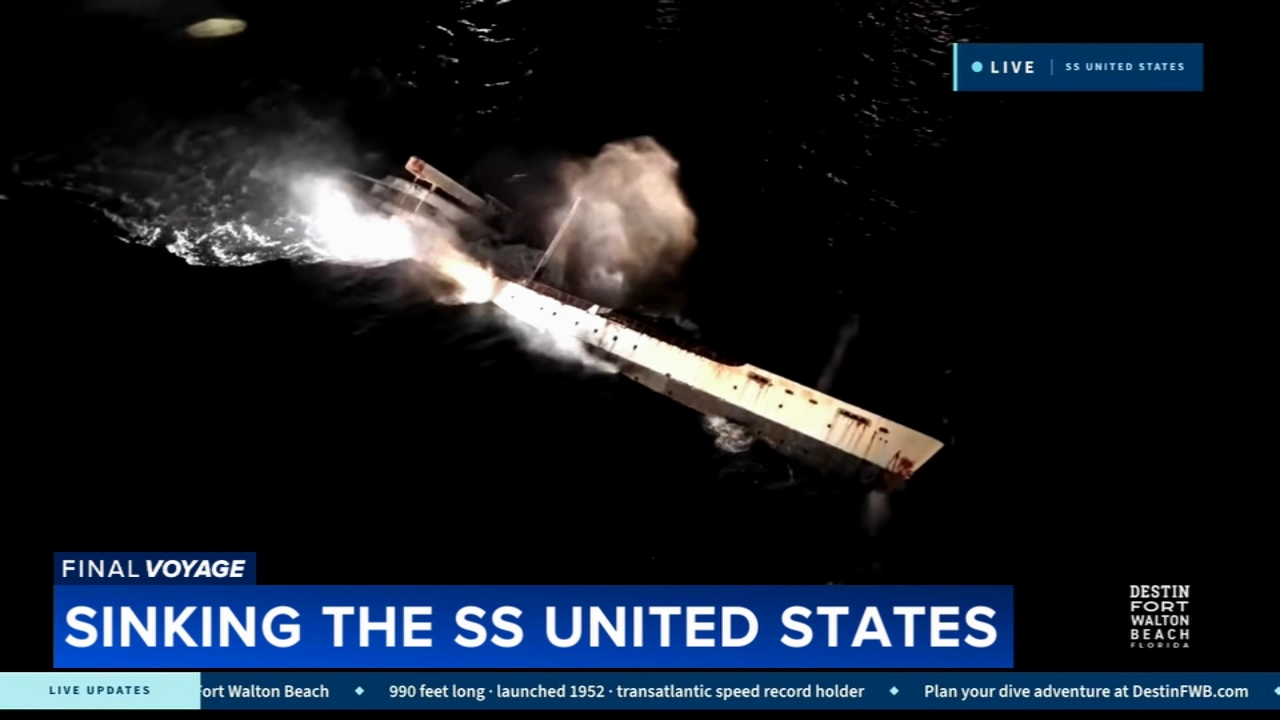
Why did they sink the SS United States? On Wednesday night, November 11, 2026, America’s historic 990-foot flagship ocean liner—which still holds the all-time transatlantic speed record set on her 1952 maiden voyage—was intentionally flooded and sunk 22 nautical miles southwest of Destin-Fort Walton Beach, Florida, to become the world’s largest artificial reef. Rather than allowing the rusting vessel to be cut up for scrap metal after a federal court eviction from her long-time berth in South Philadelphia, Florida’s Okaloosa County purchased the ship for $1 million inside a $13 million eco-tourism project designed to transform the 53,330-ton hull into a permanent marine habitat and scuba diving mecca.
Because millions of viewers watched the marathon livestream and immediately asked why did the ss united states sink hours after dark instead of in the afternoon as planned—and why preservationists could not turn her into a floating hotel like the RMS Queen Mary—the full story involves Cold War military naval architecture, an irreversible 1990s asbestos gutting in Ukraine, and strict federal environmental laws that banned the use of explosives. Below is the complete engineering, financial, and ecological breakdown of why the SS United States was sunk and what happens next on the Gulf seafloor.
| Key Reef & Vessel Metric | Official Specification / Timeline | Why It Matters for the Sinking |
|---|---|---|
| Official Sinking Date & Time | Wednesday, November 11, 2026 (Submerged at 8:59 p.m. CST / 9:59 p.m. EST) | Moved up 24 hours from Nov. 12 due to Gulf wind forecasts; coincided with Veterans Day |
| Expected vs. Actual Sinking Duration | Projected: 45–90 minutes • Actual: ~8 hours from 1:00 p.m. CST deployment (~5 hours of active flooding) | EPA rules barred explosives; seawater was pumped through boiler cooling pipes into 2-inch steel compartments |
| Exact Reef Location & Coordinates | 22 nautical miles SW of Destin East Pass (LAARS C Site: 30° 07.148′ N, 86° 46.755′ W) | Located 12 nautical miles from the 911-foot USS Oriskany aircraft carrier reef off Pensacola |
| Ship Dimensions vs. Titanic | 990 feet (301.8 m) long • 101.5 feet wide • 108 feet longer than the RMS Titanic | Surpasses the USS Oriskany by 79 feet to become the world’s largest intentional shipwreck reef |
| Underwater Depth Profile | Seabed keel depth: ~180 feet (55 m) • Upper promenade decks: ~55–60 feet below surface | Allows both recreational open-water divers and technical wreck divers to explore the hull year-round |
| Total Project Cost & Funding | ~$13 million total ($1 million vessel purchase + 12-month Mobile, AL remediation + tow + museum) | Funded by Okaloosa County tourist development bed taxes; projected to generate millions in annual dive tourism |
At-a-Glance Fact Sheet: Technical specifications, coordinates, and timeline of the SS United States artificial reef deployment off Destin, Florida (November 2026).
Why Did They Sink the SS United States Instead of Saving It as a Museum?
For decades, maritime historians and passengers wondered why are they sinking the ss united states when smaller twentieth-century ships—most notably the RMS Queen Mary in Long Beach, California, and the SS Rotterdam in the Netherlands—were successfully converted into stationary hotels, restaurants, and museums. The answer comes down to three insurmountable financial and structural realities that left the non-profit SS United States Conservancy with only two choices in 2024: sink the ship intact as a reef or watch her get blowtorched at a scrapyard.
1. The 1990s Ukraine Asbestos Stripping Left an Empty Steel Shell
Unlike the Queen Mary, which retired directly into port with her Art Deco wood paneling, dining saloons, and staterooms intact, the SS United States was designed in the early 1950s under strict U.S. Navy fireproofing standards. Naval architect William Francis Gibbs banned virtually all wood on board, insulating every bulkhead, ceiling, and pipe with hundreds of tons of friable asbestos. Between 1992 and 1994, the ship was towed to Sevastopol, Ukraine, where a 200-person salvage crew gutted the vessel down to her bare steel ribs to remove the hazardous asbestos. Because the ship had no wiring, plumbing, HVAC, elevators, or interior walls left inside, commercial developers estimated that refitting the 990-foot hull into a modern hotel or mixed-use pier would cost between $500 million and $800 million—a sum no private investor was willing to underwrite.
2. The Pier 82 Rent Dispute and Federal Court Eviction in Philadelphia
From 1996 until February 2025, “America’s Flagship” sat moored at Pier 82 along the Delaware River in South Philadelphia. In 2021, the pier’s landlord, Penn Warehousing & Distribution, suddenly doubled the daily dockage fee from $850 to $1,700 per day ($620,500 per year), sparking a bitter three-year federal lawsuit. Although a federal judge ruled that the landlord could not retroactively collect the doubled rent, the court ordered the Conservancy to vacate Pier 82 permanently by late 2024. Because the ship’s engines had been cold since 1969, moving her required an ocean tugboat escort, comprehensive liability insurance, and a deep-water hurricane-safe berth—none of which any East Coast city offered for free.
3. Why Scrapping Was the Only Other Alternative
When the court-ordered eviction deadline arrived, rising global scrap-steel prices meant recyclers were prepared to tow the liner to Brownsville, Texas, and shred her into razor blades. Selling the ship to Florida’s Okaloosa County for $1 million allowed the Conservancy to keep the iconic hull structurally intact beneath the waves while securing millions of dollars in funding to build an onshore SS United States Land-Based Museum and Visitor Center in Destin-Fort Walton Beach, which will display the ship’s original 65-foot aluminum smokestacks, radar mast, propellers, and mid-century artwork.
Why Was the SS United States Sunk Off Destin, Florida? The $13 Million Reef Plan
When local residents and travelers ask why is the ss united states being sunk specifically in the Florida Panhandle, the driving force is marine biology combined with high-yield eco-tourism. The seabed off Destin-Fort Walton Beach consists largely of flat, featureless quartz sand offering very little natural shelter for reef fish or coral polyps.
According to marine ecologists and CBS News reports on the Gulf Coast deployment, submerging a 990-foot structure made of 2-inch-thick battle-grade steel immediately creates 5.33 million cubic feet (nearly 40 million gallons) of protected vertical habitat. Within weeks, barnacles, sponges, and hydrocorals attach to the bare metal hull, attracting baitfish that draw prized Gulf species including red snapper, gag grouper, greater amberjack, king mackerel, wahoo, and yellowfin tuna.
Okaloosa County funded the entire $13 million acquisition, remediation, and deployment using tourist development bed taxes collected from hotel stays rather than local property taxes. Lying just 12 nautical miles away from the 911-foot aircraft carrier USS Oriskany (which was sunk off Pensacola in 2006 and generates millions of dollars in annual dive charters), the SS United States sinking cements Northwest Florida as the wreck-diving capital of North America, expected to attract tens of thousands of certified divers from around the globe every year.
Why Did the SS United States Sink So Slowly on November 11, 2026?
One of the biggest surprises on deployment day—originally scheduled for November 12 before high wind forecasts prompted officials to move the operation up by 24 hours to Veterans Day, November 11, 2026—was how fiercely the 74-year-old ocean liner resisted going under. Engineering projections anticipated the ship would slip beneath the surface in roughly 45 to 90 minutes once flooding began at 1:00 p.m. CST. Instead, as documented by PhillyVoice and maritime trackers at gCaptain, the vessel remained afloat past sunset and did not fully submerge until 8:59 p.m. CST (9:59 p.m. EST)—nearly eight hours after operations began and roughly five hours after active seawater valves were opened at 4:50 p.m. CST.
Three technical factors explain why did the ss united states sink so much slower than the USS Oriskany (which sank in just 37 minutes in 2006):
- Federal Environmental Ban on Explosives: Unlike earlier military sinkings that used C-4 shaped charges to blow massive holes in the lower hull, strict Environmental Protection Agency (EPA) and Florida Department of Environmental Protection permits prohibited explosives to protect Gulf sea turtles and marine mammals from acoustic shockwaves. Instead, salvage crews had to rely on gravity-fed sea chests and pump seawater through piping once used to cool the ship’s steam boilers.
- Cold War “Unsinkable” Naval Architecture: Because the Pentagon subsidized $50 million of the ship’s original $79.4 million construction cost in 1952 so she could rapidly convert into a troopship capable of carrying 14,000 U.S. soldiers during a Cold War crisis (see our related analysis on why governments plan emergency civil defense and strategic reserves), William Francis Gibbs built the hull with a compartmentalized double bottom and military-grade subdivision bulkheads designed to survive torpedo strikes.
- Trapped Air Pockets Across 12 Decks: Despite spending 12 months at a shipyard in Mobile, Alabama (from March 2025 to April 2026), where crews removed 120 fuel tanks, stripped all wiring and non-metal debris, removed over 400 portholes, and cut strategic flooding holes across the hull, pressurized air pockets trapped inside the cavernous upper promenade decks slowed the water intake and caused the ship to list heavily before her stern and bow finally slipped beneath the dark Gulf waves at 8:59 p.m. CST.
Why the “Big U” Was a Marvel of American Engineering (1952 Blue Riband Record)
To understand why thousands of spectators lined the Delaware River in February 2025 and gathered on charter boats off Destin on Veterans Day 2026—a holiday when many Americans also search why flags fly at half-staff vs. full-staff on Veterans Day—you have to look at the ship’s unmatched engineering pedigree. Christened in 1952 as the crown jewel of United States Lines, the SS United States was equipped with classified Westinghouse steam turbines generating more than 240,000 shaft horsepower—more power than an Iowa-class battleship.
On her maiden voyage in July 1952, the “Big U” shattered the transatlantic speed record in both directions, crossing from Ambrose Light, New York, to Bishop Rock, England, in just 3 days, 10 hours, and 40 minutes at an average speed of 35.59 knots (nearly 41 mph)—beating the RMS Queen Mary by 10 hours to claim the Hales Trophy and the prestigious Blue Riband. To keep the ship light enough to reach top speeds exceeding 38 knots (44 mph) while maintaining a low center of gravity, her entire superstructure, massive 65-foot funnels, lifeboats, and even deck furniture were fabricated from lightweight aircraft-grade aluminum.
During her 17-year career before cheap transatlantic Boeing 707 jet flights forced her retirement in November 1969, she carried four U.S. Presidents (Harry Truman, Dwight Eisenhower, John F. Kennedy, and a young Bill Clinton on his way to Oxford), Hollywood icons Marilyn Monroe, Marlon Brando, Walt Disney, and Judy Garland, and even Leonardo da Vinci’s Mona Lisa in a temperature-controlled first-class cabin in 1963.
When Can Divers Visit the SS United States Reef and How Deep Is It?
Now that the ss united states sinking is complete at coordinates 30° 07.148′ N, 86° 46.755′ W inside Okaloosa County’s Large Area Artificial Reef Site C (LAARS C), the Coast Guard and county marine safety teams are conducting multi-beam sonar scans and commercial Remotely Operated Vehicle (ROV) inspections. Before recreational dive boats are cleared to tie off to the site, engineers must verify the hull’s exact resting angle on the 180-foot sandy seabed and confirm that no loose metal plates shifted during the final nighttime roll.
Once Okaloosa County Natural Resources Chief Alex Fogg and maritime authorities officially lift the safety perimeter, the wreck will offer a two-tier diving experience: the upper superstructure and promenade decks are designed to sit roughly 55 to 60 feet below the surface—well within the 60-foot limit for Open Water and Advanced Open Water recreational scuba divers—while the lower engine rooms and keel at 180 feet will challenge technical trimix divers. Meanwhile, non-divers will be able to stand beneath the ship’s real red-white-and-blue funnels at the upcoming land-based museum in Destin-Fort Walton Beach.
Frequently Asked Questions (FAQ)
Why did they sink the SS United States instead of restoring it?
Okaloosa County, Florida, intentionally sank the SS United States on November 11, 2026, to create the world’s largest artificial reef after a federal court ordered the ship to vacate Pier 82 in Philadelphia. Because the ship’s entire interior was stripped down to bare steel during asbestos removal in the 1990s, restoring her into a hotel or museum would have cost over $500 million, leaving reefing as the only viable alternative to the scrapyard.
Why did the SS United States take so long to sink?
Although engineers projected the sinking could take as little as 45 to 90 minutes, the SS United States took roughly 8 hours from the start of deployment (and 5 hours of active flooding) before fully submerging at 8:59 p.m. CST on November 11, 2026. Federal environmental regulations prohibited the use of explosives, requiring crews to pump seawater through internal piping into a compartmentalized Cold War hull specifically engineered by the U.S. Navy to resist sinking.
Where was the SS United States sunk and how deep is the wreck?
The SS United States was sunk in the Gulf approximately 22 nautical miles southwest of Destin-Fort Walton Beach, Florida (coordinates 30° 07.148′ N, 86° 46.755′ W), about 12 nautical miles from the USS Oriskany reef. The seabed at the site is roughly 180 feet deep, placing the ship’s upper decks within 55 to 60 feet of the surface for scuba divers.
Why is the SS United States famous?
Launched in 1952 and designed by William Francis Gibbs, the 990-foot SS United States is the largest passenger ocean liner ever built entirely in the United States and still holds the Blue Riband for the fastest transatlantic crossing in history (3 days, 10 hours, and 40 minutes at an average speed of 35.59 knots).