

Last Updated on 6 months ago by TodayWhy Editorial
The Cuba blackout that struck the entire island on March 16, 2026, represents one of the most severe infrastructure failures in the nation’s modern history. At approximately 1:54 p.m. local time, Cuba’s national electric grid — the Sistema Electroenergético Nacional (SEN) — suffered a complete disconnection, leaving all 11 million residents without electricity from Pinar del Río in the west to Guantánamo in the east.
This Cuba blackout was not an isolated incident but the culmination of a deepening energy crisis exacerbated by chronic fuel shortages, decades-old infrastructure, and geopolitical pressures. As of March 17, 2026, partial restoration efforts are underway, yet large portions of the country remain in darkness, with rolling outages expected for weeks, according to USA Today.
In this in-depth explainer, we examine the root causes of the Cuba blackout, its historical context within the 2024–2026 blackout series, the immediate human and economic consequences, official responses, and realistic predictions for when stable power might return. Drawing on statements from Unión Eléctrica (UNE), international media reports, and expert analysis, this article provides a clear, evidence-based understanding of why the Cuba blackout occurred and what lies ahead.
Timeline of the March 16, 2026 Cuba Blackout
The sequence of events unfolded rapidly:
- 1:54 p.m. local time, March 16: UNE announced a “total disconnection” of the national grid. No single power plant failure was initially reported; instead, the entire system collapsed simultaneously.
- Within hours: The U.S. Embassy in Havana issued a security alert warning of nationwide power outages and “significant disruptions.”
- Afternoon of March 16: UNE confirmed the activation of emergency protocols, prioritizing the restoration of small “microsystems” (localized circuits) before attempting full grid reconnection.
- March 17 morning (ongoing): Partial power began returning to select areas, with priority given to hospitals, water pumps, and communications infrastructure. However, no nationwide timeline has been released, and officials described the process as gradual and dependent on system stability.
This event follows a similar western Cuba blackout on March 4, 2026, which affected Havana and surrounding provinces and required at least 72 hours for initial restoration.

Primary Causes of the Cuba Blackout: Fuel Shortage Meets Systemic Collapse
The Cuba blackout stems from two intertwined factors: an acute shortage of fuel for electricity generation and a critically degraded transmission and generation infrastructure.
Cuba relies on oil-fired thermoelectric plants for approximately 95% of its electricity. When fuel supplies drop below operational thresholds, generation capacity plummets, overloading transmission lines and triggering automatic shutdowns across the grid.
In early 2026, Venezuelan oil deliveries — historically providing up to 50,000 barrels per day — ceased entirely following U.S. actions in Venezuela. Additional suppliers were deterred by U.S. threats of tariffs on any nation exporting fuel to Cuba. Independent tracking showed only minimal shipments (one from Mexico in January and limited liquefied petroleum gas in February), leaving major ports such as Matanzas and Cienfuegos idle for over a month, CNN reported.
Compounding the fuel crisis is Cuba’s aging infrastructure. Key facilities like the Antonio Guiteras thermoelectric plant in Matanzas have suffered repeated boiler and turbine failures due to lack of spare parts, a direct consequence of long-standing trade restrictions. Even when fuel is available, maintenance issues reduce output far below the system’s nominal 2,000-megawatt peak capacity.
UNE’s March 16 statement explicitly noted that “no malfunctions are reported in any of the thermal units” at the moment of collapse, pointing instead to transmission problems triggered by critically low generation levels. This pattern — insufficient generation leading to grid-wide instability — has become the signature mechanism behind recent Cuba blackout events, CiberCuba reported.
Historical Context: The 2024–2026 Series of Cuba Blackouts
The March 2026 Cuba blackout did not occur in a vacuum. It is the latest chapter in a multi-year crisis documented extensively in public records.
Key episodes include:
- February–March 2024: Initial large-scale outages affecting up to 45% of the country, driven by fuel shortages and mechanical breakdowns at Antonio Guiteras. Protests erupted in Santiago de Cuba.
- October 2024: A nationwide blackout lasting several days after Antonio Guiteras failed, causing a 1.64-gigawatt deficit. Partial restoration reached 70% within four days.
- December 2024 and September 2025: Additional full or near-full collapses linked to plant failures and transmission issues.
- March 4, 2026: Western Cuba blackout affecting millions in Havana, with official estimates of at least 72 hours for recovery.
Throughout this period, the Cuban government has consistently attributed outages to the U.S. embargo, while independent analysts highlight a combination of underinvestment, poor maintenance, and external fuel constraints. The 2026 escalation coincides with the broader “2026 Cuban crisis,” triggered by the cutoff of Venezuelan supplies following U.S. intervention.
This historical pattern demonstrates that the March 16 Cuba blackout was predictable rather than sudden, resulting from years of deferred modernization and mounting external pressure.
Immediate Impacts: Life Without Power Across Cuba
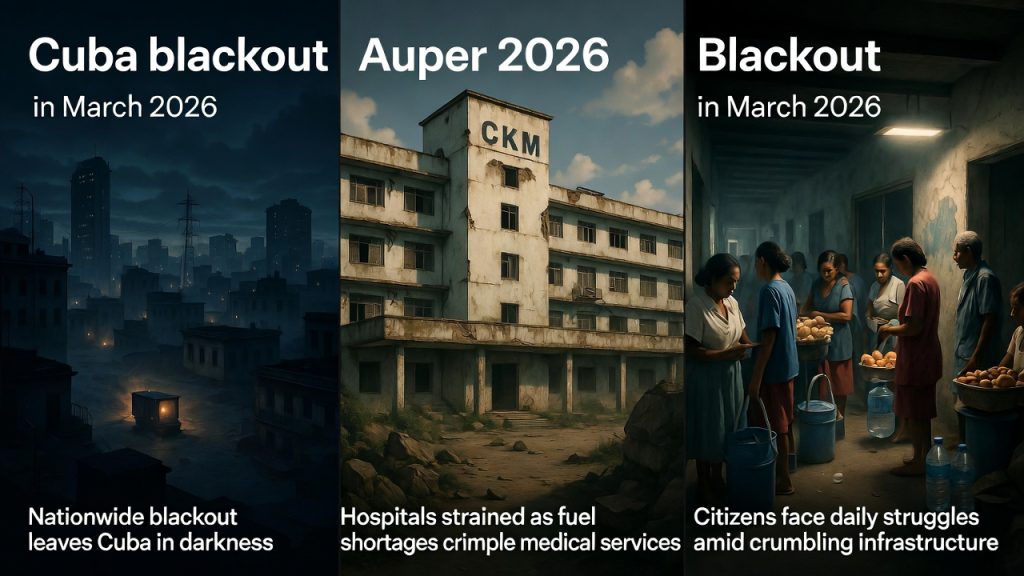
The human toll of the Cuba blackout has been immediate and widespread. Hospitals switched to diesel generators, many of which are themselves low on fuel. Non-emergency medical procedures were postponed, and critical equipment operated under strain.
Food refrigeration failed nationwide, prompting families to consume perishable goods rapidly or risk spoilage. Water supply systems dependent on electric pumps experienced interruptions, forcing reliance on stored reserves. Internet and mobile communications dropped sharply, isolating families and halting business activity.
Economically, the Cuba blackout has accelerated existing pressures. Tourism — a vital revenue source — has suffered further cancellations, with airlines including American, Delta, and JetBlue suspending flights due to related fuel and operational issues. Factories and small businesses remain idle, compounding unemployment and inflation in basic goods.
Socially, the outage has fueled frustration. Rare protests were reported in central Cuba in the days leading up to the event, linked to chronic blackouts and shortages. Residents in Havana described using wood stoves, solar lamps, and community generators where available, with one local noting the growing normalization of crisis conditions.
Government and Diplomatic Responses
Cuban officials have been unequivocal in linking the Cuba blackout to external factors. President Miguel Díaz-Canel described the impact of the U.S. blockade as “tremendous,” while Deputy Foreign Minister Carlos Fernández de Cossío suggested U.S. policymakers were aware of the harm inflicted on families.
At the same time, indications of dialogue have emerged. Cuban representatives have signaled openness to bilateral discussions aimed at resolving energy and economic issues, marking a potential shift in approach amid mounting domestic pressure.
The U.S. Embassy has limited its statements to security alerts, while broader administration comments have referenced Cuba’s energy vulnerabilities without announcing immediate policy changes.
Restoration Efforts and Expert Predictions for Resolution
As of March 17, 2026, UNE is following a phased restoration strategy used in prior incidents: reconnecting small microsystems first, then gradually scaling up while prioritizing essential services.
Historical precedents provide benchmarks:
- The March 4, 2026 western outage saw initial power return within days, though full stability took longer.
- October 2024 nationwide collapse achieved 70% restoration within four days.
Analysts estimate partial power could reach major cities within 48–96 hours, with widespread but unstable supply resuming by late March. However, sustained 24/7 electricity across the island is unlikely without new fuel imports.
Short-term outlook (1–2 weeks): Rolling blackouts and intermittent supply are probable as the grid is rebuilt incrementally.
Medium-term outlook (1–3 months): Full recovery depends on securing additional fuel shipments or diplomatic relief. Without them, experts predict recurring partial or nationwide Cuba blackout events at least 3–5 times in 2026.
Long-term outlook (2026–2028): Structural resolution requires diversification beyond oil, including accelerated solar and wind development (Cuba has strong renewable potential), modernization of thermoelectric plants, and broader economic reforms or sanctions relief to enable spare parts and investment imports.
Long-Term Solutions to Prevent Future Cuba Blackouts
Preventing the next Cuba blackout demands multifaceted action:
- Renewable Energy Expansion: Cuba has announced solar initiatives, but progress has been slow. Scaling photovoltaic and wind capacity could reduce oil dependence significantly.
- Infrastructure Modernization: Importing turbines, boilers, and transmission upgrades — currently hindered by restrictions — is essential.
- Fuel Diversification and Efficiency: Exploring natural gas options or improved conservation measures.
- Policy and International Cooperation: Easing external pressures through dialogue could unlock commercial fuel flows and investment.
Cuban officials have privately acknowledged that domestic maintenance reforms and better resource allocation are also necessary alongside external factors.
Broader Implications of the Cuba Blackout
The March 2026 Cuba blackout highlights the intersection of energy security, geopolitics, and economic resilience. It has drawn international attention to the effectiveness and humanitarian costs of sustained pressure policies, while underscoring the vulnerability of small island nations reliant on imported fossil fuels.
For ordinary Cubans, repeated outages have become a daily reality, affecting education, healthcare, and quality of life. Economically, the crisis risks further isolating the island from global markets and accelerating emigration pressures.
Conclusion: Understanding the Cuba Blackout and the Path Forward
The Cuba blackout of March 16, 2026, was the predictable result of a perfect storm: critically low fuel supplies colliding with an obsolete, under-maintained grid. While emergency restoration is progressing, true stability remains contingent on addressing both immediate fuel needs and long-term systemic weaknesses.
Power is expected to return in stages over the coming days and weeks, yet without meaningful changes in supply chains or infrastructure, similar Cuba blackout events will likely recur. Ongoing monitoring of diplomatic developments and fuel import data will be key indicators of progress.
This article will be updated regularly as restoration advances and new information emerges. For those seeking deeper insight into specific aspects — such as the technical mechanics of the SEN grid, detailed economic data, or resident coping strategies — additional explainers are available on todaywhy.com.
Last updated: March 17, 2026
Sources drawn from official UNE statements, U.S. Embassy alerts, Reuters, CNN, Associated Press, Al Jazeera, The Guardian, Wikipedia’s documented timeline of the 2024–2026 Cuba blackouts, Havana Times, and Bloomberg reporting. All citations reflect publicly available information as of the update date.