
Last Updated on 2 months ago by TodayWhy Editorial
In July 2026, Spain did two opposite things on the same fourteen-kilometre stretch of water.
On 15 July, the fence at the Gibraltar frontier came down. Passport checks on the land border ended, and around 15,000 workers began crossing daily between La Línea and the Rock without stopping. Spanish officials called it the removal of the last border fence in continental Europe.
On 30 July, fifteen days later, Spain deployed the army to Ceuta after thousands of people crossed from Morocco.
One border opened. One militarised. Both sit on the Strait of Gibraltar, and both are contested — but in opposite directions. Spain wants Gibraltar back from Britain. Morocco wants Ceuta and Melilla back from Spain. The arguments each side uses are close to interchangeable.
This is not hypocrisy exactly. It is what happens when three leftover pieces of empire are squeezed into one narrow channel and then handed to modern international law, which has never resolved what to do with them.
Three anomalies, fourteen kilometres apart
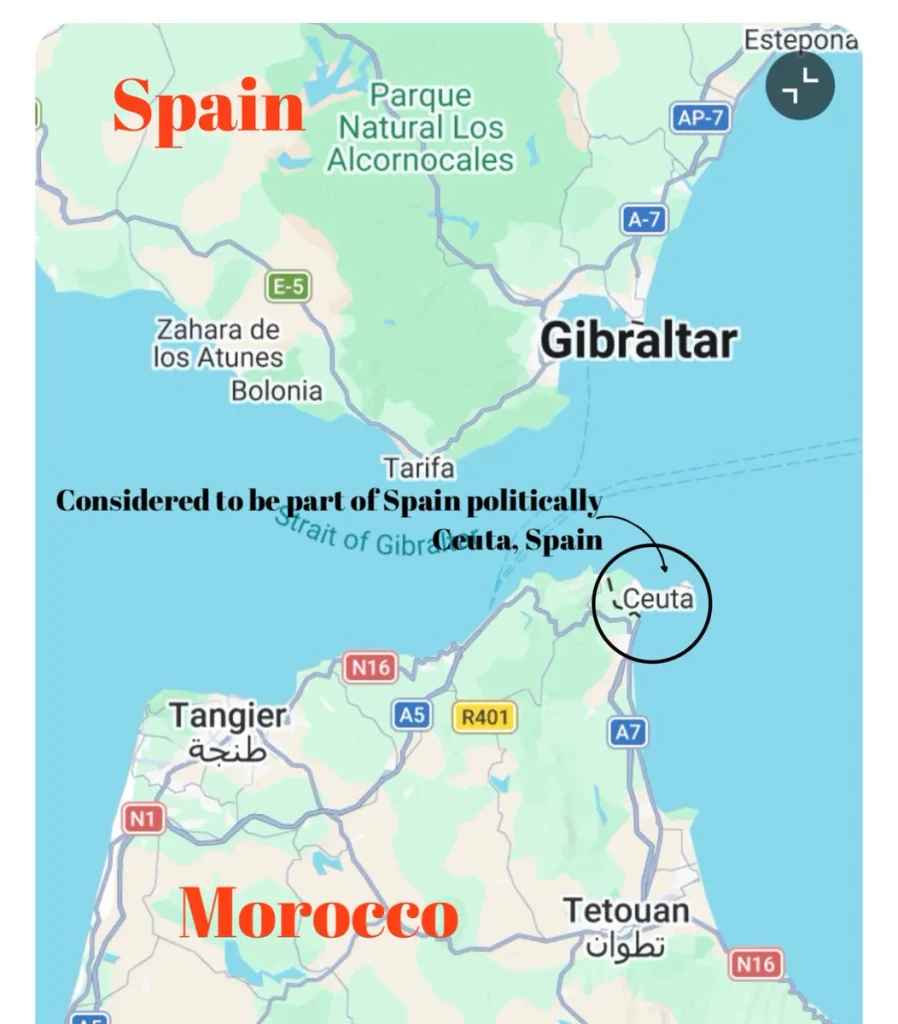
The Strait of Gibraltar is the only place on Earth where this particular knot exists.
Gibraltar is a British Overseas Territory of about 38,000 people on the Spanish mainland, ceded by Spain to Britain in 1713 under the Treaty of Utrecht. Spain has wanted it back ever since.
Ceuta and Melilla are Spanish autonomous cities of roughly 85,000 people each on the Moroccan coast. Spain has held Ceuta since 1580 and Melilla since 1497. Morocco has claimed both since its independence in 1956.
So Europe holds territory in Africa and Britain holds territory in Europe, all within sight of each other.
The mirror argument
Put the two disputes side by side and the symmetry is uncomfortable.
Spain’s case against Britain over Gibraltar rests on territorial integrity: the Rock is geographically part of the Iberian peninsula, and a colonial-era treaty should not permanently sever it. Spain has pressed this at the United Nations for decades.
Morocco’s case against Spain over Ceuta and Melilla rests on exactly that: the cities are geographically part of North Africa, and colonial-era possession should not permanently sever them.
Spain’s answer to Morocco is that Ceuta and Melilla predate the modern Moroccan state — Spain held them before Morocco existed in its current form, so they were never taken from Morocco.
Britain’s answer to Spain is the wishes of the population. In a 2002 referendum, Gibraltarians rejected shared British–Spanish sovereignty by 98.97 percent. The United Kingdom has committed to a “double lock”: no transfer of sovereignty against the will of Gibraltarians.
Spain does not accept self-determination as decisive for Gibraltar. Morocco does not accept it as decisive for Ceuta and Melilla either — and Spain, in the Ceuta case, does not lean on it much.
Each capital reaches for whichever principle favours the territory it currently holds. That is not unusual in international disputes. It is simply visible here, because the two cases are so close together.
What actually happened at Gibraltar in July 2026
The Gibraltar change was the end of a very long negotiation, not a concession on sovereignty.
Gibraltar left the European Union with the United Kingdom in January 2020, even though Gibraltarians had voted overwhelmingly to remain. It was then left out of the post-Brexit Trade and Cooperation Agreement, at Spain’s insistence that it be handled separately. Four years of talks followed.
The resulting UK–EU treaty was signed in Brussels on 14 July 2026 and provisionally applied from 15 July. According to the House of Commons Library, it removes physical barriers at the land border, applies Schengen border rules at Gibraltar’s airport and port instead, and establishes a customs union between Gibraltar and the EU.
Crucially, Gibraltar does not join Schengen or the EU. Immigration, policing and justice stay with Gibraltar’s own authorities. Arriving travellers face two sets of checks at the airport — Gibraltar entry controls by British and Gibraltarian officers, then Schengen entry controls by Spanish ones.
Article 2 of the treaty states that nothing in it affects the legal positions of the UK or Spain on sovereignty, and that it cannot be used as the basis for any sovereignty claim. Spain’s foreign ministry describes its claim as remaining intact. Gibraltar’s government obtained legal opinions saying no sovereignty was conceded.
In other words: both sides removed the fence while formally agreeing to disagree about who owns the ground it stood on.
The inversion nobody planned
Here is the consequence, and it is genuinely strange.
Since 15 July 2026, a person can walk from Gibraltar — which is not in the EU and not in Schengen — into Spain without showing anything.
A person leaving Ceuta — which is in the EU and is covered by the Schengen rulebook — must show identification to reach mainland Spain, because every route out is by sea or air and Spain checks all of them.
British territory outside the Union is now more freely connected to Spain than Spanish territory inside it.
The reason is not ideological. Gibraltar’s check moved to the airport because 15,000 people cross that land border every working day and the economy depends on it. Ceuta’s exit check exists because Moroccan residents of Tétouan and Nador can enter without a visa under a local border arrangement dating to Spain’s 1991 Schengen accession, and the check is what keeps that local exemption local.
Both are pragmatic fixes. Together they produce a map that makes no intuitive sense.
The islands almost nobody mentions
Ceuta and Melilla are not the whole of Spanish North Africa.
Spain also holds the plazas de soberanía — a scatter of rocks and islets along the Moroccan coast: the Peñón de Vélez de la Gomera, the Peñón de Alhucemas, the Chafarinas Islands, and Perejil, a bare uninhabited islet of about fifteen hectares.
In July 2002, a small detachment of Moroccan gendarmes landed on Perejil and put up a flag. Spain responded within days by sending special forces to remove them. Nobody was hurt. The Moroccan personnel were flown back. The islet was returned to its previous state: empty, and claimed by both.
The Perejil episode is worth remembering because it shows how thin the margin is. A goat island with no population and no resources brought two NATO-adjacent states to a military stand-off in under a week, and required American mediation to defuse.
Why Morocco has leverage Spain cannot replace
The asymmetry that matters is not legal. It is operational.
Spain’s border policy at Ceuta and Melilla only works if Moroccan forces hold the other side of the fence. When Moroccan enforcement relaxes, the fence stops functioning almost immediately, whatever Spanish law says.
That gives Rabat quiet influence over every other file between the two capitals — fisheries access, agricultural quotas, counter-terrorism cooperation, and above all Western Sahara.
In May 2021, roughly 10,000 people entered Ceuta in a matter of days, at a moment when Spain had admitted a Western Saharan independence leader for medical treatment without consulting Rabat. Spain’s defence minister at the time used the word blackmail. In 2026, no Spanish minister is saying that publicly, and Moroccan diplomats describe the cooperation as exemplary — but Guardia Civil sources on the ground describe Moroccan assistance as thin.
Britain faces nothing comparable at Gibraltar. Spain closed that border entirely from 1969 to 1985 under Franco and after, and Gibraltar survived it. Morocco does not need to close anything at Ceuta. It only has to stop trying quite so hard.
Does any of this get resolved?
Probably not, and the July 2026 treaty is a clue as to why.
The Gibraltar agreement worked precisely because it did not settle sovereignty. It settled queues, customs, workers’ rights and airport management, and it wrote the underlying dispute out of scope. Both governments could sign because neither had to concede the thing they actually disagree about.
The same template is difficult to apply at Ceuta. There, the disputed question and the practical question are the same question: who controls entry. You cannot bracket sovereignty and still agree on a border regime when the border regime is the sovereignty claim in practice.
What is more likely is what has happened for seventy years — long periods of workable cooperation, punctuated by sudden surges that remind everyone the arrangement is voluntary on Morocco’s side.
For the immediate legal trigger behind the 2026 crossings, see our explainer on why people are fleeing Morocco into Ceuta. For a comparable dispute where a European state holds contested territory far from home, we looked at why Argentina claims the Falkland Islands, and for a contested waterway rather than contested land, at who owns the Strait of Hormuz.
Frequently asked questions
Did Gibraltar join Schengen in July 2026?
No. Schengen border rules now apply at Gibraltar’s airport and port, and land checks with Spain ended, but Gibraltar has not joined the Schengen area or the EU. It remains a British Overseas Territory with its own immigration policy.
Did the treaty change who owns Gibraltar?
No. Article 2 explicitly states the agreement does not affect either side’s legal position on sovereignty and cannot support any sovereignty claim. Spain says its claim remains intact; the UK says British sovereignty is fully protected.
Why does Spain claim Gibraltar but keep Ceuta?
Spain argues the cases differ: Gibraltar was ceded from Spanish territory by treaty in 1713, whereas Ceuta and Melilla were held before the modern Moroccan state existed and were never Moroccan. Morocco rejects that distinction.
What are the plazas de soberanía?
Small Spanish-held rocks and islets off the Moroccan coast, including Perejil, Alhucemas, the Chafarinas Islands and the Peñón de Vélez de la Gomera. Most are uninhabited apart from small military garrisons.
What was the Perejil incident?
In July 2002, Moroccan gendarmes occupied the uninhabited islet of Perejil. Spain sent special forces to remove them within days. No one was killed, and the islet reverted to its unoccupied, disputed status after American mediation.
Where can I read the primary documents?
The House of Commons Library briefing on the UK–EU Gibraltar agreement summarises the treaty part by part, and Spain’s foreign ministry sets out its own position on the Gibraltar question.