
Iran war news today continues to dominate global security briefings, energy market trading floors, and diplomatic cables as direct military friction between Washington, Jerusalem, and Tehran reaches a critical juncture in November 2026. Following explosive revelations that U.S. forces conducted weeks of calibrated airstrikes ahead of the American midterm elections—and Tehran’s immediate warning that retaliation attacks against U.S. and Israeli targets could resume—searches for US Iran news, Iran war update, and Iran news today have surged worldwide. Beyond the daily missile alerts, the conflict operates across multiple simultaneous fronts: heightened naval vigilance along the Strait of Hormuz, intensified inspections of Tehran’s 60%-enriched nuclear stockpiles, asymmetric shadow-war exchanges across the Red Sea, and severe domestic economic strain inside Iran.
Because breaking developments in the US Iran war shift by the hour, this comprehensive explainer hub combines our verified November 2026 Iran war news live updates and strategic conflict tracker with an automated real-time headlines feed below—giving you both the immediate daily developments and the deep geopolitical context behind the crisis.
🚨 Executive Summary: Iran War News Today & Live US-Iran War Update (November 2026)
- Pre-Midterm US Strikes & Retaliation Ultimatum: Following disclosures that U.S. forces carried out weeks of kinetic strikes targeting IRGC assets ahead of the November midterms, Iranian military commanders warned that large-scale retaliation attacks against U.S. and Israeli positions could resume if sovereign red lines are crossed.
- Strait of Hormuz Maritime Alert: While commercial oil and Liquefied Natural Gas (LNG) transit remains open—carrying roughly 20% of global petroleum consumption (20 to 21 million barrels per day)—war-risk insurance premiums and electronic GPS/AIS spoofing across the Persian Gulf remain at multi-year highs.
- The Nuclear Threshold & IAEA Oversight: Monitoring reports from the International Atomic Energy Agency (IAEA) continue to scrutinize Iran’s stockpiles of uranium enriched up to 60% purity at Natanz and Fordow, alongside ongoing disputes over advanced IR-6 centrifuge cascades.
- Shadow Fleet Sanctions & Peace Deal Backchannels: Even as tightened enforcement against dark-fleet oil tankers squeezes Tehran’s currency reserves, diplomatic observers tracking Iran peace deal news note that secret de-escalation backchannels in Oman and Qatar remain active to prevent a total regional war.
Iran War News Today — Live Conflict & Economic Status Tracker (November 2026)
To give readers following Iran war news today an immediate, verifiable snapshot of the crisis, the table below synthesizes the core military, maritime, nuclear, and macroeconomic indicators shaping the conflict in November 2026:
| Strategic Dimension | Current Status (November 2026) | Key Operational Metrics & Thresholds | Primary Verification Source |
|---|---|---|---|
| Strait of Hormuz Transit | Open to commercial shipping under heightened naval escort and electronic warfare advisories. | ~20–21 million bpd of crude & condensate; ~20% of global LNG trade; 2-mile-wide inbound/outbound shipping lanes. | U.S. Energy Information Administration (EIA) |
| Direct Military Posture | High readiness across IRGC Aerospace & Navy units; U.S. CENTCOM carrier and land-based airwings positioned for deterrence. | Focus on long-range ballistic missiles (Fattah/Kheibar Shekan series), Shahed loitering munitions, and integrated air defense. | Reuters Middle East / Defense Briefings |
| Nuclear Program & Enrichment | Technical threshold capability maintained at underground facilities in Fordow and Natanz. | Uranium enriched up to 60% U-235 purity (short technical step from 90% weapons-grade); reduced IAEA camera monitoring. | IAEA Safeguards Reports |
| Regional Proxy & Maritime Fronts | Calibrated attrition across the Levant, Iraq/Syria militias, and Bab el-Mandeb / Red Sea shipping corridors. | Container ships rerouting around Africa’s Cape of Good Hope (+10 to 14 days transit time); recurring air-defense interceptions. | Associated Press Iran Hub |
| Cyber & Hybrid Operations | Escalating state-linked cyber intrusions, GPS jamming, and false-flag infrastructure threats. | Targeting financial networks, utilities, and aviation/municipal databases across the Middle East and Europe. | National Cyber Security Authorities / CISA |
| Oil Exports & Domestic Economy | Sanctions-evading crude exports rely heavily on ship-to-ship transfers bound for independent Asian refineries (“teapots”). | Annual inflation hovering above 35%–45%; severe rial depreciation; periodic industrial power and natural gas deficits. | Council on Foreign Relations (CFR) |
🌍 TodayWhy Geopolitics Series: Iran, Persia & Global Energy Chokepoints Explained
To understand the historical roots and legal battles behind Iran war news today and Iran news today, read our foundational investigative guides:
- The Origins of the Conflict: Why Did the Iran War Start? Key Historical Turning Points & Geopolitical Triggers Explained
- Maritime Law & Territorial Waters: Who Owns the Strait of Hormuz? International Maritime Law & Control Explained
- Supertanker Economics: Why a Blockade of the Strait of Hormuz Could Trigger a Global Energy Crisis
- The 1935 Name Change: Why Was Iran Called Persia? The 1935 Name Change & Identity Debate Explained
- Civilizational Context: What Is Persia? A Complete Guide to the Empire, Culture, and Modern Legacy
US Iran War News & Iran War Update: Why Pre-Midterm Strikes and Retaliation Threats Escalated (November 2026)
A major surge in searches for US Iran news, US Iran war, and Iran war update today in November 2026 has been driven by explosive disclosures regarding sustained U.S. kinetic operations and Tehran’s subsequent retaliation warnings. Just ahead of the November 2026 U.S. midterm elections, defense briefings and investigative reports revealed that American air and naval assets under U.S. Central Command (CENTCOM) had been conducting weeks of calibrated strikes targeting IRGC command-and-control nodes, drone launch sites, and radar installations—sparking a dramatic spike in global queries for US strikes Iran news and US attack Iran.
In direct response to those revelations and ongoing allied air operations, senior commanders in Tehran issued a formal ultimatum—widely tracked under headlines warning that Iran warns US and Israel retaliation attacks will resume if further strikes cross sovereign red lines. For readers following Iran war news live updates, this latest escalation cycle highlights three critical shifts on the ground:
1. Trump Iran Strategy, the Eve-of-Midterms Strikes & Washington’s Deterrence Calculus
Why did Trump Iran news and reports of pre-midterm military strikes dominate international headlines at the start of November 2026? In American domestic and foreign policy, military operations in the Persian Gulf are closely scrutinized for both their battlefield impact and their political timing. Defense analysts note that the weeks-long campaign of precision strikes was designed to degrade Iranian missile-production and proxy-resupply corridors before winter, while signaling unwavering deterrence during a sensitive political window in Washington. However, as US Iran war news continues to unfold, Pentagon planners face the persistent challenge of escalation management: striking hard enough to re-establish deterrence without triggering an all-out regional conflagration that would send Brent crude oil soaring ahead of the winter heating season.
2. Why “Iran Warns US Israel Retaliation Attacks Resume” Is Reshaping Air Defense
When Tehran’s military leadership signaled that retaliatory missile and drone operations against U.S. bases and Israeli strategic targets could resume (“Operation True Promise” follow-on phases), allied defense ministries immediately elevated alert levels across the Eastern Mediterranean, Iraq, Syria, and the Red Sea. In practical military terms, Iran latest news today shows that any renewed retaliation campaign relies on coordinated multi-axis salvos—combining solid-fuel ballistic missiles launched from western Iran with low-altitude cruise missiles and drone swarms fired simultaneously by allied militias in Iraq and Yemen. To counter this threat, U.S. THAAD batteries, Navy Aegis destroyers, and Israeli Arrow-3 interceptors operate under a unified radar-sharing architecture supervised by CENTCOM.
3. Iran Peace Deal News: Are Secret Ceasefire Backchannels Still Alive?
Despite fiery rhetoric in daily Iran war update broadcasts, diplomatic correspondents tracking Iran peace deal news point out that covert de-escalation channels in Muscat (Oman), Doha (Qatar), and Geneva have never fully closed. Both Washington and Tehran recognize the catastrophic economic cost of a total war. Current diplomatic frameworks under discussion focus on a “freeze-for-freeze” arrangement: halting direct kinetic strikes and proxy attacks on Red Sea commercial shipping in exchange for verifiable caps on Iran’s 60% uranium enrichment and de-escalation along the Israel–Lebanon and Syria borders.
Why the Conflict Dominates Iran War News Today: From Shadow War to Direct Brinkmanship
When readers search for Iran war news today, a central question consistently emerges: How did decades of indirect regional rivalry evolve into open missile exchanges, maritime seizures, and global energy anxiety? For more than forty years following the 1979 Islamic Revolution, hostilities between Tehran, Israel, the United States, and Gulf Arab states were largely confined to what military historians call the “gray zone”—clandestine intelligence operations, cyber sabotage (such as the Stuxnet worm), targeted assassinations of nuclear scientists, and proxy engagements in Lebanon, Syria, Iraq, and Yemen.
As we detailed in our foundational report on why the Iran war started, that long-standing shadow paradigm fractured between 2024 and 2026. The breakdown of unwritten deterrence rules transformed localized proxy clashes into direct state-on-state confrontations involving long-range ballistic missiles, cruise missiles, and swarms of one-way attack drones (UAVs). Even when diplomatic backchannels in Oman, Qatar, and Switzerland succeed in pausing major aerial exchanges, the underlying strategic dilemma remains unresolved.
The Three Structural Pillars of the 2026 Confrontation
- The “Forward Defense” Doctrine vs. Preemptive Containment: Tehran’s military architecture—spearheaded by the Islamic Revolutionary Guard Corps (IRGC) and its extraterritorial Quds Force—was built around the concept of “forward defense.” By arming, funding, and training allied non-state actors across the Levant and Arabian Peninsula, Iran sought to deter attacks on its own soil by threatening asymmetric retaliation along multiple borders. Conversely, Israeli and Western defense planners view this regional network, combined with Iran’s ballistic missile arsenal, as an intolerable encirclement that must be degraded at its source.
- The Asymmetric Missile and Drone Equation: Unlike conventional air forces that rely on multi-billion-dollar fifth-generation fighter squadrons, Iran invested heavily in underground “missile cities” housing solid-fuel medium-range ballistic missiles (such as the Kheibar Shekan and Fattah hypersonic-glide variants) alongside low-cost Shahed-136 loitering munitions. This creates a stark economic asymmetry in Iran war news today: defending against a $20,000 to $50,000 drone or a $500,000 ballistic missile frequently requires firing air-defense interceptors (such as Arrow-3, THAAD, Patriot PAC-3, or Standard Missile-3) costing between $1 million and $4 million per shot.
- Regime Survival vs. Regional Hegemony: Every military calculation made by Iran’s Supreme National Security Council is balanced against internal stability. While hardliners within the IRGC push for assertive deterrence to maintain credibility among regional allies, technocrats and economic ministries warn that an all-out war targeting domestic oil refineries (such as Abadan or Bandar Abbas), export terminals (Kharg Island), or the national electrical grid could trigger catastrophic economic collapse at home.
Strait of Hormuz & Global Energy: Why Supertankers Are Hostage to Iran News Today
No aspect of Iran news today impacts the everyday bank accounts of American and European households faster than developments along the southern coast of Iran. Connecting the Persian Gulf to the Gulf of Oman and the Arabian Sea, the Strait of Hormuz is the single most important oil transit chokepoint on Earth.
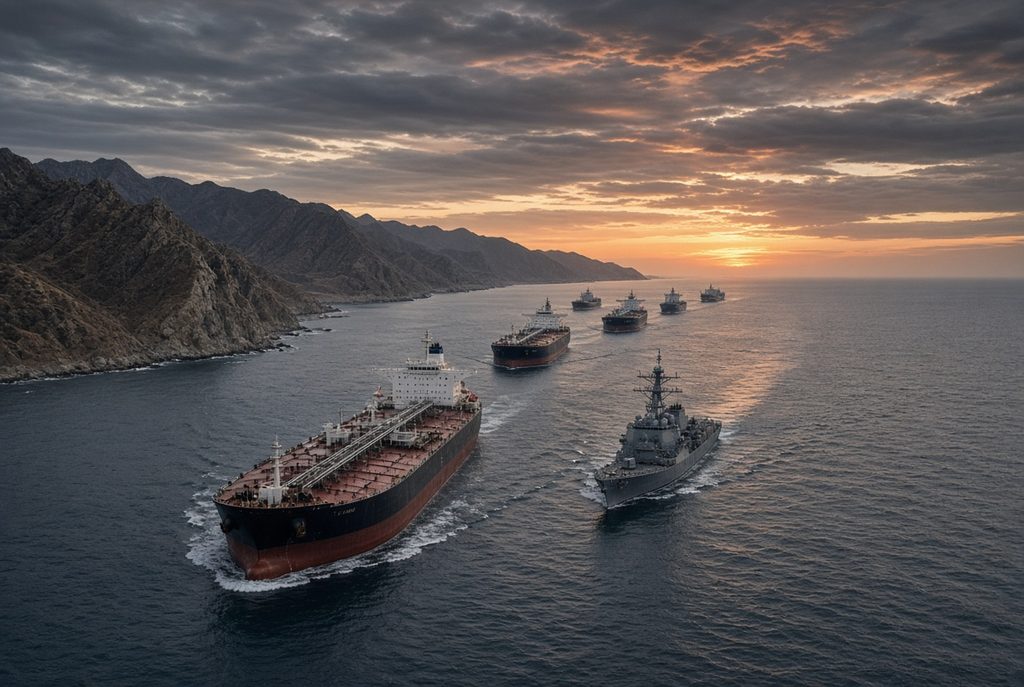
To understand why energy traders monitor every IRGC Navy speedboat patrol, consider the physical geography we mapped in our legal guide on who owns the Strait of Hormuz. At its narrowest point between Iran’s Qeshm Island and the Musandam Peninsula of Oman, the waterway measures just 21 nautical miles (39 kilometers) across. However, because of shallow coastal shelves, massive Very Large Crude Carriers (VLCCs)—supertankers stretching over 330 meters in length and carrying 2 million barrels of crude oil—cannot sail anywhere they please. They are restricted to a mandatory international Traffic Separation Scheme consisting of a two-mile-wide inbound lane, a two-mile-wide outbound lane, and a two-mile buffer zone.
Why Pipeline Workarounds Cannot Replace the Strait of Hormuz
A common misconception in financial commentary is that Gulf oil producers could simply bypass the strait via overland pipelines if a military blockade occurred. According to empirical transit assessments from the U.S. Energy Information Administration (EIA) World Oil Transit Chokepoints Report, approximately 20 to 21 million barrels per day (bpd) of crude oil, condensate, and refined petroleum products pass through Hormuz—representing roughly 20% of global petroleum liquids consumption and over one-quarter of all seaborne oil trade.
Only two major operational pipeline systems can bypass the chokepoint entirely:
- Saudi Arabia’s East-West Pipeline (Petroline): Running 1,200 kilometers from the Abqaiq processing facilities in the Eastern Province to the Red Sea port of Yanbu, this pipeline has a nameplate capacity of roughly 5.0 million bpd (temporarily expandable to 7.0 million bpd), but much of that capacity is already utilized for regular Red Sea exports and domestic refineries.
- The UAE’s Habshan–Fujairah Pipeline (ADCOP): Connecting Abu Dhabi’s onshore oil fields directly to the port of Fujairah on the Gulf of Oman, this link carries approximately 1.5 to 1.8 million bpd.
Even if both pipelines operated at absolute maximum surge capacity, their combined unused spare capacity sits between 3.5 and 5.5 million bpd—leaving more than 15 million bpd of Gulf oil (including 100% of Kuwaiti, Qatari, and southern Iraqi seaborne exports) completely stranded. Worse still, Qatar exports roughly 20% of the entire world’s Liquefied Natural Gas (LNG) through the Strait of Hormuz, and there is zero alternative pipeline capacity for super-chilled LNG cargoes bound for Europe and Asia.
Kharg Island: Iran’s Own Economic Achilles’ Heel
Why hasn’t Tehran simply mined or closed the Strait of Hormuz during periods of peak military tension? As analyzed in our report on why a Strait of Hormuz blockade triggers an energy crisis, closing the strait would be an act of economic self-strangulation for Iran itself. Roughly 90% of Iran’s own crude oil exports are loaded onto tankers at Kharg Island, located deep inside the Persian Gulf just 25 kilometers off the Iranian coast, and must sail outward through the Strait of Hormuz to reach buyers in Asia. Furthermore, Iran relies on maritime commercial traffic through Bandar Abbas for vital imports of grain, industrial machinery, and pharmaceuticals.
Instead of a total closure, Iran war news today reflects a strategy of calibrated maritime harassment: selective boarding of commercial vessels alleged to have links to Western or Israeli shipping magnates, widespread electronic spoofing of Automatic Identification System (AIS) transponders, and drone overflights designed to drive up Lloyd’s of London maritime war-risk insurance premiums without provoking an immediate full-scale U.S. Fifth Fleet intervention.
The Nuclear Dimension in Iran News Today: 60% Enrichment, Fordow & Breakout Timelines
Running parallel to conventional missile and maritime tensions in Iran war news today is the unresolved crisis surrounding Tehran’s nuclear program. Following the 2018 U.S. withdrawal from the Joint Comprehensive Plan of Action (JCPOA) and the subsequent collapse of Vienna revival talks, Iran systematically rolled back its voluntary limits on uranium enrichment and centrifuge installation.
To grasp why intelligence agencies treat the nuclear file as the ultimate red line in November 2026, it helps to examine the physics of uranium enrichment verified by the International Atomic Energy Agency (IAEA):
- Natural Uranium vs. Low-Enriched Reactor Fuel (3.67%): Natural uranium ore contains about 99.3% U-238 and only 0.7% fissile U-235. Under the original 2015 nuclear accord, Iran was permitted to enrich uranium up to 3.67% U-235—the level required to generate electricity in commercial nuclear power stations like Bushehr.
- The 60% High-Enriched Threshold: Since 2021, Iran has produced and accumulated substantial stockpiles of uranium hexafluoride gas enriched up to 60% U-235 purity using advanced IR-4 and IR-6 gas centrifuges. Because the isotopic separation effort required to enrich uranium is non-linear (measured in Separative Work Units, or SWU), enriching uranium from 0.7% to 60% actually completes roughly 90% of the physical work needed to reach 90% weapons-grade uranium.
- Technical Breakout vs. Weaponization: Nuclear proliferation analysts distinguish between “fissile breakout”—the time needed to enrich enough 60% stockpiles to 90% weapons-grade material for a single nuclear device, which is now estimated at less than one to two weeks—and “weaponization,” which involves converting uranium gas into a metallic spherical core, building a high-explosive implosion lens system, and miniaturizing the warhead to fit inside the re-entry vehicle of a Shahab-3 or Khorramshahr ballistic missile (a process estimated to take several months to a year).
What makes military planners particularly anxious in Iran news today is the physical fortification of these facilities. Unlike the Natanz enrichment halls buried beneath reinforced concrete in central Iran, the Fordow Fuel Enrichment Plant near Qom is excavated 80 to 90 meters deep inside solid mountain granite—and new tunnel complexes constructed inside Kūh-e Kolang Gaz Lā (“Pickaxe Mountain”) south of Natanz are buried even deeper, specifically engineered to withstand conventional bunker-busting munitions such as the U.S. GBU-57 Massive Ordnance Penetrator.
Within Tehran’s political establishment, this near-threshold status has sparked an unprecedented public debate. Several former nuclear negotiators and senior lawmakers have openly suggested that if Iran’s sovereign territory or energy infrastructure faces existential military strikes, Supreme Leader Ayatollah Ali Khamenei’s long-standing religious fatwa prohibiting the development of nuclear weapons could be revised in favor of a formal nuclear deterrent.
Hybrid Warfare, Cyber Sabotage & Global Spillover in Late 2026
A defining feature of Iran war news today is that the conflict no longer stays within the geographical borders of the Middle East. In late 2026, security agencies across Europe and North America have documented a sharp rise in hybrid warfare, cyber operations, and cross-border intimidation campaigns linked to state and non-state actors operating in the shadow of the Middle Eastern and Ukrainian conflicts.
1. Cyber Operations and False-Flag Infrastructure Disruption
Iranian state-affiliated cyber collectives—often tracked by cybersecurity researchers under designations such as APT33 (Elfin), APT34 (OilRig), APT42, and CyberAv3ngers—have long targeted water treatment programmable logic controllers (PLCs), municipal networks, and energy companies. In November 2026, European authorities investigating waves of coordinated hybrid disruptions noted how multi-layered false-flag identities are increasingly used to sow public panic. For example, during the November 2026 wave of hoax bomb threats against European schools and commercial aviation, perpetrators alternated between posing as Iranian Revolutionary Guard operatives and Russian ultranationalist collectives—a phenomenon we analyzed in detail in our reports on why 33 European flights were diverted by bomb threats and the mass school evacuations across Italy and the UK.
These gray-zone infrastructure threats are a primary reason why NATO and European Union civil defense agencies have accelerated national resilience advisories—a trend covered in our investigative guide on why governments are telling citizens to stockpile food and water in 2026.
2. Sanctions Evasion, the “Dark Fleet” & Parallel Energy Blockades
To keep its economy afloat under U.S. Treasury Office of Foreign Assets Control (OFAC) secondary sanctions, Tehran relies on an intricate maritime network of aging supertankers—commonly known as the “shadow fleet” or “dark fleet.” These vessels disable their AIS transponders, conduct covert ship-to-ship (STS) oil transfers in international waters off Malaysia and the Fujairah anchorage, and use complex shell-company registries in Panama, Liberia, and the Marshall Islands to deliver discounted Iranian Light and Heavy crude to independent refineries in China.
As Washington tightens maritime interdictions and financial sanctions against these tanker networks in late 2026, the mechanics of energy blockades have become a central theme in global geopolitics—mirroring the exact maritime insurance and tanker tracking tactics we examined in our analysis of why the U.S. is blockading Cuba oil imports and our Cuba news today live crisis hub.
3. The BRICS+ Axis and Naval Friction
Diplomatically, Tehran has sought to break out of Western isolation by achieving full membership in both the Shanghai Cooperation Organisation (SCO) and the expanded BRICS+ bloc, while supplying drone technology and industrial components to Russia. However, Iran’s military outreach has also created acute diplomatic crises for non-aligned nations. In late October and November 2026, an official investigation in South Africa triggered international headlines after revealing that Iranian warships had participated in joint naval drills off the coast of Cape Town despite direct instructions from South African President Cyril Ramaphosa to bar their participation to avoid jeopardizing trade relations with Washington (for German-speaking readers, see our dedicated report: Warum nahmen iranische Kriegsschiffe an Marineübungen vor Südafrikas Küste teil?).
Historical Timeline: Key Turning Points Leading to Iran War News Today (1979–2026)
To fully contextualize Iran war news today, military historians and diplomatic analysts point to a four-decade sequence of escalations, broken treaties, and maritime clashes that steadily dismantled the region’s security architecture. The reference table below traces the critical milestones from the 1979 revolution and the 1980s “Tanker War” to the multi-front confrontation of 2026:
| Year / Period | Major Geopolitical or Military Event | Strategic Impact on the Modern Conflict |
|---|---|---|
| 1979–1988 | Islamic Revolution & the Iran–Iraq War (“Tanker War” phase, 1984–1988). | Birth of the IRGC; over 400 commercial vessels attacked in the Persian Gulf; U.S. Navy launches Operation Earnest Will to escort reflagged Kuwaiti oil tankers through the Strait of Hormuz. |
| 2002–2010 | Exposure of clandestine Natanz and Arak nuclear sites; U.N. Security Council sanctions; discovery of the Stuxnet cyber weapon (2010). | Establishes the modern nexus between underground centrifuge fortification (Fordow) and state-sponsored offensive cyber warfare. |
| July 2015 | Signing of the Joint Comprehensive Plan of Action (JCPOA) between Iran and the P5+1 powers (US, UK, France, Russia, China, Germany). | Caps Iranian uranium enrichment at 3.67% purity and reduces stockpiles by 98% in exchange for sanctions relief on oil exports and banking. |
| May 2018 – Jan 2020 | U.S. withdrawal from the JCPOA (“Maximum Pressure” campaign); series of Gulf tanker limpet-mine attacks (2019); U.S. drone strike kills IRGC Quds Force commander Qasem Soleimani in Baghdad (Jan 2020). | Iran begins step-by-step rollback of JCPOA nuclear limits; retaliates with ballistic missile strike on Al-Asad airbase in Iraq, establishing a precedent for direct missile strikes. |
| 2021–2023 | Iran initiates 60% high-enriched uranium production; expands drone manufacturing partnerships; regional maritime shadow war intensifies. | Shortens Iran’s fissile nuclear breakout timeline from one year to roughly one to two weeks; Shahed-136 loitering munitions become a global export commodity. |
| 2024–2025 | Collapse of the shadow-war ceiling: first-ever direct long-range missile and drone exchanges between Iranian territory and Israel; Red Sea shipping crisis escalates; political transition in Tehran following the May 2024 helicopter crash. | Replaces decades of indirect proxy skirmishes with overt long-range aerial deterrence, integrating U.S., European, and regional Arab air-defense radar networks. |
| 2026 (Current) | Heightened naval and nuclear standoff; tightened OFAC sanctions on Iran’s “dark fleet” oil tankers; BRICS+ naval controversies and hybrid cyber-sabotage alerts across Europe. | Creates the volatile multi-theater landscape tracked daily in Iran war news today, keeping global energy markets and central banks on permanent alert. |
The Military Balance: Air Defense, Ballistic Missiles & Naval Asymmetric Doctrines
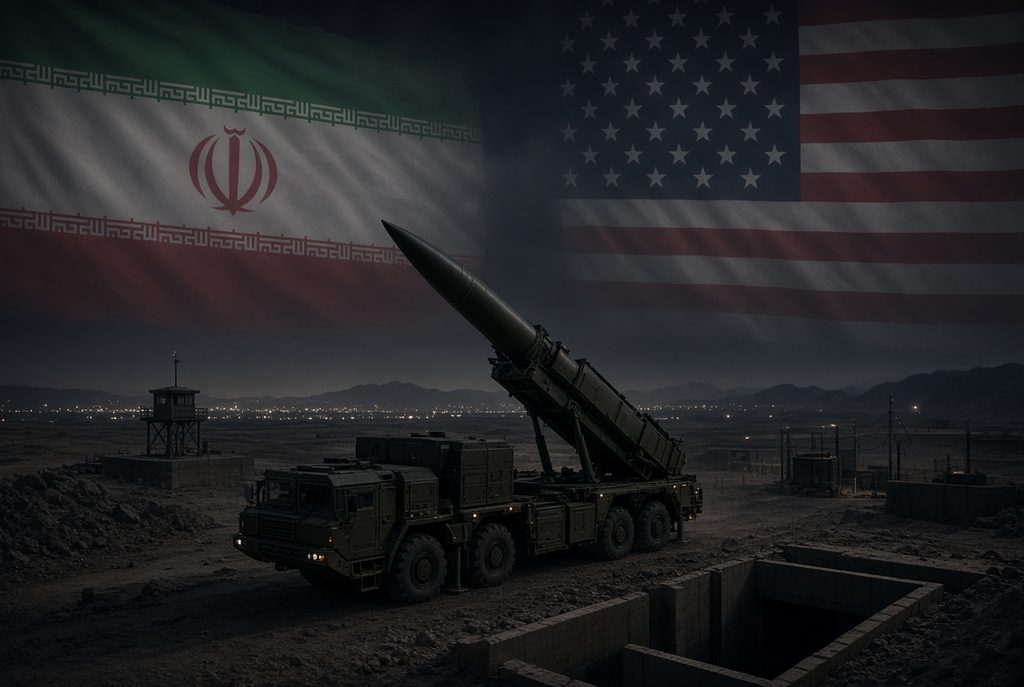
Another critical question driving searches for Iran war news today is how a nation under four decades of Western arms embargoes can challenge some of the most technologically advanced militaries on the planet. According to open-source defense assessments published by the International Institute for Strategic Studies (IISS) and the Center for Strategic and International Studies (CSIS), Iran’s armed forces—divided between the conventional national military (Artesh) and the ideologically driven Islamic Revolutionary Guard Corps (Sepah/IRGC)—compensated for their aging conventional air force (which still flies 1970s-era American F-14 Tomcats, F-4 Phantoms, and Russian MiG-29s) by building three specialized asymmetric capabilities:
1. The Underground Ballistic & Cruise Missile Arsenal
Iran possesses the largest and most diverse inventory of ballistic and land-attack cruise missiles in the Middle East, estimated at over 3,000 operational launchers and projectiles. Over the past decade, Iranian aerospace engineers shifted from liquid-fueled missiles (like the Shahab-3, which required hours of exposed fueling prior to launch) to solid-propellant, road-mobile missiles stored in deep subterranean tunnel networks across the Zagros Mountains. Key systems frequently cited in Iran war news today include:
- Kheibar Shekan & Haj Qasem: Solid-fuel medium-range ballistic missiles (MRBMs) with a range of approximately 1,400 to 1,450 kilometers and maneuverable re-entry vehicles (MaRVs) designed to evade terminal-phase air-defense interceptors.
- Fattah-1 & Fattah-2: Marketed by Tehran as hypersonic-glide and maneuverable warhead systems capable of reaching speeds between Mach 13 and Mach 15 while altering trajectory mid-flight.
- Emad & Ghadr-110: Precision-guided liquid-fuel variants equipped with steerable nose cones that dramatically reduce Circular Error Probable (CEP) compared to older Scud-derived designs.
- Paveh Land-Attack Cruise Missiles & Shahed-136/238 UAVs: Low-flying subsonic cruise missiles and delta-wing loitering munitions (including the jet-powered Shahed-238 variant) used to saturate enemy radar screens ahead of faster ballistic salvos.
2. Layered Air Defense vs. Stealth Penetration
To protect its nuclear enrichment halls at Natanz and Fordow, its heavy-water reactor at Arak, and its oil export lifelines on Kharg Island, Iran deployed a layered Integrated Air Defense System (IADS). This network combines Russian-supplied S-300PMU-2 long-range surface-to-air missile batteries with domestically produced systems such as the Bavar-373 (Iran’s indigenous long-range road-mobile SAM), the Khordad-15, and the Sevvom Khordad. However, military exchanges between 2024 and 2026 highlighted the intense technological duel between these ground-based radars and fifth-generation Western stealth aircraft (such as the F-35I Adir) firing air-launched ballistic missiles (such as Rocks and Golden Horizon) from stand-off distances well outside Iranian airspace.
3. Swarming Tactics in the Persian Gulf
At sea, the IRGC Navy (IRGCN) operates independently from the regular Iranian Navy (IRIN), assuming direct responsibility for the Persian Gulf and the Strait of Hormuz while the regular navy patrols the Gulf of Oman and the Caspian Sea. Rather than building expensive aircraft carriers or destroyers that would be vulnerable to U.S. Fifth Fleet airpower, the IRGCN relies on a doctrine of “swarming” asymmetric warfare: hundreds of high-speed Boghammar and Ashura fast-attack craft armed with anti-ship cruise missiles (such as the Noor and Qader), torpedo-firing Ghadir-class midget submarines designed for shallow coastal waters, unmanned explosive surface vessels (USVs), and thousands of smart naval mines stockpiled along the islands of Abu Musa, Greater and Lesser Tunb, and Qeshm.
Inside Iran Today: Inflation, the Rial Collapse & Domestic Pressures
While international broadcasts focus on missile ranges and naval movements, millions of people searching for what is happening in Iran today are looking for information on daily life inside the country of nearly 90 million citizens. Beneath the geopolitical standoff lies a severe structural economic and environmental crisis:
- The Collapse of the Iranian Rial & 40%+ Inflation: On Tehran’s open currency market (Ferdowsi Street exchange trackers), the Iranian rial has suffered relentless depreciation whenever regional war fears spike. With official and informal inflation rates consistently running between 35% and 50% for food, housing, and medicine, middle-class purchasing power has been severely eroded.
- The Paradox of Domestic Energy Shortages: Despite holding the world’s second-largest natural gas reserves and fourth-largest proven crude oil reserves, Iran faces chronic domestic electricity blackouts in summer and acute natural gas deficits in winter. Decades of underinvestment, international sanctions blocking Western turbine technology, and heavily subsidized domestic energy prices have forced the government to periodically shut down cement and steel factories—and even burn high-sulfur mazut (heavy fuel oil) in power plants, creating hazardous winter smog blankets over Tehran, Isfahan, and Arak.
- Political Transition under President Masoud Pezeshkian: Elected following the May 2024 helicopter crash that killed former hardline President Ebrahim Raisi, reformist-leaning President Masoud Pezeshkian campaigned on easing social restrictions and reviving nuclear diplomacy to lift economic sanctions. However, in Iran’s dual power structure—whose historical evolution from the ancient Persian monarchy to the post-1979 theocracy is detailed in our guides on why Iran was called Persia and what Persia is—foreign policy, nuclear decisions, and military operations remain firmly under the authority of the Supreme Leader and the IRGC.
How Iran War News Today Impacts Global Oil Prices, Inflation & Your Wallet
Why does every escalation in Iran war news today immediately trigger sell-offs on Wall Street and spikes at neighborhood gas stations? According to macroeconomic modeling by the International Monetary Fund (IMF) and the World Bank, Middle Eastern conflict transmits into Western household budgets through three rapid channels:
- The Geopolitical Risk Premium on Brent Crude: Even when not a single barrel of physical oil production is lost, commodity traders price in a $5 to $15 per barrel “war premium” whenever strikes threaten Iranian export terminals or Gulf shipping lanes. If physical supplies through the Strait of Hormuz were disrupted, analysts project Brent crude could surge past $120 to $150 per barrel within days (for European market context, see our German analysis on why oil prices rise and fall).
- Red Sea & Suez Canal Container Rerouting: Because Houthi militia attacks in the Bab el-Mandeb strait have forced major container lines (Maersk, Hapag-Lloyd, MSC) to divert ships around South Africa’s Cape of Good Hope, voyage times between Asia and Europe have increased by 10 to 14 days, burning millions of extra tons of marine diesel and inflating global freight rates.
- Safe-Haven Flows into Gold, Silver & the U.S. Dollar: Whenever headlines signal an imminent military strike in the Middle East, institutional investors rotate capital out of equities and into safe-haven assets—driving record volatility in spot gold, silver, and U.S. Treasury yields, which directly impacts mortgage rates and cost-of-living adjustments such as the Social Security COLA 2027.
Iran War News Today – Iran News Now (Live Automated Feed)
Your real-time window into the Persian Gulf and the Middle East. Covering everything from Iran war news today, Strait of Hormuz maritime alerts, and IAEA nuclear inspections to oil sanctions and diplomatic shifts. Stay informed with our continuously updated news feed below:
Frequently Asked Questions (FAQs) About Iran War News Today
What is the latest status in Iran war news today?
In Iran war news today (November 2026), the conflict remains in a state of high-alert deterrence across the Middle East. While commercial shipping through the Strait of Hormuz continues, U.S., allied, and Iranian military forces maintain elevated readiness amid ongoing proxy clashes, strict maritime sanctions against Iran’s shadow tanker fleet, and international concern over Tehran’s 60%-enriched uranium stockpiles.
Has Iran closed the Strait of Hormuz today?
No, the Strait of Hormuz is currently open to commercial oil and LNG supertankers. Although Iranian naval forces periodically conduct vessel inspections, military drills, and electronic GPS/AIS interference, a total blockade has not occurred—in part because Iran relies on the exact same waterway to export roughly 90% of its own crude oil from Kharg Island.
How close is Iran to building a nuclear weapon in 2026?
According to International Atomic Energy Agency (IAEA) assessments, Iran possesses substantial stockpiles of uranium enriched up to 60% purity at its Natanz and Fordow facilities. While its “technical breakout time” to enrich enough fissile material to 90% weapons-grade purity is estimated at one to two weeks, building, testing, and miniaturizing an actual deliverable nuclear warhead would require several additional months.
Why is Iran fighting a shadow war through regional proxies?
Iran utilizes its “Axis of Resistance” network—including allied groups in Lebanon, Yemen, Iraq, and Syria—as a “forward defense” strategy. This allows Tehran to project power, disrupt maritime trade in the Red Sea, and pressure regional adversaries asymmetrically while attempting to avoid a devastating direct conventional war on Iranian territory.
How does Iran news today affect global oil and gas prices?
Because roughly 20% of the world’s petroleum (20 to 21 million barrels per day) and 20% of global LNG pass through the Strait of Hormuz along Iran’s coast, any military escalation in Iran news today immediately raises maritime war-risk insurance premiums and adds a geopolitical risk premium to Brent and WTI crude oil prices.