
Last Updated on 52 minutes ago by TodayWhy Editorial
Quick answer: Where can you see the northern lights depends on one thing above all — how close you are to the auroral oval, the ring of activity that sits roughly over Alaska, northern Canada, Iceland, northern Scandinavia and Greenland. Inside that ring, the aurora appears on most clear, dark winter nights. Outside it, you need a geomagnetic storm to push the lights south. The best months are September through March, and the best hours are between 10 PM and 2 AM local time.
This guide covers the ten most reliable destinations, what you can realistically expect from lower latitudes, and how to read the numbers that actually predict a good night.
First, understand the auroral oval
The aurora is not spread evenly across the north. It forms an oval-shaped band centred on the geomagnetic pole, not the geographic one. That distinction matters more than most travel guides admit.
Because the geomagnetic pole currently sits on the Canadian side of the Arctic, North America gets the aurora at lower latitudes than Europe does. Yellowknife in Canada sits at about 62°N and is directly under the oval. Oslo sits at about 60°N and is not. Someone in northern Scotland has to travel much further north than someone in Alberta to reach the same odds.
Two practical consequences follow:
- If you are inside the oval, you barely need a storm. Quiet conditions are enough on most clear nights.
- If you are outside the oval, you need geomagnetic activity strong enough to expand it southwards. That is a matter of luck and timing, not planning.
So the first question is not “when should I go” but “how far into the oval can I get”.
Where can you see the northern lights? The 10 best places
| Destination | Latitude | Why it works | Watch out for |
|---|---|---|---|
| Fairbanks, Alaska (USA) | ~65°N | Directly under the oval; dry, clear interior climate | Extreme cold in midwinter |
| Yellowknife, NWT (Canada) | ~62°N | Flat terrain, very dry air, famously clear skies | Remote; limited flights |
| Tromsø, Norway | ~70°N | Deep inside the oval, easy to reach, good infrastructure | Coastal cloud is the main enemy |
| Abisko, Sweden | ~68°N | Sits in a rain shadow — an unusually clear pocket of sky | Small village; book early |
| Finnish Lapland (Rovaniemi, Saariselkä) | ~66–68°N | Accessible, glass-roof accommodation, good road network | Lower in the oval than Tromsø |
| Kangerlussuaq, Greenland | ~67°N | Inland site with very stable, dry, clear weather | Expensive and hard to reach |
| Iceland | ~64°N | Whole country works; easy from Europe and North America | Cloudiest option on this list |
| Whitehorse, Yukon (Canada) | ~61°N | Under the oval, easier to reach than Yellowknife | Shorter dark season than Arctic sites |
| Shetland & Caithness, Scotland | ~58–60°N | The most realistic aurora in the UK | Needs an active night (roughly Kp 5+) |
| Svalbard, Norway | ~78°N | Polar night allows daytime viewing; can see daytime aurora | So far north it can sit inside the oval’s quiet centre |
A note on Svalbard, because it trips people up: going further north is not automatically better. Once you are north of the oval, the band of light can sit to the south of you, and on quiet nights you can see less than someone 1,000 km further south. The sweet spot is on the oval, not beyond it.
Where can you see the northern lights in the United States?
Outside Alaska, American aurora viewing is a storm-chasing activity, not a booking decision.
- Alaska is the only US state where the aurora is routine. Fairbanks is the practical base. The Geophysical Institute at the University of Alaska Fairbanks runs a dedicated forecast for the state, and the local season runs from late August to late April.
- The northern tier — Washington, Idaho, Montana, North Dakota, Minnesota, Wisconsin, Michigan and Maine — sees the aurora several times a year when activity is elevated. NOAA notes that at Kp 6–7 the aurora can be visible from the northern edge of the United States.
- Further south — Iowa, Nebraska, Illinois, Pennsylvania, New York — needs a severe storm. NOAA’s guidance is that at Kp 8–9 the aurora may be seen overhead from the northern states and lower down on the horizon from further south.
The honest summary: if you live in the lower 48 and want to see the northern lights on a specific date, you cannot plan it. What you can do is set up alerts and be ready to drive an hour north away from city lights at short notice.
Where can you see the northern lights in Canada?
Canada is the most reliable aurora country in the world, because the geomagnetic pole works in its favour.
- Yellowknife, Northwest Territories is the benchmark. Its combination of latitude, flat horizon and dry air makes it statistically one of the best places on Earth.
- Whitehorse, Yukon and Churchill, Manitoba both sit under or near the oval. Churchill has the added attraction of being a polar bear destination in autumn.
- Northern Alberta and Saskatchewan — anywhere north of the major cities, with a clear view north — work well on moderately active nights.
- Southern Canada, including Toronto, Montreal and Vancouver, needs a storm and a drive away from light pollution.
What about the southern hemisphere?
The same phenomenon happens in the south, where it is called the aurora australis. It is harder to see simply because there is much less land at the right latitudes.
- Tasmania, Australia (~42°S) is the most accessible option. Look south from the southern coasts.
- Stewart Island and southern South Island, New Zealand (~46–47°S) offer dark skies and a clear southern horizon.
- Antarctica and the Southern Ocean are inside the southern oval, but are not realistic destinations for most people.
Seasons flip: the southern aurora season runs roughly March to September.
When can you see the northern lights? Months, hours and the moon
Location decides whether it is possible. Timing decides whether you actually see it.
Best months: September to March. The reason is not that the aurora stops in summer — it does not. It is that high-latitude summers have no darkness. Above the Arctic Circle the sun barely sets in June and July, so the aurora is there but invisible.
The equinox bonus is real. Around the March and September equinoxes, geomagnetic storms are measurably more frequent. This is the Russell–McPherron effect: the tilt of Earth’s magnetic field lines up more favourably with the solar wind’s field around the equinoxes, so it is easier for energy to couple into the magnetosphere. NOAA explicitly names the equinoxes as the most favourable periods.
Best hours: 10 PM to 2 AM local time. NOAA puts the best aurora “within an hour or two of midnight”. During strong storms the window widens into the evening and early morning.
Avoid the full moon. A full moon washes out faint aurora the same way it washes out the Milky Way. Aim for the week around a new moon.
Weather beats everything. Clouds are the single most common reason people travel to the Arctic and see nothing. This is why Abisko’s rain shadow and Yellowknife’s dry inland air are worth more than a couple of degrees of latitude.
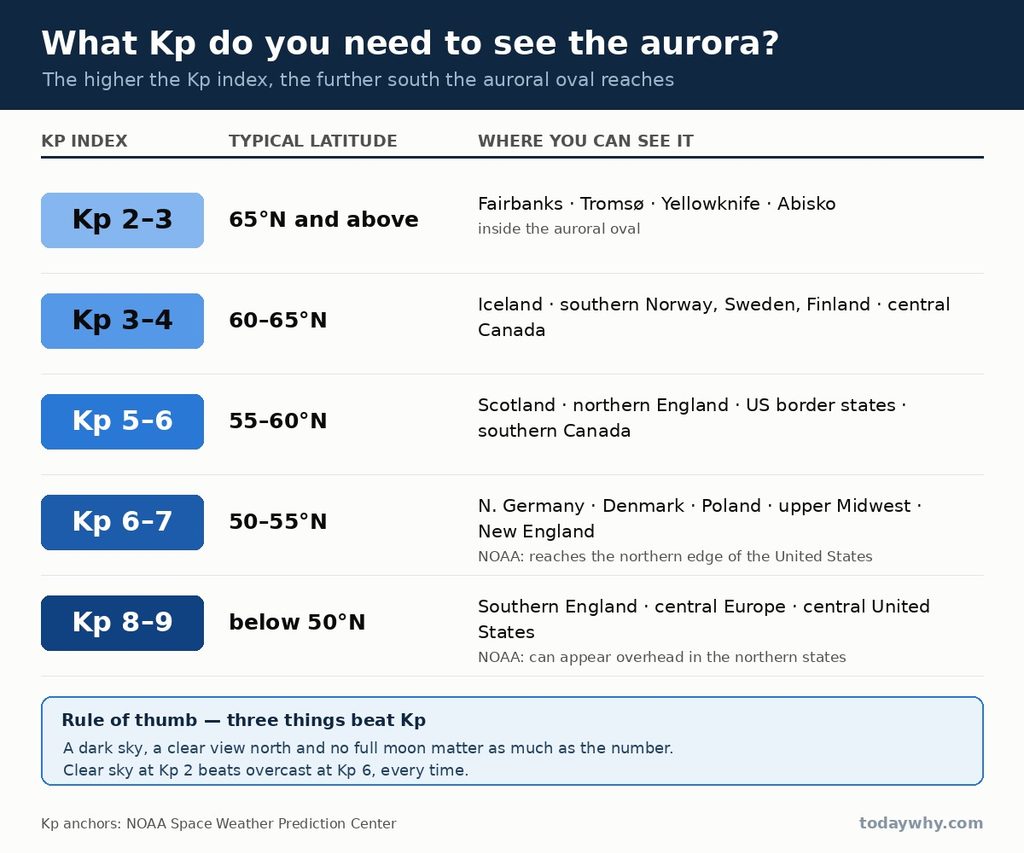
What Kp index do you need where you live?
The Kp index runs from 0 to 9 and measures global geomagnetic disturbance. Higher Kp means the auroral oval expands further from the pole.
| Roughly where you are | Kp usually needed |
|---|---|
| Inside the oval — Fairbanks, Tromsø, Yellowknife, Abisko | Kp 2–3 |
| Iceland, southern Norway/Sweden/Finland, central Canada | Kp 3–4 |
| Scotland, northern England, US border states, southern Canada | Kp 5–6 |
| Northern Germany, Denmark, Poland, upper Midwest and New England | Kp 6–7 |
| Southern England, central Europe, central United States | Kp 8–9 |
Treat this as a rule of thumb, not a promise. NOAA’s own anchors are the useful ones: Kp 6–7 puts the aurora within reach of the northern edge of the United States, and Kp 8–9 can bring it overhead in the northern states. Two other factors shift the outcome a lot — how dark your sky is, and how clear your view to the north is.
One more caveat worth knowing: a modern phone camera will pick up aurora that your eyes cannot. Faint aurora often looks grey to the naked eye and green in a photo. That is normal, not a trick.
Does 2026 still offer good chances?
Yes, though the peak has passed.
Solar Cycle 25 most likely reached its maximum in October 2024. We are now in the declining phase, and 2026 is producing fewer sunspots, flares and coronal mass ejections than 2024 did — 2025 already showed that drop clearly.
That is not the end of the story. Strong individual flares regularly occur after a cycle peaks. Solar Cycle 23 peaked in 2001, but its most powerful flare came in 2003. The declining phase is also known for recurrent high-speed solar wind streams, which produce moderate but frequent activity.
Practical takeaway: the odds of a once-in-a-decade display visible from mid-latitudes are lower than in 2024, but the odds of a good night inside the oval are essentially unchanged. If your plan depends on being in Tromsø or Fairbanks, the solar cycle barely matters. If your plan depends on the aurora coming to you in Ohio or Kent, it matters a great deal.
Where can you see the northern lights without going to the Arctic?
If a trip north is not realistic, treat it as opportunistic rather than impossible:
- Set up alerts. NOAA’s Space Weather Prediction Center publishes an experimental aurora viewline for tonight and tomorrow night. Several apps push notifications when Kp rises.
- Know your escape route in advance. Pick a dark spot 30–60 minutes north of you with an open northern horizon — a lake shore, a ridge, a rural road. Decide this before an alert arrives, not during one.
- Watch the equinox weeks. Late September and late March give you the best mid-latitude odds of the year.
- Look between 10 PM and 2 AM, and give your eyes 20 minutes to adapt to the dark.
- Photograph the northern horizon even if you see nothing. A three-second exposure will reveal a faint green band that the eye misses.
Seven mistakes that ruin aurora trips
- Going for two nights. Weather alone can wipe out a short trip. Five to seven nights is the realistic minimum.
- Booking in June. There is no darkness at high latitudes in midsummer.
- Staying in town. Even a small Arctic town produces enough light pollution to hide a weak display.
- Ignoring the cloud forecast. Check cloud cover before Kp. Clear sky with Kp 2 beats overcast with Kp 6, every time.
- Travelling at full moon.
- Giving up at 11 PM. Displays often build after midnight.
- Expecting the photos. Long-exposure images are far more colourful and brighter than the naked-eye view. The real thing is usually a pale green, slowly moving band — beautiful, but not neon.
Frequently asked questions
Where can you see the northern lights most reliably? Inside the auroral oval — Fairbanks in Alaska, Yellowknife in Canada, Tromsø in Norway, Abisko in Sweden, and Kangerlussuaq in Greenland. In those places the aurora appears on most clear, dark nights outside summer.
When can you see the northern lights? September through March, between roughly 10 PM and 2 AM local time, with the best odds around the March and September equinoxes and around a new moon.
Can you see the northern lights in the United States outside Alaska? Yes, but only during elevated activity. The northern border states see them several times a year; states further south need a severe geomagnetic storm.
What Kp do I need? Roughly Kp 2–3 inside the oval, Kp 5–6 for Scotland or the northern US, and Kp 8–9 for central Europe or the central United States.
Is 2026 a good year to see the aurora? Solar maximum passed in October 2024, so mid-latitude displays are less likely than in 2024. Inside the auroral oval, however, your chances on any given clear night are largely unchanged.
Why do the northern lights look grey to my eyes but green in photos? Human colour vision fails in very low light. Cameras accumulate light over several seconds and record the green oxygen emission that your eyes cannot register.
Conclusion
Where can you see the northern lights comes down to a simple ranking. Get inside the auroral oval and the aurora becomes a matter of waiting for a clear night. Stay outside it and you are waiting for a storm instead. Add darkness, a new moon, a clear northern horizon and the hours around midnight, and you have done everything within your control. The rest belongs to the sun.