
Last Updated on 38 seconds ago by TodayWhy Editorial
Updated 18 October 2026. Clocks have not gone back yet. Europe changes on 25 October. The United States changes on 1 November.
When does daylight saving time start and end in 2026? In the United States and most of Canada it started on Sunday, 8 March 2026, and ends on Sunday, 1 November 2026. In the United Kingdom and the European Union it started on Sunday, 29 March 2026, and ends on Sunday, 25 October 2026. As of 18 October, both regions are still on summer time. The next change most people will feel is the autumn “fall back,” one week apart on either side of the Atlantic.
That is the answer. The rest is the exact times, the places that do not change, the spelling, and why the dates differ.
When does daylight saving time start and end in 2026? The dates
The phrase “when does daylight saving time start and end” is really two questions: when did the clocks already go forward, and when do they go back. For the Northern Hemisphere in 2026 the answers are:
| Region | DST starts (spring forward) | DST ends (fall back) | Local change time |
|---|---|---|---|
| United States (most states) | Sunday, 8 March 2026 | Sunday, 1 November 2026 | 2:00 a.m. local |
| Canada (most provinces) | Sunday, 8 March 2026 | Sunday, 1 November 2026 | 2:00 a.m. local |
| United Kingdom (BST) | Sunday, 29 March 2026 | Sunday, 25 October 2026 | 1:00 a.m. GMT forward; 2:00 a.m. BST back |
| European Union | Sunday, 29 March 2026 | Sunday, 25 October 2026 | 1:00 a.m. UTC |
| Australia (south-east states) | Sunday, 4 October 2026 | Sunday, 5 April 2026 (already ended) | 2:00 a.m. local |
| New Zealand | Sunday, 27 September 2026 | Sunday, 5 April 2026 (already ended) | 2:00 a.m. / 3:00 a.m. NZST/NZDT |
The U.S. schedule is set by the Energy Policy Act of 2005 and confirmed for 2026 by NIST and the U.S. Naval Observatory: second Sunday in March to first Sunday in November, both at 2:00 a.m. local time. The UK dates are on GOV.UK: last Sunday in March and last Sunday in October.
Spring forward shortens that night by one hour. Fall back repeats 1:00–2:00 a.m., which is why the autumn Sunday feels longer and why shift workers double-check rosters.
Are we in daylight saving time right now?
Yes — if you are in most of the United States, most of Canada, the United Kingdom or the EU on 5 September 2026.
- The U.S. is on Eastern, Central, Mountain or Pacific Daylight Time (EDT, CDT, MDT, PDT).
- London is on British Summer Time (BST, UTC+1), not GMT.
- Berlin, Paris, Madrid and Rome are on Central European Summer Time (CEST, UTC+2).
You leave DST when the clocks go back: 25 October in Europe and Britain, 1 November in the U.S. After that Sunday you are on standard time until March 2027.
“Is it daylight saving time now?” spikes every March and October because phones update themselves and kitchen clocks do not. If your phone already shows the extra hour in summer, you are on DST. The next manual job for most people is the fall-back weekend.
When does daylight saving time end in the United States?
Sunday, 1 November 2026, at 2:00 a.m. local time. Clocks go back to 1:00 a.m. That is the first Sunday in November, the date fixed since 2007.
It applies in every state except Hawaii and most of Arizona. U.S. territories — Puerto Rico, the U.S. Virgin Islands, Guam, American Samoa, the Northern Mariana Islands — stay on standard time all year.
November 1 is also the date people type as “when do the clocks go back,” “when is fall back,” and “daylight saving end date.” Halloween 2026 falls on Saturday, 31 October, so U.S. trick-or-treat still happens on daylight saving time. The extra hour of sleep arrives the next night.
When does daylight saving time end in the UK and Europe?
Sunday, 25 October 2026. In Britain the clocks go back at 2:00 a.m. BST to 1:00 a.m. GMT. Across the EU the legal instant is 1:00 a.m. UTC, which is 2:00 a.m. in countries on Central European Summer Time and 3:00 a.m. in the east.
That is the last Sunday in October, the rule written into EU summer-time legislation and into UK practice. GOV.UK lists the same pair for 2027 (28 March / 31 October) if you are planning a year ahead.
The European Commission has already published summer-time weekends through 2031 under the current rules. That calendar is a planning tool, not a promise that the twice-yearly switch will last until 2031. The 2018 proposal to scrap clock changes is still stuck: Parliament wanted it, member states never agreed whether to keep winter time or summer time, and the file has not become law. For 2026, assume 25 October.
When does daylight saving time start?
For readers who arrived late: the 2026 start dates have already passed in the north.
- United States and most of Canada: Sunday, 8 March 2026, 2:00 a.m. → 3:00 a.m.
- UK and EU: Sunday, 29 March 2026, 1:00 a.m. GMT → 2:00 a.m. BST / the matching EU hour.
The next spring-forward in the U.S. is the second Sunday in March 2027 (14 March 2027). In Britain and the EU it is the last Sunday in March 2027 (28 March).
In the Southern Hemisphere the seasons run the other way. South-east Australia (New South Wales, Victoria, South Australia, Tasmania, the ACT) ended DST on 5 April 2026 and starts it again on Sunday, 4 October 2026. New Zealand ended on 5 April and starts again on Sunday, 27 September 2026. Queensland, the Northern Territory and Western Australia do not use DST.
Which places do not change the clocks?
A complete answer to “when does daylight saving time start and end” has to name the holdouts. Otherwise a flight from Phoenix to Denver, or Vancouver to Seattle, produces the wrong meeting time.
United States
- Hawaii stays on Hawaii Standard Time (UTC−10) all year. Near the tropics, the gap between the longest and shortest day is only about two and a half hours, so shifting the clock buys almost nothing. Hawaii last used DST in 1945. History.com walks through the opt-out.
- Most of Arizona stays on Mountain Standard Time (UTC−7) all year, and has since 1968. Extra evening sun in a desert summer would keep air-conditioners running later. The Navajo Nation inside Arizona does observe DST so the reservation matches Utah and New Mexico. The Hopi Reservation, surrounded by Navajo land, does not. In summer, Phoenix lines up with Los Angeles; in winter it lines up with Denver.
Canada
- Saskatchewan has stayed on Central Standard Time year-round for decades.
- Yukon moved to permanent “Pacific Time” (UTC−7) in 2020 and does not spring forward or fall back.
- Most of British Columbia sprang forward on 8 March 2026 for the last time. The province adopted permanent year-round daylight saving time. On 1 November 2026, clocks in most of B.C. will not go back. The new year-round offset is UTC−7, branded as Pacific Time. Some Mountain Time communities in the east of the province were allowed to choose; several are still sorting alignment with Alberta.
Elsewhere
Most countries near the equator never adopted DST. Japan, China, India and much of Africa stay on one offset. Russia, Belarus, Iceland and Turkey already dropped the seasonal switch. That is why a Tokyo call at “9 a.m. their time” does not jump in March or October, while a New York call does.
Did the daylight saving bill pass?
This is the other cluster sitting under the same searches: “sunshine protection act,” “did daylight savings bill pass,” “is daylight savings time permanent,” “no more daylight saving time.”
No. The United States will still fall back on 1 November 2026.
The Sunshine Protection Act of 2025 (H.R. 139) would make daylight saving time permanent. The House passed it on 14 July 2026, 308–117. The Senate received it on 15 July and sent it to the Committee on Commerce, Science, and Transportation. As of early September 2026 it has not become law. Local reporting in late July and August said a floor vote was not expected soon. Until the Senate passes a bill and the president signs it, the Uniform Time Act schedule still governs: March forward, November back.
States can opt out of DST and stay on standard time, which is what Arizona and Hawaii did. They cannot, on their own, lock in permanent daylight time. That is why Florida and others have passed “we will go permanent if Congress allows it” laws that sit unused.
Sleep researchers generally prefer permanent standard time, not permanent DST, because it keeps winter mornings closer to the sun. Retail and evening sport prefer the extra afternoon light. Congress has spent years stuck between those two lobbies. The House vote in July 2026 moved the argument; it did not end the clock change.
If you want the longer origin story — Franklin’s joke, Hudson’s insects, Willett’s pamphlet, the 1916 German coal law, and why the farmer myth is backwards — that is the companion piece: Why was Daylight Saving Time started?.
Why the dates still move every year
DST is not a fixed calendar date. It is a rule about Sundays.
- United States: second Sunday in March, first Sunday in November.
- Europe and the UK: last Sunday in March, last Sunday in October.
That is why 2025, 2026 and 2027 do not share the same numbers, and why “when is daylight saving time” without a year is a bad search. The 2005 U.S. law also stretched the season. Before 2007, America sprang forward in April and fell back in October. DST now covers about 238 days, roughly 65 percent of the year.
The original wartime pitch was coal and electric light. That case is thin. A 2018 meta-analysis of 44 studies put average electricity savings around a third of one percent, and in hot regions evening air-conditioning can wipe the gain out. The live debate is health and habit: the spring-forward Sunday is the one tied to a short rise in crashes and heart attacks. Ending the switch is the part almost everyone agrees on. Ending it onto which clock — standard or daylight — is what keeps bills in committee.
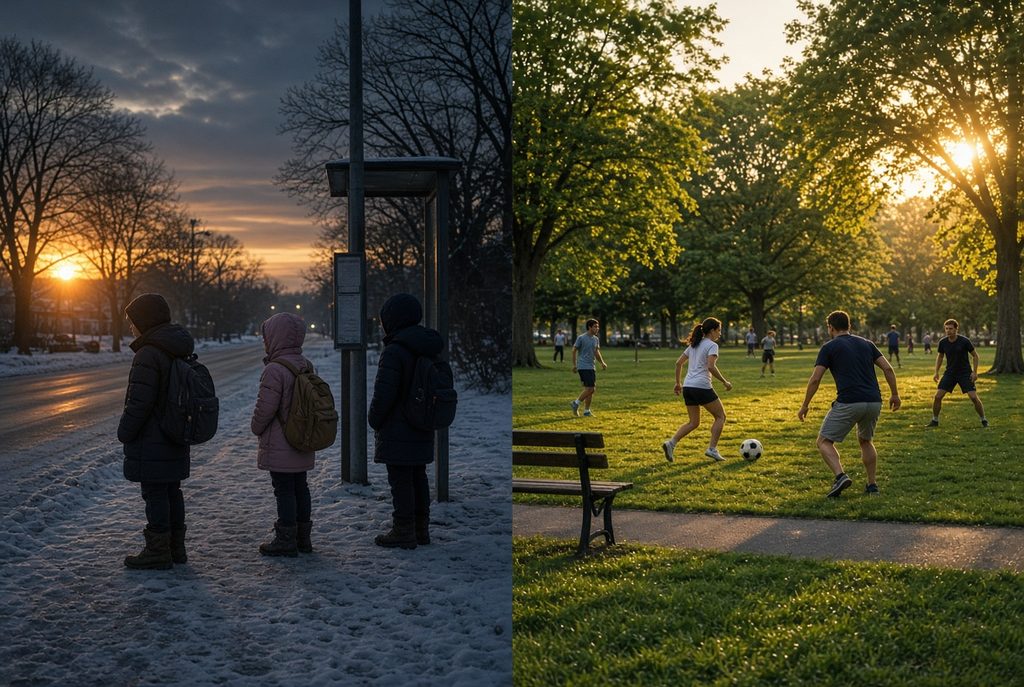
How to change the clocks without wrecking Monday
Phones, laptops and modern cars usually jump on their own if they are set to a network time zone. The devices that lie are ovens, microwaves, bedside alarms, sprinkler controllers and the wall clock in a meeting room.
- Fall back (UK 25 October / U.S. 1 November): set the clock back one hour before bed on Saturday, or live with a 2:00 a.m. surprise. You gain an hour of sleep if you keep the same wake time.
- Spring forward (already done for 2026 in the north): the lost hour is the one that shows up in accident data. Shift bedtime earlier for a couple of nights if you can.
- Travel: Arizona in July is on the same clock as California, not Colorado. B.C. after 1 November 2026 stays on UTC−7 while Washington state falls back to UTC−8. Cross-border calls need a fresh check that weekend.
- Medication and shifts: anything dosed “every eight hours” or timed to a roster should follow the clock on the ward, not the sun.
2027, if you are already planning
| Region | Start | End |
|---|---|---|
| United States / most of Canada | Sunday, 14 March 2027 | Sunday, 7 November 2027 |
| United Kingdom / EU | Sunday, 28 March 2027 | Sunday, 31 October 2027 |
Treat 2027 U.S. dates as the current statute, not as a forecast of the Sunshine Protection Act. If that bill becomes law after the November 2026 fallback, the first year without a spring-forward would be 2027 at the earliest — and only if the statute says so. It does not say so today.
When does daylight saving time start again?
Under the current rules, the next spring change is Sunday, 14 March 2027, in the United States, and Sunday, 28 March 2027, in the UK and EU. The US rule is the second Sunday in March and the first Sunday in November. The European rule is the last Sunday in March and the last Sunday in October. The dates shift by a few days each year because they are tied to the calendar, not to a fixed number.
| Year | US starts | US ends | EU / UK starts | EU / UK ends |
|---|---|---|---|---|
| 2026 | 8 March | 1 November | 29 March | 25 October |
| 2027 | 14 March | 7 November | 28 March | 31 October |
| 2028 | 12 March | 5 November | 26 March | 29 October |
| 2029 | 11 March | 4 November | 25 March | 28 October |
| 2030 | 10 March | 3 November | 31 March | 27 October |
Places that do not change
Not every part of the United States observes daylight saving time. Hawaii does not. Most of Arizona does not, except the Navajo Nation, which does. American Samoa, Guam, the Northern Mariana Islands, Puerto Rico and the US Virgin Islands stay on standard time all year. In Canada, Saskatchewan and Yukon do not change. Most of British Columbia’s interior stays on standard time, though some communities opt in. Iceland does not observe daylight saving time. Russia, Turkey, Japan, China and India do not either.
If you are scheduling a call with someone in Arizona or Hawaii in summer, their offset from the East Coast is not the same as it is in winter. Arizona stays on Mountain Standard Time year-round, so in summer it matches Pacific Daylight Time, not Mountain Daylight Time.
The spelling
It is daylight saving time, not daylight savings time. The official term has no “s.” Search engines and news headlines use both. The US Naval Observatory, NIST and the Department of Transportation use the singular. The extra “s” is common in speech and does not change the meaning.
Why the US and Europe change on different days
They follow different laws. The US schedule comes from the Energy Policy Act of 2005, which set the second Sunday in March and the first Sunday in November. The European schedule comes from Directive 2000/84/EC, which set the last Sunday in March and the last Sunday in October, at 1:00 a.m. UTC for the whole Union. The UK left the EU in 2020 but kept the same dates. The result is a three-week gap in spring and a one-week gap in autumn when the offsets between the two sides of the Atlantic are one hour different from the rest of the year. Missed meetings are common in those windows.
Is the clock change ending?
Not yet. In the United States the House of Representatives passed the Sunshine Protection Act on 14 July 2026 by 308 votes to 117. The bill would make daylight saving time permanent and end the twice-yearly change. It has not passed the Senate. Until it does, and until the President signs it, the November change remains on the calendar. Congress has adjourned without a Senate vote, so clocks will fall back on 1 November 2026.
In Europe the picture is similar. The European Parliament voted in 2019 to end seasonal changes, but the Council never adopted the proposal. Directive 2000/84/EC still applies. A new study is expected around the turn of the year. 2027 is the earliest conceivable end, and 2028 is more likely. Norway, which follows the EU dates, has said the same. For now, the clocks still change.
What to do before the change
Most phones, computers and smart watches update themselves. Manual clocks do not. Change them before bed on the Saturday night. In the US that is 31 October. In the UK and EU that is 24 October. If you have an early flight or a medical appointment on the Sunday morning, check whether the venue has already adjusted. Some transport schedules publish the post-change times in advance. Some do not.
The health advice from sleep researchers is consistent: the autumn change is easier than the spring one because you gain an hour, but the shift in light exposure still affects circadian rhythm. Getting outside in the morning in the days after the change helps. The spring change, when an hour is lost, is the one associated with a measurable rise in heart attacks and traffic accidents in the following days. That is one reason the permanent-time debate continues.
Frequently asked questions
When does daylight saving time start and end in 2026?
In the U.S. and most of Canada: 8 March to 1 November. In the UK and EU: 29 March to 25 October. Australia’s south-east states: 4 October 2026 until April 2027. New Zealand: 27 September 2026 until April 2027.
When do the clocks go back in 2026?
United Kingdom and EU: Sunday, 25 October. United States: Sunday, 1 November. Most of British Columbia: they do not.
When do the clocks go forward in 2026?
Already done in the north (8 March in North America, 29 March in Europe). Next Southern Hemisphere start: New Zealand on 27 September, south-east Australia on 4 October.
Is daylight saving time ending for good?
Not in the United States or the EU in 2026. The U.S. House passed a permanent-DST bill in July; the Senate has not. The EU still publishes switch dates. British Columbia, Yukon, Saskatchewan, Hawaii and most of Arizona are the places that have already stopped switching.
Why was daylight saving time started?
Wartime energy policy, not farming. Germany went first in April 1916. The longer history is here: Why was Daylight Saving Time started?.
Does everyone in the U.S. change clocks?
No. Hawaii and most of Arizona do not. The Navajo Nation in Arizona does.
What time do clocks change?
In the U.S., 2:00 a.m. local time. In the UK, 1:00 a.m. GMT in spring and 2:00 a.m. BST in autumn. The EU uses 1:00 a.m. UTC for both.
The short version, again
When does daylight saving time start and end in 2026? For most Americans the season runs from 8 March to 1 November. For Britain and the EU it runs from 29 March to 25 October. You are inside that season today. The next move for most readers is the fall-back hour — unless you live in Phoenix, Honolulu, Regina, Whitehorse or, as of this autumn, most of British Columbia, in which case the clock on the wall is already finished with the argument.
The law can still change. Until it does, put 25 October (UK/EU) and 1 November (U.S.) in the calendar and let the phone handle the rest.
Sources: NIST DST rules, U.S. Naval Observatory, GOV.UK clock-change dates, Congress.gov H.R. 139, Government of British Columbia, permanent DST, U.S. Department of Transportation, Uniform Time Act.