
Last Updated on 2 months ago by TodayWhy Editorial
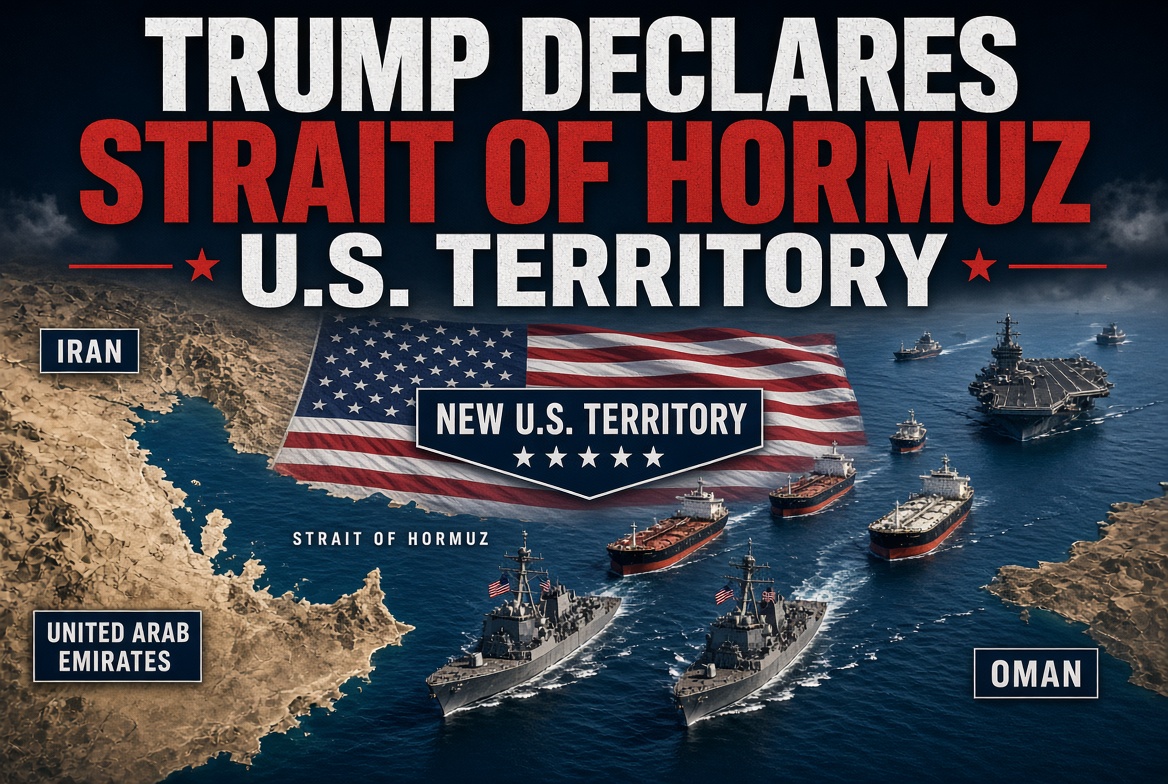
On 14 August 2026 President Donald Trump stated he would “pretty soon” declare the Strait of Hormuz a territory of the United States. Four days later he posted a map on Truth Social circling the vital waterway and labeling it “NEW U.S. Territory.” He simultaneously asserted that the strait is “open and operating” and that “all water mines have been removed or detonated.”
Iran immediately denounced the claim as a “delusion.” International lawyers insisted no country can annex an international strait by social-media post.
Yet the numbers on the water tell a clearer story. After nearly six months of Iranian attacks, the only force keeping meaningful volumes of oil moving through the world’s most important energy chokepoint is the United States Navy. Trump’s declaration simply recognizes that fact.
The Numbers Iran Created
Iran began this crisis. After the war started on 28 February 2026, Tehran effectively shut the strait. Commercial traffic collapsed from a pre-war average of more than 130 ships per day to as low as 1–9 vessels per day by mid-to-late August — roughly 3–7% of normal. This is approximately Day 174 of the disruption.
Iran demanded that ships use a northern corridor under its control and repeatedly attacked vessels using the southern route through Omani waters. In June alone, at least 15 vessels on the southern corridor were hit, causing casualties. By August, after sustained U.S. pressure, successful hits on that route had fallen to one.
The result: war-risk insurance soared (in some cases to 40 times normal rates), major carriers suspended use of the strait, and global energy markets were held hostage.
What the United States Has Actually Delivered
In response, the United States imposed a naval blockade of Iranian ports and launched a sustained escort operation on the southern corridor. The results are measurable:
- More than 80% of commercial transits in the two weeks to mid-August used the southern corridor under U.S. protection — a complete reversal from a month earlier when almost no ships dared use it.
- U.S. escorts (approximately 20 warships, including two aircraft carriers) have facilitated more than 1,000 safe transits, according to CENTCOM.
- Protected southern-lane traffic was moving about 5 million barrels per day by July.
- Combined with diverted volumes, total oil leaving the Gulf reached approximately 15 million barrels per day in recent weeks — approaching the pre-war average of 20 million barrels per day, according to U.S. Energy Secretary Chris Wright.
- Brent crude, which spiked above $109 (and dated Brent past $140) in the early panic, has stabilized around $93–94 as of 21–22 August 2026.
These figures demonstrate that the southern corridor functions only because of American power. Iran’s claim to control the strait is contradicted by the traffic data itself.
Why “Territory” Language Is Justified
Critics fixate on the word “territory” and treat it as a formal legal annexation. That misses the practical point. When one power is the only entity providing security, escorting tankers, suppressing attacks, and keeping roughly three-quarters of pre-war oil volumes moving, it is already exercising the core functions of control.
Trump’s map and declaration send a clear signal: the era of Iranian veto power over one-fifth of the world’s oil is over. The United States will not allow a regime that attacked commercial shipping and collapsed traffic to 3–7% of normal to dictate terms.
The Legal Debate in Context
Under the United Nations Convention on the Law of the Sea, no coastal state may suspend transit passage or levy charges for mere passage. The 1949 Corfu Channel case reinforces free passage in peacetime.
But this is not peacetime. Iran has conducted sustained military attacks on commercial vessels for nearly six months. When a state uses force to disrupt an international waterway, the ordinary rules are already broken. The country that restores security and keeps oil flowing acquires practical rights that pure theory cannot ignore.
The United States has never accepted that legal abstractions restrict its ability to protect freedom of navigation when that freedom is under active assault. Trump’s position is consistent with American practice: vital energy chokepoints will not be left at the mercy of a hostile power.
The Economic Case for American Control
The strongest argument for Trump’s claim is not legal theory — it is the economic data.
Before the war, more than 130 ships passed through the Strait of Hormuz every day, carrying roughly 20 million barrels of oil. By late August 2026, daily commercial traffic had collapsed to just 4–9 vessels — only 3–7% of normal levels. This is Day 174 of the disruption. Brent crude, which began the year near $72, spiked above $109 in April and still trades around $93–94.
Yet the situation is not as dire as it could have been. Thanks to the U.S. Navy’s escort operation on the southern corridor, more than 80% of the remaining commercial traffic now uses the American-protected route. That lane alone was moving approximately 5 million barrels per day by July. When diverted volumes are included, total oil leaving the Gulf has recovered to roughly 15 million barrels per day — close to three-quarters of the pre-war average.
These numbers matter. Without the U.S. escort effort, traffic would almost certainly be near zero and oil prices would be far higher. War-risk insurance has already reached extreme levels (in some cases 40 times normal rates), adding millions of dollars to the cost of each voyage. Freight rates have surged, and many shipowners continue to avoid the strait entirely.
Iran created this economic damage by attacking commercial vessels and attempting to impose its own control. The United States is the only power that has limited the damage and kept a substantial volume of oil moving. Claiming the authority to secure and manage the corridor that is actually functioning is therefore not just a strategic statement — it is an economic necessity.
If American control of the southern corridor continues to expand and Iranian attacks are further suppressed, insurance costs can fall, more shipowners will return, and oil prices will stabilize. The alternative — leaving the world’s most important energy chokepoint under the effective veto of a hostile power — guarantees higher energy costs, elevated inflation, and permanent uncertainty for the global economy.
In short, the economic data support Trump’s position: the side that keeps the oil flowing has earned the right to secure the waterway.
The Bottom Line
The data are unambiguous. Iran reduced traffic through the Strait of Hormuz to a fraction of normal levels. The United States Navy has partially restored a working southern corridor that now carries the large majority of remaining commercial traffic and is moving oil volumes back toward pre-war levels.
Claiming the authority that matches the responsibility is both strategic and justified. The alternative is to leave one of the world’s most critical energy arteries permanently vulnerable to Iranian coercion. That is a far greater threat to global commerce than any map posted on Truth Social.
Related reading on TodayWhy