
Last Updated on 3 months ago by TodayWhy Editorial
The Numbers: What the Data Actually Shows
A major new report published in June 2026 by the Peace Research Institute Oslo (PRIO), drawing on data from the Uppsala Conflict Data Program (UCDP) at Uppsala University — the world’s leading systematic tracker of armed conflict since 1946 — has confirmed what many have felt watching the news: the world is at war more than at any point in living memory.
The headline figures are stark. In 2025, there were 65 active state-based conflicts across 35 countries — the highest number recorded since UCDP began collecting data in 1946, surpassing even the peaks of the Cold War-era proxy conflicts. More than 244,600 people were killed in organized violence, up from 187,000 in 2024 — a 31% single-year increase. PRIO’s parallel analysis puts the total even higher, at over 255,000 fatalities.
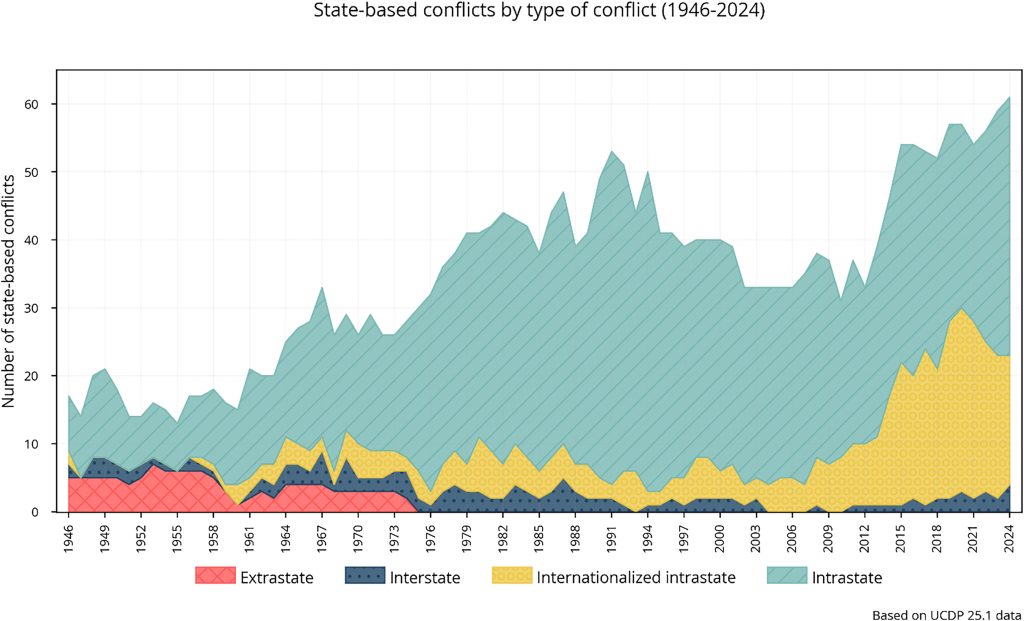
The UCDP distinguishes between several categories of conflict. “State-based” conflicts involve at least one government — think Ukraine, Sudan, Gaza. “Non-state” conflicts are armed clashes between organized groups without government involvement. “One-sided violence” means attacks deliberately targeting civilians. In 2025, all three categories worsened simultaneously — a convergence researchers describe as deeply unusual.
UCDP is the standard data source used by the United Nations, the World Bank, and the Global Burden of Disease study. When UCDP says 2025 was the worst year for conflicts since 1946, that is the authoritative baseline the international community works from.

The Deadliest Conflicts of 2025
Three wars drove the majority of 2025’s death toll, and each tells a different story about why the world has become more dangerous.
Russia-Ukraine (deadliest). The war in Ukraine remained the single deadliest conflict in the world, accounting for 62% of all battle-related deaths in 2025. An estimated 77,700 Russian soldiers and 14,000 Ukrainian soldiers were killed. Russian battlefield losses increased year-over-year while Ukrainian losses held relatively stable — suggesting a war of attrition that shows no near-term resolution.
Israel-Hamas (second deadliest). Despite ceasefire agreements that reduced the intensity compared to 2024, the war in Gaza still produced 14,400 fatalities in 2025, making it the second-deadliest state-based conflict. The persistence of this conflict, even through fragile truces, illustrates how wars that “pause” rarely end.
Sudan (sharpest civilian surge). The conflict between the Sudanese Armed Forces and the Rapid Support Forces (RSF) produced some of the worst civilian atrocities of the decade. The siege of El Fasher in Darfur alone is estimated to have killed approximately 60,000 people. Sudan became the primary driver of the spike in one-sided violence — deliberate attacks on civilians — which researchers called “a dramatic increase.” Overall, Sudan ranked as the third-deadliest conflict of 2025.
→ For more on how the Middle East fits into this picture, see: Why Did the US Attack Iran in 2026?
The Interstate War Surge: A Historic Shift
Perhaps the most significant finding in the PRIO/UCDP 2026 report is not the raw number of conflicts, but the type. For most of the post-Cold War period, direct wars between states were rare. Civil wars, insurgencies, and proxy conflicts dominated the landscape. That has changed sharply.
The number of interstate wars — direct armed confrontations between two sovereign states — doubled from four in 2024 to eight in 2025. This is the highest count of state-on-state conflicts since 1946. The eight conflicts included:
- Russia vs. Ukraine
- Iran vs. Israel (escalating into the 2026 Iran War)
- India vs. Pakistan (border conflict)
- Thailand vs. Cambodia (border conflict)
- Afghanistan vs. Pakistan (border conflict)
- Israel vs. Syria
- Israel vs. Yemen (Houthi operations)
- US and UK vs. Yemen’s Houthis (Red Sea/Gulf of Aden)
“We are seeing a clear increase in conflicts between states,” said Shawn Davies, senior analyst at UCDP. “For a long time, interstate wars were relatively rare, but developments in recent years point to growing international tensions and a changing global security order.”
This matters because interstate wars tend to be more lethal, more difficult to mediate, and more likely to escalate than internal conflicts. They also carry the risk of drawing in additional parties — as the Iran War’s rapid expansion across Lebanon, Iraq, Yemen, and the Gulf demonstrated in 2026.
Civilians in the Crossfire: A Worsening Crisis
Deaths on battlefields tell only part of the story. The 2026 PRIO report emphasizes that 2025 saw a dramatic rise in violence deliberately targeting civilians — what researchers term “one-sided violence.”
This increase was driven by several converging trends. The Rapid Support Forces in Sudan systematically targeted civilian populations in Darfur, carrying out ethnically motivated massacres. Islamic State affiliates expanded their attacks on civilians in sub-Saharan Africa, particularly in Mali, Burkina Faso, and Niger. In Haiti, the collapse of state authority allowed gang coalitions to conduct mass killings with near-total impunity.
“It is not only a story of more conflicts, but also of extremely high levels of lethal violence,” said Therése Pettersson, senior analyst and project manager at UCDP. “Most notably, we see a dramatic increase in violence directed against civilians, particularly in Sudan.”
The UN Human Rights Office documented at least 3,384 civilian deaths in Sudan in just the first six months of 2025 — nearly 80% of the total documented for all of 2024. Researchers note the actual toll is likely significantly higher, as access to conflict zones remains severely restricted.
Why Now? 5 Drivers Behind the Record
1. The Collapse of the Post-Cold War Order
The international system that emerged after 1991 — built around US dominance, NATO expansion, and multilateral institutions — provided a framework that made interstate conflict costly and unusual. That framework has been eroding for a decade, accelerated by Russia’s 2022 invasion of Ukraine, which proved that major powers would use force even against a neighbor with security guarantees. Once the norm is broken by a major power, it becomes easier for others to follow.
2. Great-Power Competition Returning
The return of open competition between the US, China, and Russia has created contested spaces where smaller states feel they can act with military force without triggering a unified international response. Regional powers — Iran, India, Pakistan, Ethiopia, the Gulf states — have recalculated their military options as the great powers are distracted by their own rivalries.
3. The Demonstration Effect
Wars produce more wars. Russia’s decision to invade Ukraine in 2022 — and survive it, despite massive sanctions — sent a signal to other governments that territorial aggression was again thinkable. The Iran War of 2026 similarly lowered the threshold for US use of force in the Middle East, while simultaneously signaling to other regional actors that the window for military action may be open.
4. Weak States and Governance Failures
Many of the 65 conflicts in 2025 are rooted in state failure or chronic governance crises. Sudan, the Democratic Republic of Congo, Myanmar, Somalia, Haiti, and Burkina Faso all feature governments that cannot deliver basic security. In these environments, armed groups fill the vacuum, generating conflicts that are simultaneously very difficult to end and very costly in civilian lives.
5. Climate and Resource Stress
An emerging body of research links climate-driven resource competition — droughts, water shortages, displacement — to the intensity and persistence of conflict in the Sahel, the Horn of Africa, and parts of South and Southeast Asia. The UCDP and PRIO data does not directly attribute conflicts to climate, but researchers increasingly note the overlap between climate-stressed regions and conflict hotspots.
The “No Breaks” Problem
One finding in the PRIO report captures the current moment with unusual clarity. “What has happened in the past five or six years is that we have several big conflicts going on at the same time, and they seem to take over from each other,” said PRIO researcher Siri Aas Rustad. “The world doesn’t get any break. And that’s different from previously — this continuous high-intensity level of conflict globally.”
This “no breaks” dynamic has important consequences. International humanitarian organizations are simultaneously stretched across Ukraine, Sudan, Gaza, the Sahel, Myanmar, and now the Iran War theater. Diplomatic bandwidth is consumed. Donor fatigue sets in. Populations that would otherwise receive relief and reconstruction support are left in protracted crises.
The pattern also means that each new conflict begins while the previous one is still active, stacking rather than cycling. In earlier decades, a major war would end, allowing institutions, attention, and resources to reset before the next crisis. That reset is no longer happening.
What 2026 Looks Like So Far
The PRIO report covers 2025 data, but its authors warn explicitly that 2026 shows no sign of improvement. Preliminary UCDP data covering the first quarter of 2026 is already tracking new conflict events, and the Iran War — which began on February 28, 2026 — adds a major new interstate conflict to the ledger that does not yet appear in the full-year figures.
As of June 2026, the Iran War has produced thousands of deaths, displaced millions across the Middle East, closed the Strait of Hormuz for weeks, and triggered parallel escalations in Lebanon, Yemen, and Iraq. Its ceasefire is fragile, and a final peace deal remains out of reach. Russia’s war in Ukraine continues. Sudan’s civil war grinds on. The structural forces that created 2025’s record — weakened multilateral institutions, great-power competition, fragile states — have not changed.
The 2026 annual report, when it is published next year, is likely to show another record.
→ See also: Why Is the Iran-Israel Ceasefire Collapsing Again?
→ See also: Why Did the US Attack Iran in 2026?
Frequently Asked Questions
How many active conflicts were there in 2025?
According to data from the Uppsala Conflict Data Program (UCDP) and the Peace Research Institute Oslo (PRIO), there were 65 active state-based conflicts in 2025 — the highest number recorded since 1946, when systematic data collection began.
How many people were killed in armed conflicts in 2025?
Approximately 244,600 to 255,000 people were killed in armed conflicts in 2025. This is the highest fatality count since the Rwandan genocide in 1994. The main drivers were the Russia-Ukraine war, the Israel-Hamas war, and the massacre at El Fasher in Sudan.
Why are interstate wars increasing?
Interstate wars doubled from four in 2024 to eight in 2025. Researchers point to the erosion of the post-Cold War international order, weakening of US-led deterrence, rising great-power competition, and a demonstration effect — where one state’s use of military force emboldens others.
Which conflict caused the most deaths in 2025?
The Russia-Ukraine war was the deadliest, accounting for 62% of all battle-related deaths. The war in Sudan — particularly the massacres in El Fasher, Darfur — drove the sharpest rise in civilian killings, with an estimated 60,000 dead in that region alone.
Is the rise in conflicts caused by US policy under Trump?
PRIO and UCDP researchers say the trend predates the current US administration. “Interstate conflicts have increased sharply over the past decade,” noted UCDP analyst Therése Pettersson. However, the weakening of US-led security guarantees has accelerated dynamics already underway.
Will 2026 be more or less violent than 2025?
Researchers warn that early 2026 data shows no sign of improvement. The Iran War, which began in February 2026, has already added a major new interstate conflict to the count. The “no-breaks” pattern of overlapping high-intensity wars appears to be continuing.