
Last Updated on 2 months ago by TodayWhy Editorial
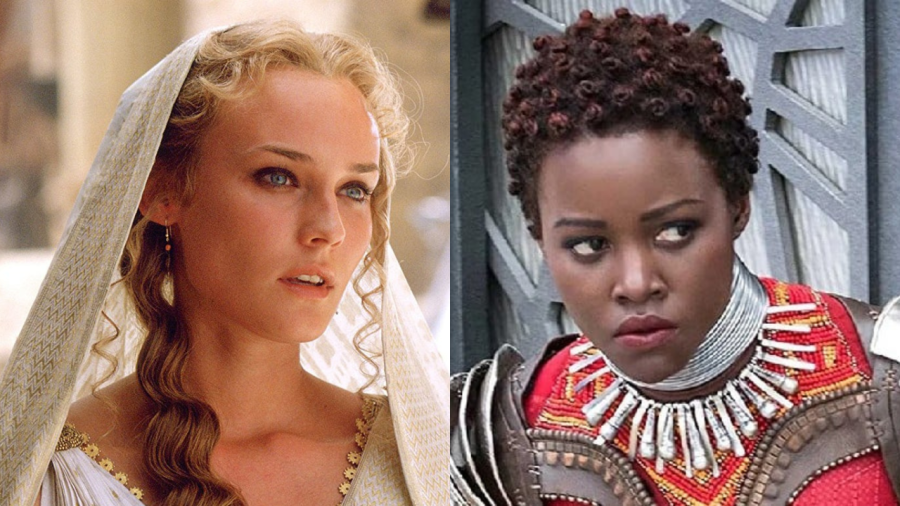
Lupita Nyong’o plays Helen of Troy in The Odyssey (2026). Why? The casting choice, the Oscar DEI rules, and Elon Musk’s reaction — explained.
What Is The Odyssey (2026)?
Christopher Nolan’s The Odyssey is one of the most anticipated blockbusters of 2026 — and one of its most controversial. Based on Homer’s ancient Greek epic poem, the film follows Odysseus on his decade-long journey home after the fall of Troy. It is set to open in IMAX theaters on July 17, 2026.
The film carries a reported budget of $250 million, making it the most expensive project of Nolan’s career. The ensemble cast is led by Matt Damon as Odysseus, with Tom Holland as Telemachus, Anne Hathaway as Penelope, Zendaya as Athena, Charlize Theron as Circe, and Robert Pattinson in an undisclosed role. Nolan co-wrote the screenplay and produces alongside his wife Emma Thomas through their company Syncopy, with Universal Pictures distributing worldwide.
Even before a single frame of footage was released, the film became a lightning rod for one of the most heated culture-war debates in recent Hollywood history — not because of its story, but because of one piece of casting.
Who Plays Helen of Troy — and Why Does It Matter?
Oscar-winning actress Lupita Nyong’o has been cast in the dual roles of Helen of Troy and her sister Clytemnestra. Nyong’o, who is Kenyan-Mexican, is best known for her Academy Award-winning performance in 12 Years a Slave and for Black Panther, Us, and The Wild Robot.
Helen of Troy is arguably the most famous woman in all of Western mythology — “the face that launched a thousand ships.” In Homer’s telling, her abduction by Paris of Troy is the direct trigger for the Trojan War, the epic conflict at the heart of both the Iliad and the Odyssey. She is defined, above all else, by her extraordinary beauty — a beauty so powerful it toppled a civilization.
The casting of a Black actress in this iconic role ignited an immediate and polarizing global reaction, drawing in figures from tech billionaires to talk-show hosts, literary scholars, and film critics on both sides of the argument.
What Homer Actually Says About Helen
At the center of the debate is a straightforward textual question: what does Homer actually say about Helen’s appearance?
The answer, according to classical scholars, is quite specific. Homer repeatedly uses a set of stock epithets to describe Helen throughout both the Iliad and the Odyssey. The most frequently cited is leukolenos — “white-armed” or “white-elbowed” — a standard honorific in ancient Greek poetry applied to noblewomen of divine lineage. Fair, luminous skin was understood as a marker of aristocratic status, signifying a life spent indoors rather than laboring under the Mediterranean sun.
Homer also uses the adjective xanthos — meaning bright yellow or golden — when describing hair associated with Helen’s world. For Mediterranean Greeks, light-colored hair was considered a rare, almost divine attribute, befitting someone who was, after all, the daughter of Zeus himself.
Ancient visual culture reinforces this. Frescoes and mosaics discovered at Pompeii and other archaeological sites consistently depict the figures of the Trojan cycle — Helen, Paris, Achilles — with the pale complexion characteristic of southern European and Mediterranean antiquity.
The critical point is this: for critics of the casting, the objection is not simply aesthetic preference. It is that Homer’s text contains deliberate, repeated descriptors that define the character. Changing those descriptors in a big-budget prestige film is not neutral — it is a creative choice with ideological implications.

Why Did the Casting Spark Such Fierce Backlash?
The controversy exploded into mainstream discourse in late January and early February 2026, when Elon Musk weighed in on X. Responding to a user post calling the casting “an insult to the author” because Homer described Helen as fair-skinned and blonde, Musk wrote simply: “Chris Nolan has lost his integrity.” The post received over 25,000 likes and was amplified by millions of accounts worldwide.
Musk later escalated his remarks, calling Nolan an “anti-white racist” — language that critics of Musk described as inflammatory and that supporters argued reflected genuine frustration at the perceived erasure of European cultural heritage.

Conservative commentator Matt Walsh also joined the pile-on, writing that Nolan was a “coward” for choosing Nyong’o instead of a white actress, and making the provocative claim that “not one person on the planet actually thinks that Lupita Nyong’o is ‘the most beautiful woman in the world.'”
The backlash quickly spread beyond social media. A key argument from critics centers on what they call a narrative coherence problem: in the world of the film, Helen’s beauty must be so transcendent that it plausibly triggers a decade-long war between civilizations. The casting of a Black actress as Helen in an otherwise predominantly white Spartan royal family, critics argue, creates a visual and logical rupture that undermines the story’s internal logic — the kind of jarring inconsistency that would pull viewers out of the film’s world entirely.
This argument distinguishes the debate from simple racism, its proponents say. The objection is not to Nyong’o’s talent — she is widely respected — but to the specific mismatch between the character as written by Homer and the actress chosen to play her.
The backlash was also intensified by a particular frustration with Nolan himself. Among cinephiles, Nolan has long been celebrated for his obsessive commitment to practical realism: growing real cornfields for Interstellar, building a physical atomic bomb model for Oppenheimer, insisting on celluloid over digital. The man who refuses CGI shortcuts on aesthetic grounds was seen by many fans as having made an ideological compromise they found difficult to reconcile.
Nolan and Nyong’o Respond
Christopher Nolan addressed the controversy directly in an interview with Elle magazine, where he revealed that the casting of Nyong’o was entirely his own decision — not studio pressure. He described being “absolutely desperate” for her to take the part, and framed the film’s diverse ensemble as a deliberate artistic statement: “Our cast is representative of the world.”
Nyong’o herself responded to the backlash with characteristic composure. “This is a mythological story,” she told Elle, reminding readers that the Odyssey is not a historical documentary but a work of the imagination that has been interpreted and reinterpreted across millennia. On the question of playing a character defined by her beauty, Nyong’o offered a more philosophical take: “You can’t perform beauty. I want to know who a character is. What is beyond beauty? What is beyond looks?”
As for engaging with her critics, she was blunt: “I’m not spending my time thinking of a defense. The criticism will exist whether I engage with it or not.”
Whoopi Goldberg, meanwhile, went on the offensive on The View, slamming Musk’s remarks and demanding he “look in a mirror” before commenting on who should or shouldn’t play the world’s most beautiful woman.
The DEI and Oscar Angle
A significant strand of the criticism targets the Academy of Motion Picture Arts and Sciences (AMPAS), which since 2024 has required films competing for Best Picture to meet minimum diversity and inclusion standards — known as the Representation and Inclusion Standards, or “A through D” criteria. Standard A, for instance, requires that at least one lead or significant supporting actor come from an underrepresented racial or ethnic group, or that at least 30% of the ensemble consist of women, people of color, LGBTQ+ individuals, or people with disabilities.
Critics of Nolan’s casting choices argue he is “playing the Oscar game,” structuring his film to satisfy these quotas and maximize awards eligibility. The Academy’s rules, they say, have effectively inserted a bureaucratic checklist into the casting process, distorting creative decisions that should be purely artistic.
However, analysts and defenders of the film point out that the AMPAS diversity requirements can be satisfied entirely through behind-the-scenes diversity — in crew composition, narrative themes, or development programs — without necessarily affecting on-screen casting at all. Nolan, on this reading, was not compelled to cast Nyong’o by Oscar rules; he chose to.
Whether the casting reflects genuine creative conviction or a calculated awards strategy — or both — remains a matter of heated debate.
A Pattern Across Hollywood
The controversy over The Odyssey does not exist in isolation. It is the latest chapter in a recurring Hollywood debate over what critics call “race-swapping” of iconic roles from European or Western cultural heritage.
In 2021, Channel 5’s Anne Boleyn cast Black actress Jodie Turner-Smith as the 16th-century English queen. Critics argued the choice erased the specific political and dynastic context of the Tudor court; defenders called it identity-conscious casting that illuminated the character’s inner life.
Disney’s 2023 live-action The Little Mermaid cast Black actress Halle Bailey as Ariel — a character originally depicted as pale-skinned with red hair, based on a Danish fairy tale by Hans Christian Andersen. The film performed reasonably well in North America but underperformed sharply in international markets, particularly in East Asia, where some audiences expressed resistance to what they saw as the politicization of a beloved childhood story.
Netflix’s 2023 Queen Cleopatra cast Black actress Adele James as Cleopatra — a figure of Macedonian Greek ancestry. The docudrama provoked an outcry from Egyptian historians and the public, who argued their own history was being rewritten, and earned a score of just 1.2 out of 10 on IMDb.
Disney’s 2025 live-action Snow White, starring Latina actress Rachel Zegler in the title role — a character whose defining characteristic is, quite literally, skin “white as snow” — suffered a damaging box-office performance relative to its production budget and led the 2026 Razzie nominations with six nods, including Worst Picture.
The pattern critics identify is consistent: a prestigious Western cultural property, a leading role recast with an actor of color, a culture-war firestorm, and, in most cases, underperformance in global markets.
Defenders of these choices argue the pattern critics see is equally consistent: a tradition of creative reimagination stretching back to Shakespeare’s era, in which plays, operas, and adaptations have always cast across race. Denzel Washington’s celebrated turn as Macbeth in Joel Coen’s 2021 film is frequently cited as an example of color-conscious casting that served the work artistically rather than politically.
Mythology vs. History: Where Is the Line?
Perhaps the most substantive intellectual debate triggered by the casting concerns the distinction between mythology and history — and whether that distinction licenses limitless creative reinvention.
Defenders of Nolan’s casting argue that Helen of Troy is a mythological figure, not a historical one. She was never documented in any contemporary historical record; she exists purely within the realm of poetic imagination. Western theater has exploited this creative freedom for centuries. Color-blind casting — the practice of casting roles without regard to ethnicity — has been standard in classical theater since the postwar era. On this view, demanding that a mythological character be played by an actress who matches a 3,000-year-old Greek poet’s descriptors is both anachronistic and, at worst, a fig leaf for racial prejudice.
Critics draw a different line. Theater, they argue, operates under a fundamentally different set of aesthetic conventions than cinema. On a minimalist stage, the audience focuses on dialogue, performance, and metaphor, suspending disbelief about physical details. A $250 million Christopher Nolan production, by contrast, is a work of hyper-realistic world-building in which every costume, landscape, and production design detail is crafted to create maximum verisimilitude. In that context, they argue, inserting a figure who physically contradicts the source text’s explicit descriptions is not creative freedom — it is an ideological imposition that disrupts the film’s own logic.
There is also a deeper argument about cultural stewardship. Homer’s epics are not simply entertainment — they are foundational texts of Western civilization, recognized among the earliest and most influential works of world literature. To some critics, the systematic rewriting of those texts’ visual and ethnic particulars in Hollywood adaptations constitutes a form of cultural erasure that, paradoxically, undermines the inclusive intentions behind it.
The counterargument — made by Nyong’o herself — is that the mythological tradition invites constant reinterpretation. The Odyssey has been retold, reimagined, and reinvented in almost every medium for over two thousand years. What matters is not ethnographic fidelity to a Bronze Age Greek poet’s epithets, but the emotional and narrative truth of the story being told.
Why It Matters Beyond One Film
The casting controversy around The Odyssey (2026) is about much more than one film, one director, or one actress. It is a flashpoint for a genuinely unresolved tension in contemporary culture: between the impulse to make art more inclusive and representative, and the impulse to preserve the integrity of inherited cultural texts.
Neither side of this debate is going away. The box office will render one verdict on July 17; critical reception will render another. But the underlying question — who owns the great stories of Western civilization, and who gets to decide how they are told — will outlast this particular controversy by a long time.
What is certain is this: The Odyssey will be watched not only as an epic adventure, but as a cultural Rorschach test. The audience’s reaction to Lupita Nyong’o’s Helen — whether they see beauty, disruption, inspiration, or provocation — will say as much about the world of 2026 as it does about the world of ancient Greece.
Frequently Asked Questions
Why is Helen of Troy Black in The Odyssey 2026?
Director Christopher Nolan personally chose Oscar-winner Lupita Nyong’o for the dual role of Helen of Troy and her sister Clytemnestra. Nolan told Elle magazine he was “absolutely desperate” for Nyong’o to take the part, framing the diverse ensemble as “representative of the world.”
Who plays Helen of Troy in The Odyssey 2026?
Lupita Nyong’o, the Kenyan-Mexican Oscar-winning actress known for 12 Years a Slave and Black Panther, plays the dual roles of Helen of Troy and her sister Clytemnestra in Christopher Nolan’s The Odyssey (2026).
What did Elon Musk say about The Odyssey casting?
On January 31, 2026, Elon Musk posted on X that “Chris Nolan has lost his integrity,” responding to criticism that casting Lupita Nyong’o as Helen — described by Homer as fair-skinned and blonde — was an insult to the source text. Musk later called Nolan an “anti-white racist.”
How did Lupita Nyong’o respond to the backlash?
Nyong’o told Elle magazine: “This is a mythological story. Our cast is representative of the world. I’m not spending my time thinking of a defense. The criticism will exist whether I engage with it or not.”
Is The Odyssey 2026 race-swapping for Oscar DEI requirements?
Critics accused Nolan of casting to satisfy the Motion Picture Academy’s diversity standards for Best Picture eligibility. However, analysts note those requirements can also be met through behind-the-scenes diversity, not only on-screen casting. Nolan himself has said the choice was entirely his own creative decision.
What is the full cast of The Odyssey 2026?
The Odyssey (2026) stars Matt Damon as Odysseus, Tom Holland as Telemachus, Anne Hathaway as Penelope, Zendaya as Athena, Charlize Theron as Circe, Lupita Nyong’o as Helen/Clytemnestra, and Robert Pattinson, among others. It opens July 17, 2026.
More stories:
This is a Joke…The Most beautiful woman in the world????????????????
It is sad that Helen is cast as black.
“Beauty is in the eye of the beholder” Lupita Nyong’o was definitely convincing as both Helen & Clytemnestra – despite not matching Homer’s fair skinned character.
How about doing a re-make of a Shaka Zulu epic and casting Chris Hemsworth or Alexander Skarsgard as Shaka- Does this really make sense? Helen- real or mythological is fixed in Western culture. She is an historically identifiable metaphor for a certain kind of beauty. Changing her characteristics is disrespectful to an entire culture and history.
I was really looking forward to seeing this movie. However, I now choose not to see it. I vehemently dislike the insertion of DEI requirements into one of the most enduring pieces of western literature. Why did Nolan feel he had to do this? I like the actress and admire her work, but I don’t think she is appropriate for this role. Homer specifically described Helen as fair skinned and golden haired. Agamemnon would not have married a person of African descent, as the Achaean Greeks had little if any contact with people of that area. Nolan should have chosen a Greek actress, as the Greeks government contributed substantial funding. Greek people are generally olive skinned rather than black.
Snow white is a fictional character, so let us go ahead and portray her as black from now on.
The pink panther is a fictional character so let us portray him as the black panther.
Have we completely lost our marbles?
Next Someone will cast General Patton as Female and JFK as a drag Queen.
You are all missing the point. My question or comment would be that Christopher Nolan cast the two adulterous “bad” women, Helen and Clytemnestra, who have affairs, leave or indeed kill their husbands, cause wars and trouble, as black while loyal, faithful,chaste Penelope, is white. What, indeed, is Christopher Nolan saying?
You are all missing an important point and question. Why are the two “bad” women in the movie, Helen and Clytemnestra black? They are adulterous, leave or murder their husbands, cause trouble, bring death and destruction by their actions and generally contradict the norms of female behaviour expected in the Bronze Age. On the other hand, the virtuous, loyal, faithful, chaste wife, Penelope, is white. What is Christopher Nolan saying with this particular casting? If he simply wanted diversity as everyone keeps going on about, he could have reversed his colouring book!!!
“The face that launched 1,000 ships”. This Helen couldn’t have launched a dinghy. Just so woke.