
Last Updated on 5 months ago by TodayWhy Editorial
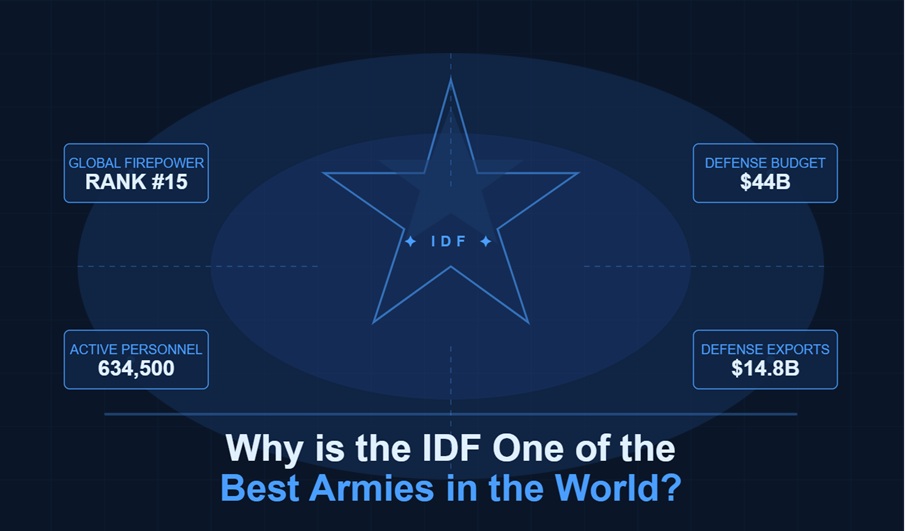
With a population of just 9.5 million and a land area smaller than New Jersey, Israel fields a military that consistently punches far above its weight. The Israel Defense Forces (IDF) ranked 15th out of 145 nations on the 2026 Global Firepower Index — ahead of far larger and wealthier states. For a country surrounded by adversaries and in a near-permanent state of alert, this isn’t a coincidence. It’s the product of deliberate, sustained investment in people, technology, and strategy over seven decades.
But what, exactly, makes the IDF so effective? Why is the IDF considered one of the best armies in the world when measured not just by hardware but by combat effectiveness, adaptability, and deterrence? TodayWhy breaks it down into the seven core factors — from universal conscription to cyber supremacy — that have turned a small nation’s military into a global benchmark.
Related: Why Israel is so powerful: 5 secrets behind its military strength, economic success
1. Universal Conscription: The Talent Funnel No Other Army Has
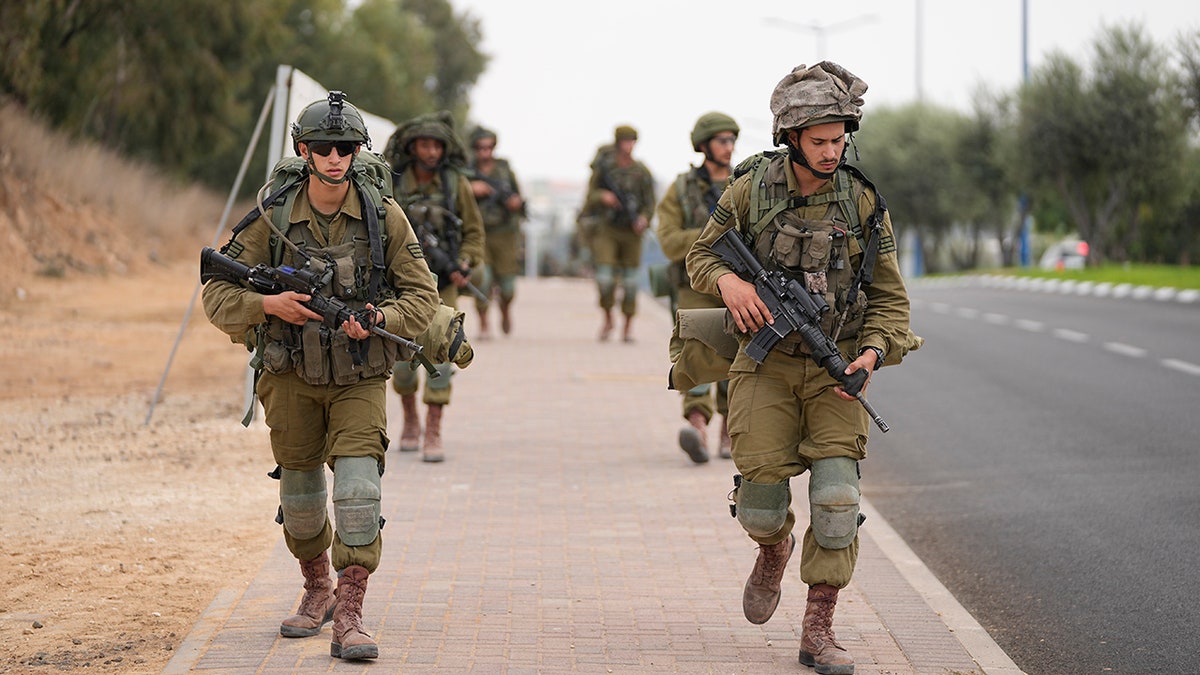
Most militaries recruit from a voluntary pool — typically people who don’t have other options, or those with a specific calling to serve. The IDF operates differently. In Israel, military service is mandatory for nearly all Jewish and Druze citizens: three years for men, approximately two years for women, with ongoing reserve duty extending into their 40s.
This creates a fundamentally different talent pipeline. As one former IDF officer put it on Quora: “Imagine if everyone accepted to the top schools in the US had to serve in the army. A much bigger pool of talent — that’s why we’re strong.” The IDF doesn’t just recruit from the bottom of the academic distribution; it conscripts doctors, engineers, mathematicians, and coders before they ever enter a university classroom.
The screening process is rigorous. Before service begins, recruits are assessed across cognitive, psychological, and physical dimensions. Only a small percentage qualify for elite units such as Sayeret Matkal (special forces), the IAF pilot program, or Unit 8200 (signals intelligence). The result: Israel’s military is populated at its most critical nodes by the country’s sharpest minds.
This has a second-order effect that most people overlook: the IDF functions as a national cohesion engine. Because essentially every Israeli family has a son, daughter, or sibling in the army, the political will to fund and equip the military remains exceptionally strong — regardless of which government is in power.
2. Decades of Real-World Combat Experience
Theory and simulation can only prepare a military so far. The IDF has been tested in live combat more frequently, and in more varied environments, than almost any other military on the planet since 1948.
From the 1948 War of Independence and the 1967 Six-Day War (in which Israel destroyed three Arab air forces in under three hours) to repeated conflicts in Lebanon, Gaza, and now direct exchanges with Iran, the IDF has accumulated an extraordinary institutional knowledge base. Every major weapons system the IDF fields has been used in real combat — not just in training ranges.
This matters enormously. Combat experience drives doctrine revision. The 1973 Yom Kippur War, in which Egypt and Syria nearly overwhelmed Israel using Soviet anti-tank missiles and surface-to-air missiles, forced a complete overhaul of IDF armored and air doctrine. That crisis directly led to the development of the Merkava tank — a design that prioritizes crew survivability based on hard-won battlefield lessons.
The same learning loop has continued in every subsequent conflict. The 2006 Lebanon War revealed weaknesses in combined-arms coordination; the IDF rebuilt its infantry-armor doctrine. The 2014 Gaza campaign exposed tunnel vulnerabilities; the IDF invested billions in tunnel detection technology. This constant feedback loop between combat reality and institutional reform is a core reason the IDF remains operationally sharp.
According to Global Firepower, few nations of comparable size can match Israel’s ratio of combat experience to force size — a metric that significantly influences real-world military effectiveness beyond simple hardware counts.
3. Cutting-Edge Technology: F-35s, Drones, and Precision Strike
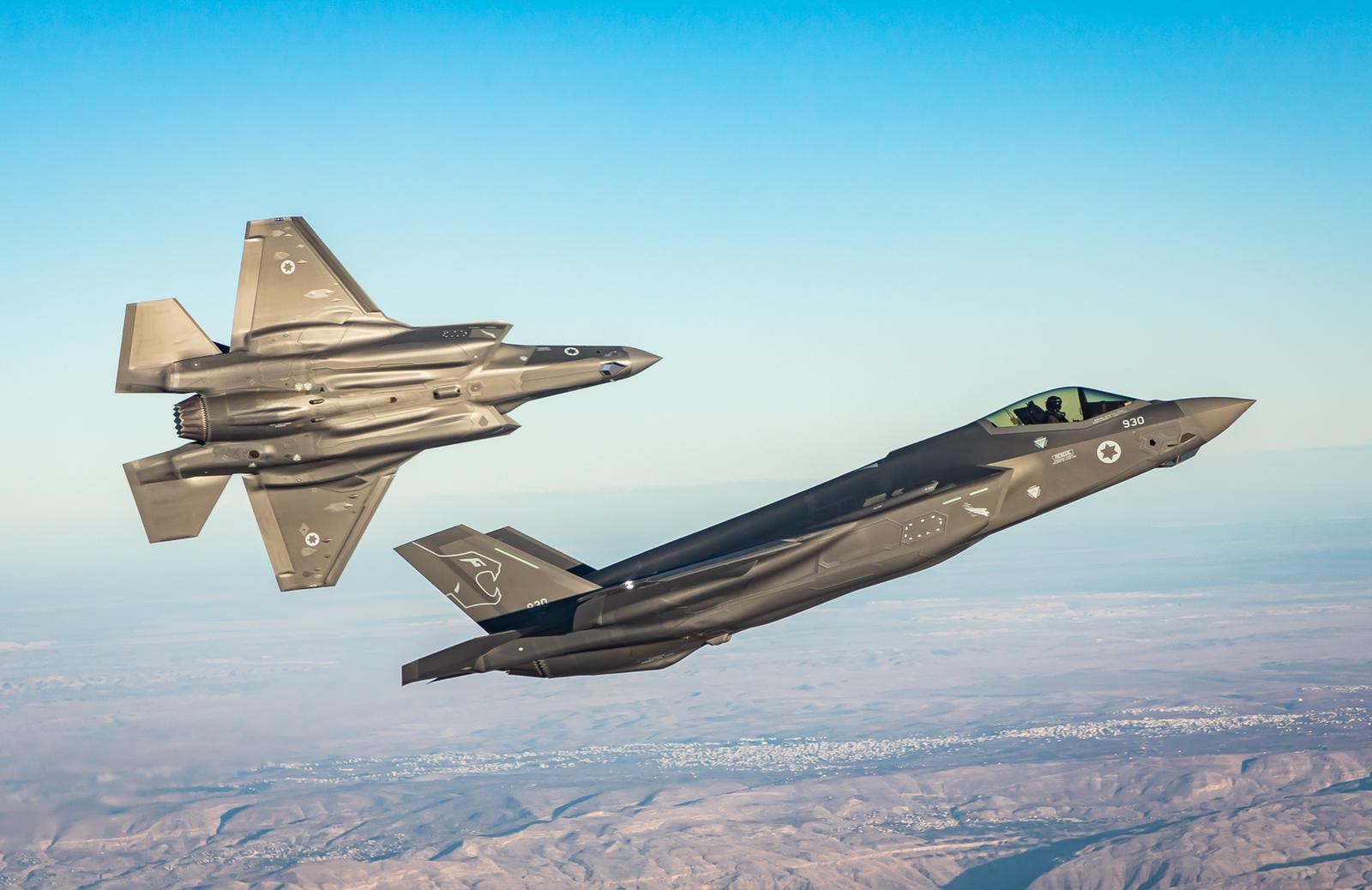
Israel compensates for its limited manpower through technological leverage. The Israeli Air Force (IAF) operates F-35I “Adir” stealth fighters — a customized variant of the Lockheed Martin F-35 with Israeli-specific avionics and electronic warfare systems. Israel was the first nation outside the US to use the F-35 in combat, conducting strikes in Syria and, later, against Iranian targets.
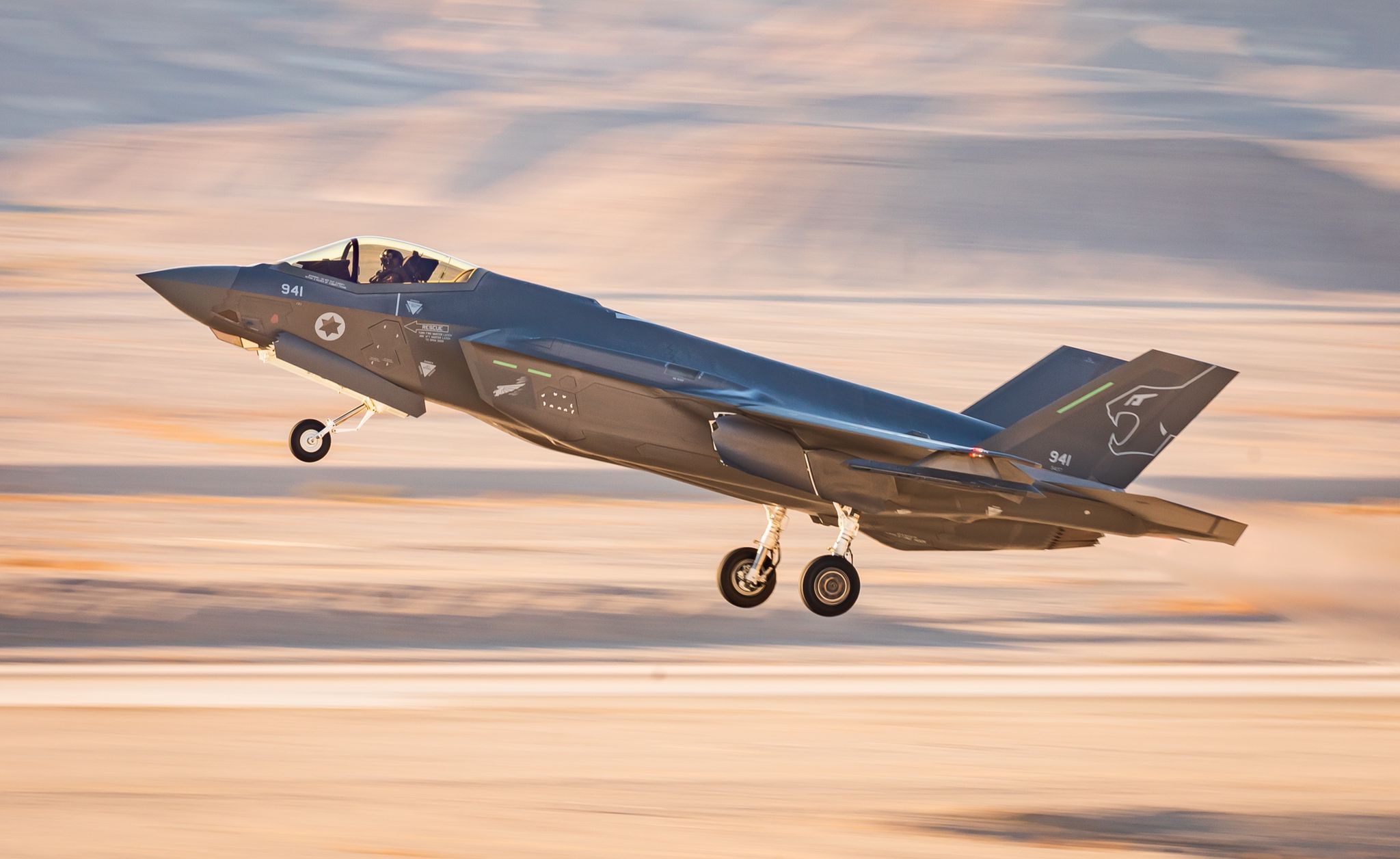
The IAF’s total fixed-wing fleet stands at approximately 531 aircraft, according to the 2026 World Data statistics, including advanced F-15I Ra’am multirole fighters capable of long-range deep-strike missions. This air force is not merely large — it is consistently rated as the most technologically advanced in the Middle East by analysts at IISS (International Institute for Strategic Studies).
Israeli drone technology deserves separate mention. The IDF’s drone arsenal — including the Heron, Hermes 450, and Skylark series — provides persistent ISR (intelligence, surveillance, and reconnaissance) coverage that larger militaries with far bigger budgets have struggled to replicate. Israeli drones have been exported to over 50 countries and have been deployed in conflicts from Azerbaijan to India.
Precision strike capability is perhaps the IDF’s single most important tactical advantage. The ability to hit a specific room in a building from 100 kilometers away — minimizing collateral damage while achieving military objectives — is the product of decades of ISR-guided munitions development and real-world refinement.
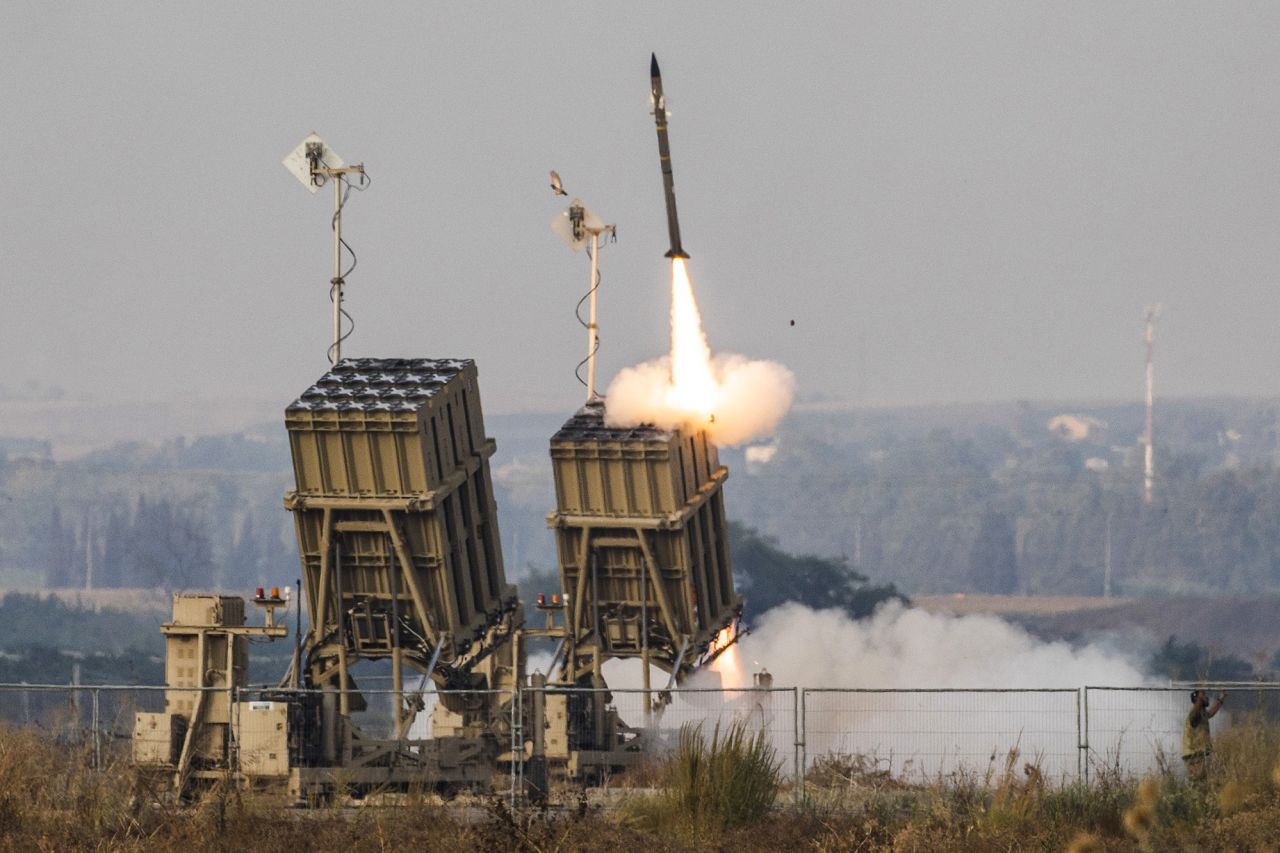
4. The Most Sophisticated Layered Missile Defense on Earth
No discussion of why the IDF is considered one of the best armies in the world can omit its missile defense architecture — arguably the most sophisticated on Earth relative to the threat environment it faces.
Israel operates a five-layer missile defense system:
- Iron Dome — short-range rockets and mortars (up to ~70 km). Interception rate above 90% in real-world deployments.
- David’s Sling (Magic Wand) — medium-range ballistic missiles and cruise missiles.
- Arrow 2 — long-range ballistic missiles within the atmosphere (endo-atmospheric).
- Arrow 3 — exo-atmospheric intercept capability against long-range ballistic missiles, including potential ICBM-class threats.
- Iron Beam — Israel’s directed-energy (laser) system, entering operational service, designed for cost-effective intercept of short-range threats.
This layered architecture means that a missile launched at Israel faces multiple independent intercept opportunities at different altitudes and ranges. No other nation of Israel’s size — and arguably no other nation, period — fields a comparably comprehensive defensive umbrella. According to Axios, Israel’s missile defense has become a global benchmark that NATO members and Asian democracies are now actively seeking to adopt or co-develop.

5. Unit 8200: The Cyber and Intelligence Edge
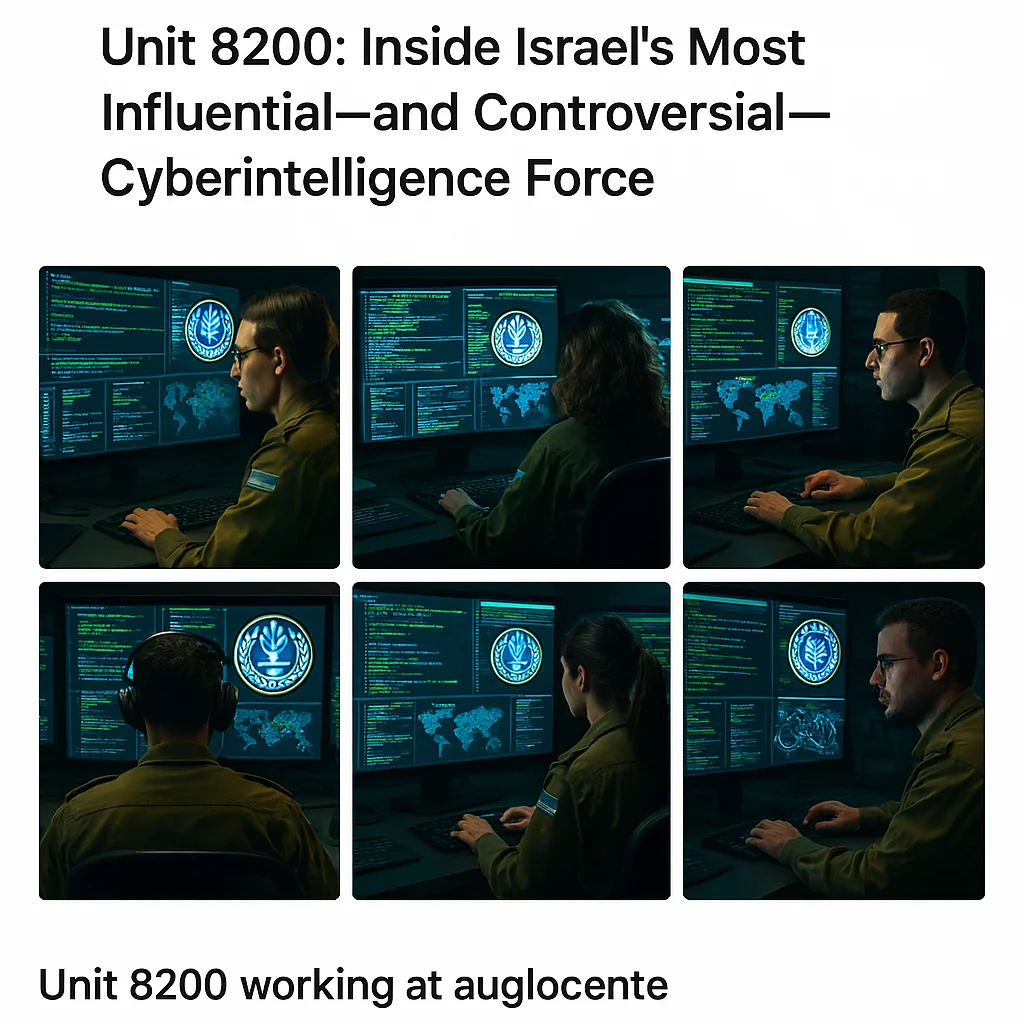
If the Iron Dome defines Israel’s defensive edge, Unit 8200 defines its offensive intelligence supremacy. Often described as “Israel’s NSA,” Unit 8200 is the IDF’s signals intelligence (SIGINT) and cyber warfare unit — and it is the single largest unit in the Israeli military.
According to reporting by The Jerusalem Post, Unit 8200 is the equivalent of the US National Security Agency or Britain’s GCHQ. It is descended from early codebreaking units formed at Israel’s founding in 1948 and has grown into a full-spectrum intelligence powerhouse.
Its capabilities include:
- Global interception of radio, microwave, satellite, fiber-optic, cellular, and internet traffic
- Cryptanalysis and offensive cyber operations (Stuxnet, which crippled Iran’s nuclear centrifuges, is the most publicly known example)
- Real-time battlefield targeting intelligence — identifying tunnel networks, rocket sites, and command nodes
- AI-driven data analysis at scale
Former Unit 8200 commander Yair Cohen has stated that “there isn’t a major operation, from the Mossad or any intelligence agency, that 8200 is not involved in,” and that approximately “90% of the intelligence material in Israel comes from 8200.”
The unit’s impact extends far beyond the battlefield. Unit 8200 alumni have founded a disproportionate share of Israel’s cybersecurity startups — companies like Check Point, CyberArk, and Wiz — creating what analysts call a “military-to-startup pipeline” unique in the world. This is a direct pathway through which Israel’s military strength translates into economic power.
6. A Defense Budget Built for Perpetual Readiness
Israel’s commitment to defense spending is extraordinary even by developed-nation standards. The 2026 approved defense budget stands at approximately $44 billion (NIS 143 billion, including a war supplemental fund) — a figure that represents a 153% increase over ten years, according to The Global Statistics.
To put this in context: Israel’s defense budget alone exceeds the combined military spending of Egypt, Iran, Lebanon, and Jordan. For a country of 9.5 million people, this level of investment — consistently above 5% of GDP — creates a military establishment that is perpetually resourced for innovation, procurement, and readiness.
The budget funds not just current operations but aggressive R&D. The IDF has invested heavily in:
- Autonomous systems and AI-guided targeting — used operationally in Gaza and Lebanon
- Next-generation armor — the Merkava Mk5 “Barak” integrates active protection systems (Trophy/Wind Breaker) that defeat anti-tank missiles in flight
- Directed-energy weapons — the Iron Beam laser system offers a near-zero marginal cost per intercept, compared to $50,000+ per Iron Dome missile
Defense exports further validate the quality of Israeli military technology. Israel’s defense exports hit a record $14.795 billion in 2024 — the fourth consecutive all-time record — according to the Israel Ministry of Defense SIBAT Export Report. Nations across Europe, Asia, and the Americas are paying premium prices for IDF-proven systems, which serves as a real-world quality signal no marketing campaign can replicate.

7. The US–Israel Military Alliance: The Force Multiplier
No analysis of IDF strength is complete without acknowledging the US–Israel strategic partnership — the single most significant external factor in Israel’s military capability.
The United States has provided approximately $130 billion in military assistance to Israel since its founding, according to Axios — by far the largest single allocation of US foreign military financing to any nation. This funding has provided Israel with F-35s, advanced munitions, and critical replenishment during wartime (the 1973 air bridge being the most dramatic historical example).
But the alliance is more than financial. It includes:
- Intelligence sharing — the US and Israel share signals intelligence and threat assessments through formal agreements
- Joint development programs — Iron Dome was co-developed and co-funded by the US; Arrow 3 was developed jointly with Boeing
- Diplomatic cover — US veto power at the UN Security Council provides Israel with strategic maneuver space that smaller states lack
- Prepositioning agreements — US military equipment is stored in Israel, accessible in regional emergencies
Critics argue this alliance creates a dependency; defenders argue it represents the world’s most cost-effective security arrangement for both parties. Either way, its impact on IDF capability is measurable and substantial.
The Bottom Line: Why the IDF Is One of the Best Armies in the World
The IDF’s reputation as one of the world’s most capable militaries isn’t the product of any single factor. It is the convergence of mandatory conscription drawing from a nation’s best talent, relentless real-world combat refinement, unmatched technology investment, a multi-layered defensive architecture, cyber dominance through Unit 8200, a defense budget that outspends entire regions, and a strategic alliance with the world’s foremost military power.
For a country of 9.5 million facing existential threats on multiple fronts, the IDF represents perhaps the most efficient translation of national resources into military capability of any nation on Earth. Vulnerability, as the IDF’s history demonstrates, can be the most powerful engine of military innovation.
Want to understand the broader picture? Read our deep-dive on why Israel is so powerful — covering military, economic, and geopolitical dimensions.
Frequently Asked Questions
Why is the IDF considered one of the best armies in the world?
The IDF combines universal conscription (drawing from a nation’s top talent), decades of real combat experience, advanced technology like F-35 stealth fighters and the Iron Dome, elite cyber units like Unit 8200, a $44 billion defense budget, and a powerful strategic alliance with the United States. Together, these factors produce a military that consistently outperforms much larger forces.
What rank is the IDF on the Global Firepower Index 2026?
The IDF ranks 15th out of 145 nations on the 2026 Global Firepower Index — ahead of Iran (16th), despite Israel having a far smaller population and territory.
How many active soldiers does the IDF have?
The IDF has approximately 634,500 total military personnel across all branches (active and reserve), according to 2026 data from the Israel Ministry of Defense.
What is Unit 8200?
Unit 8200 is the IDF’s signals intelligence and cyber warfare unit — the largest single unit in the Israeli military. Often called “Israel’s NSA,” it is responsible for an estimated 90% of Israel’s intelligence material and has been involved in landmark cyber operations including Stuxnet. Its alumni have gone on to build a large proportion of Israel’s cybersecurity industry.
Does the IDF have nuclear weapons?
Israel is widely believed to possess a nuclear arsenal — estimates range from 80 to several hundred warheads — though Israel has never officially confirmed or denied this, adhering to a policy of “nuclear ambiguity.” The IDF has missiles and aircraft assessed as capable of delivering nuclear payloads.
How does Israel’s defense budget compare to its neighbors?
Israel’s 2026 defense budget of approximately $44 billion exceeds the combined military spending of Egypt, Iran, Jordan, and Lebanon — countries with a combined population roughly 40 times larger than Israel’s.