
Last Updated on 2 months ago by TodayWhy Editorial
The Ceuta crisis looked like a story about a fence, a court ruling and a smuggling network. Underneath it sits a much older and much bigger question: who governs a stretch of desert on the Atlantic coast that Spain walked away from fifty years ago.
Western Sahara rarely makes headlines on its own — the territory itself. But almost every major decision Spain has made about its southern border in the last five years traces back to it — including, several analysts argue, the events of 30 July 2026.
This is the dispute underneath the dispute.
What is Western Sahara?
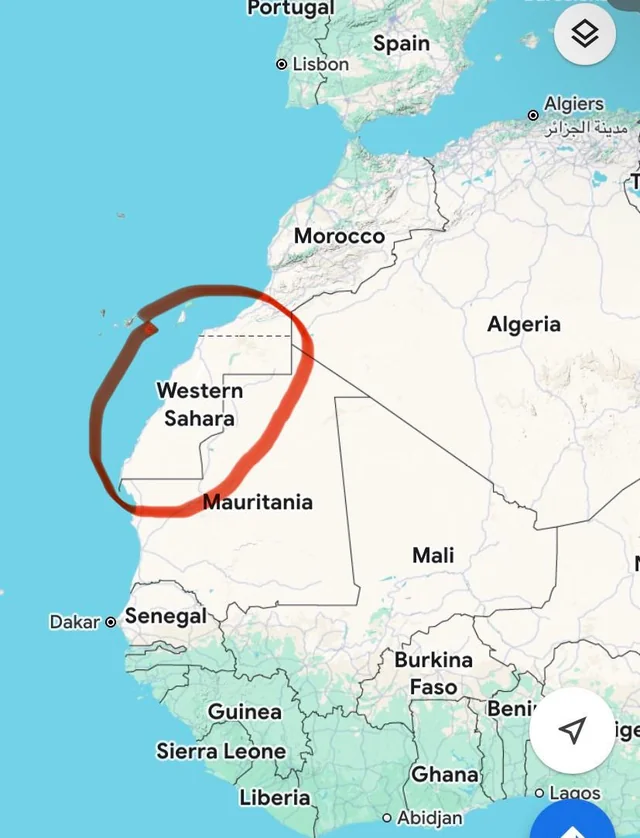
It is a territory roughly the size of the United Kingdom, on the Atlantic coast of North Africa, wedged between Morocco and Mauritania. It is also Africa’s last unresolved decolonisation case.
Spain colonised it in the late nineteenth century and withdrew in 1975 without holding the referendum on self-determination it had promised. In the Madrid Accords, Spain handed administration to Morocco and Mauritania. Morocco then organised the Green March — hundreds of thousands of civilians walked into the territory to assert its claim — and later took full control after Mauritania withdrew in 1979.
The Polisario Front, a Sahrawi independence movement backed by Algeria, fought Morocco for the territory until a UN-brokered ceasefire in 1991. That ceasefire created MINURSO, a UN mission originally meant to organise a referendum on independence. The referendum has never happened. Polisario formally ended its adherence to the ceasefire in 2020 after clashes near a road Morocco was building, and low-level hostilities have continued since, though Morocco generally denies open conflict.
The International Court of Justice recognised the Sahrawi people’s right to self-determination in a 1975 advisory opinion. Morocco claims historical sovereignty over the territory and, since 2007, has offered an autonomy plan instead of a referendum: self-government under continued Moroccan sovereignty, not independence.
The Western Sahara stalemate just broke — decisively, in Morocco’s favour
For most of the last decade, the international position on Western Sahara held roughly steady: a frozen conflict, a moribund UN mission, and a UN Security Council that kept renewing MINURSO’s mandate without resolving anything.
That changed with a sequence of decisions culminating in 2025 and 2026.
In December 2020, the outgoing Trump administration recognised Moroccan sovereignty over Western Sahara, as part of the deal that saw Morocco normalise relations with Israel under the Abraham Accords.
On 31 October 2025, the UN Security Council adopted Resolution 2797, describing “genuine autonomy under Moroccan sovereignty” as the most feasible solution and endorsing Morocco’s 2007 plan as the basis for negotiations. The vote passed 11 in favour, none against, with China, Russia and Pakistan abstaining; Algeria did not participate. Morocco declared 31 October a national holiday — Unity Day — to mark it. The UK called the plan “the most credible, viable and pragmatic basis for a solution.”
In January 2026, the European Union aligned its own position with the autonomy framework. In July 2026, Donald Trump reaffirmed US support, calling Morocco’s plan the sole solution. France has separately recognised Moroccan sovereignty over the territory.
Put together, this is close to a sweep. The Polisario Front’s core demand — an independence referendum — no longer has a serious diplomatic path. Sidi Omar, the Polisario representative at the UN, said the resolution implied no recognition of Moroccan sovereignty, but the practical momentum is unmistakable.
What Spain paid over Western Sahara to get here
Spain’s own reversal on its Western Sahara position is the clearest illustration of how this issue extracts a price — and it happened right after a Ceuta crisis before this one.
Spain held official neutrality on the Western Sahara question for decades, a legacy of its own colonial withdrawal. In March 2022, Prime Minister Pedro Sánchez abandoned that neutrality and described Morocco’s autonomy plan as “the most serious, realistic and credible basis” for resolving the conflict — a position reversal, not a small adjustment.
The timing was not incidental. It followed the May 2021 Ceuta crisis, when more than 10,000 people crossed into the enclave within two days after Morocco eased its border controls, angered that Spain had admitted Polisario leader Brahim Ghali for medical treatment without consulting Rabat. Spain’s then defence minister called it blackmail at the time. Sánchez later defended the 2022 reversal as the foundation for renewed cooperation with Morocco on migration control — cooperation that, on the border-management numbers, has broadly held since.
The price was paid twice over, because Algeria — Polisario’s principal backer — retaliated. Algiers recalled its ambassador from Madrid on 19 March 2022, and in June suspended a decades-old friendship treaty. Trade and energy relations, with Algeria a major gas supplier to Spain, deteriorated for years.
The Algeria thaw — and its timing
This is where the Ceuta story acquires a second layer, and where the timing becomes hard to ignore.
Spain spent much of 2023 to 2026 quietly rebuilding ties with Algeria without reversing its position on Western Sahara. Algeria proposed a new ambassador to Madrid in November 2023. In March 2026, Foreign Minister José Manuel Albares visited Algiers, after which Algeria reactivated the suspended friendship treaty.
On 20 July 2026, Sánchez travelled to Algiers and met President Abdelmadjid Tebboune — his first visit since 2022, and the highest-level engagement between the two governments in years. Sánchez called it the start of “a new stage” and described Algeria as a “strategic partner and friendly country.” The two sides agreed to increase Algerian gas exports to Spain by 10 percent and scheduled an eighth high-level bilateral summit for October 2026 in Madrid, the first in eight years. Algeria has been Spain’s leading gas supplier since the start of 2026.
Crucially, none of this touched Western Sahara itself. Spain repeated that Morocco’s autonomy plan remains its preferred basis for a solution. Analysts at the Italian Institute for International Political Studies described the visit as restoring dialogue “without securing any shift in Madrid’s position” — a genuine thaw, but a narrow one.
Ten days later, the Ceuta crisis began.
Was Ceuta a message to Madrid?
This is a theory, not an established fact, and it deserves to be treated as one — but it is being made by serious people, not fringe commentators.
Historian Steven Forti, in comments to Argentine newspaper La Nación shortly after the crisis, argued that Morocco was “sending a message to Spain and to the whole European Union.” His reading connects the timing directly to the Algiers visit: having watched Spain warm to its regional rival within days of the Ceuta surge, Morocco reminded Madrid — visibly and painfully — how much Spanish border management still depends on Moroccan cooperation.
The pattern would not be new. It is close to what happened in 2021, when a diplomatic slight was followed almost immediately by a relaxation of border controls that produced a migration surge. Spanish officials avoided the word blackmail this time. Guardia Civil sources described Moroccan assistance during the crisis as thin rather than absent, and Moroccan authorities eventually used water cannon to push back further crossings at Fnideq — visible cooperation, delivered only after the surge had already made its point.
Morocco’s official position throughout was that criminal smuggling networks, not the state, drove the crossings, and that cooperation with Spain has been exemplary. Rabat has not commented on any connection to the Algiers visit, and no Moroccan official has confirmed Forti’s reading. Other explanations for the surge — a Spanish Supreme Court ruling narrowing summary returns, and a shortage of Guardia Civil officers on the fence — do not depend on any Moroccan signal at all, and may be sufficient on their own.
What is not in dispute is the sequence: reconciliation with Algeria on 20 July, mass crossings into Ceuta beginning 30 July. Correlation is not proof of intent. But it is the kind of correlation regional analysts do not consider coincidental, given the 2021 precedent.
Why this leverage exists at all
Spain’s dependency is structural, not incidental, and it explains why this keeps happening regardless of which party governs in Madrid.
Ceuta and Melilla’s land border with Morocco is the only one the European Union has with Africa. Spain’s ability to manage it rests almost entirely on Moroccan enforcement on the other side of the fence — patrols, checkpoints, and the willingness to prevent people from reaching it in the first place. When that enforcement continues, the border looks calm and Spanish policy looks successful. When it relaxes, the same border becomes a crisis within hours, whatever fencing or personnel Spain has in place. The floating barrier installed on 1 August addresses the sea route at Tarajal specifically; it does nothing about Moroccan-side enforcement generally.
That dependency gives Rabat quiet influence over every other file between the two governments — trade, fishing rights, counter-terrorism cooperation, and above all recognition of its position on Western Sahara. Spain’s 2022 reversal is the clearest evidence that the leverage works. Whether the 2026 Ceuta crisis is a second exercise of the same leverage, or simply the same underlying vulnerability triggered by unrelated causes, is the open question.
Why the referendum is effectively dead
With Washington, Brussels, London and now increasingly Paris and Madrid converging on autonomy-under-Moroccan-sovereignty as the practical outcome, Polisario’s diplomatic path to independence has narrowed to almost nothing.
MINURSO remains in place, its mandate renewed to 31 October 2026, but a UN strategic review of its future role is due around the same date — the resolution asked the Secretary-General to report on this within six months of the October 2025 vote. Algeria did not participate in that Security Council vote and continues to back Polisario’s independence demand, but its own bilateral priorities with Spain — energy sales, trade, investment — appear, for now, to be running on a separate track from its position on the territory itself.
A secret US-sponsored meeting in Madrid in February 2026 brought Morocco, Polisario, Algeria and Mauritania together for the first time in years, with Morocco presenting an expanded version of its autonomy proposal. Talks continued in Washington later that month. Momentum exists. It runs almost entirely in one direction.
What to watch
Four dates and processes will show whether this analysis holds up.
The Spain–Algeria summit scheduled for October 2026 in Madrid — the first in eight years — will show whether the Algiers thaw survives a Ceuta-scale migration crisis, or cools in response to it.
The UN Secretary-General’s strategic review of MINURSO’s mandate, due around the same month, will indicate whether the mission’s role changes now that a political outcome looks more settled than at any point in three decades.
Whether Morocco offers Spain any further, more overt gesture of goodwill in the coming weeks — the kind of visible cooperation that followed the 2021 crisis — would support the message theory. Continued ambiguity would support the simpler explanations already covered in our reporting on why people are fleeing Morocco into Ceuta.
And whether Algeria’s rapprochement with Spain extends to migration cooperation — something analysts have flagged as unresolved — would tell us whether Madrid is quietly building an alternative to its dependence on Rabat, or merely diversifying its energy suppliers while the border dependency remains exactly where it was.
For the geography behind all of this, see our guide to what Ceuta is and where it sits. For a comparable dispute over contested European-held territory, we looked at Gibraltar, Ceuta and Spain’s border paradox.
Frequently asked questions
What is Western Sahara?
A former Spanish colony on the Atlantic coast of North Africa, administered by Morocco since 1975 but claimed by the Polisario Front, an Algeria-backed independence movement. It is considered Africa’s last unresolved decolonisation case.
Does the UN recognise Moroccan sovereignty?
Not formally. Security Council Resolution 2797 (October 2025) describes autonomy under Moroccan sovereignty as the most feasible solution and endorses Morocco’s plan as the basis for talks, but it stops short of a formal recognition of sovereignty, and Polisario disputes that any recognition is implied.
Why did Spain change its Western Sahara position?
In March 2022, Prime Minister Pedro Sánchez endorsed Morocco’s autonomy plan, reversing decades of Spanish neutrality. The shift followed a major migration crisis at Ceuta in May 2021 and was defended by Sánchez as the basis for renewed Moroccan cooperation on border control.
Why did Algeria break off relations with Spain?
Algeria, the principal backer of the Polisario Front, recalled its ambassador from Madrid in March 2022 and suspended a friendship treaty that June, in protest at Spain’s reversal on Western Sahara. Relations began normalising from late 2023 and reached a high point with Sánchez’s July 2026 visit to Algiers.
Is there a proven link between the Algiers visit and the Ceuta crisis?
No. It is a theory advanced by some regional analysts, based on the timing and on a similar pattern in 2021. Morocco has not acknowledged any connection, and other explanations for the July 2026 surge — a Spanish court ruling and a shortage of border personnel — do not depend on it.
What is MINURSO?
The UN Mission for the Referendum in Western Sahara, established in 1991 to monitor a ceasefire and organise a referendum on independence that has never taken place. Its mandate runs to 31 October 2026, alongside a due UN review of its future role.
Where can I read the primary sources?
The UN’s own account of Security Council Resolution 2797 sets out the vote and the positions of member states in detail.