
Last Updated on 4 months ago by TodayWhy Editorial
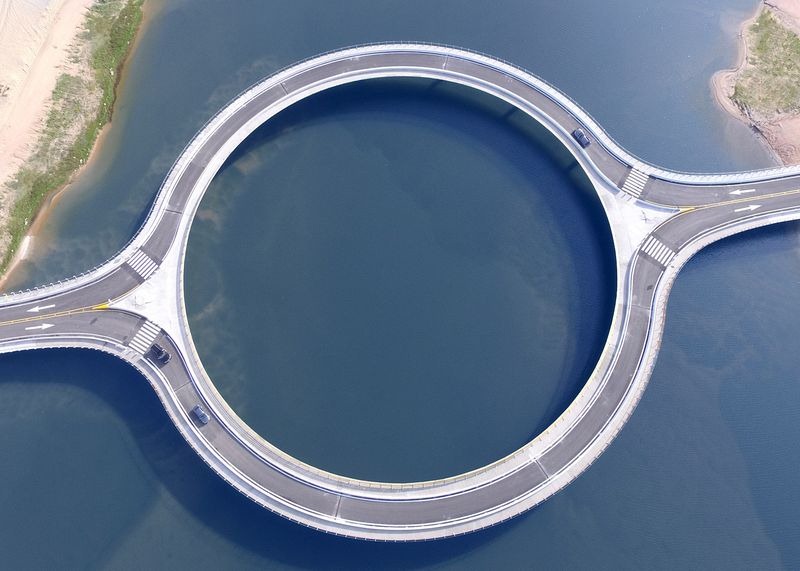
Most bridges are built to get you across a body of water as quickly and directly as possible. The Laguna Garzón Bridge in Uruguay does the opposite. Instead of a straight line, it sends every car, cyclist, and pedestrian around a full circle before letting them continue on their way. It looks like a design accident — or a roundabout that forgot to lead anywhere. It’s neither. The circle is deliberate, and it solves two very different problems at once: one about driving behavior, and one about the lagoon underneath it.
Where the Laguna Garzón bridge is and what it replaced
The bridge crosses the Laguna Garzón, a coastal lagoon on Uruguay’s Atlantic coast that marks the border between the Maldonado and Rocha departments, near the resort towns of Punta del Este and José Ignacio. Before it was built, the only way across was a small motorized raft that could carry just two vehicles at a time and only operated in daylight and good weather. Uruguay’s transport ministry had wanted a fixed crossing over the lagoon for years; what it got, after construction between September 2014 and December 2015, was a 202-meter ring of road that has become more famous than almost any conventional bridge in South America.
Reason one: it forces drivers to slow down
The bridge was designed by Rafael Viñoly, the Uruguayan-born architect also known for towers like 432 Park Avenue in New York and London’s “Walkie-Talkie” skyscraper. According to Rafael Viñoly Architects, the circular deck exists specifically to interrupt the instinct to drive straight through at speed. The tight turning radius of the ring — about 51.5 meters — physically requires cars to slow down to take the curve, turning what would otherwise be a few seconds of highway driving into a deliberate, unhurried loop past open water on both sides.
That slowdown wasn’t just about safety. The firm has described the goal as turning a routine crossing into a moment to actually notice the landscape — one of the most scenic, undeveloped stretches of Uruguay’s coastline — rather than blow past it at 60 miles an hour.
Reason two: protecting the lagoon underneath
The second reason is ecological, and it’s specific to the shape of a circle rather than just “slow traffic.” The Laguna Garzón is recognized as an Important Bird and Biodiversity Area, home to species including the Chilean flamingo, several plover species, and the endangered Darwin’s toad, along with one of the country’s last stretches of intact coastal forest and scrub. A long, straight, solid bridge deck would cast a continuous band of shadow across the same strip of water all day as the sun moves overhead, disrupting light penetration into the lagoon below.
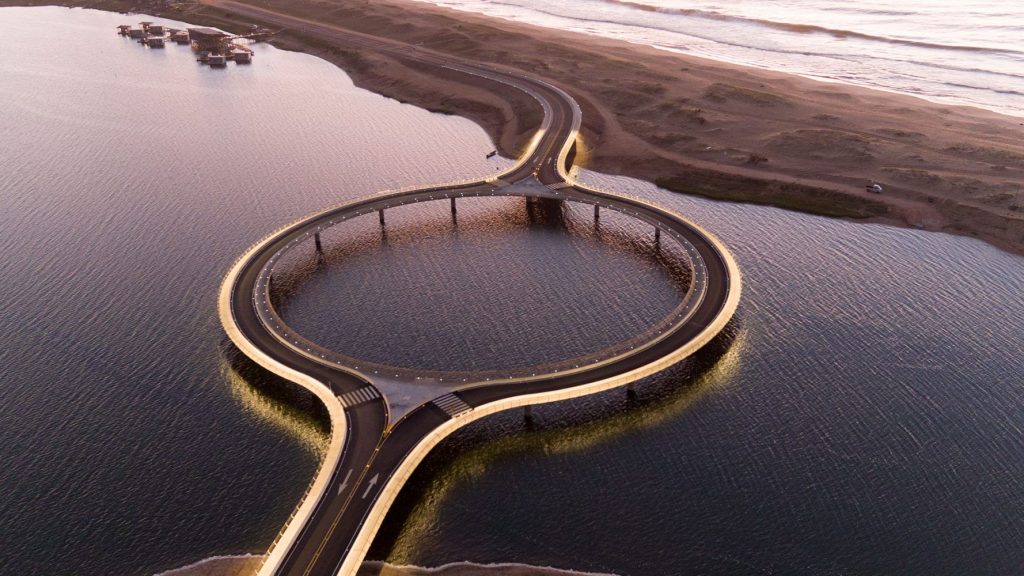
By splitting the roadway into a ring supported on widely spaced columns, the design breaks up that shadow instead of concentrating it in one place, which the architects say improves light dispersal across the water. The bridge’s 16 round pillars are spaced 20 meters apart and built tall enough for small boats to pass freely beneath the deck, so the lagoon’s ecosystem and the people who fish and harvest clams in it were barely disturbed by the construction.
Who actually paid for it
The $11 million project wasn’t a typical government infrastructure job. Roughly $10 million of the cost came from Argentine real estate developer Eduardo Costantini, who also built the nearby Las Garzas Blancas development and had a clear commercial interest in making the surrounding Rocha coastline easier to reach. Viñoly’s firm has said it agreed to design the bridge only on the condition that the adjoining national highway be downgraded to local jurisdiction, in hopes that local authorities would manage future coastal development more carefully than a federal highway agency would. The arrangement wasn’t free of controversy: environmental groups protested during construction over exactly the kind of coastal development the bridge was, in part, designed to attract.
What it’s like to actually cross it
Today the bridge carries close to 1,000 vehicles a day along with cyclists and pedestrians, who get their own sidewalks on both the inner and outer edges of the ring with crosswalks linking the two. Opposing traffic is split into separate one-way lanes that diverge near the start of the loop and merge back together at the far end, so it functions less like a roundabout and more like two long, gentle curves joined into a circle. Drivers, walkers, and cyclists who stop midway often do so to fish, take photos, or just watch the lagoon meet the Atlantic — exactly the pause the design was built to create.
FAQ
Why is the Laguna Garzón bridge circular instead of straight?
It’s circular for two reasons: the curve’s tight turning radius forces drivers to slow down for safety and to take in the scenery, and splitting the deck into a ring reduces how long any one patch of the lagoon stays shaded as the sun moves, protecting the ecosystem below.
Where is the Laguna Garzón bridge located?
It crosses the Laguna Garzón on Uruguay’s Atlantic coast, on the border between the Maldonado and Rocha departments, near the resort areas of Punta del Este and José Ignacio.
Who designed the bridge?
Uruguayan architect Rafael Viñoly, whose firm Rafael Viñoly Architects is also known for buildings including 432 Park Avenue in New York and 20 Fenchurch Street in London.
When was it built and how much did it cost?
It was built between September 2014 and December 2015 at a cost of about $11 million, roughly $10 million of which was funded by Argentine real estate developer Eduardo Costantini.