
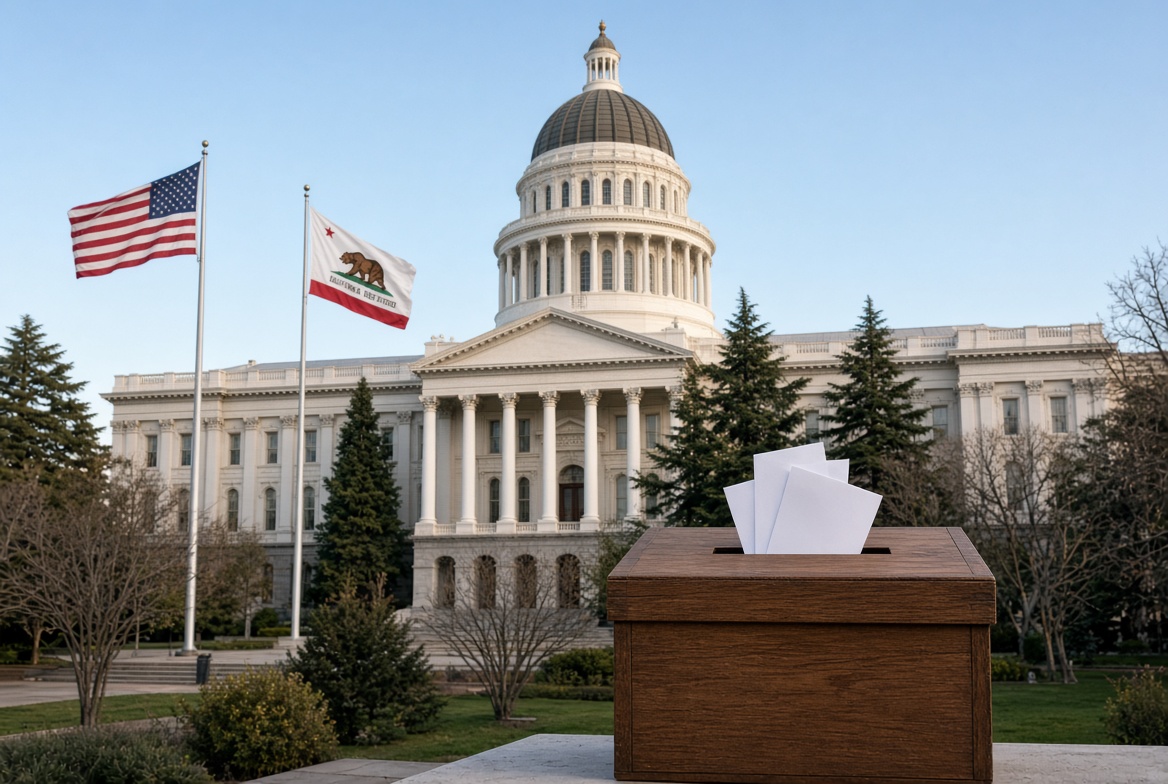
Prop 40 California is the November 3, 2026 ballot measure that would impose a one-time 5 percent tax on the net worth of the state’s billionaires—those who were California residents on January 1, 2026—with 90 percent of the revenue reserved for health care. Officially titled “Imposes One-Time Tax on Certain Taxpayers,” it is an initiative constitutional amendment and statute that has become the highest-profile and most expensive fight on the California ballot.
Voters deciding what is Prop 40 are effectively choosing whether California becomes the first U.S. state to levy a broad wealth tax rather than a traditional income or property tax. The measure was placed on the ballot by the Service Employees International Union–United Healthcare Workers West (SEIU-UHW) after collecting more than 980,000 valid signatures. It faces two rival measures, Propositions 41 and 42, that could prevent it from taking effect even if a majority of voters approve it.
What Is Prop 40 California?
California Prop 40, also called the Billionaire Tax Act or the California billionaire tax, would require individuals (and certain trusts) with a worldwide net worth of at least $1 billion to pay a one-time state tax equal to 5 percent of that net worth. The residency test date is fixed at January 1, 2026—already past when the measure qualified—so billionaires who left the state after that date would still be subject to the tax if they were residents on the cutoff. Net worth is measured as of December 31, 2026, and the tax is due in 2027.
Covered assets include businesses, publicly traded securities, private business interests, art, collectibles, intellectual property, vehicles, and most other forms of personal property. Real estate held directly or in a revocable trust, qualified pensions, and most retirement accounts are generally excluded. For taxpayers with net worth between $1 billion and $1.1 billion, the rate phases in; it reaches the full 5 percent at $1.1 billion. Married couples are treated as a single taxpayer. Taxpayers may spread payment over five annual installments, but each later installment carries a 7.5 percent charge on the unpaid balance.
According to the nonpartisan Legislative Analyst’s Office (LAO), a YES vote means the state would collect a one-time tax from billionaires equal to 5 percent of their wealth. A NO vote means the state would not collect that tax. The official title and summary appear in the California Official Voter Information Guide.
How the California Billionaire Tax Would Work
The California wealth tax proposed by Prop 40 is not an income tax. It taxes the assessed value of assets—similar in concept to a property tax, but applied to stocks, private companies, art collections, and other holdings rather than real estate. The state would have six months after passage to create valuation rules and an appeals process. Taxpayers could submit their own appraisals for private assets such as closely held businesses or intellectual property.
Gifts over $1 million made after October 15, 2025, and certain transfers to non-grantor trusts in 2025 and 2026 are largely added back into the net-worth calculation to limit avoidance. Worldwide assets count. The LAO notes that administration costs could reach tens of millions of dollars per year for several years; those costs would be paid from the new tax revenue itself.
Because the residency date is already past, the measure is designed to reduce the incentive for last-minute departures. Several high-profile billionaires, including Google co-founders Larry Page and Sergey Brin, have publicly moved residences or assets out of California in the months leading up to the vote. Whether those moves successfully establish non-residency as of January 1, 2026 will likely be the subject of audits and litigation if the measure passes.
Who Would Pay Prop 40 California
Only a few hundred people would owe the tax. Estimates of the number of California billionaires range from roughly 200 to 272, depending on the source and the date of the wealth snapshot. On an October 2026 Forbes snapshot used by PolicyEngine, 272 individuals were identified with a combined net worth that would generate more than $100 billion under a pure statutory calculation before behavioral responses.
The ten wealthiest alone could face bills in the tens of billions of dollars. Meta’s Mark Zuckerberg and Nvidia’s Jensen Huang have been cited in analyses as facing multi-billion-dollar individual liabilities under a full 5 percent rate. Most of the affected wealth is concentrated in publicly traded stock of companies founded or headquartered in California.
Ordinary Californians filing 2026 resident returns would simply declare that their net assets were $1 billion or less. The tax does not apply to anyone below that threshold, nor does it create a new ongoing annual wealth tax. It is explicitly one-time.
Where Prop 40 Revenue Would Go
Ninety percent of the money must be spent on health care services for the public. The remaining 10 percent is allocated to education, food assistance, and administration of the tax. Existing constitutional rules that require a minimum share of state spending to go to schools and community colleges, that limit overall state spending, and that govern budget reserves would not apply to these revenues. The measure also prohibits using the new money to replace existing funding for the same purposes.
Supporters, led by SEIU-UHW, argue the revenue is needed to offset federal cuts to Medi-Cal and other health programs enacted in 2025 as part of federal budget legislation. State officials have projected those cuts could reach tens of billions of dollars annually. Opponents note that the legislature retains discretion over the precise timing and programs funded within the broad health-care category, and that some health organizations, including Planned Parenthood, have opposed the measure over concerns the money may not fully protect services.
Fiscal Impact and Revenue Estimates for the California Billionaire Tax
The LAO estimates that Prop 40 California would produce a temporary state revenue increase of “tens of billions of dollars” spread over several years. It cautions that the exact amount is very hard to predict because billionaires may take steps to reduce their liability and because much of the wealth is tied to volatile stock prices. The same analysis notes a possible ongoing decrease of less than $1 billion per year in state income-tax collections if some billionaires leave or change how they realize income.
Independent estimates diverge sharply. Supporters and economists including Emmanuel Saez and Gabriel Zucman have projected roughly $100 billion after a 10 percent allowance for avoidance or evasion. A PolicyEngine open model using an October 2026 Forbes snapshot produced a baseline statutory score of about $118 billion before behavioral adjustments. Under “Berkeley assumptions” the net present value remains positive and large; under “Hoover assumptions” developed by Benjamin Jaros and Joshua Rauh of Stanford, the net present value turns negative (around –$35 billion to –$39 billion) once permanent future income-tax losses from departures are counted.
Critics of the higher estimates point out that several billionaires have already left, removing a substantial share of the tax base, and that litigation risk is high. Defenders argue that a one-time tax should not be scored against infinite future income-tax losses and that the concentration of wealth in publicly traded shares makes collection more feasible than critics claim. The LAO’s cautious “tens of billions” language remains the official nonpartisan benchmark.
Prop 40 Pros and Cons
Arguments for Prop 40 California center on fairness and fiscal necessity. Proponents say California’s roughly 200 billionaires hold a combined net worth measured in the trillions while ordinary residents face high costs of living and looming cuts to Medi-Cal. A one-time 5 percent levy, they argue, is a modest share of accumulated wealth and would generate revenue that is constitutionally protected for health care. Senator Bernie Sanders and other progressive endorsers have framed the measure as a response to federal tax cuts for the wealthy and as a model other states could follow. Labor unions including the California Nurses Association and the California Federation of Teachers have backed it.
Arguments against focus on economic risk, legality, and practicality. Governor Gavin Newsom has opposed the measure, calling it damaging. Opponents warn that billionaires will continue to leave, eroding the income-tax base that already supplies a large share of California’s general-fund revenue. The California Teachers Association and some building-trades unions have opposed it on those grounds. Valuation of private businesses and art is complex and certain to generate years of litigation. The retroactive residency date has been challenged as unfair or unconstitutional. Two competing measures on the same ballot exist specifically to block the tax if they receive more votes.
Business groups and the California Taxpayers Association argue the state already has among the highest income-tax rates in the country and that adding a wealth tax risks accelerating the outflow of high-earning residents and the jobs and investment they support. Some analyses from the Hoover Institution conclude that under many plausible scenarios the long-term fiscal effect is negative.
Competing Measures: Propositions 41 and 42
Even a majority “yes” vote on California Prop 40 may not be enough. Proposition 41 would prohibit new state taxes from being exempted from the existing constitutional spending limit and would require pre-election and recurring audits of programs funded by new special taxes. Proposition 42 would ban new taxes on personal property, retirement holdings, and other forms of personal savings enacted after January 1, 2026, and would also bar certain retroactive taxes.
Both were placed on the ballot by opponents of the wealth tax, including groups funded by Sergey Brin and other billionaires. Under California law, if Prop 40 and either of the competing measures pass, the one that receives more “yes” votes generally prevails. Courts could also find that 41 or 42 conflict with 40 and thereby prevent the wealth tax from taking effect. Recent polling has shown both counter-measures competitive with or ahead of Prop 40 in some surveys, creating a real possibility that the tax fails even if it wins a plurality.
Polling, Campaign Spending, and the Path to Election Day
Support for Prop 40 has fluctuated. Earlier in 2026 several polls showed a narrow majority or plurality in favor. By late October, the Public Policy Institute of California found 46 percent of likely voters in favor and 52 percent opposed. Berkeley IGS recorded 42 percent yes and 50 percent no. Other surveys were closer or slightly positive for the measure. Prediction markets in the final days placed the odds of passage well below 50 percent.
The campaign has been extraordinarily expensive. Opponents, including Sergey Brin (who has contributed more than $100 million), have raised more than $200 million—and by some counts more than $300 million—to defeat the tax and promote Props 41 and 42. The “yes” side, led by SEIU-UHW, has been outspent by a wide margin. The California Democratic Party endorsed the measure, while Newsom and several prominent Democrats have opposed it. The result is a rare intra-party split on a high-profile tax question.
Because the election is November 3, 2026, final results will not be known until after polls close. Even if Prop 40 wins the most votes, implementation would still face almost certain legal challenges over valuation methods, residency determinations, and the interaction with Props 41 and 42.
What Happens If Prop 40 California Passes
If the measure prevails over its rivals and survives court challenges, the Franchise Tax Board would collect the tax with 2026 returns filed in 2027. The state would then allocate 90 percent of net revenue to health-care programs and the rest to education, food assistance, and administration. Because the revenue is exempt from ordinary school-funding and spending-limit rules, the legislature would have broad discretion within the health-care category. Collection could be delayed by litigation; the LAO has noted that the amount and timing are difficult to forecast precisely.
If either Prop 41 or Prop 42 receives more yes votes, the wealth tax is expected to be blocked. A simple majority “no” vote on Prop 40 itself would also prevent the tax from taking effect. In either failure scenario, California continues without a state wealth tax, and the debate over how to address federal health-care funding cuts returns to the legislature and future ballot measures.
For readers following the broader 2026 election, Prop 40 sits alongside more than a dozen other statewide propositions covering housing bonds, voter ID, school funding, and local tax rules. Nationally, the measure is being watched as a test of whether an American state can successfully tax unrealized wealth at the billionaire level.
Frequently Asked Questions
What is Prop 40 in California?
Prop 40 California is the November 2026 ballot measure that would impose a one-time 5 percent tax on the net worth of individuals who were California residents on January 1, 2026 and whose net worth is $1 billion or more. Ninety percent of the revenue is reserved for health care.
How much would the California billionaire tax raise?
The Legislative Analyst’s Office estimates “tens of billions of dollars” over several years. Supporters project about $100 billion. Some academic models that include permanent income-tax losses from departures show a negative net present value. The exact figure is highly uncertain.
Who supports and opposes Prop 40?
Supporters include SEIU-UHW, Senator Bernie Sanders, the California Democratic Party, and several progressive economists and labor unions. Opponents include Governor Gavin Newsom, the California Teachers Association, many business groups, and a well-funded campaign backed by Sergey Brin and other billionaires that also sponsors Props 41 and 42.
Can Props 41 and 42 stop Prop 40?
Yes. If either competing measure receives more “yes” votes than Prop 40, or if courts find a conflict, the wealth tax can be prevented from taking effect even if a majority of voters approve it.
Is the tax only for billionaires?
Yes. The tax applies only to taxpayers and certain trusts with net worth of at least $1 billion (with a phase-in between $1 billion and $1.1 billion). Real estate and most retirement accounts are excluded.
When would the tax be due?
The tax is due in 2027, based on net worth measured December 31, 2026, for people who were residents on January 1, 2026. Payment may be spread over five years at an added cost.
Prop 40 California asks voters whether the state should collect a one-time 5 percent tax on the net worth of its billionaires to fund health care and other services. The official nonpartisan analysis from the Legislative Analyst’s Office describes a temporary revenue increase measured in the tens of billions of dollars, while independent models range from roughly $100 billion to a net long-term loss once behavioral responses are included. Competing Propositions 41 and 42 give opponents a second path to block the tax. Whatever the final vote, the measure has already forced a high-stakes public debate over whether California should become the first state to tax accumulated wealth at this scale.