
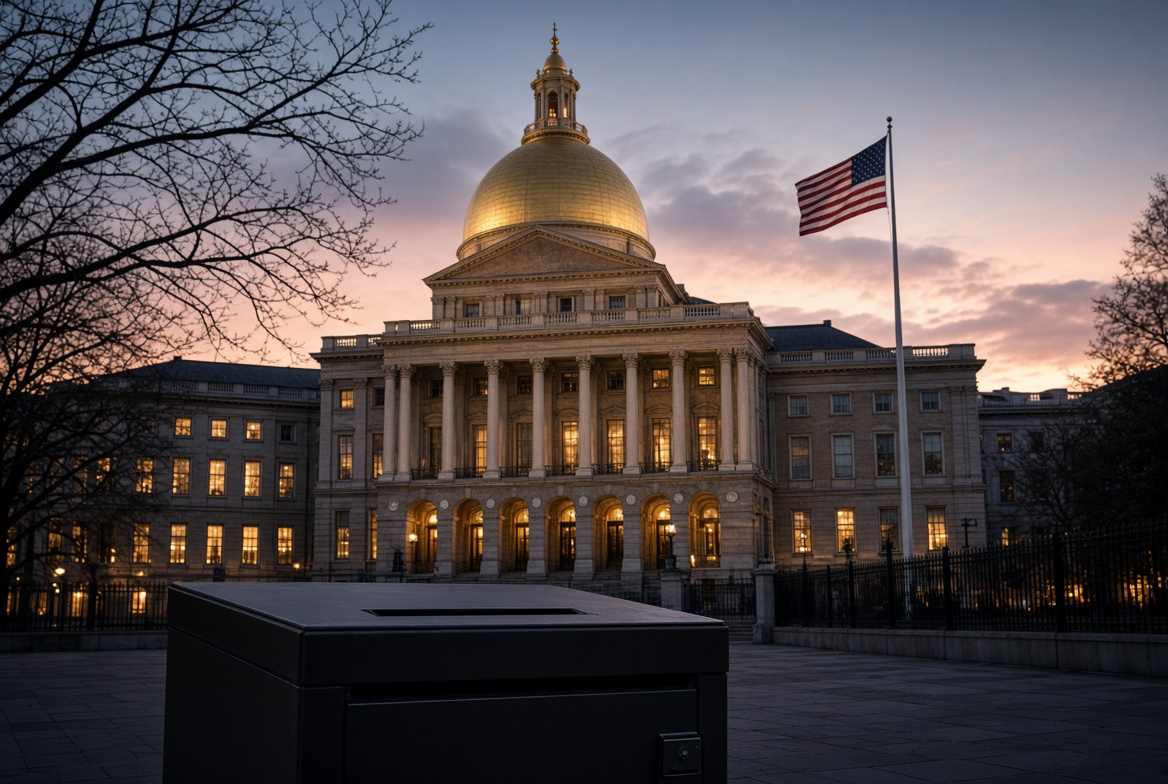
Massachusetts ballot questions 2026 put nine binding statewide measures on the November 3 ballot—the most the state has asked voters to consider in more than three decades. The questions cover public records, primary elections, same-day voter registration, a revenue limit, housing lot sizes, recreational marijuana, a 2024 gun law, and more.
Eight of the questions are laws proposed by citizen initiative. One is a referendum on an existing law. Official summaries, full text, and pro/con arguments appear in the Secretary of the Commonwealth’s Information for Voters guide, which was mailed to every household. For the national picture of races and measures on ballots across the country, see our explainer on what Americans are voting for on Election Day 2026. For a detailed look at another high-volume state ballot, see the California propositions 2026 guide.
How many Massachusetts ballot questions are there in 2026?
Nine binding statewide questions. Secretary of the Commonwealth William Galvin confirmed the total in the official voter guide. It ties the modern record set in 1994. Questions 1–8 reached the ballot after two rounds of citizen signatures. Question 9 is a veto referendum on a 2024 firearms law. Non-binding local public-policy questions also appear on some district ballots, but the nine statewide items are the ones that change law if approved.
Massachusetts ballot questions 2026: the full list
Here is what each question does and what a yes or no vote means, based on the official descriptions and Ballotpedia tracking.
Question 1: Public records for the Legislature and Governor
A yes vote would bring most records held by the Massachusetts Legislature and the Office of the Governor under the state’s public records law. Those two branches are currently exempt, so they do not have to release documents requested by journalists or citizens. A no vote leaves the current exemptions in place. Supporters say the change increases transparency in a state where the Legislature and governor have long claimed special status. Opponents argue it could expose internal deliberations and create administrative burdens.
Question 2: Collective bargaining for public defenders
A yes vote would allow employees of the Committee for Public Counsel Services (CPCS)—the agency that oversees legal representation for people who cannot afford an attorney—to form a union and collectively bargain over wages, benefits, and working conditions. A no vote makes no change. The potential cost depends on any future contract. Supporters frame it as basic labor rights for public employees; opponents raise questions about cost and management of the public-defender system.
Question 3: All-party (top-two) primary
A yes vote would eliminate separate Democratic and Republican primaries for state offices and replace them with a single all-party primary. The top two candidates, regardless of party, would advance to the general election. Gubernatorial and lieutenant-gubernatorial candidates would run as a joint ticket in the primary. A no vote keeps the current closed-party primary system. Both major parties have opposed the change, arguing it weakens party organizations. Supporters say it gives independents more influence and reduces polarization. Late October 2026 polling showed the measure trailing or close, one of the tighter contests on the ballot.
Question 4: Election Day registration
A yes vote would allow eligible residents to register to vote or update their address at the polls on Election Day. A no vote keeps the current deadline (Saturday, October 24, for the 2026 election). Massachusetts already has early voting and mail voting; this would add same-day registration. Supporters say it reduces barriers for people who move or miss the deadline. Opponents raise concerns about administrative load and potential for last-minute errors.
Question 5: State revenue limit and rebates
A yes vote would change how the state’s revenue cap is calculated so that it equals the prior year’s revenue plus the average growth of wages and salaries over the past three years. Revenue above the new limit would trigger rebates to taxpayers. It would also include revenue from the millionaire’s tax in the definition of state revenue subject to the limit. A no vote leaves the existing formula unchanged. Supporters present it as a taxpayer protection that returns surplus money more reliably. Opponents say it could constrain needed spending on education, transportation, and health care.
Question 6: Nature for All Fund
A yes vote would create a dedicated conservation fund supported by new state taxes on sporting goods, recreational vehicles, and golf courses. The money would be used for land conservation, parks, and related programs. A no vote creates no such fund. Supporters emphasize outdoor access and environmental protection. Critics question the new taxes and the earmarking of revenue.
Question 7: Single-family homes on smaller lots
A yes vote would require cities and towns to allow single-family homes on residentially zoned lots of at least 5,000 square feet (about 0.12 acres), provided the lot has adequate frontage and access to public sewer and water. The measure would preempt local zoning rules that currently require larger lots. A no vote leaves local zoning intact. Supporters call it a housing-supply measure that makes it easier to build in high-cost areas. Opponents argue it overrides local control and could strain infrastructure or change neighborhood character. Polling has been mixed, with some surveys showing it ahead and at least one showing it essentially tied.
Question 8: Repeal recreational marijuana retail sales
A yes vote would repeal the laws that allow retail sales of adult-use recreational marijuana (legalized by voters in 2016 via Question 4). Limited personal possession would still be allowed with reduced penalties. A no vote keeps the current legal retail market in place. If approved, Massachusetts would become the first state to reverse a voter-approved marijuana legalization measure. Supporters cite public-health and public-safety concerns. Opponents point to tax revenue, regulated sales, and the original 2016 vote. Polling has consistently shown this measure trailing, with support in the mid-20s to low-30s percent range.
Question 9: Referendum on the 2024 gun law
Question 9 is a veto referendum on House Bill 4885, “An Act Modernizing Firearm Laws,” passed in 2024. A yes vote keeps the 2024 law in place. A no vote repeals it. The law made a series of changes to firearms regulations. Supporters of keeping the law argue it strengthens public safety. Opponents who want repeal say it is overly broad and restricts the rights of law-abiding gun owners. Because it is a referendum on an existing statute, the wording on the ballot asks voters whether they approve of the law remaining in effect.
Which Massachusetts ballot questions are closest?
Public polling through late October 2026 showed most of the nine questions with a clear lead one way or the other. The exceptions were Question 3 (all-party primary), which trailed in the newest UMass Lowell/YouGov survey (41% yes, 44% no), and Questions 5 and 7, which had been within a few points of a tie in at least one earlier poll. Question 8 (marijuana repeal) has never led. Mail ballots postmarked by November 3 are counted if received by 5 p.m. on Friday, November 6, so very close races may not be called on election night.
Where to find official information
The authoritative source is the Secretary of the Commonwealth’s 2026 State Election Ballot Questions page and the full Information for Voters booklet. Ballotpedia maintains detailed entries for each question, including campaign finance and the full text. Local news outlets including the Boston Globe, Boston Herald, and Boston 25 News have published plain-language explainers. Early voting ran October 17–30; Election Day polls are open 7 a.m. to 8 p.m.
The same November 3 ballot also includes races for governor, U.S. Senate, U.S. House, and the state legislature. For context on the wider midterm landscape—including House, Senate, governors, and the roughly 145 statewide ballot measures nationwide—see what is on the ballot across the United States on Election Day 2026.
The volume of questions is unusual even for Massachusetts, a state with a long tradition of citizen initiatives. The Secretary of the Commonwealth noted in the official guide that nine binding statewide questions is the most voters have ever been asked to consider in a single election. That density has practical consequences: voters receive a longer ballot, the Information for Voters booklet is thicker, and campaigns must compete for attention against the open governor’s race and the federal midterms. Several questions also interact with existing law in ways that reward careful reading of the yes/no statement rather than the campaign slogan.
Question 3’s top-two primary is one of the more structural changes. Under the current system, only registered Democrats can vote in the Democratic primary and only registered Republicans can vote in the Republican primary; unenrolled (independent) voters must choose one primary or the other. The proposed system lists every candidate on a single primary ballot. The two highest vote-getters advance, even if both are from the same party. Supporters argue this reduces the influence of party activists and gives moderates a better chance. Party organizations counter that it weakens the ability of parties to nominate candidates who reflect their members’ views and could produce general-election matchups between two candidates from the same party. Because the newest public poll showed the measure slightly behind, it is one of the few questions that could still swing with late turnout or mail ballots.
Question 7’s lot-size rule is a response to Massachusetts housing costs. Many suburban communities require lots of half an acre or more for single-family homes. The measure would override those local rules for lots of at least 5,000 square feet that have street frontage and public utilities. Proponents say the change is a modest way to increase supply without large apartment buildings. Local officials and some neighborhood groups say the state is imposing a one-size-fits-all standard that ignores local infrastructure capacity, wetlands, and historic character. The measure does not require towns to approve every proposal; it simply prevents them from using lot-size minimums above 5,000 square feet as the reason for denial when the other conditions are met.
Question 8 would reverse one of the state’s highest-profile voter decisions of the past decade. In 2016, 53.7 percent of voters approved Question 4, which legalized adult-use cannabis and created a regulated retail market. Tax revenue from that market has since become part of the state budget. A yes vote on Question 8 would shut down retail sales while still allowing limited personal possession. Supporters of repeal argue that the original promises about reduced black-market activity and public-health safeguards have not been fully met. Opponents of repeal note that the market is already operating under state regulation and that reversing a voter-approved law sets a precedent that could apply to other measures. Consistent polling has shown the repeal trailing by large margins.
Question 9 is the only referendum among the nine. In 2024 the Legislature passed and the governor signed a package of firearms changes. Opponents of that law gathered signatures to place it on the 2026 ballot. The wording asks voters whether they approve of the law remaining in effect. A yes vote upholds the 2024 statute; a no vote repeals it. The distinction matters: a low-turnout election or a confusing ballot title can produce results that do not match the campaign’s preferred framing. Official arguments on both sides appear in the voter guide; the full text of the 2024 law is also available from the Secretary of the Commonwealth.
Campaign spending on the Massachusetts questions has been lower than the totals seen on California’s Proposition 40, but several of the more contested measures have still attracted outside money. Question 3 and Question 8 in particular have drawn organized opposition or support from national groups interested in primary reform and marijuana policy. Because Massachusetts does not have the same volume of high-dollar initiative campaigns as California, local and state-level organizations remain the dominant voices in the official arguments.
Voters who have not yet returned a mail ballot or voted early can still do so until the close of polls on November 3. Those who prefer to vote in person should confirm their polling location on the Secretary of the Commonwealth’s website or on the sample ballot mailed to their household. The official Information for Voters booklet remains the single best source for the exact legal effect of a yes or no vote on each of the nine questions.
Frequently Asked Questions
How many ballot questions are on the Massachusetts 2026 ballot?
Nine binding statewide questions, the most since 1994.
What is Question 8 about?
It would repeal the retail sale of recreational marijuana that voters legalized in 2016. Limited personal possession would still be allowed. It would make Massachusetts the first state to reverse a voter-approved legalization measure if it passes.
What does a yes vote on Question 9 mean?
A yes vote keeps the 2024 firearms law (An Act Modernizing Firearm Laws) in place. A no vote repeals it.
When is the election?
Tuesday, November 3, 2026. Polls are open from 7 a.m. to 8 p.m. Mail ballots postmarked by that date are counted if received by 5 p.m. on Friday, November 6.
Where can I read the official text?
The Secretary of the Commonwealth’s Information for Voters guide and the official ballot-questions page contain the summaries, full text, and arguments.