

Last Updated on 3 months ago by TodayWhy Editorial
🔔 Updated June 13, 2026: UAP Files Tranche 3 has now been officially released. The preview section below has been replaced with a full breakdown of what the release actually contains. The fourth release (Tranche 4) has since been published on July 10, 2026.
The short version: Two tranches of the US government’s most significant UFO declassification in history are done. UAP Files Tranche 3 is in development and expected to arrive in mid-June 2026. Insiders say it will focus on underwater UAP encounters — a category that Tranche 2 already began teasing. But even as public excitement builds, Republican lawmakers who pushed hardest for transparency are saying the government still isn’t telling the whole story. Here’s everything you need to know.
1. What Is PURSUE and Why Does It Matter?
In February 2026, President Donald Trump signed an executive order directing all federal agencies to identify and declassify records connected to UFOs, UAPs, and extraterrestrial phenomena. The result was PURSUE — the Presidential Unsealing and Reporting System for UAP Encounters — a multiagency initiative coordinating the Department of War (formerly Defense), the Office of the Director of National Intelligence (ODNI), the FBI, NASA, the CIA, and the Department of Energy.
All released materials are hosted publicly at war.gov/UFO — no security clearance required. Since the portal launched on May 8, 2026, it has received over one billion visits, reflecting a level of public interest that few government transparency initiatives have ever generated.
Defense Secretary Pete Hegseth framed the effort in deliberately dramatic terms: “These files, hidden behind classifications, have long fueled justified speculation.” Trump posted on Truth Social characterizing the effort as one of “complete and maximum transparency” and told the public to decide for themselves “WHAT THE HELL IS GOING ON?”
For the complete history of every tranche, all NSA records, and the full technical breakdown of what has been released, see our pillar guide: Pentagon UFO Files: Complete 2026 UAP Disclosure Guide.
2. UAP Files Tranche 1: 162 Files, Mixed Reactions
The first release comprised 162 files documenting more than 400 UAP incidents — spanning from the late 1940s through recent months. The material came from multiple agencies: FBI case files from 1947–1968 covering metallic spheres and glowing orbs, military intelligence reports from global hotspots including Iraq, Syria, the UAE, Greece, and Africa, and cockpit footage from fighter aircraft.
Notable cases in Tranche 1 included a January 1, 2020 encounter over the Middle East: a pilot on patrol observed a bright, erratically moving point of light recorded on infrared sensors, which lingered for 63 seconds before disappearing. A separate 2025 report described a “pill-shaped” stationary object that accelerated away at extreme speed after hovering over a Middle East location.
Public reaction was sharply divided. Many UAP enthusiasts were disappointed by the image quality — most footage consisted of blurry orbs, and some files contained computer-generated imagery that caused widespread confusion. Independent scientists noted that many cases could plausibly be explained by conventional causes: balloons, sensor artifacts, optical distortions. The All-domain Anomaly Resolution Office (AARO) emphasized that the Pentagon’s disclaimer on all files states that descriptive language in military memos reflects the “subjective interpretation” of the reporting officer and “should not be interpreted as a conclusive indication” of what was observed.
Still, former Pentagon UAP investigator Luis Elizondo called the release a “treasure trove of intelligence dating back to the 1940s,” noting the files demonstrate that the US government has treated UAPs as a serious national security matter for over seven decades.
GIMBAL – UAP Video
3. UAP Files Tranche 2: The Videos That Changed the Conversation
If Tranche 1 underwhelmed, Tranche 2 delivered. The May 22 release contained 64 files — 51 infrared and sensor videos, 6 PDF documents, and 7 NASA mission audio recordings. The footage was notably sharper than Tranche 1, and several clips have proven genuinely difficult for analysts to explain.
The most significant items from Tranche 2, detailed fully in our article Pentagon UFO Files Second Batch: All 51 Videos Explained:
F-16 Shoots Down a UAP Over Lake Huron
For the first time, full footage was released of the February 2023 incident in which a US Air Force F-16 shot down an unidentified object over Lake Huron, Michigan. The object — never conclusively identified — had been in restricted airspace. The footage shows the intercept and the object breaking apart. NORAD confirmed the intercept at the time but released no visual material until this tranche.
Video Footage of Unidentified Aerial Phenomenon (UAP) captured by fifth generation aircraft on 20 Jan 23
Spherical Objects Around a US Navy Submarine
A 2022 video — location redacted — shows multiple spherical objects moving in and out of the ocean surface in close proximity to a US Navy submarine. The objects travel in different directions simultaneously and execute sharp course changes. The Pentagon’s notation on the clip states: “Varying directions of travel indicate these are not balloons.”
Four-UAP Formation Over Iran
Video captures four objects flying in a structured formation over Iranian airspace — behavior inconsistent with conventional drones or balloons. This clip has drawn particular interest given the ongoing US-Iran conflict and the existence of prior documented UAP incidents over Iran, including the notable 1976 Tehran incident.
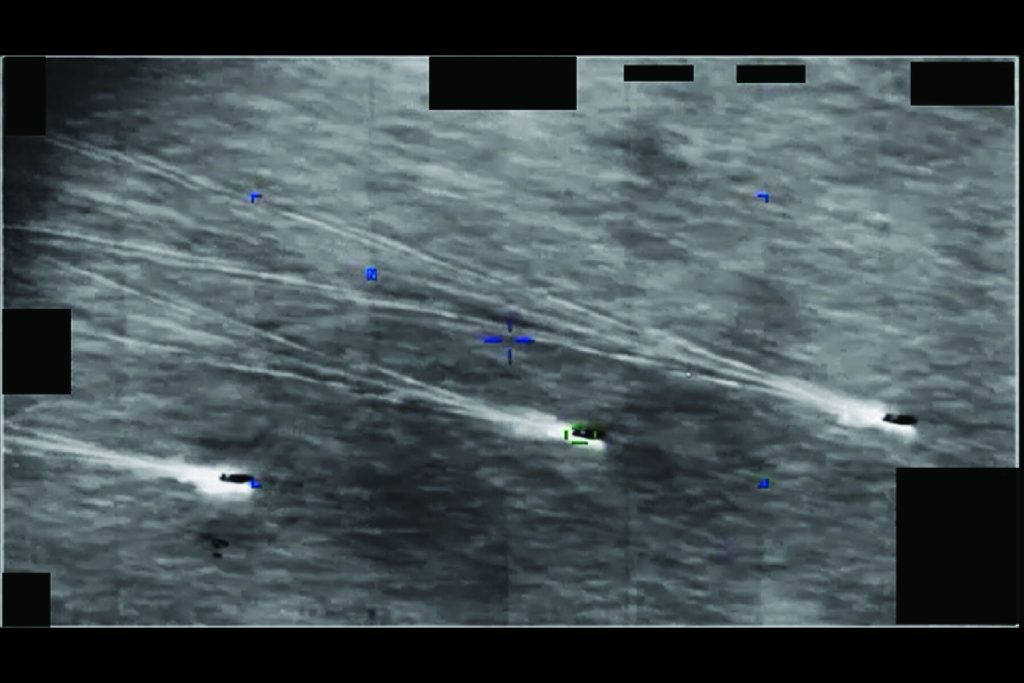
Spherical UAP Pulsing Over Water (June 2024)
One of the clearest pieces of footage in either tranche: a spherical object hovering over open water, exhibiting a rhythmic pulsing motion. No conventional explanation has been offered.
The Intelligence Officer’s Account: “Virtually Speechless”
The most striking document in Tranche 2 is a written account by a currently serving senior US intelligence officer. While investigating “thuds” near a mountain range in the western United States — aboard a military helicopter in late 2025 — the officer and crew encountered orange orbs that split apart, changed direction independently, and then appeared to pursue scrambled fighter jets. The officer wrote that the orbs “matched the jets’ speed and flight path” before the crew was left “virtually speechless after these observations.” The account was filed through the Office of the Director of National Intelligence.
DOW-UAP-PR49, Unresolved UAP Report, Department of the Army, 2026
4. The NSA Top Secret UMBRA Records: A Parallel Disclosure
Running alongside the PURSUE tranches is a separate disclosure stream. On May 18, 2026, the National Security Agency released hundreds of pages of UAP-related records previously classified at the TOP SECRET UMBRA level — one of the most sensitive classification tiers in US signals intelligence — following a FOIA appeal by the Disclosure Foundation.
These documents demonstrate that the NSA treated certain UAP incidents as serious intelligence matters across several decades, not as fringe curiosities. The release adds another layer to the picture that PURSUE is building: UAP are not a new phenomenon, and multiple intelligence agencies have been actively tracking them for far longer than the public record suggests.
For the full breakdown of what the NSA UMBRA records contain, see our dedicated analysis: NSA Top Secret UMBRA UAP Records Released: What the 2026 FOIA Documents Reveal.
5. UAP Files Tranche 3 (June 12) Released
The Department of War published PURSUE Release 03 on June 12, 2026 — earlier than the late-June window many analysts had projected. The full database is accessible at war.gov/UFO. The release contains 53 documents, 10 digital renderings, 6 videos, and 3 NASA audio recordings, sourced from the CIA, FBI, US Army, NASA, and the Intelligence Community Assessment (ICA) office. The portal has now received over 1.7 billion hits worldwide since launching May 8, 2026, according to the Department of War’s official press statement.
Here is what the files actually contain.
CIA Document: Disc-Shaped Object Over Harare International Airport, Zimbabwe (2008)
A previously secret CIA document records a July 2008 sighting of an unidentified object over Harare International Airport in Zimbabwe, detected by both radar and optical instruments. The object was described as disc-like in shape with a hollow center and a series of rotating lights on its underside. Observers at the time reportedly debated whether it was an advanced surveillance tool from a foreign government or a UAP of unknown origin — a distinction the CIA document explicitly frames without resolution. The document is labeled with routing information referencing Zimbabwe, making it one of the few PURSUE records tied to African airspace.
FBI Orb Sightings: Northeast US, 2024–2026
Multiple FBI field documents cover a cluster of orb sightings in the northeastern United States spanning 2024 through early 2026. The files include FD-302 interview reports — the standard FBI witness interview format — along with one document concerning a 2022 sighting near Colorado Springs and another from 1949 via a Department of Justice referral. Witnesses in the 2026 northeast cluster were assessed by the FBI as “highly credible.” A video released alongside these documents, titled Orbs Over the Pond, shows what appears to be a ball of light over a body of water in October 2024, with a companion video showing two lights above a treeline from a 2025 incident occurring within 25 miles of the same location.
Colorado Springs Incident: The Potato-Shaped UAP Near Cheyenne Mountain (October 2023)
One of the most detailed narratives in Tranche 3 concerns a series of events in the western United States over two days in October 2023. Five federal law enforcement special agents filed accounts with the Pentagon’s All-domain Anomaly Resolution Office (AARO). Their reports, along with an Intelligence Community Assessment analysis of the incident, are included in the release.
The accounts are specific and consistent across witnesses. One agent wrote: “As we headed through an alley area, we suddenly noticed a large glowing ball to our right 90 degrees from where we were” — later using a range finder to place it at approximately 1,100 meters away. The agent described it as “a circle of light that looked like a swirly pattern of bright lava.” Shortly after, the same agent reported three red lights that “flew out of and away from it,” moving quickly and disappearing, followed by a flash from over the horizon. Another agent’s account captured the spontaneous reaction in real time: “Are you seeing this?” the agent recalled asking a partner as a glowing orb lit up the sky.
A separate report on the same cluster describes the object as “shaped like a potato, with fish-like scales with a white opalescent color” — somewhat translucent and shimmering. A digital rendering and a full ICA analysis of the Colorado Springs incident are included in the release. Cheyenne Mountain, the site nearest to the reported encounters, houses NORAD’s operations center and is one of the most hardened military facilities in the United States.
US Army Flying Saucer Study, 1949
Among the historical documents in Tranche 3 is a declassified cover sheet from a Department of the Army study on flying saucers dating to 1949 — confirming that US military analysis of anomalous aerial objects predates the CIA’s Project Blue Book and extends to the earliest years of the Cold War. The document adds to the accumulating record that UAP have been treated as serious military intelligence matters for over seven decades.
NASA Audio: Gordon Cooper and Walter Cronkite, 1962
Three NASA audio recordings are included in the release. The most notable is an audio clip of astronaut Gordon Cooper speaking with journalist Walter Cronkite in 1962. Cooper, who flew two Mercury and Gemini missions, was one of the most outspoken early NASA astronauts on the subject of anomalous aerial phenomena, having reported a UAP sighting in 1951 while flying over Germany. The specific content of the 1962 recording has not been fully transcribed in the official release materials, but it joins the seven Apollo-era NASA audio recordings released in Tranche 2 as part of a pattern of NASA mission audio making its way into the declassified record.
What Tranche 3 Does Not Contain
The underwater USO focus that pre-release sources anticipated did not materialize in Tranche 3’s initial documents. No new submarine or transmedium footage was included. Department of Energy records — which analysts expected given Tranche 2’s PANTEX material — are also absent. The Department of War’s statement following the release confirmed a fourth tranche was in preparation; it was published on July 10, 2026 as PURSUE Release 04 — and it included the Department of Energy Pantex material that Tranche 3 notably lacked.
The AARO disclaimer applied to all PURSUE files remains in effect: every document represents an unresolved case in which investigators could not reach a definitive conclusion. Descriptive language in military and law enforcement reports reflects the subjective interpretation of reporting officers and should not be interpreted as confirmation of extraordinary phenomena.
6. What the Government Hasn’t Released
Arguably as important as what has been disclosed is what has not appeared in any tranche. Several categories of records remain conspicuously absent.
AAWSAP/AATIP technical reports. The Advanced Aerospace Weapon System Applications Program (AAWSAP) — the classified Pentagon program that ran from 2008 to 2012 with a $22 million budget — produced dozens of technical reports on UAP physics, biology, and materials. Almost none of these have appeared in PURSUE. The program’s successor, AATIP (Advanced Aerospace Threat Identification Program), is similarly absent from the released record.
Physical materials. Former Defense Intelligence Agency officer David Grusch testified before Congress in 2023 that the US government maintains physical materials recovered from UAP incidents. Nothing in PURSUE has addressed this claim — no inventory, no denial, no declassified discussion of material recovery programs.
Full-resolution sensor data. Most videos in Tranches 1 and 2 are compressed or downsampled. Raw sensor data — radar returns, thermal signatures, acceleration measurements — has been largely redacted or omitted. This makes independent scientific analysis of the footage extremely difficult.
Private contractor records. A significant portion of US UAP research has been conducted through private defense contractors not subject to the Freedom of Information Act. These records sit entirely outside the PURSUE framework.
7. Why Republican Lawmakers Still Aren’t Satisfied
The political dimension of the PURSUE releases is unusual: the strongest criticism of the disclosures has come not from Democrats, but from the Republican legislators who spent years fighting for them.
Rep. Anna Paulina Luna (R-FL), one of the most persistent Congressional voices on UAP transparency, stated flatly: “We have been stonewalled. We have been blocked. We have had witnesses intimidated.” She further alleged that former workers at the Pentagon’s UAP office were actively “attacking” some whistleblowers who came forward — suggesting an ongoing institutional resistance to full disclosure even within the Trump administration’s own bureaucracy.
Rep. Tim Burchett (R-TN), equally outspoken, dismissed the released files as “Deep State classic” — a phrase meaning the government is releasing only what cannot hurt it, while keeping the genuinely sensitive material locked away. “The stuff they’re dropping right now is just Deep State classic,” Burchett said after viewing Tranche 2.
This dynamic matters for how to interpret PURSUE. The program may represent genuine transparency — or it may represent a carefully managed disclosure that gives the public enough to satisfy curiosity while protecting whatever the government most wants to protect. The lawmakers who know the most about what should be in these files are the ones most skeptical that it’s all there.
8. How to Read the PURSUE Files Without Losing Your Mind
With over a billion visits to the portal and an internet full of breathless commentary, maintaining analytical clarity about these files requires deliberate effort. A few principles worth keeping in mind:
“Unresolved” is not “alien.” The Pentagon’s own disclaimer states that every file represents a case in which investigators could not reach a definitive conclusion with available evidence. That is a statement about the limits of data, not confirmation of extraordinary origins. NASA’s independent UAP research group has consistently emphasized this distinction.
Chain of custody matters. Some files lack fully verified chain of custody documentation — meaning it cannot always be confirmed where a recording came from or whether it has been altered. This is a standard evidentiary concern, not a conspiracy theory. Apply the same scrutiny you would to any evidence.
National security framing vs. extraterrestrial framing. Congress and the Pentagon consistently frame UAP as a national security question: unknown objects in restricted airspace are a threat regardless of their origin. The question of whether they are extraterrestrial is genuinely secondary to the question of whether they are adversarial. Keep those two questions distinct.
Watch what isn’t released. Selective declassification is a standard intelligence tradecraft technique. In any large-scale document release, what is withheld often tells you more than what is provided. The gaps in PURSUE are as informative as the content.
TodayWhy will continue tracking each new tranche as it is released. For the full technical breakdown of every document released to date, visit our complete guide: Pentagon UFO Files: Complete 2026 UAP Disclosure Guide.
9. Frequently Asked Questions
When was Pentagon UAP files Tranche 3 released?
Tranche 3 was released on June 12, 2026, under the name PURSUE Release 03. It is available in full at war.gov/UFO. Downloads include an 826 MB document bundle and a 4.6 GB video package.
What does Tranche 3 contain?
Tranche 3 contains 53 documents, 10 digital renderings, 6 videos, and 3 NASA audio recordings from the CIA, FBI, US Army, NASA, and Intelligence Community Assessment office. Key items include a CIA document on a disc-shaped object over Zimbabwe’s Harare airport, FBI footage of orbs in the US Northeast, five federal agent accounts of a “potato-shaped” UAP near Cheyenne Mountain in Colorado, a 1949 US Army flying saucer study, and a 1962 Gordon Cooper audio recording.
Will there be a Tranche 4?
Yes. The Department of War confirmed in its June 12, 2026 press statement that additional releases are actively being prepared. The Pentagon committed to rolling releases every few weeks as materials are discovered and declassified.
What is the PURSUE program?
PURSUE — Presidential Unsealing and Reporting System for UAP Encounters — is a multiagency US government declassification initiative ordered by President Trump in February 2026. All files are publicly available at war.gov/UFO.
Do the released UFO files prove the existence of extraterrestrial life?
No. The Pentagon states clearly that none of the released materials confirm extraterrestrial life. “Unresolved” means investigators could not reach a definitive conclusion — not that the objects are of non-human origin.
Why are Republican lawmakers unhappy with the releases?
Rep. Anna Paulina Luna stated witnesses have been stonewalled and intimidated. Rep. Tim Burchett called the releases “Deep State classic,” suggesting the government is only releasing records it has decided are safe to disclose.
Continue reading — Why UFO series:
- Pentagon UFO Files: Complete 2026 UAP Disclosure Guide — Full breakdown of every tranche released to date, all 51 videos from Tranche 2, and the intelligence officer’s “speechless” account.
- NSA Top Secret UMBRA UAP Records: What the 2026 FOIA Release Reveals — The parallel NSA disclosure running alongside PURSUE.
- Bermuda Triangle Explained: Stargates, Alien Bases & the Untold Truth