
Last Updated on 5 months ago by TodayWhy Editorial
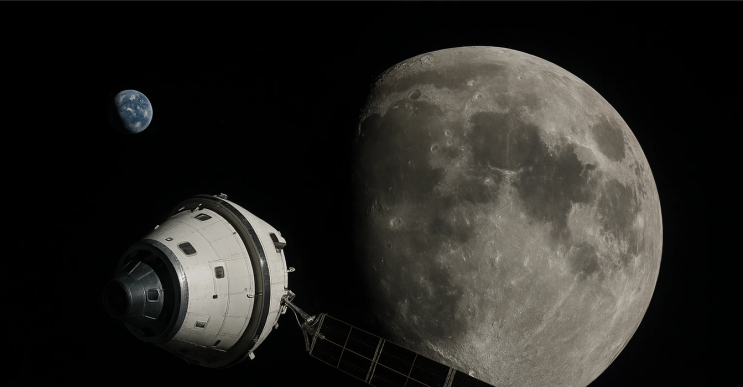
In early April 2026, for the first time since Apollo 17 in 1972, human beings orbited the Moon. The four crew members of NASA’s Artemis II mission — aboard the Orion capsule named Integrity — completed a historic 10-day voyage, sweeping roughly 7,400 kilometers beyond the lunar far side before returning safely to Earth.
Among the most scientifically significant moments of that journey came during their closest lunar approach on April 6, 2026: all four astronauts reported seeing brief, brilliant flickers of light bursting across the darkened lunar surface — meteoroid impact flashes, created in a fraction of a second when space rocks vaporize upon striking the Moon at extreme velocity.
What made the moment even more remarkable: the Orion spacecraft was equipped with 31 cameras, yet none of them captured what the human eye could see.
TodayWhy explains what lunar impact flashes are, what the Artemis II crew observed, how citizen scientists on Earth joined the effort in real time, and why these split-second events are now a critical piece of NASA’s planning for a permanent human base on the Moon.
What Are Lunar Impact Flashes?
The Moon has no atmosphere. Unlike Earth, where incoming space rocks burn up as meteors before reaching the surface, the lunar surface is completely exposed to the constant bombardment of meteoroids — fragments of asteroids and comets traveling at speeds of tens of kilometers per second.
When a meteoroid strikes the lunar surface, the kinetic energy of the collision is released almost instantaneously. Most of that energy excavates a new crater and generates a pressure wave through the lunar regolith. But a tiny fraction — less than 1% — converts into a brief flash of visible light.
These flashes are called lunar impact flashes, and they are exactly what the name suggests: instantaneous bursts of light appearing on the Moon’s dark side, visible to spacecraft and, under the right conditions, to telescopes on Earth.
As NASA’s own Impact Flash citizen science project explains, these events are “split-second flares of light” that carry an outsized scientific value relative to their brief duration.
Why the Moon Is Hit So Often
The Moon’s surface tells the story of billions of years of impacts — every crater visible through a backyard telescope is the scar of a collision. But impacts are not just ancient history. They are happening right now.
The Moon is bombarded by meteoroids the size of ping-pong balls on a daily basis. The lack of protective atmosphere, the Moon’s orbital position in the inner solar system, and the sheer density of debris in near-Earth space means the lunar surface accumulates new craters continuously.
Scientists are particularly interested in the current impact rate — not the ancient bombardment record, but how frequently the Moon is being struck today. That rate determines everything from the pace at which the lunar surface is being gardened and reshaped to the practical risks that future human habitats will face.
The Artemis II Observation: What Happened on April 6, 2026
The Historic Flyby
The Artemis II mission launched from Florida’s Space Coast on April 1, 2026. Five days later, on April 6, the Orion capsule made its closest approach to the Moon — a sweeping flyby that brought the crew around the lunar far side, a region permanently hidden from Earth and never before observed at such close range by human eyes since the Apollo era.
As the spacecraft arced around the darkened hemisphere, all four crew members remained alert at the spacecraft’s windows, watching for impact flashes. Their vigilance was rewarded.
What They Saw — and What the Cameras Missed
The entire crew reported seeing multiple impact flashes: brief, instantaneous bursts of light on the lunar surface below them. The observations were made entirely with the unaided eye.
Critically, none of the Orion spacecraft’s 31 cameras — designed to capture the mission from every conceivable angle, from external hull cameras to internal cabin equipment — successfully recorded the events that the astronauts witnessed directly.
Kelsey Young, NASA’s Artemis II lunar science lead, explained the challenge: the human eye’s ability to detect fleeting, unpredictable, fractional-second phenomena significantly outperforms digital camera technology in this context. As Young told Space.com: “It’s extremely difficult to capture impact flashes with a camera, which is one of the benefits of sending trained crew to observe the Moon.”
The data from these observations is being archived by the Artemis II Lunar Science Team on NASA’s Planetary Data System for the broader scientific community to analyze.
A First Since Apollo 17
The last time a human being observed a lunar impact flash from space was during the Apollo 17 mission in 1972, when astronaut Harrison Schmitt reported the phenomenon on three separate occasions while in lunar orbit. The Artemis II crew’s observations in April 2026 represent the first human-witnessed impact flashes in 54 years.
The Science Behind the Flash: Why These Events Are So Valuable
Measuring the Impact Flux
Every observed flash is a data point in the effort to map the lunar impact flux — the rate at which meteoroids of different sizes strike the Moon’s surface. Understanding this flux with precision is difficult. There are simply too many variables: the size distribution of the incoming objects, their velocities, their compositions, and the lighting and observational conditions that determine whether a flash is detectable at all.
Each time an impact flash is observed from multiple positions simultaneously — for example, from a spacecraft at lunar distance and from a telescope on Earth — scientists gain far more information than either observation could provide alone. The combined data constrains the nature and origin of the impactors, the size of the craters they form, and the frequency of strikes at different energy levels.
Understanding the Moon’s Interior
Lunar impact flashes also have a deeper application: understanding what lies beneath the surface.
Ben Fernando, the Impact Flash project lead and a planetary scientist at Los Alamos National Laboratory, explained the connection: “We are planning to send seismometers to the Moon to measure how the ground shakes. Your measurements of impact flashes will help us work out the sources of moonquakes we detect. This will help us work out what the Moon’s interior looks like.”
Each meteoroid strike generates a seismic signal — a moonquake — that propagates through the lunar interior. By correlating the known timing and location of an impact flash with the seismic signal it produces, scientists can use the impact as a calibration tool, revealing information about the Moon’s deep structure in the same way that geologists use controlled explosions to image rock strata on Earth.
The Impact Flash Citizen Science Project: How the Public Joined In
GEODES and the Impact Flash! Program
The Artemis II mission did not rely solely on the astronauts’ unaided eyes. At the same time the crew was sweeping around the lunar far side, hundreds of volunteer citizen scientists on Earth were pointed their own telescopes at the Moon, contributing to the NASA-funded Impact Flash! project.
Impact Flash! is run under the auspices of GEODES — the Geophysical Exploration of the Dynamics and Evolution of the Solar System — a team within the NASA Solar System Exploration Research Virtual Institute based at the University of Maryland. Ben Fernando, who leads the project through his affiliation with both Los Alamos National Laboratory and Johns Hopkins University, spearheaded the citizen science coordination.
“We were incredibly grateful for the videos people submitted,” Fernando stated in a NASA Science release.
Who Contributed and How
To collect data during the Artemis II mission window, the Impact Flash team coordinated with several partner groups of amateur astronomers, including:
- NASA-funded Kilo-nova Catchers
- Exoplanet Watch
- UNITE (Unistellar Network Investigating TESS Exoplanets)
- Night Sky Network
- The Lunar Impact Flashes project based at the National Research Council of Italy (IMATI-CNR)
Volunteers submitted video recordings of the Moon taken through their own telescopes. One contributor, Joerg Tomczak, captured an image with a highlighted orange circle showing a candidate impact flash — exactly the kind of data the science team needed.
What Equipment Is Required
The Impact Flash! project is designed to be accessible to any amateur with basic equipment. The project recommends a telescope with a mirror or lens diameter of at least 4 inches (10 cm) to detect all but the very largest, most infrequent flashes. A focal ratio of f/6 or smaller helps maximize the lunar surface area in focus. The telescope must be trained on the darkened hemisphere of the Moon — impact flashes are invisible against the sunlit side.
Why This Research Matters: Designing the Artemis Base Camp
The Moon’s South Pole as a Human Outpost
NASA’s long-term vision for the Artemis program extends far beyond orbital flybys. The agency is planning to construct Artemis Base Camp — a long-duration outpost near the lunar south pole — as the anchor of a sustained human presence on the Moon and a stepping stone toward Mars missions.
Designing a structure intended to last years on the lunar surface requires accounting for every environmental hazard the site will face. A 2025 study led by Daniel Yahalomi, now a Torres Postdoctoral Fellow at MIT, addressed this challenge directly: “To design for longevity, one must account for the myriad environmental hazards that a long-duration outpost will face — among them radiation, extreme thermal cycling, regolith dynamics, seismic shaking, dust, and, of particular importance to this work, impacts.”
Good News for the South Pole Site
The same study brought encouraging news for NASA’s choice of location. The lunar south pole carries a lower meteoroid impact risk than equatorial regions of the Moon, supporting its selection as the site for sustained human presence.
Moreover, Yahalomi and colleagues found that currently available shielding technology is sufficient to suppress micrometeoroid hazards “by nearly five orders of magnitude, reducing the effective risk to a manageable level for current habitat designs.”
In other words: the threat is real, quantifiable, and — importantly — manageable with the right engineering.
The Dual-Observation Advantage
Research from Johns Hopkins University reinforced the scientific value of combining ground-based and orbital observations. When data from citizen scientists on Earth is paired with data from astronauts or spacecraft near the Moon, scientists gain more detailed information about the timing, location, and dynamics of each impact than either perspective could produce alone. This dual-observation model is now a central strategy for impact flux research going forward.
From Apollo to Artemis: A 54-Year Thread of Observation
The current excitement over lunar impact flash science builds on a thread stretching back more than half a century.
During the Apollo program, astronauts on three separate missions reported anomalous visual phenomena on the lunar surface. The newly released Pentagon UAP file references from the Apollo 11, 12, and 17 missions — in which astronauts described flashes, unexplained lights, and luminous objects — are now being re-examined in the context of the known science of impact flashes, as well as other natural phenomena such as cosmic ray interactions with the retina and electrostatic lunar surface activity.
During Apollo 17, Harrison Schmitt’s three recorded observations of impact flashes in lunar orbit remain the most well-documented pre-Artemis account of the phenomenon from space. The 54-year gap between Schmitt’s 1972 observations and the Artemis II crew’s April 2026 sightings underscores just how rare and scientifically precious this category of observation is.
What Comes Next: The Impact Flash Program’s Future
Ongoing Citizen Science
The Artemis II crew has returned to Earth, but the scientific work continues. The Impact Flash team is actively calling for continued participation from the global community of amateur astronomers. Every session of lunar observation contributes to the baseline dataset that will guide impact flux modeling for future missions.
The team also plans to expand the program’s scope in parallel with upcoming Artemis missions, including Artemis III, which is planned to land astronauts near the lunar south pole, and Artemis IV.
Seismometer Deployment
Future Artemis surface missions will carry seismometers to the lunar surface. When those instruments are in place, the correlation between observed impact flashes and measured seismic events will open a new window into the Moon’s internal structure — a goal that the Impact Flash citizen science network is already helping to prepare for.
Connecting Flash Data to Crater Formation
Scientists are also working to directly connect observed impact flashes to the fresh craters they produce. The Lunar Reconnaissance Orbiter (LRO), which has been mapping the Moon since 2009, regularly images the surface and can, in principle, detect newly formed craters by comparing before-and-after images. Combining flash observation data with LRO crater detection will allow researchers to directly measure how the energy of an observed flash translates into a specific crater size — a fundamental calibration for all impact flux modeling.
Key Takeaways
- On April 6, 2026, the Artemis II crew became the first humans since Apollo 17 in 1972 to visually observe meteoroid impact flashes on the lunar surface from space.
- The flashes were detected with the unaided human eye — none of the 31 onboard cameras captured them, demonstrating a critical scientific advantage of crewed missions.
- Impact flashes occur when meteoroids vaporize on contact with the lunar surface, converting less than 1% of the impact energy into a brief burst of visible light.
- The NASA-funded Impact Flash! citizen science project coordinated simultaneous ground-based observations by amateur astronomers worldwide during the Artemis II flyby.
- Flash data feeds directly into planning for Artemis Base Camp near the Moon’s south pole, where understanding the meteoroid impact rate is essential for designing habitats built to last.
- Research suggests the lunar south pole carries lower impact risk than equatorial regions, and existing shielding technology is sufficient to protect future structures.
- The Impact Flash! project, led by Ben Fernando through GEODES at the University of Maryland, is ongoing and open to public volunteers with basic telescopes.
Frequently Asked Questions (FAQ)
Q: What is a lunar impact flash?
A: A lunar impact flash is a brief burst of visible light produced when a meteoroid strikes the Moon’s unprotected surface at high velocity and vaporizes on impact. Less than 1% of the collision’s energy is converted into light. Because the Moon has no atmosphere to slow or burn up incoming space rocks, these events occur continuously.
Q: Did the Artemis II cameras capture the impact flashes?
A: No. Although the Orion spacecraft carried 31 cameras, none of them captured the flashes observed by the crew. The human eye is more capable than current digital camera technology at detecting unpredictable, fractional-second light events against a dark background.
Q: How often does the Moon get hit by meteoroids?
A: The Moon is struck by meteoroids roughly the size of a ping-pong ball on a daily basis. Precise quantification of the impact rate across different meteoroid sizes is one of the primary goals of the Impact Flash! research program.
Q: What is the Impact Flash! citizen science project?
A: Impact Flash! is a NASA-funded project run by the GEODES team at the University of Maryland, led by Ben Fernando. It invites amateur astronomers worldwide to observe the Moon’s dark side with their own telescopes and submit video recordings. This data is combined with orbital observations to build a more accurate picture of the lunar impact flux.
Q: Why does impact flash research matter for Artemis Base Camp?
A: NASA plans to build a long-duration lunar outpost near the Moon’s south pole. Knowing the precise meteoroid impact rate at that location is essential for designing structural shielding and ensuring the habitat can withstand years of continuous bombardment. MIT research indicates the south pole carries lower impact risk than equatorial regions, supporting its selection as the base camp site.
Q: How can I participate in Impact Flash! observations?
A: Participants need a telescope with a mirror or lens of at least 4 inches (10 cm) in diameter, a video camera capable of recording the Moon, and the telescope pointed at the darkened hemisphere (the non-sunlit side). Full participation details, guidelines, and submission instructions are available at geodes.umd.edu/impactflash.
Q: When was the last time astronauts observed lunar impact flashes before Artemis II?
A: The last documented observation of lunar impact flashes by a human from space was by astronaut Harrison Schmitt during the Apollo 17 mission in 1972 — 54 years before the Artemis II crew’s April 2026 sightings.
Last updated: May 9, 2026. Sources: NASA Science (science.nasa.gov), Space.com, Johns Hopkins University Hub, Popular Science, Air and Space Museum, Orbital Today, Rolling Out, Los Alamos National Laboratory.