
Last Updated on 2 months ago by TodayWhy Editorial
The UK’s emergency alert reached millions of phones across England and Wales at 7:01pm on Friday 14 August 2026, triggering a loud, siren-like alarm as the same message landed on lock screens within seconds of each other — a warning about wildfires, issued on a scale the system had never been used at before.
Why did the UK send an emergency alert to millions of phones? Because a heatwave-driven wildfire crisis had already destroyed homes, hospitalised firefighters, and pulled the Prime Minister to the scene in person — and officials decided a text message reaching almost the entire population was the fastest way to stop it getting worse.
What the emergency alert actually said
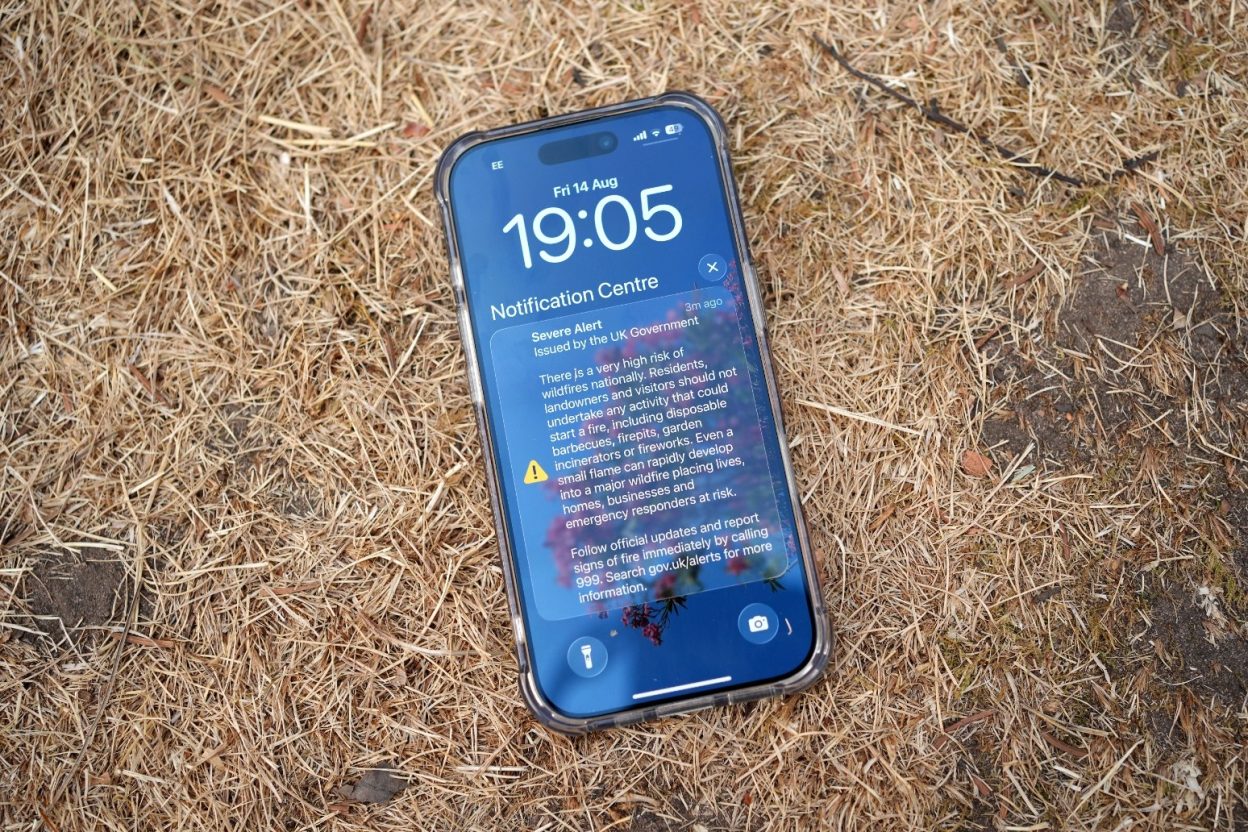
The message, issued by the Cabinet Office and visible on the government’s own alerts page, read: “There is a very high risk of wildfires nationally. Residents, landowners and visitors should not undertake any activity that could start a fire, including disposable barbecues, firepits, garden incinerators or fireworks. Even a small flame can rapidly develop into a major wildfire placing lives, homes, businesses and emergency responders at risk.” It closed by urging anyone who spotted a fire to call 999 immediately.
It went out on a rolling basis from approximately 7pm, broadcast directly from nearby cell towers to every compatible phone in England and Wales simultaneously — the same technology used for flood and severe weather warnings, but deployed this time at a genuinely national scale.
Why the government escalated to this emergency alert
The immediate trigger was Stourbridge, in the West Midlands, where a wildfire destroyed 19 homes outright and damaged another 18, according to ITV News, which reported 68 people were treated by paramedics, including 25 taken to hospital, as roughly 100 firefighters battled the blaze overnight. The Prime Minister visited the town earlier the same day to meet affected residents and thank exhausted firefighters, some of whom had been hospitalised battling the blaze the day before. That visit followed a meeting of the government’s COBR emergency committee earlier in the week.
First Secretary Louise Haigh, announcing the alert, called it “the most extensive use of the UK’s Emergency Alert system in response to an active incident” — a direct acknowledgment that this went well beyond the system’s previous uses, which have mostly been localised: flood warnings, a 2024 unexploded WWII bomb evacuation in Plymouth, and regional weather alerts. Sending it to two entire countries at once, rather than the areas immediately burning, reflected how unpredictable the fire risk had become across the wider heatwave-dried landscape.
Why some phones didn’t get the emergency alert
It only went to England and Wales — Scotland and Northern Ireland were excluded, since the wildfire risk assessment didn’t extend there. Beyond geography, receiving it depends on a few technical requirements: a 4G or 5G-capable phone, switched on and not in airplane mode, with the feature enabled in settings. Phones sold before roughly 2015 may lack the capability entirely or need a settings change, which is the most common reason someone connected to a network still missed it.
The system doesn’t use your phone number or track your location to deliver a message, which is also why it can’t guarantee delivery to every single device — it broadcasts to towers covering an area, not to a registered list of numbers.
What else the government announced alongside the alert
It arrived bundled with a wider package. Ministers introduced an immediate, temporary nationwide ban on selling disposable barbecues, with retailers told to pull them from shelves right away. Around 100 military personnel were deployed to support the response in South Wales, with a further 100 following the same evening. Emergency funding was released for fire and rescue services under the most operational pressure, and the government said it was pushing insurers to process claims from affected households and businesses without delay.
Housing Secretary Angela Rayner said several firefighters had been hospitalised in incidents the day before, and confirmed a national wildfire summit would follow later in the year, bringing together fire chiefs and the Fire Brigades Union to plan for what she described as “increasingly severe weather events.” The government also pointed to £97 million already committed to fire service training and equipment, and reminded local authorities they can use Public Spaces Protection Orders to restrict barbecues and open fires in high-risk areas.
What to actually do if you’re in the alert area
The government’s guidance is specific: don’t light any fire or open flame in the countryside, parks, moorland or wooded areas; never leave a barbecue unattended and make sure it’s fully out after use; dispose of cigarettes carefully and never throw them from a vehicle; take litter home, since glass bottles can concentrate sunlight and start fires on their own; and call 999 immediately at the first sign of a fire rather than waiting to see if it spreads.
Frequently asked questions
Why didn’t I get the emergency alert?
The most common reasons are being in Scotland or Northern Ireland, where it wasn’t sent, having a phone older than roughly 2015 that lacks the required capability, having the phone switched off or in airplane mode at 7pm, or having emergency alerts disabled in your phone’s settings.
What exactly did the emergency alert say?
It warned of a very high national wildfire risk and told people not to light barbecues, firepits, garden incinerators or fireworks, warning that even a small flame could rapidly become a major wildfire, and asked anyone spotting a fire to call 999.
Is this the first time the UK has sent an emergency alert on this scale?
According to the government, it’s the most extensive use of the system in response to an active incident to date. Previous alerts have generally been localised, such as flood warnings or a 2024 unexploded bomb evacuation in Plymouth.
Are disposable barbecues now illegal in the UK?
Their sale has been temporarily banned nationwide while the wildfire risk remains elevated, with retailers instructed to remove them from shelves immediately. The government has described this as a temporary measure under ongoing review, not a permanent ban.
What triggered the wildfire crisis behind the alert?
A sustained heatwave dried out vegetation across large parts of England and Wales, contributing to major fires including one in Stourbridge that destroyed 19 homes and injured several firefighters.
Does receiving the emergency alert mean my phone shares my location with the government?
No. It is broadcast to all compatible phones connected to cell towers in the affected area; it does not use your phone number, track your location, or collect personal data.