
Last Updated on 3 weeks ago by TodayWhy Editorial
Look at a map of Spain and you will not find it. Look at a map of Morocco and you will find a small notch on the northern coast that Morocco does not control: Ceuta Spain.
That notch is Ceuta: a Spanish city of about 85,000 people sitting on the African continent, roughly 14 kilometres across the water from mainland Spain. It is part of Spain, part of the European Union, and its only land neighbour is Morocco.
This guide answers the questions people actually ask about it — where it is, what to call it, how Spain ended up with it, and why its legal status is stranger than almost anywhere else in Europe.
Where is Ceuta, Spain located on the map?
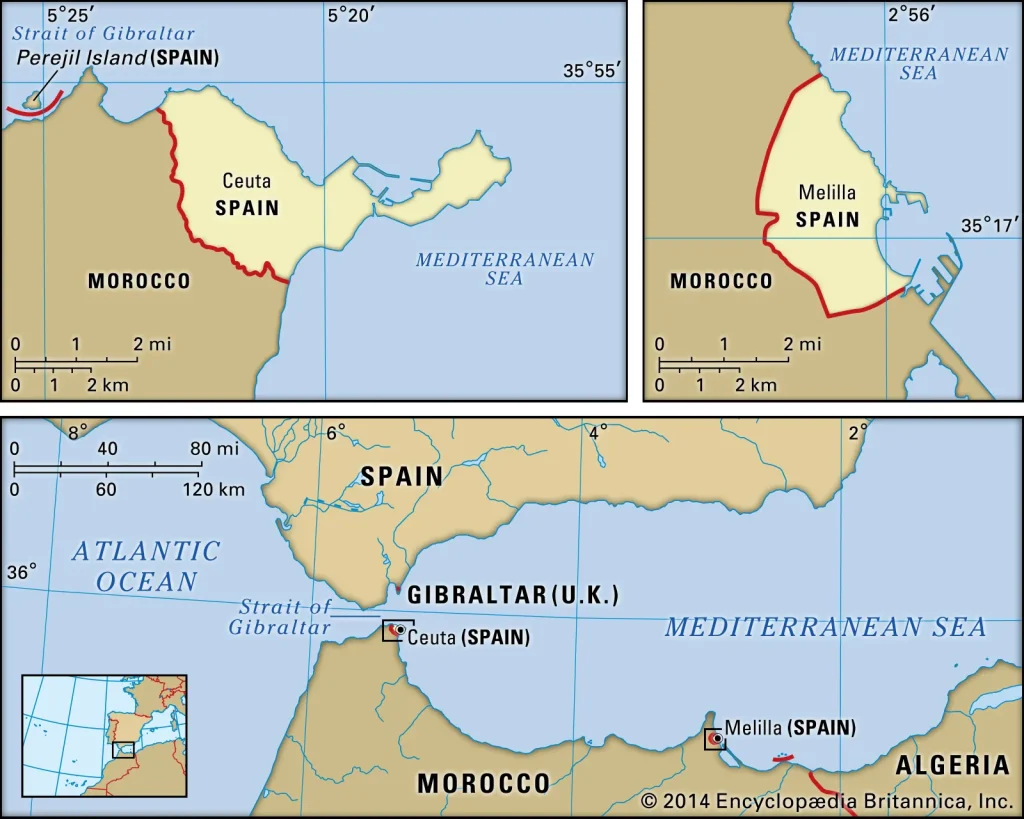
Ceuta, Spain, sits on a narrow peninsula on the north coast of Africa, right at the entrance to the Strait of Gibraltar. Although it is a fully integrated Spanish autonomous city, it uniquely lies on the African continent, sharing a heavily fortified 8-kilometre land border with Morocco.
The city covers just 18.5 km². Three sides face the sea (Mediterranean to the east and north, Atlantic influence to the west). The only land connection is the border fence with Morocco.
Ceuta, Spain: Quick Facts (2026)
- Status: Autonomous city of Spain (not an enclave/colony).
- Location: North Africa, bordering Morocco and the Mediterranean Sea.
- Population: Approximately 85,000 residents.
- Currency & Travel: Uses the Euro (€); outside the Schengen visa-free zone for land border crossings.
Ceuta on the map: Spain, Morocco and the Strait of Gibraltar
When people search for “Ceuta Spain map”, they are usually surprised. Looking at a normal map of Spain, Ceuta does not appear on the Iberian Peninsula. It is located across the Strait of Gibraltar, on the African side.
- To the north: the Spanish mainland (Andalusia) and Gibraltar
- To the south and west: Morocco
- The shortest sea distance to mainland Spain is roughly 14–16 nautical miles (about 28–30 km)
The city occupies a strategic position that has made it valuable for centuries — controlling the entrance to the Mediterranean.
How far is Ceuta from Spain, and from Morocco?
To mainland Spain (Algeciras):
The ferry crossing takes about 1 hour. Multiple daily services operate (Baleària, FRS/DFDS, Naviera Armas). Distance is approximately 15–16 nautical miles (28–30 km).
To Morocco:
- Zero land distance — Ceuta shares a direct border with Morocco. The main crossing points are at El Tarajal (south) and near Benzú (west).
- At the closest points, the swim across the breakwaters is only a few hundred metres, which is why the border remains a major migration pressure point.
There is no land route to the rest of Spain. The only practical connections are by ferry or helicopter/plane (limited).
How far is the swim from Morocco?
Only a few hundred metres. Swimmers do not cross the strait — they round the breakwaters where the border fence runs into the sea.
El Tarajal beach on the Spanish side is about 250 metres long. Because the fence itself is hard to climb along its length, pressure concentrates at the two points where it meets water: Benzú in the north and El Tarajal in the south. That geography sits behind almost every mass crossing you will see reported.
Short does not mean safe. Currents, exhaustion and crushes at the breakwater have killed dozens of people in 2026 alone.
Melilla, its sister city, lies roughly 400 kilometres east along the same Moroccan coast and has a similar population. Together the two form the European Union’s only land border with Africa.
Is Ceuta an enclave or an exclave?
Both words are in heavy use right now, and one of them is wrong.
An enclave is territory completely surrounded by another country. San Marino inside Italy is a true enclave. It is not one, because it has a Mediterranean coastline.
An exclave is territory separated from the main body of its own country, reachable by land only by crossing another state. That fits. Britannica classifies Ceuta as a Spanish exclave, and so does most geographic literature.
Geographers sometimes use a third term, semi-enclave, for exactly this case: separated from the motherland, bordered on land by a single foreign state, but with its own sea access.
In everyday journalism you will see “Spanish enclave” constantly. It is not a scandal — it is shorthand. But if you want to be precise, exclave is the better word.
Is Ceuta part of Spain?
Yes, fully. It is not a colony, a protectorate or an overseas dependency.
It is an autonomous city — a status it received in 1995, which sits between an ordinary Spanish municipality and a full autonomous community. It elects an assembly, uses the euro, sends deputies to the Spanish parliament and is governed under Spanish law.
Morocco disputes this. Rabat regards Ceuta and Melilla as occupied territory and has raised the claim at the United Nations. Spain rejects the comparison to colonialism, pointing out that it held Ceuta long before the modern Moroccan state existed.
How did Spain end up with a city in Africa?
Not through the nineteenth-century scramble for Africa. The city is far older than that, which is central to Spain’s legal argument.
The city was successively held by Carthaginians, Greeks, Romans and Byzantines before Portugal captured it in 1415. It passed to the Spanish crown in 1580, when the crowns of Spain and Portugal were united, and a later treaty with Portugal confirmed Spanish possession when the two separated again.
So Spain has held Ceuta continuously since 1580 — more than three centuries before the French and Spanish protectorates over Morocco were established in 1912, and nearly four before Morocco gained independence in 1956.
A short timeline makes the sequence clear:
- Antiquity — successively Carthaginian, Greek, Roman and Byzantine
- 1415 — Portugal captures the city
- 1580 — passes to the Spanish crown with the union of the Iberian crowns
- Late 1600s — a treaty with Portugal confirms Spanish possession after the crowns separate again
- 1912 — French and Spanish protectorates established over Morocco
- 1956 — Morocco becomes independent; Spain returns the protectorate zone but keeps the two cities
- 1995 — autonomy statute granted
That 1580 date carries the whole of Spain’s legal argument: the city was Spanish long before the modern Moroccan state existed, so on Madrid’s account it was never taken from Morocco at all.
When Morocco became independent, Spain handed back the protectorate zone but kept Ceuta and Melilla, on the grounds that they had never been part of it.
Is Ceuta in the EU? And is it in Schengen?
This is where the answers get genuinely complicated, and where most quick explainers get it wrong.
The EU: yes. This is EU territory because it is Spanish territory. But it is carved out of several EU regimes. It sits outside the customs union, outside the VAT area and outside the excise territory, and it is excluded from the common agricultural and fisheries policies. That is why it functions as a free port and why goods moving between Ceuta and the rest of the EU follow special rules.
Schengen: no — and this is where most quick explainers get it backwards. Ceuta and Melilla are formally excluded from the Schengen area. Spain’s own government confirms this directly: the exclusion has applied since Spain joined Schengen in 1991, under the Declaration on the Towns of Ceuta and Melilla annexed to the Accession Agreement, expressly preserved today by Article 41 of the Schengen Borders Code.
That is why Spain checks identity on everyone leaving Ceuta for the mainland or any other Schengen country — by sea or air, the only ways out. It is not an exception bolted onto Schengen membership. It is the reason Ceuta was never inside the free-movement zone to begin with.
That arrangement dates from Spain’s 1991 accession to Schengen. It exists because Moroccan nationals resident in the neighbouring provinces of Tétouan and Nador can enter Ceuta and Melilla without a visa, for local cross-border traffic. The exit check is what stops that local exemption from becoming free access to the whole Schengen area.
The practical result is a genuine oddity: crossing from Ceuta to Spain involves showing ID, while crossing between most Schengen countries does not.
Who lives in Ceuta?
Around 85,000 people in about 19 square kilometres, which makes it one of the most densely populated corners of Spain.
The population is mixed. Roughly a third is Muslim, and Spanish and Moroccan Arabic are both widely spoken alongside Darija. Christian, Muslim, Jewish and Hindu communities have all been long established in the city, and the city markets itself as one of Spain’s most multicultural places.
Public administration is the largest employer. Fishing, food processing and the port account for much of the rest, and tourism has grown slowly. With so little land, the economy cannot diversify much.
How do you pronounce Ceuta?
In Castilian Spanish it is roughly THAY-oo-tah, with the “c” pronounced like the “th” in “think”. In Latin American Spanish and in English-language broadcasts you will more often hear SAY-oo-tah.
The Arabic name is Sabta. The Spanish name descends from the Latin Septem Fratres, meaning seven brothers — a reference to seven hills around the site.
Why does the city keep making news?
Because it is the European Union’s only land border with Africa (together with Melilla). The fortified border fence and the short sea crossings make it a permanent pressure point for migration. Large-scale attempts to cross, diplomatic tensions between Spain and Morocco, and debates about Schengen frequently put the city in international headlines — persisting through the late summer and into September 2026 as migration policies face renewed scrutiny.
For the detailed explanation of the 2026 crossings, see: Why are people fleeing Morocco into Ceuta?
Frequently asked questions
Can you drive from Ceuta to Spain?
No. There is no land route to the rest of Spain. You take a ferry to Algeciras, or a helicopter to Málaga.
Does Ceuta have an airport?
No. There is a heliport with scheduled services to Málaga and Algeciras, but no runway for fixed-wing passenger aircraft — the terrain leaves no room for one. Travellers flying in usually land at Málaga, Jerez or Tangier and continue by ferry or helicopter.
Do you need a passport to go from Ceuta to mainland Spain?
You need identification. Spain runs identity checks on all sea and air departures from Ceuta to the rest of the Schengen area, which is unusual for travel within Schengen.
What currency does Ceuta use?
The euro. This is the eurozone, though the city lies outside the EU VAT area, so it applies its own local tax instead of Spanish VAT.
Is Ceuta safe to visit?
The city itself is generally calm and is a regular stop for Mediterranean cruises. Tensions concentrate at the border fence, not in the centre. Standard travel advice from your own foreign ministry is the sensible check before any trip.
What is the difference between Ceuta and Melilla?
They are two separate Spanish autonomous cities on the Moroccan coast, roughly 400 kilometres apart, with similar populations and near-identical legal status. Ceuta faces the Strait of Gibraltar; Melilla sits further east on the Mediterranean.
Where can I read more about the July 2026 crossings?
Al Jazeera reported on the alarm raised by Ceuta’s authorities as thousands crossed. For the city’s history and geography, Britannica’s entry on Ceuta is a solid reference.