
Last Updated on 2 months ago by TodayWhy Editorial
In the summer of 1999, the Chinese Communist Party launched what would become the longest sustained campaign of religious persecution in modern Chinese history — targeting a meditation group that, by the government’s own earlier assessment, had done nothing but improve the health and morality of tens of millions of citizens: Falun Gong China.
Twenty-seven years later, arrests, torture, and deaths in custody continue daily. This is the complete explainer: what Falun Gong is, why China banned it, how the persecution works, and why the world has taken notice.
What Is Falun Gong?
Falun Gong — also known as Falun Dafa — is a Chinese spiritual discipline founded by Master Li Hongzhi in Changchun, in northeastern China, on May 13, 1992. It is rooted in the traditional Chinese practice of qigong and draws on elements of Buddhist and Taoist thought.
Practitioners follow three core principles: Zhen (truthfulness), Shan (compassion), and Ren (forbearance). The practice involves five sets of gentle meditative exercises and the study of Master Li Hongzhi’s primary teaching text, Zhuan Falun, first published in 1995 and subsequently translated into dozens of languages.
Falun Gong charges no fees, has no temples or churches, requires no formal membership, and has no clergy structure. Practitioners typically gather voluntarily at public parks and community spaces. The practice is today classified by academic scholars of religion as a new religious movement — a category that historically includes many spiritual traditions that began as minority practices within larger cultural environments.
How Falun Gong Rose in China: 1992–1999
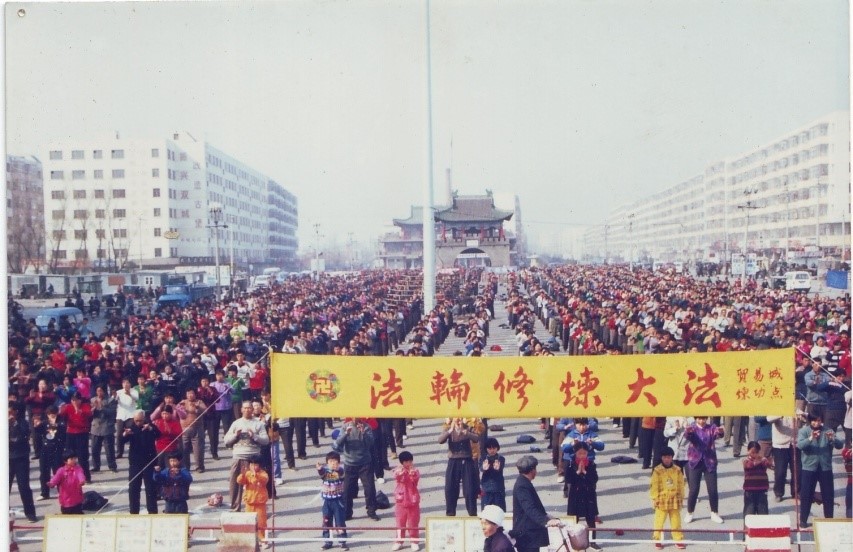
Falun Gong’s growth during the 1990s was, by any measure, extraordinary. Master Li Hongzhi began public teaching in 1992 under the auspices of the state-sponsored China Qigong Scientific Research Society. The practice spread rapidly through word of mouth and free public instruction, driven in part by widespread reports of improved health among practitioners at a time when China’s public healthcare system was under severe strain.
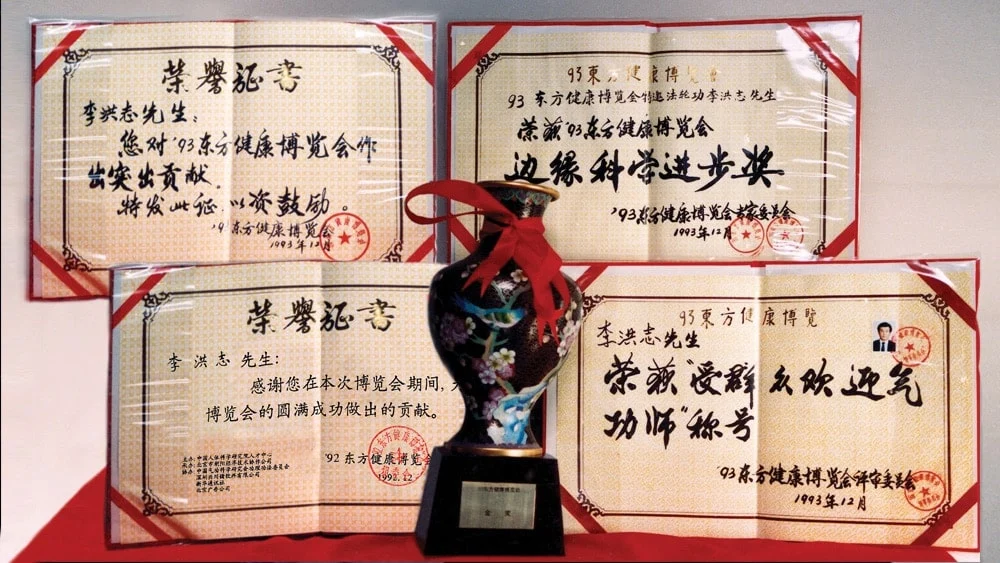
By the mid-1990s, state media was publishing positive coverage and practitioners were receiving “healthy citizen awards” at official government events. In 1993, the China Foundation for Justice and Courage — an affiliate of the Ministry of Public Security — issued Li Hongzhi an honorary certificate. In 1995, the Chinese government invited Li to lecture at the Chinese embassy in Paris.
This relationship deteriorated from 1996 onward, as Falun Gong’s books were banned from state printing presses and sporadic negative articles appeared in state media. The practice had by then grown too large and too independent to be absorbed into the CCP’s system of controlled religious organizations.
By 1999, practitioner estimates placed Falun Gong’s following at 70 to 100 million people in China — surpassing the roughly 63 million members of the Chinese Communist Party itself. This scale, and the speed with which 10,000 practitioners organized a silent, peaceful petition outside the Party’s Zhongnanhai headquarters on April 25, 1999, alarmed Jiang Zemin personally.
Why China Banned Falun Gong — The Real Reasons
The answer lies less in Falun Gong’s actual activities than in the CCP’s fundamental intolerance for any organized group outside Party control — and in one man’s personal decision.
Jiang Zemin’s Personal Decision
The Washington Post reported in November 1999 — citing Communist Party sources — that “the standing committee of the Politburo did not unanimously endorse the crackdown and that President Jiang Zemin alone decided that Falun Gong must be eliminated.” A Party official told the same newspaper: “This obviously is very personal for Jiang.”
Jiang had reportedly been unsettled by Falun Gong’s popularity since at least April 1998, when he asked his security services for a report on the group. When Premier Zhu Rongji took a conciliatory approach to the April 25 petition — meeting with representatives and listening to their concerns — Jiang overruled him.
The Structural Threat
Beyond the personal, Falun Gong presented a structural challenge that the CCP cannot tolerate: a large, self-organizing, spiritually motivated community that operated independently of Party direction. The CCP’s model of governance requires that all significant social institutions — churches, mosques, trade unions, civic organizations — be registered with, monitored by, and ultimately subordinate to Party structures. Falun Gong, with its decentralized volunteer network and its emphasis on universal moral principles rather than Party ideology, fit none of these frameworks.
What China Said — And What the Evidence Shows
The CCP’s public justification — applied retroactively, three months after the ban — was that Falun Gong was an “evil cult” that threatened social stability. Independent scholars, Freedom House, Amnesty International, and the United Nations Special Rapporteurs have consistently rejected this characterization. The government’s own record of praising Falun Gong through the mid-1990s makes the sudden “cult” designation implausible as a genuine assessment.
📖 Deep dive: Why Is Falun Gong Called a Cult — And Why That Label Is Wrong — full analysis of the xiejiao mistranslation and political origins of the “cult” label.
Video: Why is Falun Gong Persecuted in China?
How the Persecution Works: The Machinery
The CCP’s campaign against Falun Gong is not a series of isolated police actions. It is a coordinated, multi-agency system built specifically to eliminate the practice — operating, in significant part, outside China’s own legal framework.
The 610 Office
On June 10, 1999 — six weeks before the public ban — Jiang Zemin established an extralegal security body now known as the 610 Office. Named for its creation date, it reported directly to the Politburo and was granted powers to use “every means necessary” to eradicate Falun Gong. It operated independently of courts, prosecutors, or legal oversight, with branch offices at every level of Chinese government — cities, counties, villages, schools, workplaces.
Christian Solidarity Worldwide, a UK-based human rights organization, documented the 610 Office’s operations in a statement to the UN Human Rights Council: “China established an extra-legal security agency called the ‘610 Office’ for that purpose. Extensive evidence shows the authorities continue to repress and abuse Falun Gong followers across China on a large scale, subjecting them to arbitrary detention, imprisonment, forced labour and discriminatory treatment while in custody on account of their faith.”
The 610 Office was formally restructured in 2018 — its functions absorbed into the Ministry of Public Security and the Central Political and Legal Affairs Commission. The persecution it oversaw has continued without interruption.
The Methods of Persecution
Documented methods include:
- Arbitrary arrest and detention — practitioners can be held without charge in police stations, labor camps, or dedicated “brainwashing centers” disguised as “legal education” facilities
- Forced labor — practitioners have been sentenced to “re-education through labor” terms of up to three years without trial; this system was formally abolished in 2013 but replaced by alternative detention mechanisms
- Torture — documented methods include electric shock batons, sleep deprivation, beatings, forced feeding, and, according to human rights lawyer Gao Zhisheng, systematic sexual abuse
- Psychiatric detention — practitioners have been confined to psychiatric institutions and subjected to forced medication in what Amnesty International has called “political psychiatry”
- Economic coercion — practitioners face job loss, fines, and denial of government services; local officials receive bonuses for meeting quotas of “transformed” (i.e., faith-recanting) practitioners
- Organ harvesting — see section below
Video: Recalling Persecution of Falun Gong in China
The Scale of Persecution: 27 Years of Data
- 5,100+ Confirmed deaths documented by Minghui.org since 1999
- 164 Deaths documented in 2024 alone
- 124 Deaths documented in 2025 (as of Feb 2026)
- 504 Practitioners sentenced Jan–Jul 2025 (USCIRF)
- 7–20M Estimated practitioners still in China (Freedom House)
- 100+ Countries where Falun Gong is practiced freely
These figures are almost certainly undercounts. The Chinese government systematically suppresses information about deaths in custody — family members are often coerced into silence, and bodies are cremated before independent forensic examination can take place. Minghui.org records only cases where individual details have been independently verified.
“According to data from Minghui.org, between January and July 2025, at least 90 Falun Gong practitioners were persecuted to death and 504 were illegally sentenced.”— USCIRF Vice Chair Asif Mahmood, October 2025 hearing on CCP state control of religion
The U.S. State Department, the Congressional-Executive Commission on China, Amnesty International, and Human Rights Watch have all documented that hundreds of thousands — and by some estimates millions — of Falun Gong practitioners have been detained in labor camps, prisons, and other facilities since 1999.
Organ Harvesting: The Gravest Allegation
Among the documented abuses, one stands apart in its severity: the systematic killing of detained Falun Gong practitioners for the removal and sale of their organs.
In 2019, the Independent Tribunal into Forced Organ Harvesting from Prisoners of Conscience in China — chaired by Sir Geoffrey Nice QC, former lead prosecutor of Slobodan Milosevic at The Hague — concluded unanimously and beyond reasonable doubt that forced organ harvesting had occurred in China on a substantial scale, that Falun Gong practitioners were the primary victims, and that these acts constituted crimes against humanity.
In August 2024, Cheng Pei Ming became the first publicly known survivor of forced organ harvesting. A Falun Gong practitioner who had been imprisoned at Harbin Prison, he testified at a Washington D.C. press conference that he had been anesthetized without consent and woke up with a 35-centimeter incision in his chest. CT scans confirmed that portions of his liver and left lung had been removed.
📖 Deep dive: Why Are Falun Gong Practitioners Killed for Their Organs? — full analysis of the China Tribunal verdict, the evidence, Congressional hearings, and the 406–1 U.S. House vote.
Falun Gong China and Beyond: The Persecution Goes Global
Since 2022, the CCP’s campaign against Falun Gong has extended beyond China’s borders in ways that have alarmed intelligence agencies and human rights monitors across the democratic world.
Xi Jinping personally issued new directives at a senior Party meeting in 2022, focusing on the “spiritual decapitation” of Falun Gong’s founder Li Hongzhi through character assassination, “public opinion warfare” targeting Falun Gong-affiliated media in Western countries, and “legal warfare” using U.S. and international legal systems against the community.
Documented incidents of transnational repression — compiled by the Falun Dafa Information Center through early 2026 — include:
- Physical intimidation of practitioners in public spaces across North America and Europe
- Coordinated harassment of elected officials who support Falun Gong
- Direct diplomatic interference at the consular level in European countries
- Over 150 fake bomb threats targeting Shen Yun performances in 38 countries over two years
- CCP-linked agents charged in the United States with conducting surveillance and intimidation operations against Falun Gong practitioners
In February 2026, a 73-year-old Falun Gong practitioner was violently assaulted in Flushing, Queens — an incident verified by an NYPD complaint report. Attacks on practitioners in Western countries have become a documented pattern.
📖 Deep dive: Why Did Falun Gong Create Shen Yun — And Why Does China Want to Shut It Down? — the cultural front of the persecution, 150+ bomb threats, and the “Unbroken” documentary.
International Response
The global institutional response to Falun Gong’s persecution has been substantial — though critics argue it has not been sufficient to change Chinese behavior.
1999–2009
The U.S. Congress passes five bipartisan resolutions in support of Falun Gong, including H.Res.605, which explicitly characterizes the “evil cult” label as “false propaganda.” The U.S. State Department and USCIRF designate China a Country of Particular Concern — a status maintained every year through 2026.
2006–2007
Canadian human rights investigators David Kilgour and David Matas publish the first major report on forced organ harvesting, documenting 41,500 unaccounted organ transplants from 2000 to 2005.
2019
The China Tribunal, chaired by Sir Geoffrey Nice QC, concludes that forced organ harvesting from Falun Gong practitioners constitutes crimes against humanity — “proved beyond reasonable doubt.”
January 2024
The European Parliament passes a resolution on the ongoing persecution of Falun Gong, citing the case of detained practitioner Ding Yuande, calling for his release and for EU member states to consider suspending extradition treaties with China.
May 7, 2025
The U.S. House of Representatives passes the Stop Forced Organ Harvesting Act (H.R. 1503) by a vote of 406–1 — one of the most bipartisan votes of the 119th Congress. The bill imposes sanctions on those engaged in organ trafficking, including CCP members.
October 2025
USCIRF holds a hearing titled “CCP State Control of Religion.” Vice Chair Asif Mahmood testifies that the CCP seeks to “completely eradicate unregistered faith groups” and cites at least 90 Falun Gong deaths and 504 sentences in the first seven months of 2025 alone.
Falun Gong China Today: What’s Still Happening in 2026
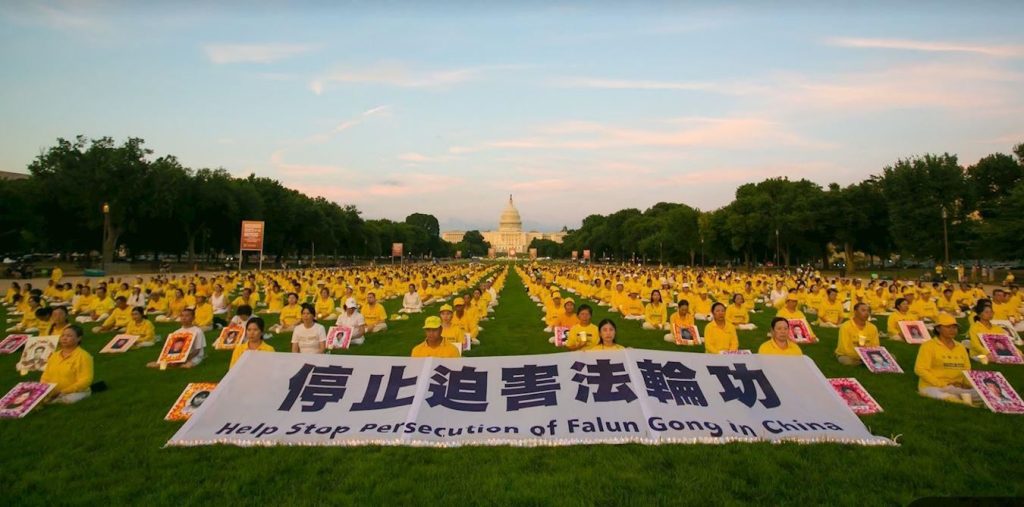
Twenty-seven years after the ban, the picture is paradoxical. Inside China, the persecution continues without pause. Practitioners are arrested, sentenced, tortured, and killed in a campaign that the Chinese government shows no sign of ending. Arrests in 2025 have followed a pattern of coordinated raids against known practitioners, sometimes involving lists of dozens of individuals targeted simultaneously.
Outside China, the picture is entirely different. Falun Gong is practiced freely across the Americas, Europe, Asia-Pacific, and Africa. Shen Yun Performing Arts completed its largest season in history in 2026 — 800+ performances in 21 countries — despite an unprecedented campaign of bomb threats and intimidation that the CCP is believed to have orchestrated.
The Chinese government’s 1999 goal of eliminating Falun Gong has not been achieved. Instead, the persecution has made Falun Gong one of the most internationally recognized religious freedom cases in the world, drawing the attention of the U.S. Congress, the European Parliament, the United Nations, and human rights organizations on every inhabited continent.
“The CCP is ‘the world’s number one persecutor of religion.’ It has ‘slaughtered tens of millions over the course of its history.'”— U.S. Congressman John Moolenaar, USCIRF hearing, October 2025
📌 Why this story matters beyond Falun Gong The persecution of Falun Gong is not only a story about one spiritual movement. It is a template. The same institutional infrastructure — the 610 Office model, the mass detention, the organ harvesting system, the transnational repression — has been applied to Uyghurs in Xinjiang, Tibetan Buddhists, underground Catholics, and house church Christians. Understanding how and why China chose to eradicate Falun Gong is essential to understanding how the CCP approaches any organized group that it cannot control.
📖 Related: Why Is Shen Yun Called a Cult — Separating CCP Propaganda from Legitimate Questions
Frequently Asked Questions
What is Falun Gong and why did China ban it?
Falun Gong is a spiritual practice founded in China in 1992, combining meditation, gentle exercises, and moral teachings centered on truthfulness, compassion, and forbearance. By 1999, it had attracted an estimated 70 to 100 million practitioners — more than the membership of the CCP. CCP leader Jiang Zemin, viewing this independent mass movement as a threat to Party authority, ordered Falun Gong banned on July 20, 1999, and launched a nationwide campaign to eradicate it.
How many Falun Gong practitioners have died because of persecution in China?
Minghui.org had recorded over 5,100 confirmed deaths as of the end of 2024. In 2024 alone, at least 164 practitioners died due to persecution. By February 2026, at least 124 deaths had been documented in 2025. Human rights analysts note the true toll is likely far higher, as China systematically suppresses information about deaths in custody.
What is the 610 Office?
The 610 Office — named for its establishment date of June 10, 1999 — was an extralegal security body created by Jiang Zemin specifically to eliminate Falun Gong. It operated outside China’s formal legal system, reporting directly to the Politburo, with powers to use “every means necessary.” Its functions were restructured into the Ministry of Public Security and Central Political and Legal Affairs Commission in 2018, but the persecution continues.
What has the international community done about Falun Gong persecution?
Responses include five bipartisan U.S. Congressional resolutions; a January 2024 European Parliament resolution; the 406–1 House passage of the Stop Forced Organ Harvesting Act in May 2025; annual USCIRF reports designating China a Country of Particular Concern; and UN Special Rapporteur statements on organ harvesting as crimes against humanity.
Does Falun Gong still exist in China today?
Yes. Freedom House estimates 7 to 20 million practitioners remain in China, practicing covertly at great personal risk. Arrests, imprisonments, and deaths in custody continue to be documented daily in 2025 and 2026. Outside China, Falun Gong is practiced freely in over 100 countries.
What is the connection between Falun Gong and Shen Yun?
Shen Yun Performing Arts was founded in 2006 in New York by Falun Gong practitioners who had fled persecution in China. Its performances include scenes depicting that persecution, making it a direct target of Chinese government suppression — including over 150 bomb threats during its 2025–2026 season.
Sources & Further Reading
- USCIRF — Freedom Forsaken: Falun Gong and Beijing’s Playbook for Repression (October 2025)
- USCIRF — China 2025 USCIRF Annual Report
- Freedom House — Battle for China’s Spirit: Falun Gong — Religious Freedom in China (2017)
- European Parliament — Resolution on the Ongoing Persecution of Falun Gong in China (January 2024)
- UK Home Office — Country Policy and Information Note: China: Falun Gong (November 2025)
- Congress.gov — H.R. 1503: Stop Forced Organ Harvesting Act of 2025
- China Tribunal — Final Judgment (March 2020)
- Amnesty International — Crackdown on Falun Gong and Other So-Called “Heretical Organizations”