
Last Updated on 2 months ago by TodayWhy Editorial
In the biggest match on the global stage, Lionel Messi fought his final international battle with everything he had left. Yet, against a young, energetic, and relentless Spanish side, the defending champions could do little more than survive. Spain crowned themselves world champions after a dominant 1-0 extra-time victory, leaving tactical analysts and fans asking one central question: Why Argentina lost in World Cup 2026 Final?
The scoreline suggests a tight contest, but the reality on the pitch painted a drastically different picture. Argentina was starved of possession, starved of chances, and ultimately neutralized. Here is a deep dive into how La Roja dismantled the champions and why Argentina lost their world title on the biggest night in football.
1. Complete Tactical Paralyzation and High-Pressing
From the opening whistle, Spain established absolute control over the match. Luis de la Fuente’s side pushed their defensive line high, deployed a synchronized multi-layered press, and effectively shut down every passing lane out of Argentina’s backline.
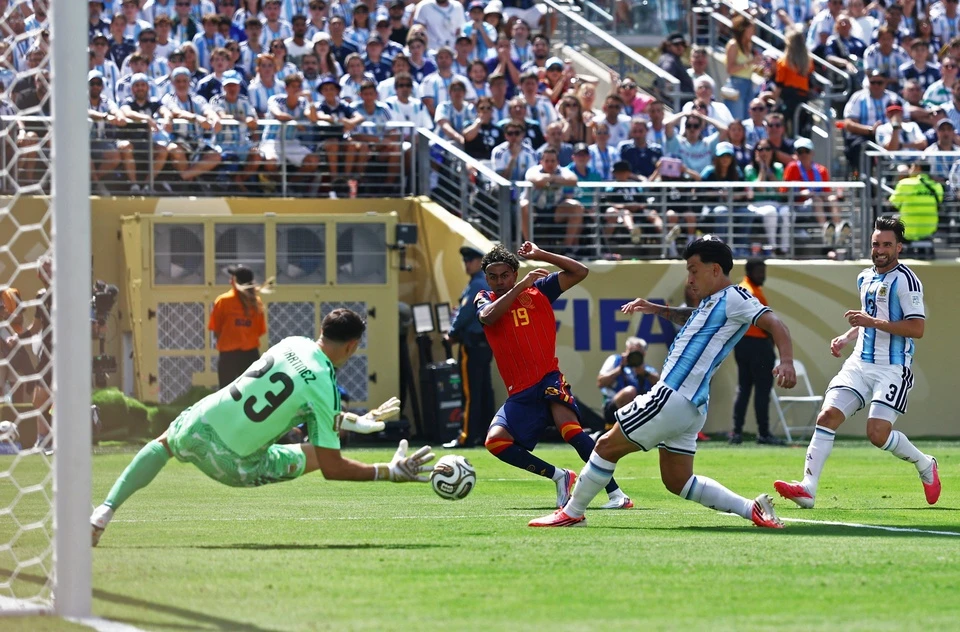
When Cristian Romero or Lisandro Martínez gathered the ball, their options were instantly smothered. Passes into the central midfield were intercepted by Rodri and his partners, while the flanks were tightly sealed. As a result, Lionel Scaloni’s men were forced into a repetitive, desperate cycle:
- Pass back to goalkeeper Emiliano Martínez under heavy pressure.
- Launch long balls forward to Lionel Messi and Julián Álvarez.
- Lose aerial duels against physical defenders Aymeric Laporte and Pau Cubarsí.
- Recede back into a low defensive block and repeat.
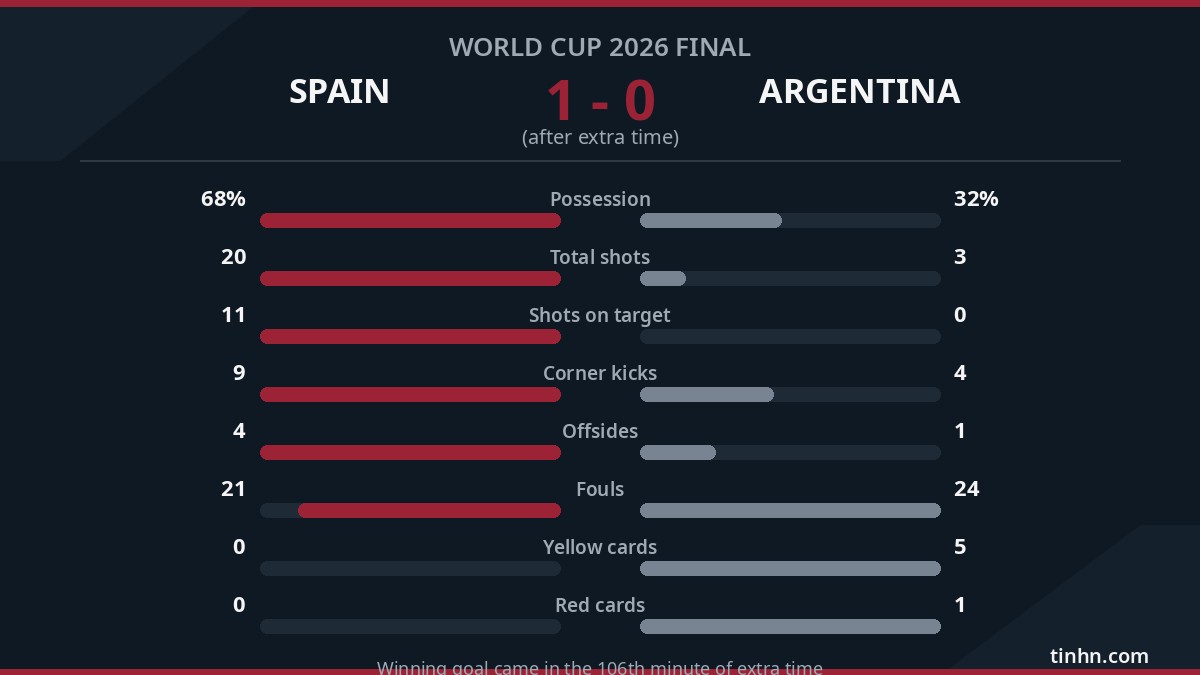
Argentina managed under 35% possession throughout the match. The extent of their tactical gridlock was underlined by a stark statistic: Emiliano Martínez was the Argentinian player with the most touches on the ball. When your goalkeeper is your primary playmaker, control of the game has been completely surrendered.
2. Messi Cut Off: How Spain Isolated the Legend
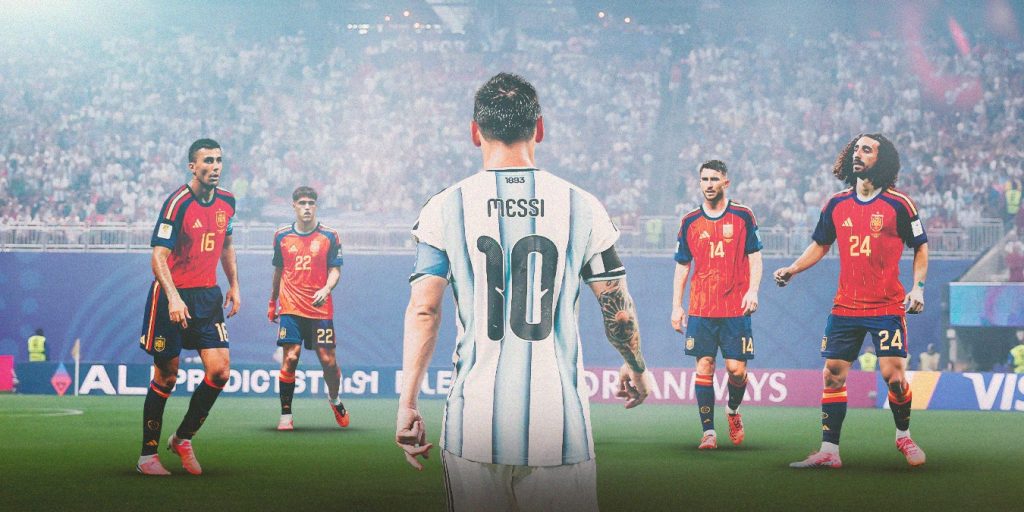
The primary reason Argentina lost its attacking edge was Spain’s masterclass in isolating Lionel Messi. Spain did not need to dedicate a single defender to man-mark the No. 10 for 120 minutes. Instead, they destroyed the supply chain feeding him.
This created an impossible paradox for Argentina:
- When Messi stayed high: The midfield could not bypass Spain’s press to deliver the ball to his feet.
- When Messi dropped deep: He was forced too far from the penalty area, lacking forward runners to combine with.
Whenever Messi did manage to receive the ball, at least two Spanish players instantly constricted his space. Rodri shielded the central area, while Laporte or Cubarsí stepped up proactively if Messi attempted to turn. Unlike the semi-final against England—where Messi broke the game open with early through-balls—Spain’s backline maintained flawless spatial discipline, preventing any rapid transitions.
3. Historical Lows in Shot Creation and xG
The statistics highlight just how completely Argentina lost the battle in the final third.
| Match Metric | Argentina | Spain |
| Possession | < 35% | > 65% |
| Total Shots | 2 | 20 |
| Shots on Target | 0 | – |
| Touches in Opponent Box | 6 | – |
| Expected Goals (xG) | 0.22 | – |
Argentina ended the first half without registering a single shot. According to Opta, they became only one of two teams in recorded World Cup Final history (since 1966) to fail to attempt a shot in the opening 45 minutes. By the hydration break in the first half, Messi had touched the ball just six times.
Argentina’s first attempt on goal didn’t arrive until the 117th minute, when Messi took a desperate shot from outside the box that deflected off a defender and went wide. Their final Expected Goals (xG) stood at a meager 0.22—an impossibly low metric for a team aiming to defend a World Cup title.
4. Red Card Discipline and Exhaustion in Extra Time
Midway through the match, Scaloni attempted to fix the tactical imbalance by bringing on Leandro Paredes for Nico González to gain midfield control. However, Spain’s collective movement was simply sharper. Enzo Fernández and Alexis Mac Allister were denied space to turn, while Rodrigo De Paul spent the majority of his energy chasing shadows in midfield.
When Enzo Fernández received a red card late in the second half, the game plan completely collapsed:
- Scaloni withdrew Julián Álvarez for defender Marcos Senesi, switching to a 5-man defense.
- Argentina accepted deep defensive posture, holding out for a penalty shootout.
- Messi was left completely stranded upfront surrounded by Spanish defenders, without the physical capacity or support to hold up the play.
Spain’s relentless pressure finally broke the dam in the 106th minute of extra time when Ferran Torres exploited space on the flank following a defensive overload, scoring Spain’s 20th shot of the match.
Conclusion: Survival Is Not Enough
A team can suffer a defeat due to missed opportunities, individual blunders, or a sudden moment of magic from the opponent. None of these describe why Argentina lost the 2026 World Cup Final. Argentina lost because they were systematically prevented from constructing a genuine attacking game.
Emiliano Martínez’s heroics, tactical fouls, and sheer grit allowed the South American giants to survive 90 minutes. But at the absolute pinnacle of international football, pure endurance is never enough. Throughout their World Cup journey, Argentina relied heavily on Messi’s moments of brilliance. In the grand final, they waited for magic once more—but failed to provide the minimum tactical conditions for their captain to operate.
Spain did not just defeat Argentina; they rendered the defending champions powerless.
Messi a Football Legend. A spectacular performance in FIFA 2026 with 8 goals,a perfect leader who’s presence in the game makes all the difference. People thought Argentina will be out of tournament playing against Egypt, Messi was the game changer. His country, fellowmen and new generation will remember Lionel Messi for Prowess in Football and many success stories to be narrated.
I always admired his relentless energy, determination and a Can Do Leader.