
Last Updated on 3 weeks ago by TodayWhy Editorial
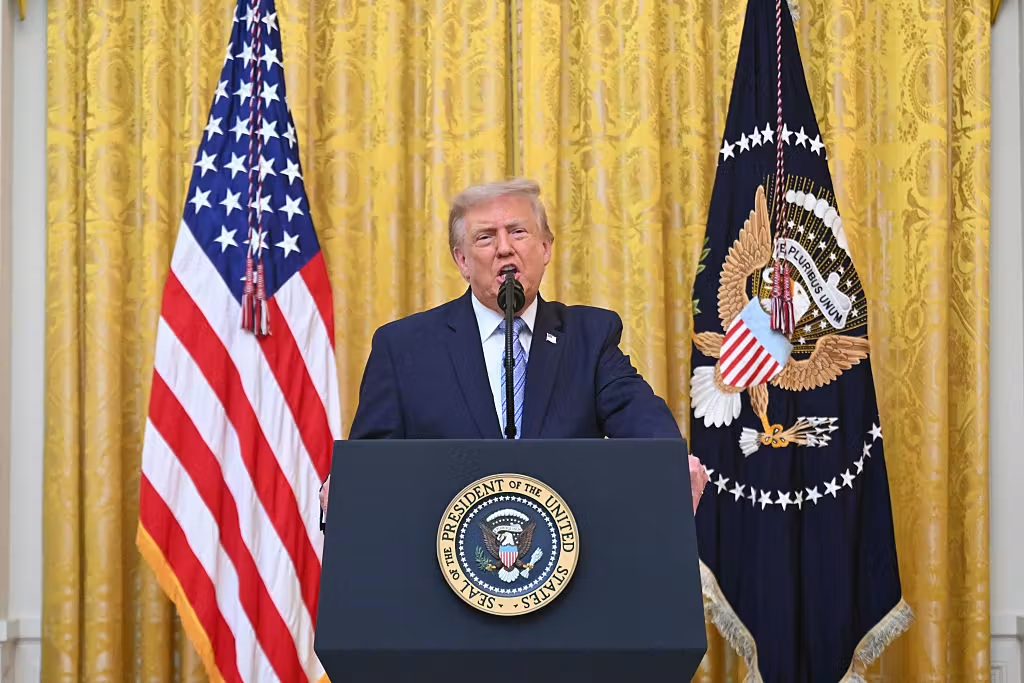
President Donald Trump says China stole 220 million US voter files, calling it the largest election-data breach in American history. He made the China voter files claim in a primetime address from the White House on July 16, 2026.
The president says the theft started in the 2020 election cycle. He also says intelligence officials knew about it for years and kept it hidden from him.
Democrats and a minority faction within Trump’s own past intelligence community dispute large parts of the story. Understanding why requires looking at what Trump actually released, what earlier intelligence assessments concluded, and what happens next in Congress.
What Trump Announced About the China Voter Files
Trump spoke for roughly 25 minutes from the East Room before invited guests, including Vice President JD Vance and Secretary of State Marco Rubio. He said he was declassifying material gathered by a White House transparency task force and the President’s Intelligence Advisory Board, which he said intelligence agency chiefs had personally reviewed and authenticated.
The White House released four sections of documents focused on alleged vulnerabilities in electronic voting and ballot-counting systems, China’s acquisition and exploitation of American voter data, Michigan voter-registration investigation and noncitizens on state voter rolls.
According to Trump, the stolen records include names, addresses, phone numbers, and party affiliation, taken from voter rolls in 18 states. He said China assigned a dedicated data-exploitation unit to the operation, and that the same campaign touched the 2018 midterms as well.
Trump also said newly declassified material shows China tried to manufacture illegal ballots for Joe Biden in 2020, and that dozens of CIA and NSA reports on the alleged targeting were kept out of his daily briefings at the time.
A separate Department of Homeland Security review, also cited in the speech, found 278,000 noncitizens registered on US voter rolls, a count Trump said excluded Democratic-led states. He pointed to a related FBI file describing a 2020 voter-registration fraud investigation in Muskegon, Michigan, where state police said canvassers had signed forms in other people’s names.
Strategies included using Chinese contracts with major U.S. companies to influence American business leaders to turn against him, Trump said. He further claimed the Chinese government sought to identify American journalists who were already covering him negatively and pay them “large sums of money” to write even more negative stories. It is unclear if such payments occurred.
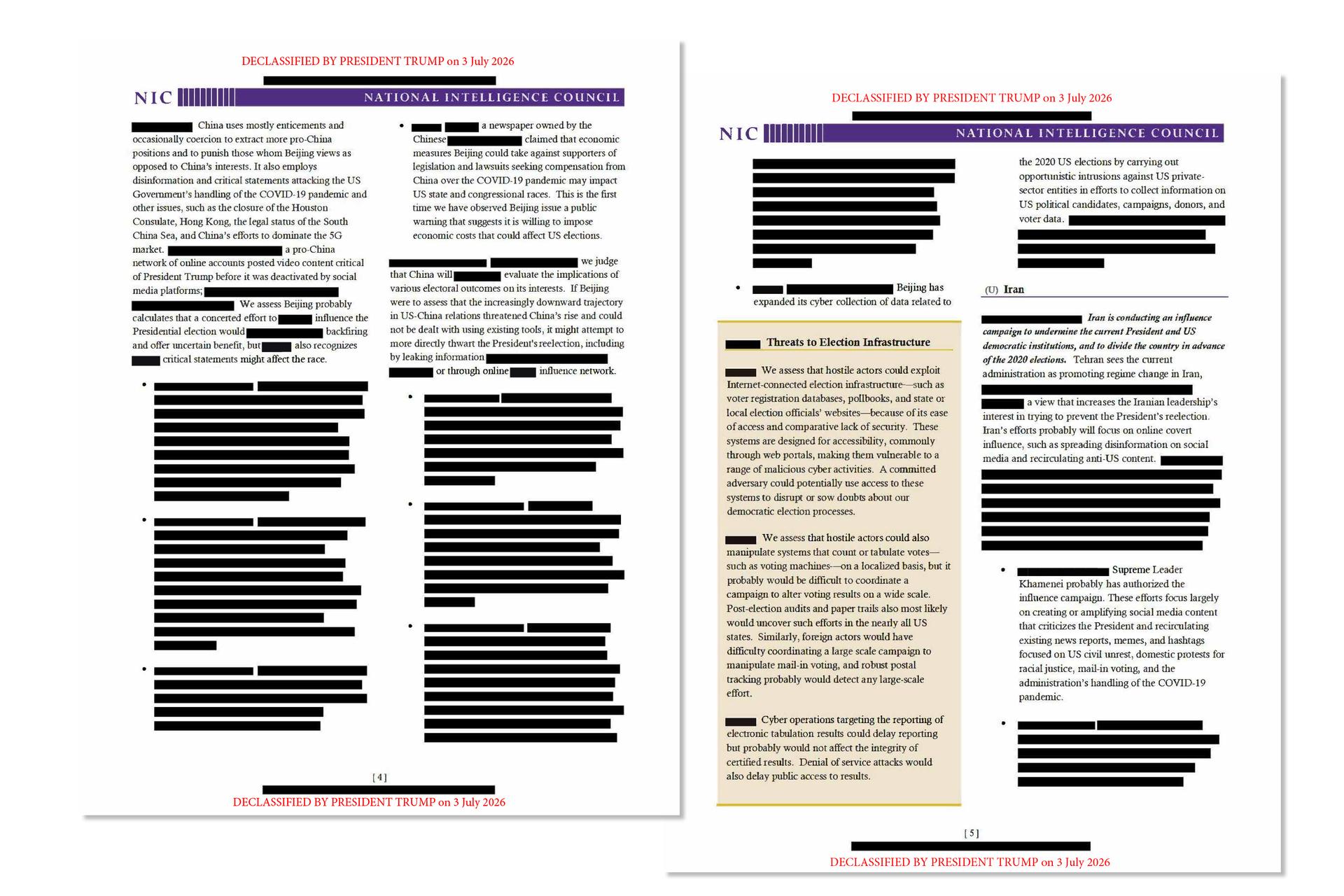
The documents Trump referenced, since posted to a dedicated White House election-integrity webpage, also include an intelligence assessment warning that Russia, China, Iran, and North Korea all have the capability to compromise US election infrastructure.
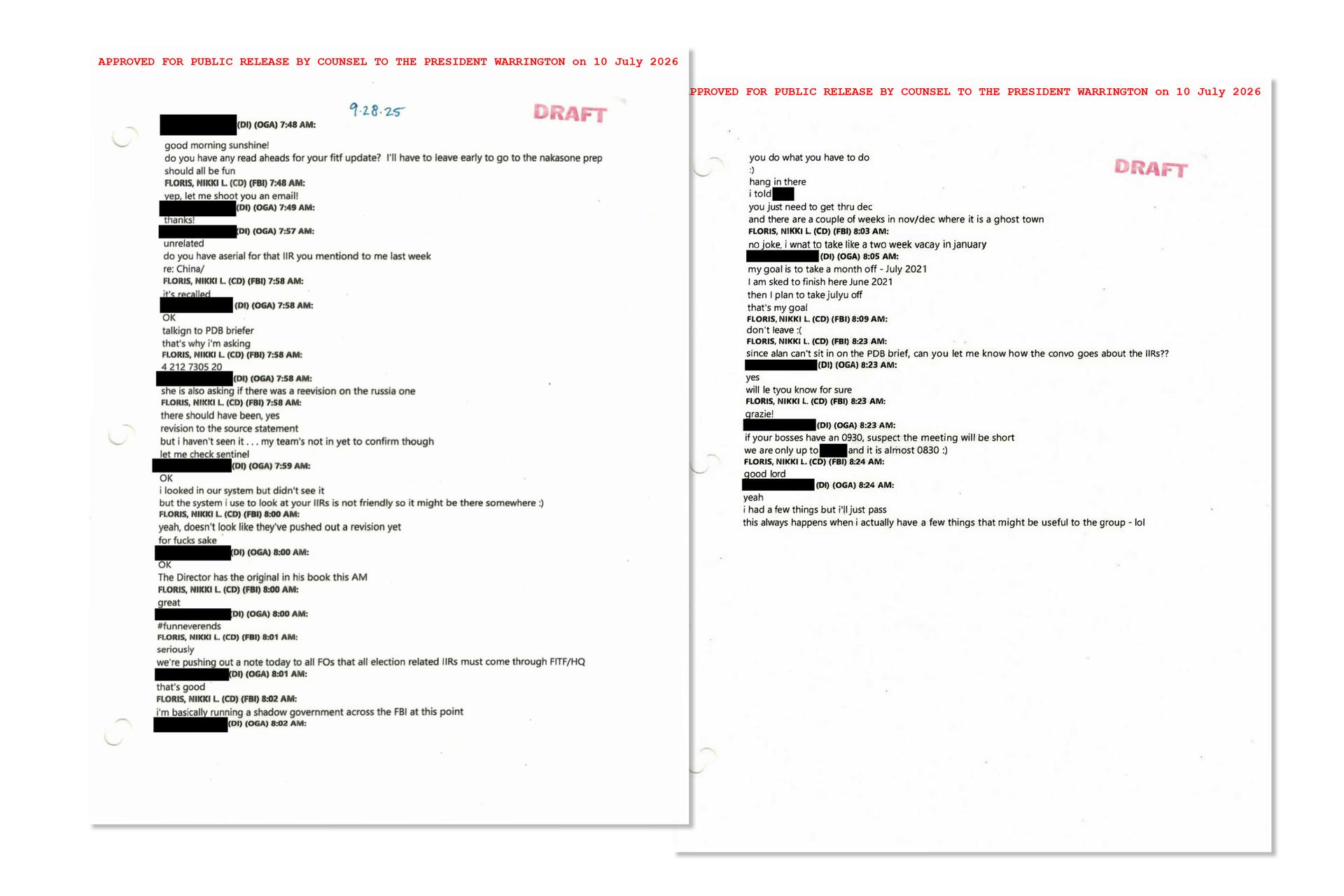
Trump described an email between intelligence analysts in which they allegedly admitted they had “deliberately massaged” the Presidential Daily Briefing email to withhold information about Chinese activities related to the election. He also cited another official inside the FBI who allegedly wrote that she was running a “shadow government” to keep intelligence about China’s election meddling from the public.
“Other officials who witnessed such efforts perceived the motivations to be blatantly political,” the president said. “Recently, we found significant numbers of burn bags, information given by President Barack Hussein Obama to be burned. These bags were supposed to be incinerated, but it never happened. We believe this was not done purposely, but rather through incompetence.”
Calling the findings “stunning,” Trump called on the Office of the Director of National Intelligence, the Justice Department, the FBI, and the CIA to investigate how and why this “crucial information was hidden” and to prosecute those involved in the alleged cover-up.
Trump argued the combined findings expose an election system that cannot be defended. He renewed his call for Congress to pass the SAVE America Act, which would require photo ID, tighten mail-in voting rules, and mandate proof of citizenship to register.
The SAVE America Act has passed the House but remains stalled in the Senate. The bill needs Democratic votes to clear the 60-vote filibuster threshold.
Inside the Internal Fight Over the China Voter Files Warning
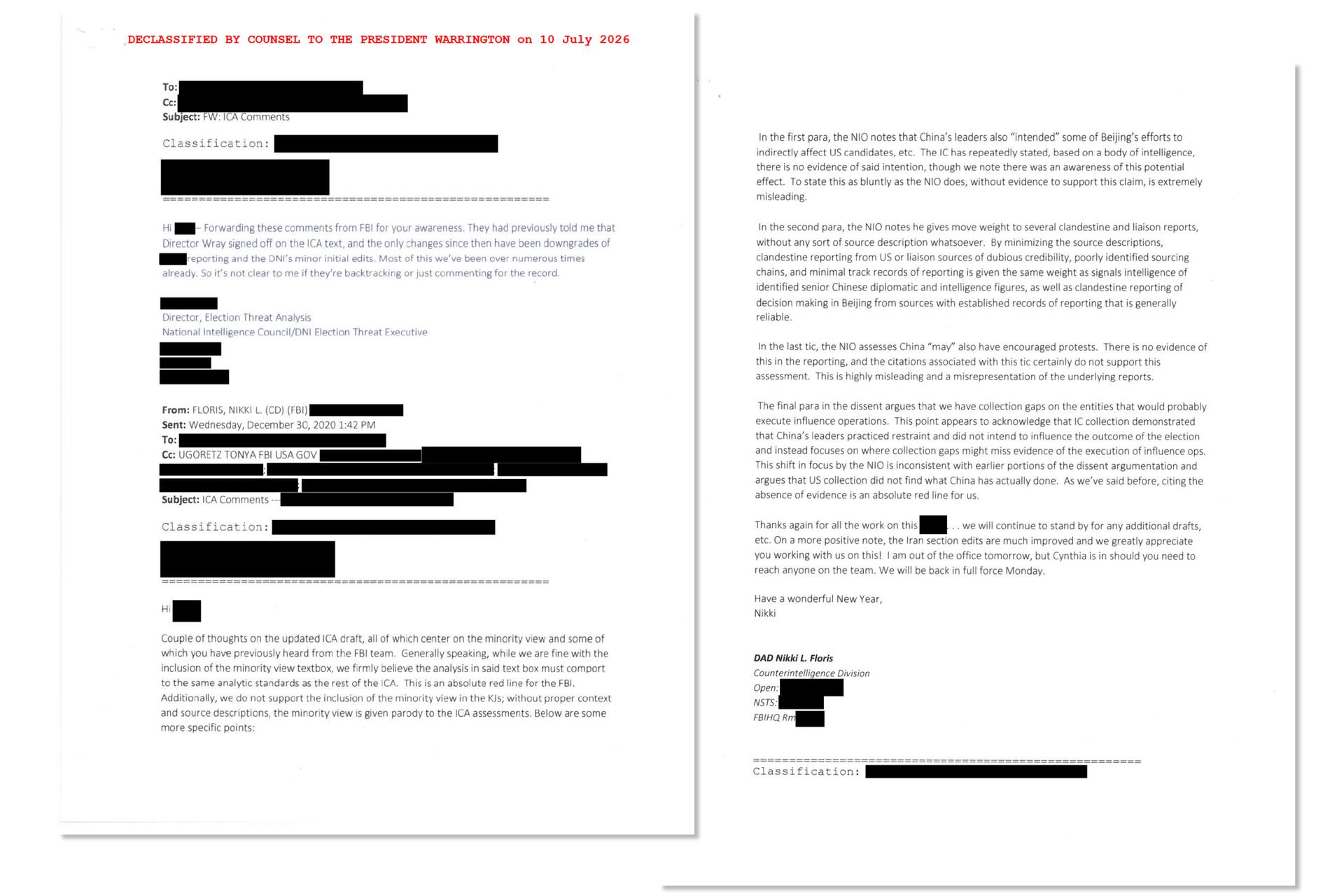
Newly declassified emails, reviewed by The Epoch Times, show years of internal fighting inside the FBI, CIA, NSA, and the Office of the Director of National Intelligence over how to describe China’s role. The dispute centered on one question: should election-related reports name China at all?
At the center of the emails is Nikki Floris, the FBI’s election security lead for the 2020 election, who later became the first person to lead the intelligence division of the FBI’s Washington Field Office. She consistently argued against language linking China to election interference, telling a colleague in 2020 that she felt like she was “running a shadow government across the FBI” just trying to manage the disagreement.
On September 25, 2020, two field offices published intelligence reports flagging Chinese election activity. Analysts who saw the reports as premature moved quickly, and both were recalled within hours. Floris and colleagues treated the recall as a win, and stayed alert in case the underlying source was interviewed again.
The sharpest exchange came in November 2020. An unnamed analyst wrote on November 19 that officials had deliberately altered a briefing meant for the president to avoid any direct link to the election. An ODNI official pushed back four days later, questioning why the analysis was being steered away from elections at all. Other analysts voiced the same frustration in blunter terms, with one asking colleagues whether the community was effectively being told to self-censor its own findings, and another warning that if officials couldn’t state their conclusions plainly, the whole team might as well quit.
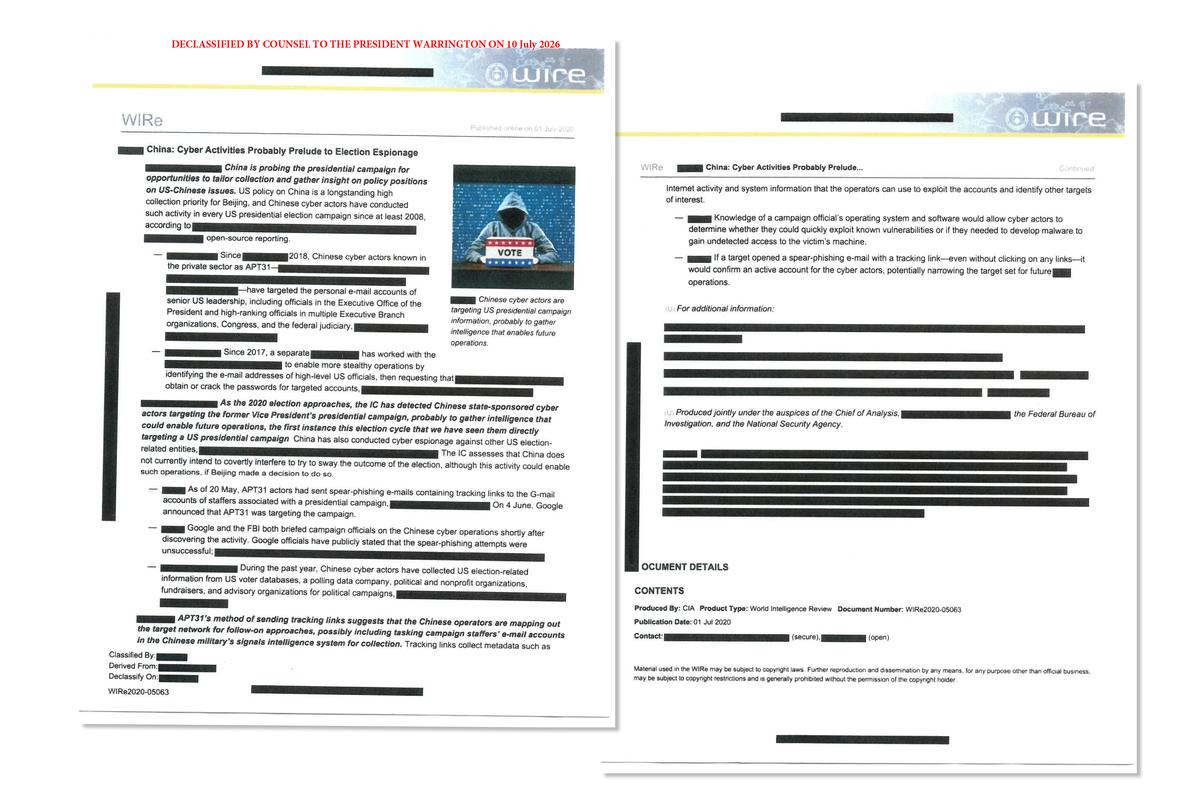
The underlying intelligence itself points to a broader, longer-running effort than a single 2020 breach. A CIA wire memo from July 2020 found Chinese cyber actors had compiled more than 200 million Americans’ personal information, gathered largely from public campaign databases, political organizations, and polling firms, rather than through a single hack of state voter rolls. A separate FBI report, citing an unverified source, alleged China produced and exported tens of thousands of fraudulent U.S. driver’s licenses, allegedly to let sympathetic Chinese students register and vote for Biden; that claim has not been independently confirmed.
The documents also update two of the figures Trump cited in his address. Homeland Security’s review has now identified more than 250,000 potential noncitizens on state voter rolls, and separately flagged over 400,000 deceased individuals still listed as registered voters. Officials in California, Pennsylvania, New Jersey, and Nevada have been told to cooperate with federal reviews or face further scrutiny.
A 2021 Intelligence Assessment
A declassified US intelligence assessment from January and March 2021, issued by the National Intelligence Council shortly after Trump left office, concluded that China ultimately held back from interfering in the 2020 vote.
The 2021 assessment reportedly found Beijing decided neither a Trump nor a Biden win was worth the risk of getting caught meddling. It also stated that China did not tamper with vote counting or the transmission of results.
A January 2021 intelligence community assessment concluded that China “probably continued longstanding efforts to gather information on U.S. voters and public opinion” in order to better predict election outcomes and inform Beijing’s policy toward whichever administration ultimately took office. Another assessment, partially declassified in 2022, similarly found that Chinese intelligence officials analyzed voter registration data from multiple states during the 2020 election cycle.
Besides, a minority view from the intelligence community’s cyber specialist, who believed with moderate confidence that China took some steps to undermine Trump’s 2020 campaign, mainly through social media activity and public statements rather than hacking.
Separately, earlier intelligence reports cited in Trump’s own disclosures describe China analyzing bulk US voter data and monitoring political figures as a routine information-gathering practice dating back to at least 2008, rather than a single 2020-era hack.
How Washington Reacted
The reaction split largely along party lines. Senate Intelligence Committee Vice Chair Mark Warner dismissed the speech as “bogus,” pointing to the intelligence community’s earlier finding that China never changed a single vote.
China’s embassy also issued a formal denial, with a spokesperson stating Beijing has never interfered in a US presidential election. The White House has not yet announced new sanctions against Chinese officials alongside the speech.
Republican reaction was more supportive. House Intelligence Committee Chair Rick Crawford called for the CIA to hold staff accountable for a cover-up, while other Republicans framed the address as a landmark moment in the fight against Chinese influence operations.
Sen. Bernie Moreno (R-Ohio) earlier confirmed Thursday that Trump’s speech would have to do with election security and China in a post to X.
“I was just briefed by the White House on what to expect this evening. I would encourage every American to tune in tonight to the President’s speech,” he said. “This may be the most important Oval Office address since the Cuban Missile Crisis. The time for complacency with China is over.”
Several major networks, including ABC, NBC, and CNN, chose not to carry the speech live on their main channels, instead offering it through streaming platforms or special reports. Outlets gave no official reason, though some Democrats had pushed for a boycott over concerns Trump would repeat claims months before the midterms.
The administration paired the speech with a new public website mapping its election-integrity actions state by state, unveiled the same evening by the Justice Department and Department of Homeland Security.
Election law expert and senior legal fellow at Advancing American Freedom Hans von Spakovsky told Fox News that Trump’s allegations are shocking, especially given that they are from reports produced by the CIA, FBI, and other intelligence agencies.
“The president should be commended for declassifying and releasing the reports that support his claims so they can be reviewed in depth,” said von Spakovsky.
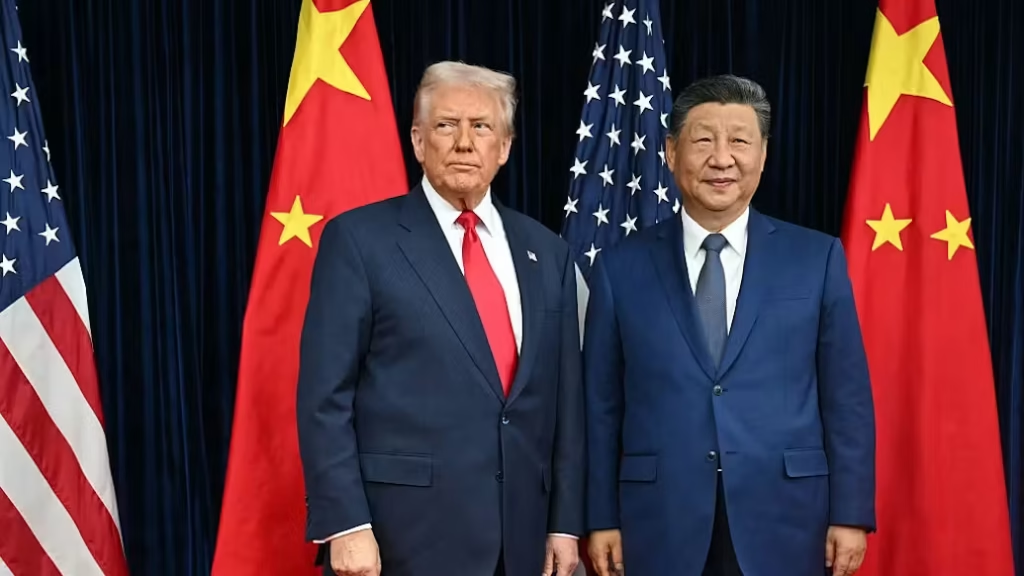
Among longtime China observers, Trump’s accusations immediately prompted questions about whether the administration’s broader China strategy can withstand the allegations. Bill Bishop, publisher of the influential Sinocism newsletter, questioned how the allegations could be reconciled with Trump’s stated interest in maintaining a working relationship with Xi.
“So how can he still be friends with Xi after what he says the PRC [People’s Republic of China] just did in stealing 220m voter files?” Bishop wrote on X. “If any of these allegations are true how can this not be a rupture?”
China hawk Gordon Chang, author of “Plan Red” and “China Is Going To War”, argued that Beijing’s leadership would be deeply unsettled by Trump’s decision to publicly release the intelligence. “China’s leaders are almost certainly in a panic right about now,” Chang wrote. “Bravo, President Trump, for revealing China’s massive interference in our elections and in our society.”
What Happens Next
Trump says he has directed the Justice Department, the FBI, the Office of the Director of National Intelligence, and the CIA to investigate how the alleged China information was withheld from him. He says that could include firings and, where appropriate, criminal referrals.
Homeland Security Secretary Markwayne Mullin is expected to hold a follow-up briefing on the alleged voting-machine vulnerabilities.