
Last Updated on 3 months ago by TodayWhy Editorial
Why is covering your mouth a red card in soccer? It’s the question thousands of fans searched within minutes of Ecuador’s Piero Hincapié being sent off in the dying minutes of a 2-0 loss to Mexico at the 2026 World Cup — the second player dismissed for exactly this at the tournament. It looks like an oddly specific rule, and it is, but it was written for a serious reason, and it’s already reshaping how players talk to each other on the pitch.
Why is covering your mouth a red card? The rule, explained
At the 2026 World Cup, a player who covers his mouth while speaking to an opponent or a referee in a confrontational way can be sent off with a straight red card. The rule was approved by the International Football Association Board (IFAB) at a special meeting ahead of the tournament, at FIFA’s request, specifically to combat discriminatory and abusive language that players had been hiding from lip-readers, broadcasters and officials by shielding their mouths. It isn’t about the gesture itself — plenty of players cover their mouths on the pitch every match without punishment. It’s about what referees judge to be happening underneath the hand.
Is the Red Card Rule Staying After the World Cup?
No — at least not everywhere. UEFA confirmed in July 2026 that it will not carry the straight red card into the Champions League, Europa League, or Conference League next season.
Instead, UEFA said players who cover their mouth to conceal confrontational speech will receive a yellow card, not a red one, calling it an act of unsporting behaviour rather than an automatic sending-off.
UEFA added that a yellow card does not rule out further discipline. Any racially charged or abusive language caught on camera can still trigger a separate misconduct investigation and ban, on top of the card shown on the pitch.
FIFA has not said whether the straight-red version will return for future FIFA-run tournaments such as the 2027 Women’s World Cup or the 2030 men’s World Cup. For now, the rule that sent off Miguel Almirón and Piero Hincapié this summer was a one-tournament experiment — not yet a permanent law of the game.
Why was this rule created in the first place?
The push for the change traces back to a Champions League match earlier in the year, when Benfica winger Gianluca Prestianni covered his mouth while speaking to Real Madrid’s Vinicius Júnior. Prestianni was initially accused of racist abuse, which he denied, but UEFA’s investigation ultimately found him guilty of homophobic conduct and banned him for six matches, three of them suspended. The incident exposed a gap: players could mask exactly the kind of language disciplinary bodies are trying to eliminate simply by covering their mouths on camera. FIFA pushed for a rule change, IFAB approved it, and the amendment has been informally nicknamed the “Prestianni Law” ever since.
Who has been sent off for it at the 2026 World Cup?
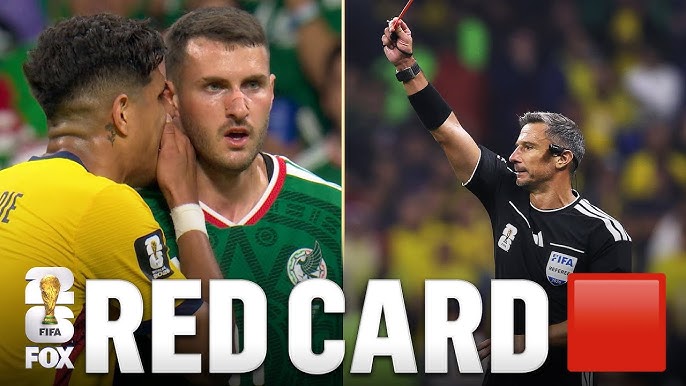
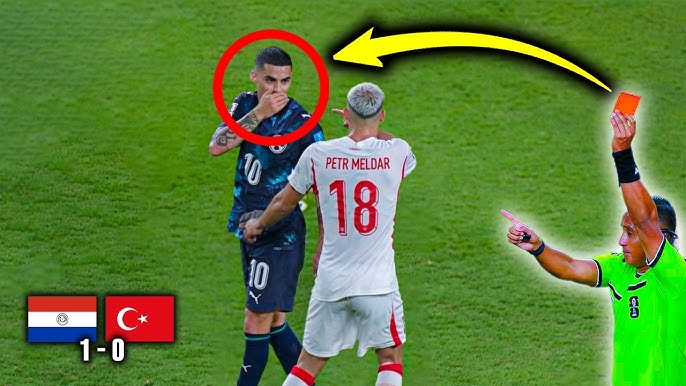
Hincapié wasn’t the first. Paraguay’s Miguel Almirón was shown a straight red card during the group stage for covering his mouth while speaking to a Türkiye opponent. Then, in Ecuador’s Round of 32 exit to Mexico — the same tournament co-hosts who now await England at Estadio Azteca in the Round of 16 — Piero Hincapié covered his mouth to say something to Mexican forward Santiago Giménez in stoppage time. Referee Slavko Vinčić initially missed it, but after Giménez complained, Vinčić reviewed the footage on the pitchside monitor and produced a straight red card. Both players sent off under the rule so far have been South American, which some commentators have noted may simply reflect how common the mouth-covering habit is in that footballing culture rather than any deliberate targeting.
Why doesn’t the rule apply every time someone covers their mouth?
This is the part causing the most confusion. Covering your mouth isn’t automatically a red card — the referee has to judge the conversation as confrontational rather than friendly. Pierluigi Collina, FIFA’s head of referees, has said players remain free to cover their mouths during “friendly conversations,” while only “confrontational interactions” are sanctioned, with officials instructed to review the footage before making a final call. That distinction played out in a separate incident at this World Cup when England’s Jude Bellingham covered his mouth while talking to Ghana’s Jordan Ayew — no card was shown, because the exchange was judged to be friendly rather than hostile.
What does this mean for players going forward?
With the rule now enforced twice at a World Cup inside its first fortnight, players across every remaining team — including those still alive in the expanded 48-team knockout bracket — have an obvious incentive to break the habit of shielding their mouths altogether, since a referee’s read of “confrontational” versus “friendly” is ultimately a judgment call that can go against them. Hincapié’s dismissal came with a genuine cost: beyond Ecuador’s elimination, the straight red also triggers an automatic one-match suspension in the team’s next competitive fixture, a reminder that FIFA and IFAB built real consequences into a rule that, on paper, sounds almost too minor to matter.
Frequently asked questions
Why is covering your mouth a red card in soccer?
Because a new 2026 World Cup rule allows referees to send off players who cover their mouths while speaking confrontationally to an opponent or referee, a change designed to stop players from hiding discriminatory or abusive language from lip-readers and cameras.
Is covering your mouth always a red card?
No. Referees only issue a red card when the conversation is judged confrontational. Covering your mouth during a friendly exchange, as Jude Bellingham did with Ghana’s Jordan Ayew, is not punished.
Why is it called the “Prestianni Law”?
It’s named after Benfica’s Gianluca Prestianni, whose mouth-covering incident with Vinicius Júnior in the Champions League exposed the loophole and led UEFA and later FIFA to push for the rule change.
Who has been sent off for covering their mouth at the 2026 World Cup?
Paraguay’s Miguel Almirón in the group stage and Ecuador’s Piero Hincapié in the Round of 32 against Mexico are the two players dismissed under the rule so far.