
Last Updated on 17 seconds ago by TodayWhy Editorial
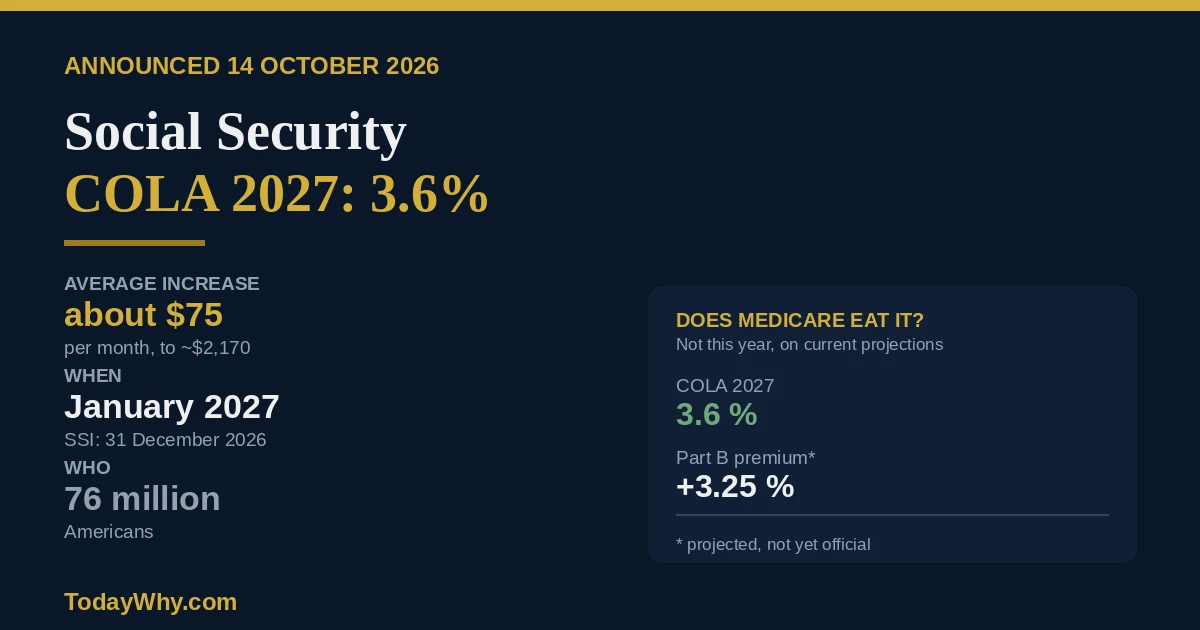
Updated: 16 October 2026. The Social Security Administration announced on Wednesday, 14 October, that benefits will rise 3.6 percent next year. The Social Security COLA 2027 is the largest annual increase in four years and reaches about 76 million Americans.
For the average retired worker, that works out to roughly $75 more per month, lifting the typical payment to around $2,170.
This page explains how the 3.6 percent was calculated, exactly when the money arrives, what happens to your Medicare premium – and why many retirees say the raise still falls short.
Social Security COLA 2027: the numbers at a glance
| Item | Figure |
|---|---|
| Cost-of-living adjustment | 3.6% |
| Announced | Wednesday, 14 October 2026 |
| Social Security payments rise | January 2027 |
| SSI payments rise | 31 December 2026 |
| Average retired-worker increase | about $75 per month |
| Average payment after the increase | about $2,170 per month |
| Social Security beneficiaries | nearly 72 million |
| SSI recipients | about 7.3 million |
| Taxable maximum | rises to $192,300 from $184,500 |
| Previous year’s COLA (2026) | 2.8% |
When the increase actually arrives
The two dates catch people out every year, because they are not the same.
- Supplemental Security Income (SSI): the higher payment begins 31 December 2026. SSI payments are made on the first of the month, and when the first falls on a weekend or holiday the payment moves earlier – which is why the 2027 increase shows up in the final days of 2026.
- Social Security retirement, survivor and disability benefits: the increase begins with January 2027 payments.
If you receive both, you will see the SSI change first.
The SSA also says beneficiaries enrolled in Medicare will be able to see their exact 2027 payment amount in the Message Center of their my Social Security account starting in late November. That is the figure that matters, because it already has the Medicare premium taken out.
How the 3.6 percent was calculated
The Social Security COLA 2027 is not a political decision. No one in Congress voted on 3.6 percent. It comes out of a formula fixed in law.
Why July through September
The adjustment is based on the CPI-W – the Consumer Price Index for Urban Wage Earners and Clerical Workers, published by the Bureau of Labor Statistics.
Specifically, the SSA takes the average CPI-W for July, August and September and compares it with the same three months a year earlier. The percentage difference is the COLA. If there is no increase, there is no adjustment.
That is why the announcement always lands in mid-October: September’s inflation data is the last piece needed, and it is published only days before.
Why September’s 3.7 percent is not the COLA
September’s CPI rose at an annual rate of 3.7 percent, slightly above the 3.6 percent COLA. These are not contradictory figures.
The COLA uses a three-month average, not a single month. July and August came in marginally lower, which pulls the average down. A single strong or weak month therefore moves the final number only a little.
This smoothing works in both directions. It protects the adjustment from a one-month spike, and it also means a late burst of inflation is not captured until the following year.
How the forecast moved during 2026
The official figure landed close to where forecasters expected – but it took a strange route to get there. Tracking that route explains why so many different numbers circulated this year.
The Senior Citizens League publishes a monthly estimate. Here is how it moved:
| 2026 | Estimated COLA | What was happening |
|---|---|---|
| January–March | 2.8% | CPI-W around 3.3% in March |
| April | 3.9% – the peak | CPI-W jumped to 3.8% |
| May–June | 3.8% | CPI-W hit 4.4% in May, then eased |
| July | 3.6% | CPI-W 3.4% |
| August | 3.5% – the low | CPI-W 3.5% |
| 14 October | 3.6% official | – |
So the estimate rose sharply in spring, drifted down over the summer, and the official number came in a tenth of a point above the final estimate. Other forecasters were clustered in the same place before the announcement: Kiplinger’s staff economist projected 3.6 percent, AARP projected 3.6 percent, FEDweek agreed with TSCL at 3.5 percent.
Energy prices drove the swing
The spring jump was not broad-based inflation. It was mostly fuel.
In August, the energy index rose 2.1 percent and gasoline rose 3.9 percent – together accounting for more than a third of that month’s CPI increase. Kiplinger’s David Payne attributed the elevated forecast to high energy prices feeding through into other categories.
That is worth sitting with for a moment. The raise 76 million Americans will receive in January was shaped substantially by what happened at the pump during 2026 – a year in which crude oil traded above $100 a barrel on Middle East supply risk.
It also explains the gap between the index and lived experience. Energy is volatile, so it pushes the COLA up and down sharply. The costs that squeeze older households hardest – medical care above all – move more slowly and steadily, and carry less weight in the index.
What it means for your monthly check
The Social Security COLA 2027 is a straight percentage, so the dollar amount depends on what you receive now.
| Current monthly benefit | Increase at 3.6% | New monthly benefit | Extra per year |
|---|---|---|---|
| $1,000 | $36.00 | $1,036.00 | $432 |
| $1,500 | $54.00 | $1,554.00 | $648 |
| $1,800 | $64.80 | $1,864.80 | $778 |
| $2,095 (near average) | $75.42 | $2,170.42 | $905 |
| $2,500 | $90.00 | $2,590.00 | $1,080 |
| $3,000 | $108.00 | $3,108.00 | $1,296 |
| $4,000 | $144.00 | $4,144.00 | $1,728 |
These are gross figures. For most people enrolled in Medicare, the Part B premium comes out before the money reaches the bank – which brings us to the question everyone asks next.
Will Medicare swallow the raise? Probably not this year
In several recent years, rising Medicare Part B premiums absorbed a large share of the Social Security COLA. That is the standard warning, and it is worth checking rather than assuming.
For 2027 the arithmetic looks different, at least on current projections.
| 2026 | 2027 | Change | |
|---|---|---|---|
| Standard Part B premium | $202.90 | $209.50 (projected) | +$6.60, about +3.25% |
| Social Security COLA | 2.8% | 3.6% | – |
The projected premium increase of roughly 3.25 percent is below the 3.6 percent COLA. On an average benefit, the raise is about $75 while the premium rises about $6.60. Most of the increase should survive.
Two important caveats. First, $209.50 is a projection, made by the Medicare Board of Trustees. The Centers for Medicare & Medicaid Services announces the official premium later in the autumn, and the final figure can differ. Second, the 2026 premium had jumped about 9.7 percent – so 2027 looks better partly because the previous year was unusually harsh.
Looking further ahead, premiums are expected to grow faster than COLAs again after 2027. This year appears to be a pause, not a trend.
The hold-harmless rule
There is a legal backstop many people have never heard of. Under the hold-harmless provision of the Social Security Act, an increase in the Part B premium cannot push your Social Security payment below what you received the year before.
In plain terms: your check can stay flat, but a Medicare premium rise alone cannot make it shrink.
Who is not protected
About 30 percent of Part B enrollees fall outside this protection. The main groups are:
- People who pay Part B premiums directly rather than having them deducted from a Social Security payment.
- People subject to IRMAA, the income-related monthly adjustment amount, which raises premiums for higher earners.
- People new to Medicare in the year concerned.
If you are in one of those groups, the rule does not apply to you and the full premium change lands on your budget.
Why many retirees say 3.6 percent is not enough
The Social Security COLA 2027 drew a consistent response from advocacy groups: welcome, but insufficient. The reasoning is worth understanding, because it is about how the number is built rather than how big it is.
Shannon Benton of the Senior Citizens League called the adjustment “certainly welcome” while noting it will not restore purchasing power already lost. Nancy Altman of Social Security Works argued the COLA is not keeping up with prices. An AARP survey found around three-quarters of older Americans doubt the increase will match what they actually pay.
The sharpest version of the argument is about health care. According to Tyler End of Retirable, health-care inflation runs at roughly 5.8 percent a year, while COLAs have averaged about 2.4 percent. Health care is a far larger share of spending for older households than for the working-age population the index is built on.
The CPI-W versus CPI-E debate
This is the structural complaint, and it explains the rest.
The COLA uses the CPI-W, which tracks the spending patterns of urban wage earners and clerical workers – in other words, people who are still working. Their budgets lean more toward transport, and less toward medical care, than a retiree’s does.
An alternative index exists: the CPI-E, an experimental index for Americans aged 62 and over. It weights health care and housing more heavily. Max Richtman of the National Committee to Preserve Social Security and Medicare is among those arguing the COLA should switch to it.
Switching would not guarantee a bigger raise every year – in some years CPI-E runs lower. But over time, in periods when medical costs rise faster than everything else, it would track retiree expenses more closely. Changing it requires an act of Congress.
What else changes in 2027
The Social Security COLA 2027 is the headline, but three other figures move with it.
The taxable maximum rises to $192,300
This is the ceiling on earnings subject to Social Security payroll tax. For 2027 it rises from $184,500 to $192,300.
Earnings above that line are not taxed for Social Security, and do not count toward future benefits. The change affects higher earners and their employers, not current retirees.
Earnings test limits go up
If you claim benefits before full retirement age and keep working, some benefits are withheld once your earnings pass a threshold. Both thresholds rise for 2027.
| Situation | 2026 limit | 2027 limit | Withholding |
|---|---|---|---|
| Under full retirement age all year | $24,480 | $25,560 | $1 withheld per $2 over |
| In the year you reach full retirement age | $65,160 | $67,920 | $1 withheld per $3 over |
The higher threshold applies only to earnings in the months before you reach full retirement age. From that month on, the earnings test stops entirely – you can earn any amount with no withholding.
Worth knowing: withheld benefits are not lost. Your payment is recalculated at full retirement age to credit the months withheld.
How 3.6 percent compares
The Social Security COLA 2027 is the largest in four years, which sounds strong until you place it in context.
- The 2026 adjustment was 2.8 percent, and it lagged actual CPI for seven months of the year.
- The long-run average of recent COLAs is roughly 2.4 percent.
- Health-care inflation has been running near 5.8 percent.
So 3.6 percent is comfortably above the recent average and above the projected Medicare premium increase – a genuinely better year than most. It remains well below the rate at which the single largest cost in many retirees’ budgets is growing.
Both statements are true at once, and that is why reactions to the same number differ so sharply.
What to do now
- Wait for the late-November notice. Your exact 2027 payment, after the Medicare deduction, appears in the my Social Security Message Center. That number is the one to budget with.
- Check whether IRMAA applies to you. It is based on your tax return from two years earlier, so a one-off income event in 2025 can raise your 2027 premium.
- If you are still working and claiming early, check the new earnings limits above before planning 2027 hours.
- Do not assume the full 3.6 percent. Until the official Part B premium is published, any net figure is an estimate.
Frequently asked questions
How much is the Social Security COLA 2027?
3.6 percent, announced by the Social Security Administration on 14 October 2026. It is the largest annual increase in four years and affects about 76 million Americans.
When will I see the higher payment?
Social Security benefits increase with January 2027 payments. SSI payments increase on 31 December 2026.
How much more money is that?
For the average retired worker, about $75 a month, bringing the typical payment to roughly $2,170. At $1,500 a month the increase is $54; at $3,000 it is $108.
How is the Social Security COLA 2027 calculated?
The SSA compares the average CPI-W for July, August and September against the same three months a year earlier. The percentage difference becomes the COLA. It is set by formula, not by a vote.
Will Medicare take the increase?
Probably not most of it in 2027. The Part B premium is projected to rise about 3.25 percent to $209.50, below the 3.6 percent COLA. That projection is not final – CMS announces the official premium later in the autumn.
Can my Social Security payment go down because of Medicare?
For most people, no. The hold-harmless rule prevents a Part B premium increase from reducing your payment below the previous year’s amount. About 30 percent of enrollees are not covered, including those paying IRMAA and those who do not have premiums deducted from a Social Security payment.
What is the 2027 taxable maximum?
$192,300, up from $184,500. Earnings above that are not subject to Social Security payroll tax.
What is CPI-E and why do people want it?
CPI-E is an experimental index tracking spending by Americans aged 62 and over. It weights health care and housing more heavily than CPI-W, which is based on working-age urban wage earners. Advocates argue it better reflects retiree costs. Changing the formula would require Congress.
The bottom line
The Social Security COLA 2027 of 3.6 percent is a better outcome than recent years: above the roughly 2.4 percent average, above the 2.8 percent granted for 2026, and – on current projections – above the Medicare Part B increase that usually erodes it.
That last point is the one most worth noting, because it reverses the usual pattern. For most retirees the majority of this raise should actually reach the bank account.
The structural complaint still stands. An index built on working-age spending will keep understating what retirees pay for health care, and that gap compounds year after year. A good COLA year does not fix a formula question – it just postpones it.
For a sense of how differently another country handles the same problem, Germany adjusts pensions by a formula tied to wage growth rather than prices, with a statutory floor on the benefit level. Our German-language coverage explains that system in detail. Closer to home, another change arrives on a fixed annual schedule: why daylight saving time was started in the first place.