
Last Updated on 15 seconds ago by TodayWhy Editorial
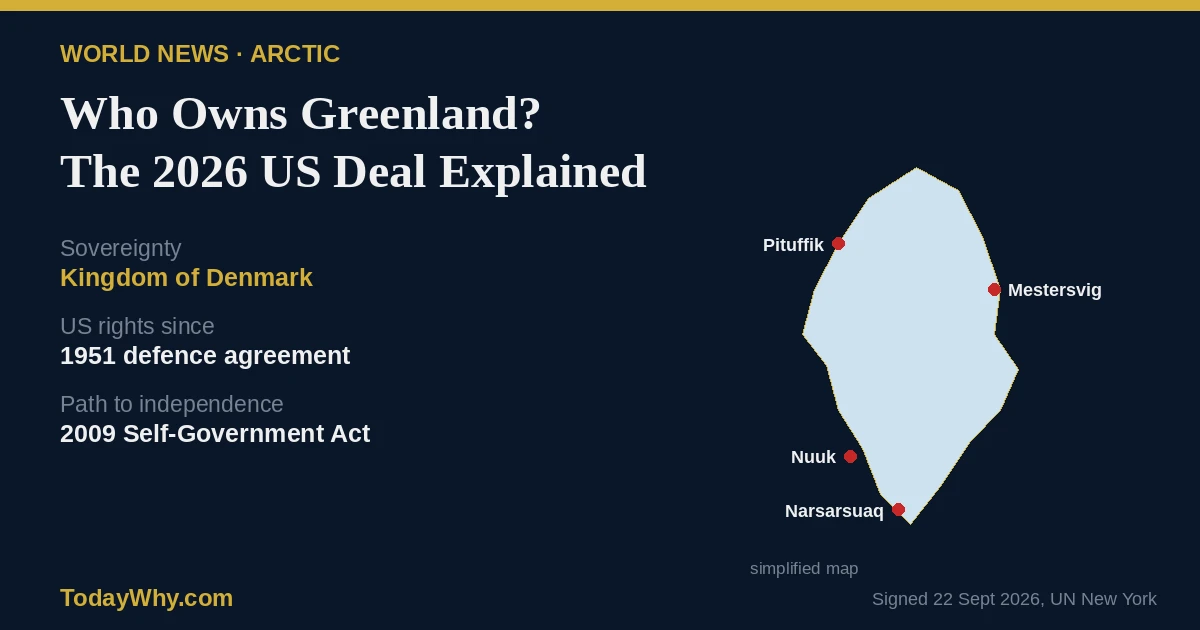
On Tuesday 22 September 2026, at United Nations headquarters in New York, three leaders signed a document that closed nearly two years of transatlantic tension. President Donald Trump, Danish Prime Minister Mette Frederiksen and Greenland’s Prime Minister Jens-Frederik Nielsen put their names to a trilateral security agreement covering the world’s largest island.
Four days earlier, Trump had announced the deal on Truth Social in blunt terms. The agreement, he wrote, “gives the United States permanent control over security, and all other needs, in Greenland.” Frederiksen described the same document rather differently, stressing that it recognises Danish sovereignty and the Greenlandic people’s right to self-determination.
Both descriptions come from the same signing ceremony. That gap is the fastest way into the question millions of people started typing into search engines that week: who owns Greenland, and what did the United States actually get? This guide answers that, along with the basic facts people look up the moment such a story breaks.
Who owns Greenland? The short answer
The answer is short: the Kingdom of Denmark. The island is not a sovereign state, not a US territory, and it was not bought, sold or transferred by the September 2026 agreement.
It is best described as a self-governing territory inside a kingdom. It has its own parliament, the Inatsisartut, its own government, the Naalakkersuisut, and its own prime minister. Denmark keeps responsibility for foreign policy, defence and security, monetary policy and citizenship.
That division is the single most useful fact for understanding the news. It explains why an agreement about the island’s security was negotiated primarily between Washington and Copenhagen, with Nuuk at the table rather than in sole charge.
Who owns Greenland today: from colony to self-government
The relationship has changed repeatedly over three centuries:
- Early 1700s: Danish colonisation begins.
- 1953: Greenland stops being a colony and becomes a formal part of the Kingdom of Denmark.
- 1979: Home Rule takes effect, giving Greenland its own parliament and government.
- 2009: The Self-Government Act greatly expands that autonomy and writes down a legal path to independence.
The 2009 Act is the document that matters most today. It recognises Greenlanders as “a people pursuant to international law with the right of self-determination” — unusually strong language for an autonomy arrangement, and the legal foundation everything else rests on.
Under the Act, the self-rule authorities have taken over or may take over fields including the administration of justice and the courts, the police, the prison service, company law and auditing, mineral resource activities, aviation, family and inheritance law, immigration and border control, the working environment, and financial supervision.
Why money complicates the question of who owns Greenland
Autonomy is not the same as independence, and the reason is fiscal. The Self-Government Act fixes an annual Danish block grant at roughly 3.44 billion Danish kroner in 2009 prices and wage levels.
The Act also contains a mechanism that shapes every debate about the island’s future. Revenue from mineral extraction accrues locally — but once annual mineral revenue exceeds 75 million kroner, the Danish subsidy is reduced according to a set formula.
In plain terms: the route to paying its own way runs through its own subsoil. That is why mining, and foreign interest in mining, is never a purely commercial story there.
Is Greenland a country?
This is one of the most-searched questions about the island, and the honest answer is: partly.
It is a country in the everyday sense. There is a flag, a national day on 21 June, an official language alongside Danish, a name the island uses for itself — Kalaallit Nunaat, “land of the Greenlanders” — and a government elected by its own people.
It is not a country in the legal sense of a sovereign state. It has no seat at the United Nations, and its foreign and defence policy sits with Denmark. Both things are true at once, which is why the question generates so much search traffic.
What continent is Greenland in?
Geologically, the island sits on the North American tectonic plate and is generally classified as part of North America. Politically and historically, it is tied to Europe through Denmark.
There is a third layer that surprises many readers: the territory is not in the European Union, even though Denmark is. Greenlanders voted to leave what was then the European Communities in a 1982 referendum, and withdrawal took effect in 1985, largely over fishing rights. It is now associated with the EU as an Overseas Country and Territory rather than as a member.
The scale is hard to picture. The island covers roughly 2.16 million square kilometres, making it the world’s largest island — about fifty times the size of Denmark itself — and roughly four-fifths of it lies under an ice sheet. Its population is around 56,000, smaller than many European towns. The capital, Nuuk, has fewer than 20,000 residents.
One caveat about that size figure. On the Mercator maps most people grew up with, Greenland appears roughly as large as Africa, which is in reality about fourteen times bigger. That distortion is exactly what the UN General Assembly voted to address in September 2026, as we explain in Why the UN Adopted the Correct the Map Resolution.
Why the United States wants Greenland
American interest is not new, and it is not mainly about owning land. Four factors drive it.
Missile geography. The shortest flight path between North America and Eurasia runs over the Arctic. That makes the island valuable ground for early-warning radar and missile defence, including, according to reporting on the negotiations, the proposed “Golden Dome” missile-defence project.
Great-power competition. Trump has argued the US must secure Greenland to keep Russia and China from gaining influence in the Arctic. Beijing has dismissed that argument as a pretext for territorial ambition.
Minerals. The subsoil is believed to hold significant deposits, including rare earth elements used in electronics and defence manufacturing. Retreating ice has made some of them more accessible.
Shipping. As Arctic sea ice thins, northern shipping routes become more viable, raising the strategic value of territory alongside them.
Why 1951, not 2026, decided who owns Greenland’s security
The United States has had a military presence there since the Second World War, and Denmark’s entry into NATO as a founding member in 1949 brought the island into the alliance. The island is not, as some coverage implies, outside Western defence structures.
Two years later came the 1951 Agreement Concerning the Defense of Greenland between the United States and Denmark, amended in 2004. According to the Congressional Research Service, that agreement has facilitated the American military presence and provides avenues to expand it.
The 1951 text is remarkable for how it handles the sovereignty question. It grants the US extensive rights inside agreed defence areas — to build and operate facilities, station personnel, control the movement of ships and aircraft — while stating explicitly that this operates “without prejudice to the sovereignty of the Kingdom of Denmark.”
Rights without sovereignty. That 1951 formula is precisely the template the 2026 agreement extends, and it explains how Trump and Frederiksen can each describe the new deal accurately in such different language.
The American footprint has shrunk dramatically since the Cold War. At its peak the US reportedly had more than 10,000 troops and 17 installations there. Today it operates one: Pituffik Space Base, run by the US Space Force, supporting missile warning and space surveillance.
What the 2026 agreement actually does
The new deal expands an existing framework rather than replacing it. Frederiksen made that explicit at the ceremony: “Seventy-five years ago, we entered into an agreement about the defense of Greenland; today, we are signing a bigger and even better agreement. A deal that can last forever.”
What is publicly known so far:
- A larger US military footprint. Trump said Washington would “immediately begin the process of developing a large Military presence in the appropriate part of Greenland.”
- No transfer of sovereignty. Frederiksen said the agreement recognises “the sovereignty and territorial integrity of the Kingdom and the Greenlandic people’s right to self-determination.”
- Two additional defence areas. Analyses of the text circulated after the signing report that the United States may establish sites at Narsarsuaq, an American airfield from the Second World War in the south, abandoned in the 1950s, and at Mestersvig in the northeast, an outpost used by Denmark’s Sirius sled patrol. Technical details must be agreed by all three parties.
- Missile defence and resources. The text refers to the establishment of a “Golden Dome” missile shield and, unlike the 1951 agreement, addresses natural resources — the clause behind much of the argument over what the deal is really for.
- No end date. The agreement runs indefinitely and can only be amended by mutual consent, under Article XIII of the 1951 agreement.
- A clause for independence. Should Greenland become independent, Denmark and Greenland commit to ensuring the new state stays in NATO and takes on the same obligations under this agreement. In other words, American access is designed to survive a change of sovereignty.
- It is not yet in force. According to Frederiksen’s office, the Danish and Greenlandic parliaments must still act before it can be enforced.
That final point is widely overlooked. A signature at the United Nations is not ratification. Reporting by NPR noted the same condition when the deal was first announced.
What Greenlanders say about who owns Greenland
Greenlandic leaders have been consistent, and their position is more nuanced than either “pro-American” or “pro-Danish” suggests.
Prime Minister Jens-Frederik Nielsen told CNN: “We want Greenland as a sovereign nation. We want our own citizenship, we want to be Greenlanders and not Danes nor Americans, but we are absolutely willing to work with either both or the other one in regards to security and defense.”
Asked earlier in the crisis to choose between the two, he was blunter: “If we have to choose between the United States and Denmark here and now, we choose Denmark. Greenland does not want to be governed by the United States.”
Public opinion has pointed the same way. A January 2025 poll found the overwhelming majority of Greenlanders, around 85 percent, opposed becoming part of the United States.
Colonial history matters here. A population that stopped being formally colonised only in 1953 tends to be sceptical when a larger power calls the island something it needs.
Why the Greenland deal may still not survive contact with parliaments
Three things remain unresolved.
First, ratification. Both the Danish Folketing and the Inatsisartut must act before the agreement takes effect, and Greenlandic legislators answer to an electorate that has shown little enthusiasm for American control.
Second, the text. Until the full agreement is published, “permanent control over security” cannot be measured against the Danish description of recognised sovereignty. Those two formulations are not obviously identical.
Third, interpretation over time. The 1951 agreement has been reinterpreted and amended across seven decades. A deal one signatory calls lasting “forever” will be tested by future governments in all three capitals.
How Greenland could actually become independent
Independence is frequently discussed and rarely explained, so it is worth setting out what the law says. Chapter 8 of the 2009 Self-Government Act lays out a sequence:
- The decision on independence is made by the Greenlandic people.
- Negotiations then begin between the Danish government and the Naalakkersuisut.
- Any agreement requires the consent of the Inatsisartut.
- It must then be approved by a referendum in Greenland.
- It also requires the consent of the Danish Parliament.
- Independence means Greenland assumes sovereignty over Greenland.
Note what the sequence does not include: any role for a third country. Under Danish law the path runs through Nuuk and Copenhagen only.
The obstacle is economic rather than legal. The annual block grant funds a substantial share of the public budget, which is why mineral revenue — and the formula that shrinks the subsidy as mining income grows — sits at the centre of every serious independence debate.
Frequently asked questions
Who owns Greenland?
Greenland is part of the Kingdom of Denmark. It is self-governing, with its own parliament and prime minister, while Denmark retains foreign policy, defence, monetary policy and citizenship. The September 2026 security agreement did not transfer ownership to the United States.
Did Trump get Greenland?
No. The agreement signed on 22 September 2026 expands the US military presence and security role. Trump described it as giving the United States “permanent control over security”, while Denmark says it recognises Danish sovereignty and Greenlandic self-determination. The island remains part of Denmark.
Is Greenland a country?
It is a country in the cultural and administrative sense, with its own flag, language, parliament and government, but not a sovereign state. It has no UN seat, and foreign and defence policy rest with Denmark.
What continent is Greenland part of?
Geologically it belongs to North America, sitting on the North American plate. Politically and historically it is linked to Europe through Denmark.
Is Greenland in the European Union?
No. Greenlanders voted to leave the European Communities in a 1982 referendum, effective 1985, mainly over fishing rights. Greenland is now associated with the EU as an Overseas Country and Territory, even though Denmark is a member state.
What is the capital city?
Nuuk, on the south-western coast, with fewer than 20,000 residents.
How big is Greenland and how many people live there?
Roughly 2.16 million square kilometres, the world’s largest island and about fifty times the size of Denmark. Around 56,000 people live there, with some four-fifths of the territory under ice.
What is the island called in its own language?
Kalaallit Nunaat, meaning “land of the Greenlanders”, in Greenlandic — the official language alongside Danish.
Does the United States already have a base on the island?
Yes. Pituffik Space Base, operated by the US Space Force, supports missile warning and space surveillance. At the height of the Cold War the US reportedly had over 10,000 troops and 17 installations on the island.
Is Greenland in NATO?
It is not a NATO member in its own right but is covered by the alliance through Denmark, a founding member since 1949.
When does the new agreement take effect?
Not yet. The Danish and Greenlandic parliaments must still act before it can be enforced, and the full text has not been published.
Can Greenland become independent?
Yes, through Chapter 8 of the 2009 Self-Government Act: a decision by the Greenlandic people, negotiations with Denmark, consent of the Inatsisartut, a referendum, and consent of the Danish Parliament. The main obstacle is economic, since the Danish block grant funds a large part of the budget.
Why does the United States want Greenland?
The Arctic position matters for missile warning and defence, the island lies near shipping routes opening as sea ice retreats, the subsoil is believed to hold significant mineral deposits including rare earths, and Washington wants to limit Russian and Chinese influence in the region.