
Last Updated on 2 months ago by TodayWhy Editorial
Spain beat Argentina 1-0 in extra time to win the 2026 World Cup Final. But the scoreline hides the real story: a disallowed Spanish goal, a red card that left Argentina down to 10 men, and a final that may have ended Lionel Messi’s World Cup career.
Here’s why each of those moments happened, and how they shaped the result.
The final score, in short
Ferran Torres scored the only goal of the match in the 106th minute, 39 seconds into the second period of extra time. Spain dominated the game from start to finish, finishing with 20 shots to Argentina’s two. Emiliano Martínez kept Argentina in it with a World Cup final record 11 saves.
It’s Spain’s second World Cup title, 16 years after their first in 2010. Argentina, the defending champions, were trying to become the first team to win back-to-back titles since Brazil in 1962.
Why was Spain’s goal disallowed?
Six minutes into extra time, Spain thought they’d broken the deadlock. Lamine Yamal found Mikel Merino in the box, Merino held off Argentina defender Nicolás Otamendi and shot, Martínez saved it, and the loose ball fell to Nico Williams, who poked it in.
The goal didn’t count. Referee Slavko Vincic ruled that Merino had fouled Otamendi in the buildup, stepping on his foot before the shot. Replays showed only minimal contact, and pundits on both sides called it a harsh decision. Because Vincic blew his whistle for the foul before the ball crossed the line, the call couldn’t be reviewed by VAR — the review system only kicks in once a goal has actually been scored.
Williams got his moment anyway. Minutes into the second period of extra time, he headed a Pedro Porro cross into the path of substitute Ferran Torres, who finished from close range for the winner.
Why did Argentina play with 10 men?
Argentina’s Enzo Fernández was sent off in the 90th minute of normal time, right before the match went to extra time. He picked up a second yellow card for a reckless challenge that sent Spain’s Pau Cubarsí flying. Vincic had no real choice but to show a second caution, and with it, a red.
Argentina played the rest of the match, roughly the final 30 minutes, a man down. The team never mounted a serious response: Argentina didn’t register a shot at all until deep into extra time, and finished the game with just two attempts, neither on target.
Why didn’t Ferran Torres’ late goal count either?
After his winner, Torres nearly doubled Spain’s lead when the team broke on a counterattack and he raced through alone on goal. That effort was ruled out for offside — a much more routine call than the one against Williams, and one that didn’t change the outcome. Spain’s 1-0 lead held to the final whistle.
Is this Messi’s last World Cup?
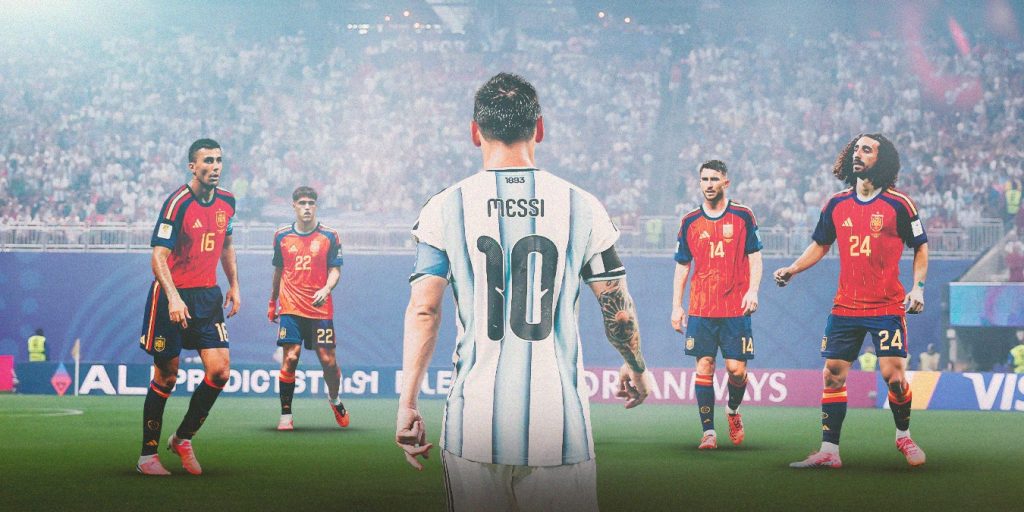
Lionel Messi is 39, and Sunday’s final is widely assumed to be his last World Cup appearance. He managed just 15 touches in the match, well below Spain teenager Lamine Yamal’s 26, and his best chance, a fifth-minute breakaway, was stopped by Spain goalkeeper Unai Simón. Argentina touched the ball only eight times inside Spain’s penalty area across the entire match.
Spain coach Luis de la Fuente, 65, became the oldest coach to win a World Cup title. Torres, whose goal was his only one of the tournament, described the moment simply: he saw the ball coming and hit it.
What happens next
Spain’s title caps a run in which they conceded just one goal across the whole tournament, the fewest ever by a champion despite playing eight matches, more than any previous winner. Argentina now heads into a rebuild without knowing whether Messi will return for another major tournament. The two teams’ paths next cross competitively at the 2030 World Cup, unless a rematch is arranged before then, following a similar pattern to the two nations’ build-up to Sunday’s historic final.
Frequently asked questions
Why was Nico Williams’ goal disallowed?
The referee ruled that Spain’s Mikel Merino fouled Argentina’s Nicolás Otamendi in the buildup to the goal. Because the whistle blew before the ball crossed the line, the decision could not be sent to VAR for review.
Why did Argentina have 10 players?
Midfielder Enzo Fernández was shown a second yellow card, and therefore a red, in the 90th minute for a reckless foul on Pau Cubarsí, leaving Argentina to play the last stretch of the match a man down.
Who scored the winning goal?
Substitute Ferran Torres scored in the 106th minute after Nico Williams headed a Pedro Porro cross into his path.
Was this Lionel Messi’s last World Cup?
It hasn’t been confirmed either way, but at 39, this is widely expected to have been his final World Cup appearance.
Sources: Al Jazeera match report, July 19, 2026; ESPN, Fox Sports and Yahoo Sports final coverage, July 19, 2026.